rustcode
Health Pass
- License — License: Apache-2.0
- Description — Repository has a description
- Active repo — Last push 0 days ago
- Community trust — 10 GitHub stars
Code Pass
- Code scan — Scanned 12 files during light audit, no dangerous patterns found
Permissions Pass
- Permissions — No dangerous permissions requested
No AI report is available for this listing yet.
Agent Harness or sum

RustCode
An agent harness (or sum), made in Rust



[email protected] · rustcode.lhagfoss.com
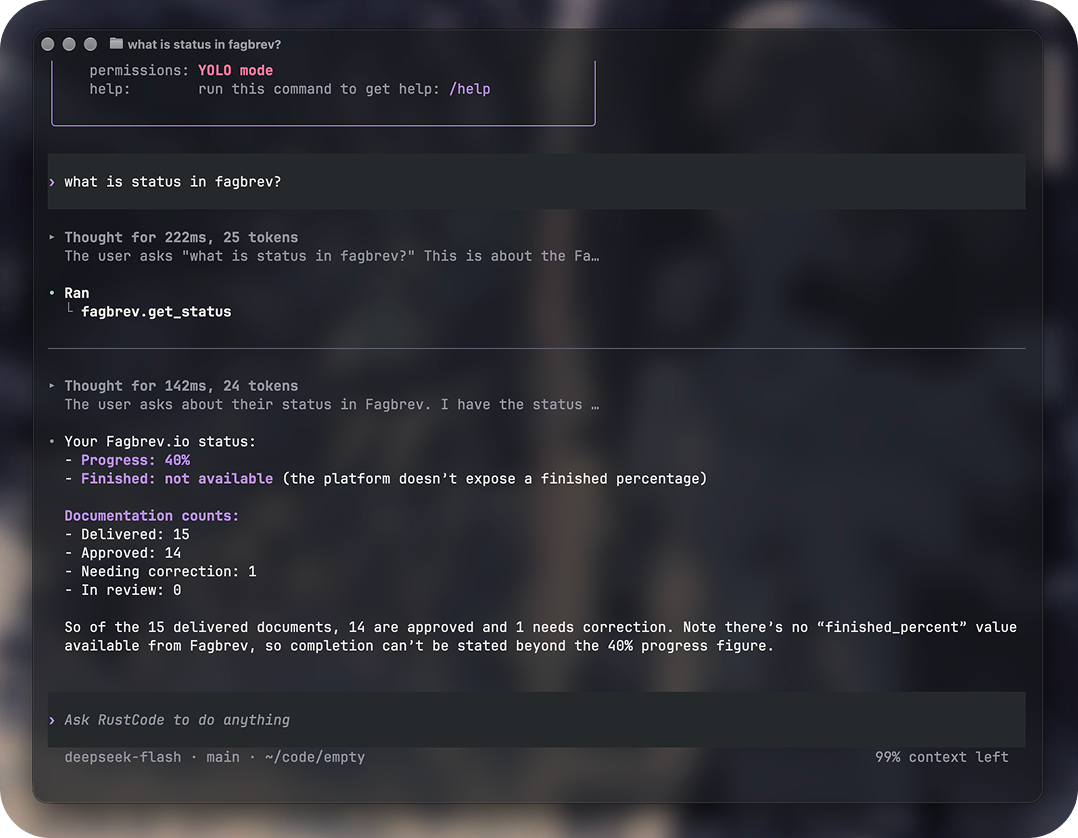
about
rustcode is a lightweight Terminal User Interface (TUI) agent harness.
Originally made for testing Apple's on-device Foundation Models. Turned into a way deeper project.
Now supports ollama or openai compatible APIs.
Provider accounts can be managed with /login, /accounts, /account and /logout; see the authentication guide for ChatGPT plan sign-in and API-key provider setup. GitHub Copilot connects with /login github-copilot (GitHub CLI credential or your own RUSTCODE_COPILOT_CLIENT_ID app); see the Copilot setup guide.
Documentation
- Background tasks and cancellation
- ACP server integration
- Provider authentication
- GitHub Copilot setup
- Provider stream traces
- Per-request thinking routing
- Runtime and workspace architecture
- TUI slash commands and command panels
- Discord Rich Presence
- Build-boundary benchmark
Installation
macOS & Linux (curl)
Run the one-line installer in your terminal:
curl -fsSL https://rustcode.lhagfoss.com/install.sh | bash
Windows (PowerShell)
Run the one-line installer in PowerShell:
irm https://rustcode.lhagfoss.com/install.ps1 | iex
macOS via Homebrew
# 1. Tap the repository
brew tap lhagfoss/tap

# 2. Trust the tap (required by Homebrew for new/custom taps)
brew trust lhagfoss/tap

# 3. Install the harness
brew install rustcode
Official release binaries are published for Linux x86_64, macOS Apple Silicon
(ARM64), and Windows x86_64. Intel macOS is not supported by the prebuilt
installer or Homebrew formula. Building from source may support additional
targets, but those targets are not covered by release CI.
From Source (Rust / Cargo)
The rustcode binary lives in the rustcode-tui package; the repository root
is the engine library and has no binary target.
# Clone and build
git clone https://github.com/lhagfoss/rustcode.git
cd rustcode
cargo install --path rustcode/tui
cargo install writes to ~/.cargo/bin. If a prebuilt rustcode frominstall.sh is already on your PATH (it installs to ~/.local/bin, or/usr/local/bin when writable), remove it or ensure ~/.cargo/bin comes
first — otherwise the older binary keeps winning:
rustcode --version # check this resolves to the build you just made
Native desktop app
The native GPUI app is a separate executable from the terminal UI. Build and
run it with Cargo, optionally passing a project directory (the current
directory is used by default):
cargo build -p rustcode-app
cargo run -p rustcode-app -- /path/to/project
On macOS, package the app with the Icon Composer icon fromimages/AppIcon.icon (requires Xcode 26 or later):
scripts/build-native-app.sh            # target/debug/RustCode.app
scripts/build-native-app.sh --release  # target/release/RustCode.app
open target/debug/RustCode.app
The bundle includes both the layered icon for newer macOS versions and a
fallback .icns. Running cargo run launches the executable directly, so use
the bundled app to see its Dock and Finder icon.
Build the terminal executable separately with cargo build -p rustcode-tui.
Tagged releases publish the terminal binaries for Linux, macOS and Windows,
plus RustCode.app for Apple Silicon (unsigned — right-click to open on
first launch).
Keeping it upgraded
RustCode comes with a built-in cross-platform self-updater for macOS, Linux, and Windows.
Native installations update from GitHub Releases; Homebrew installations use Homebrew.
- In CLI: Run
rustcode --update(orrustcode --upgrade) - Inside RustCode TUI: Type
/update(or accept the update modal on startup) - Homebrew (macOS):
brew upgrade rustcode
Updating pre-v0.31.0 native installs
Native binaries released before v0.31.0 predate the GitHub Release updater and
cannot bootstrap themselves without Homebrew. Reinstall once from the current
release, then rustcode --update will use the matching GitHub archive for
future upgrades:
curl -fsSL https://rustcode.lhagfoss.com/install.sh | bash
The installer verifies the downloaded archive with the release SHA256 manifest
before replacing the existing binary. Homebrew installations should instead
continue to use brew upgrade rustcode.
ACP runtime
For editors and agent orchestrators that support the Agent Client Protocol, run
rustcode headlessly over stdio:
rustcode --acp
The process speaks stable ACP v1 JSON-RPC on stdin/stdout. A runtime such as
Multica can launch it as a subprocess, create a session with session/new, and
send work with session/prompt. The working directory supplied tosession/new becomes RustCode's task working directory and default project
scope. Relative tool paths stay in the task project. Trusted mode permits
paths outside the workspace; explicitly restricted modes retain the launch
workspace boundary. Rustcode stores
its canonical configuration in config.toml. On macOS and Linux this is${XDG_CONFIG_HOME:-~/.config}/rustcode/config.toml; on Windows it is%APPDATA%\rustcode\config.toml. RUSTCODE_CONFIG_DIR overrides the
directory on every platform, which is useful for portable installs and tests.
Older installations using models.json and config.json are still read. On
the next normal save, Rustcode writes the merged configuration toconfig.toml and leaves the legacy files intact as a rollback copy. Missing
fields use compiled defaults. Malformed or newer unsupported TOML is preserved
and reported instead of being overwritten.
Configured MCP servers are started by Rustcode before ACP prompts are handled;
ACP's optional MCP-over-ACP transport is not required.
Native API requests expose at most 16 MCP tool schemas at a time. Setalways_include = true on an MCP server's [[mcp_servers]] entry to reserve
slots for its complete toolset, independent of the current prompt:
[[mcp_servers]]
name = "mail"
command = "mail-mcp"
args = []
always_include = true
Reservations are applied in configuration order and still obey the schema
byte budget. If a complete server toolset cannot fit either limit, that
reservation is rejected for the request; the rejection and omitted tool names
are recorded in mcp.native_schema_selection.
ACP supports background command completion and continuation. A background tool
call is reported as InProgress, its terminal update retains the provider's
original tool-call ID, and the same logical turn resumes after completion.
Cancelling a prompt never revives that prompt when its detached process later
finishes; the completion is still persisted in the session. session/close
cancels the active turn and that session's running tasks. See
docs/acp.md for lifecycle and integration details.
Non-interactive prompt
Run one prompt without opening the TUI:
rustcode --prompt "inspect this repository and run its tests"
Add --yolo only in a trusted workspace when the run should automatically
approve all tool confirmations and override saved sandbox restrictions for
the session. Plan-mode capability blocking and saved forbid rules remain. Background commands started by the turn are
tracked until their terminal result is delivered; unrelated tasks already
running in the same session do not delay the turn.
Interactive shell confirmations offer one-time approval, reusable plain-token
command-prefix allows, and reusable token-sequence denies. An allow forcargo test covers cargo test --lib but not cargo testing; deny rules take
precedence over allows and session auto-confirm. Shell composition, dynamic
shell syntax, environment or background overrides, privileged/network
commands, package installation/publication, deployment/release actions, and
known destructive commands remain ineligible for reusable allows. Approval
rules do not provide operating-system isolation or change the shell process's
permissions. OS sandbox enforcement is available only on supported backends
(currently Linux and macOS); on unsupported platforms such as Windows,
approved commands run with the RustCode process's permissions. Configure the
effective Linux/macOS mode with sandbox_mode = "read_only","workspace_write", "workspace_write_network", or "trusted" (default) in
the user config, or switch it in a session with /sandbox <mode> — /sandbox
with no argument lists every mode with its permissions and marks the current
one. The status line and the welcome banner display the effective mode
separately from the approval mode. network_access: true requests network
access for one command and needs interactive approval when YOLO is off. The filesystem_write_path argument requests one-command write access to
one existing absolute directory outside the active workspace; its canonical path
is shown in the approval card. It also requires
interactive approval when YOLO is off and cannot be covered by a saved command approval. See
docs/shell-approvals.md.
Sandbox modes and the default
trusted is the default. Shell commands and native filesystem/search tools run
with RustCode's process permissions, including network access and paths outside
the workspace. Relative paths still resolve from the active task directory or
workspace. Restricted modes are opt-in through the global config or /sandbox;
project configuration cannot change this selection.
YOLO overrides a saved restricted mode and auto-approves all tool confirmations,
including one-shot network and filesystem requests. It applies to interactive,
headless, and ACP turns and does not rewrite the saved mode. Turning YOLO off
restores that selection. Plan-mode capability restrictions and explicit saved
forbid rules remain in effect.
Failed restricted commands report effective network permissions and actual
writable roots, including one-shot grants. Permission-specific errors suggest
possible sandbox enforcement. DNS errors, refused connections, generic host
filesystem permissions, credentials, SSH keys, and certificates are not treated
as proven sandbox denials. Enabled network access is never blamed as a network
restriction. Trusted execution and platforms without a native OS backend receive
no sandbox attribution.
The TUI shows active foreground tools with elapsed time and a bounded output
preview, including no output yet for quiet work. Esc interrupts foreground
work. A running command gets one indicator row — • Running $ <command> · 12s · esc interrupt — instead of repeating its state per line; the row above the
composer keeps only the current state and turn token total. Tool groups use ●
for running, ○ for queued, ✓ for completed, × for failed, and − for
cancelled work. Each child row carries a tree connector (├ for a child with
siblings below, └ for the last one) and its output hangs under a continuous│ side spine, so wrapped output keeps the same indentation. Background
tasks keep their task IDs and process IDs visible; /ps lists them and /stop
stops them. A completed background result withheld during a foreground turn is
marked result ready until the turn consumes it. Approvals and questions have
separate waiting states.
Background commands
The run_command tool can detach long-running work with background: true.
RustCode returns a task ID immediately and delivers the final output
automatically. The model should not poll manage_task in a loop. manage_task
is intended for an occasional list, status, or explicit kill operation.
Tasks are isolated by session. A task ID from one session cannot be used to
terminate another session's process. Cancellation terminates the complete
process group on Unix and the process tree on Windows, including descendants.
See docs/background-tasks.md for exact behavior.
Remote frontends (experimental)
rustcode serve exposes the active session over TCP for remote frontends
(mobile is remote-only by decision):
rustcode serve --port 17878
It prints the address and a per-launch token (pass --token to fix it).
Binding defaults to loopback; LAN binds need --allow-remote (never0.0.0.0 without it). The protocol is newline-delimited JSON in the daemon
framing style; see docs/mobile.md for the message schema.
No TLS, no multi-session routing yet — loopback or trusted LAN only.
Configuration
Configuration files
The TOML file contains the default model selection, models array, runtime
preferences, MCP servers, tool protocol, agent mode, verbosity, theme, active
session, and the per-turn max_tool_rounds safety backstop. It defaults to 40
rounds and is only a final limit after semantic loop and failure guards.
Writes use a temporary file and replacement so an interrupted save does not
leave a truncated configuration. On Unix, the file is written with owner-only
permissions because model profiles may contain API keys.
Each model profile may optionally set max_mutating_calls_per_response to a
bounded value when its provider is trusted to emit independent edits. Omit the
field to retain the safe default of one; zero is normalized to that default and
values above the hard cap are clamped. Calls still execute sequentially and the
absolute per-response tool-call ceiling remains in force:
[[models]]
name = "trusted-model"
url = "https://example.invalid/v1"
model = "trusted-model"
max_mutating_calls_per_response = 2
OpenCode Zen's paid Muse model uses the OpenAI Responses API. RustCode includes
this profile by default; add OPENCODE_API_KEY to the environment and selectopencode-muse-spark-1.3 as the model:
[[models]]
name = "opencode-muse-spark-1.3"
url = "https://opencode.ai/zen/v1/responses"
model = "muse-spark-1.3"
engine = "openai"
env_key = "OPENCODE_API_KEY"
api_protocol = "responses"
tool_protocol = "apinative"
OpenCode's temporary free models are restricted by OpenCode's service to the
OpenCode client session. RustCode does not bypass that restriction; use a paid
Zen model and valid billing/API credentials for this provider profile.
Project configuration
Create a project-local override with:
rustcode init
# or: rustcode --init
This creates .rustcode/config.toml from the global model defaults and adds.rustcode/config.toml to the project .gitignore. It intentionally does not
copy API keys, MCP servers, or session state. Project configuration is loaded
from parent to child directories, so the nearest file wins:
CLI overrides > nearest project config > global config > built-in defaults
Project files are partial overrides; omitted fields continue to come from the
lower-precedence layer.
Legacy [laya] config tables are ignored and can be removed from user or
project config files.
Skills
Skills are plain Markdown: <root>/<name>/SKILL.md, scanned exactly one level
deep. RustCode reads them from these roots, highest precedence first, and the
first definition of a skill name wins:
extra_skill_dirsfrom the globalconfig.toml(explicit override)RUSTCODE_EXTRA_SKILL_DIRS, using the platform path-list separator<workspace>/.rustcode/skills<workspace>/.agents/skills~/.agents/skills— the universal root, shared with other agents<config dir>/skills— RustCode's own root (see Configuration files)
So a project can override a user-level skill, and an explicitly configured
root can override both. .claude/skills is deliberately not scanned; add
it to extra_skill_dirs if you really want Claude Code's skills.
Extra roots are a global-only setting — a checked-out .rustcode/config.toml
cannot widen skill discovery:
extra_skill_dirs = ["~/work/team-skills", "/opt/shared/skills"]
Run /skills (or the list_skills tool) to see every root that was actually
searched, and rustcode doctor to see which ones exist. rustcode doctor --fix creates only the RustCode-owned root, never the universal or workspace
roots.
Reduced motion
The activity line above the composer animates a highlight sweep while RustCode
is working. Set reduced_motion = true in config.toml to render it as plain
static text instead:
reduced_motion = true
The default is off, so the sweep is unchanged unless you opt in. This is purely
presentational, so a project .rustcode/config.toml may set it.
Keeping the transcript in terminal scrollback
The readable transcript lives in the terminal surface RustCode paints, and on
exit that surface is erased, so the conversation does not stay in the
terminal's own scrollback. Set preserve_transcript_scrollback = true inconfig.toml to also copy every committed transcript row into native
scrollback as the session runs:
preserve_transcript_scrollback = true
The default is off. Native scrollback is write-only: rows copied there cannot
be revised, so an expanded tool body stays expanded after you collapse it, and
the rows sit above the exit handoff where no erase can reach them (#1587,
#1593). Turn it on if you rely on the scrollback copy for terminal copy/paste
or shell piping, and accept that it is a copy rather than the live transcript.
Use the mouse wheel, PageUp/PageDown, or Esc to read the transcript while
a response streams; the transcript never leaves the view (#1595).
Syncing config, skills, and themes
Initialize a config sync repository with a remote Git URL, then choose a
direction explicitly or run the default pull-then-pull sync:
rustcode sync init <remote-git-url>
rustcode sync --pull       # or: rustcode sync pull
rustcode sync --push       # or: rustcode sync push
rustcode sync              # pull, then push
--pull and --push cannot be used together.
rustcode sync stages only files inside the RustCode config directory:.gitignore, config.toml, skills/, themes/, and commands/. Skills in~/.agents/skills, a workspace .rustcode/skills, or anyextra_skill_dirs entry are not synced — the universal root is shared
with other agents, and pushing one agent's skills into it would conflict with
them. Version those skills separately, or point extra_skill_dirs at a
directory you sync yourself.
Prompt commands
In the terminal frontend, reusable Markdown templates are loaded with/prompt <name> [arguments]; /prompts lists their names and source paths. A
loaded template is placed in the composer for editing and review, and is sent
only after you press Enter again. Put user templates in<config dir>/commands/<name>.md and workspace templates in<workspace>/.rustcode/commands/<name>.md. Workspace templates override user
templates with the same name. Names use lowercase ASCII letters, numbers,
hyphens, or underscores. Templates can use the literal $ARGUMENTS
placeholder; supplied arguments replace every occurrence, or are appended after
a blank line if there is no placeholder. With no arguments, placeholders are
removed.
For example, create <workspace>/.rustcode/commands/review.md:
Review $ARGUMENTS for correctness and missing tests.
Then run /prompt review the current diff, review or edit the staged text, and
press Enter to submit it. Templates are limited to 64 KiB and expanded prompts
to 256 KiB; empty, invalid UTF-8, symlink, and slash-command expansions are
rejected. Listing does not create command directories. User templates are
included in rustcode sync; workspace templates remain with the project.
Optional local audio generation (Apple Silicon)
RustCode can generate project-local WAV effects and instrumental music through
external MLX backends. Audio tools are enabled by default and discover the
backends automatically; override them in config.toml when needed:
[audio]
enabled = true
sfx_backend = "auto"
music_backend = "auto"
The explicit backend values are "mlx-speech" for sound effects and"musicgen-mlx" for music.
For sound effects, create an Apple Silicon Python environment and install themlx-speech package (Python 3.13+):
python3 -m venv ~/.local/share/rustcode/audio-venv
source ~/.local/share/rustcode/audio-venv/bin/activate
pip install mlx-speech
RustCode discovers the venv's bin directory automatically, including when
launched from the macOS Dock.
For music (Python 3.10+), keep the audio venv active and install themusicgen-mlx project:
git clone https://github.com/andrade0/musicgen-mlx.git
cd musicgen-mlx
make install
make install installs musicgen-mlx under ~/.local/bin; RustCode also
discovers that directory automatically.
The sound-effect command is mlx-speech; RustCode invokes its sound-effect
model through the backend interface. See the upstream
mlx-speech documentation and
musicgen-mlx documentation for
current Apple Silicon and Python requirements. The first generation downloads
the model lazily, so the first call can take substantially longer. The initial
music model is about 1.2 GB, while the sound-effect model and larger music
variants can require several GB. RustCode never permanently loads these models
into its own process. The initial native path intentionally accepts and
inspects WAV output only; music longer than 30 seconds and additional audio
formats are deferred.
Native declarative video editing
RustCode can inspect and compose project-local media through externalffprobe and ffmpeg processes. Install FFmpeg through the package manager for
your platform, then use inspect_media, validate_video_project, andrender_video. RustCode never accepts raw FFmpeg arguments from the model.
Video edits are stored in a reusable, versioned project file:
{
    "version": 1,
    "output": "output/final.mp4",
    "video": { "width": 1920, "height": 1080, "fps": 30 },
    "clips": [
        { "path": "media/intro.mp4", "trim": { "start": 1.5, "end": 8.0 } },
        { "path": "media/demo.mp4" }
    ],
    "transitions": [{ "after_clip": 0, "type": "crossfade", "duration": 0.5 }],
    "audio": {
        "music": {
            "path": "media/music.wav",
            "volume": 0.2,
            "fade_in": 1.0,
            "fade_out": 2.0
        },
        "keep_clip_audio": true,
        "clip_audio_volume": 1.0
    }
}
Only output and clips are required. Defaults are 1920x1080 at 30 FPS with
clip audio preserved. Supported transitions are crossfade, fade,wipe-left, wipe-right, slide-left, and slide-right. Inputs are
normalized before composition and output is MP4/H.264 with optional AAC audio.
IMPORTANT
If you wanna run rustcode using Apple FM you NEED to be on MacOS 27 and have XCode v27 for this to work. As this was introduced in the Beta version of MacOS 27.
Also not recmomended to use FM system model. as it only have like 2k context window...
Made with rust by goat (me) and models inside rustcode harness
License
Licensed under the Apache License, Version 2.0.
Performance and agent threads
/perf displays the latest turn's measured context, schema/serialization,
provider and tool time, request/round counts, context bytes and reported token
usage. Each session writes performance.json; rustcode bench --report PATH --baseline PATH compares recorded measurements. Missing provider usage remains
unavailable. Time to first token tracks generated deltas, not keep-alives.
Safe built-in inspection calls run in bounded groups of four. Results keep
announcement order; shell commands, mutations and unknown MCP tools remain
serial barriers. Workspace generations drive incremental symbol queries,
environment snapshots, read validity and conservative successful-verification
reuse. Persisted evidence includes a process epoch so resume cannot mistake an
old generation for current evidence. Pressure projection preserves durable
history and native call/result pairing while making old inspection evidence
recoverable by reading it again.
Agent threads have isolated context snapshots, parent/child relationships,
bounded mailboxes, explicit followups, waits, cancellation and session restore.
Use spawn_agent, list_agents, inspect_agent, send_message, send_agent,wait_agent and cancel_agent; select a child in the TUI to inspect its history.
See performance and validity,
agent behavior and
architecture research.
Description-based skill routing requires multiple matching intent terms and
keeps coding requests from activating live-app workflows incidentally.
Selection benchmarks distinguish backend
frame latency from live terminal input-to-paint latency.
Reviews (0)
Sign in to leave a review.
Leave a reviewNo results found