context-engineering-protocol
Health Warn
- License — License: Apache-2.0
- Description — Repository has a description
- Active repo — Last push 0 days ago
- Low visibility — Only 8 GitHub stars
Code Warn
- network request — Outbound network request in .github/skills/ult-cep-wizard/scripts/static/wizard.js
- network request — Outbound network request in .github/skills/ult-cep-wizard/scripts/tests/manual_playwright_box_files.py
Permissions Pass
- Permissions — No dangerous permissions requested
No AI report is available for this listing yet.
Portable AI coding-agent skills for source-attributed, human-approved context packages.
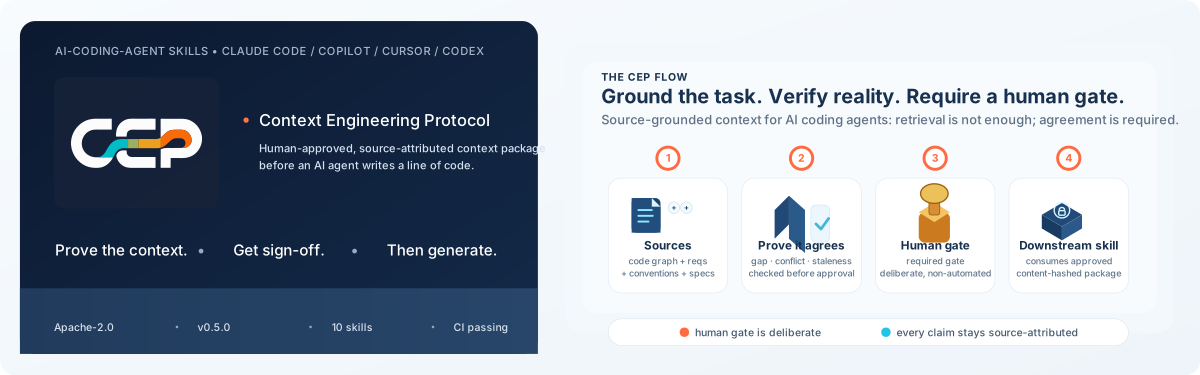



Concept · Protocol · Glossary · Conformance ·
Quickstart · Skills · Runtime support ·
Evidence · Roadmap · Evidence methodology ·
FAQ · Contributing
New here? Start with
CONCEPT.md— the conceptual model CEP is built on,
written to be read before the protocol specification below.
Don't let the agent guess what's true. Make it prove the context agrees, then get a human to
sign off before it writes a line of code.
A set of AI-coding-agent skills that assemble a human-approved, source-attributed context
package — code graph + requirements + org conventions + constraints — before a generation task
runs, instead of letting the agent free-read the repo and guess.
In practice: an ungrounded assistant invented the same hallucinated concept twice, in two
completely unrelated codebases — a UI framework and a telecom protocol stack. The CEP-grounded run
produced 26 real, checkable citations and zero inventions across both. See Evidence
for the full measured breakdown, plus field-validated runs across Claude Code, GitHub Copilot,
Codex, and Cursor, across ten real-codebase cases including one deliberate negative control.
Built for Claude Code / GitHub Copilot, with Cursor and OpenAI Codex field-validated as well (see
Runtime support below). Beyond code: the same mechanism that stops an agent
from inventing an API is the mechanism an engineering org can run its own conventions, constraints,
and process standards through — context engineering as the substrate for a QMS in agentic mode.
Now shipped: a trip-wire layer (ult-institutional-memory-distill) that watches for a task
walking a road the org has already rejected — and surfaces that history to a human before the agent
repeats the mistake, instead of silently reinventing it — see PROTOCOL.md §7.
Also shipped: ult-cep-retrofit, a metaskill that brings an existing third-party skill library
under this protocol without rewriting it — validated end-to-end against two real, unrelated skill
libraries, mattpocock/skills andobra/superpowers, seePROTOCOL.md §8.
See Roadmap for what's still open (chiefly: field-validating trip-wire against a real,
not fixture, decision corpus).
Why this exists
Most "give the agent context" tools stop at retrieval: chunk the repo, embed it, hand back
whatever's nearest to the prompt. That's fine for lookups. It's not enough for a change that
touches requirements, org conventions, and code at once — because nothing checks whether those
three sources actually agree, or whether the code graph they're reasoning from is still current.
This protocol's centerpiece, ult-context-generate,
runs an explicit gap → conflict → staleness state machine before anything gets generated, and
gates the result behind a human-approval step:
flowchart LR
    Sources["Code graph + requirements<br/>+ org conventions + external specs"] --> Engine["gap · conflict · staleness<br/>checks"]
    Engine --> Gate{"Human<br/>approval"}
    Gate -- approved --> Consumer["Downstream generation skill"]
- Gap detection — per requirement aspect, is it covered by code, by docs, by neither?
- Conflict detection — does a requirement doc contradict what the code graph shows, or do two
org-convention sources disagree with each other? Unresolved conflicts block approval. - Staleness detection — was the code graph or the compiled-guidelines cache built from a commit
that's no longer HEAD? Surfaced as a nudge, not a block.
The package that comes out the other side is source-attributed (every claim traces to a
file/section) and content-hashed, and requires a human to explicitly approve it before a
downstream skill consumes it — this is deliberately not a fully autonomous pipeline. SeePROTOCOL.md for the full layer model, the state machine in detail, and how the
piloting How-L1 layer is gap-triggered off How-L2.
That's the difference from Cline's Memory Bank (persistent notes, no conflict/staleness checking),
Cursor's .cursorrules (static convention injection, no code-graph grounding), and generic
RAG-over-docs frameworks (retrieval without a gate): this protocol treats "is the context still
true" as a first-class question, not an assumption.
Quickstart
Clone this repo, then copy its skill set into your target project:
git clone https://github.com/linkpranay-ai/context-engineering-protocol.git
cd context-engineering-protocol
./install.sh --target /path/to/your/project --init-project   # or install.ps1 -TargetPath ... -InitProject
That copies .github/skills/, .github/prompts/, .cursor/rules/, and AGENTS.md into your
project, and (with --init-project/-InitProject) scaffolds a starter context-config.yaml.
Re-running is safe — library files are refreshed, project-owned files (like a filled-incontext-config.yaml) are left alone. Run ./install.sh --help / Get-Help ./install.ps1 for
the full flag list, including --dry-run/-DryRun and --only/-Only <skill1,skill2> to
install just a subset of skills instead of the full set.
You can also drive layout setup itself through a browser instead of the CLI above —ult-repo-layout doesn't need to have run first; a repo with it merely installed
gets a guided "Run Discover" step in the browser instead of a wall of CLI output:python .github/skills/ult-cep-wizard/scripts/wizard_server.py . — seeult-cep-wizard.
Then see user_guides/topics/project-setup-context-engineering.md
for the two setup paths:
- Path A (simple) — just compile scattered guideline sources into one conflict-checked
COMPILED-GUIDELINES.mdfor any AI agent to read. 3 steps. - Path B (full pipeline) — code graph + requirements + constraints assembled into a full
context package, then handed to a downstream generation skill. 9 steps, usingdemo-consume-contextas a worked example of
what "consuming" a context package looks like.
Common setup and scope questions ("do I have to run the full pipeline, or can I just compile
guidelines," "what's implemented vs. still piloting," "what's a trip-wire") are answered inFAQ.md.
Skills in this repo
| Skill | What it does |
|---|---|
compiling-project-guidelines |
Compile scattered guideline sources into one scope-aware COMPILED-GUIDELINES.md for other skills and ult-context-generate's Constraints layer. |
ult-codegraph |
Generate a codebase knowledge graph with graphify so other skills can query cross-file relationships before touching code. |
ult-context-generate |
Assemble a context package (code graph, requirements, constraints, blast radius) before a downstream generation task runs — human-approved, source-attributed. |
ult-repo-layout |
Register, resolve, and validate where a project's path-slots actually live via .layout-slots.yaml markers, so relocating a slot needs zero SKILL.md edits. |
ult-cep-wizard |
Local, localhost-only browser wizard, two journeys: (1) for a project with ult-repo-layout installed — guides an uninitialized repo through Run Discover, then shows resolved What/How/Guidelines/Trip-wire state through four labeled boxes and a directory picker, and lets you resolve and Apply pending layout decisions; (2) retrofit — walks an existing skill library through ult-cep-retrofit's inventory/classify/draft/apply flow with an editable per-file diff preview before anything is written. |
ult-institutional-memory-distill |
Trip-wire: distill PRs/design docs/postmortems into a persistent decision ledger, and surface prior-rejected paths to a human before a package's approval gate closes, never auto-applied or auto-suppressed. |
ult-cep-retrofit |
Bring an existing, third-party skill library under this protocol — inventory, classify, and insert an idempotent pointer to CONSUMING-CONTEXT-PACKAGE.md into each relevant unit, without rewriting the library's own instructions. |
ult-autoscaffold-content |
Generate real starter content for a project's What-L2/How-L2 layers once ult-repo-layout has resolved their paths but found them empty — a minimal single overview for small targets, or graph-informed per-module tiering with resumable CONTEXT.md generation and a CEP-INDEX.md router for large repos. |
demo-consume-context |
Worked example that discovers, loads, and tags a context package per CONSUMING-CONTEXT-PACKAGE.md — proves the produce/consume/tag loop end-to-end. |
demo-write-user-stories |
Reference implementation that writes functional user stories from a feature description, optionally grounded in an approved context package, with per-story citations and the standard tag/reverse-index loop — a worked example for teams building their own context-consuming skills. |
Each skill's SKILL.md frontmatter carries tier/origin/tags/bundle per the Agent Skills
convention, with an explicit "Do NOT use for..." clause to keep triggering unambiguous.
Consuming a context package
Building a skill that should use an approved context package instead of free-reading the repo?
Start with user_guides/topics/consuming-a-context-package.md
— a plain-language, 10-minute walkthrough of discover → confirm → load → cite → tag. For a
working reference implementation, read demo-consume-context.
The full formal contract (addenda, multi-package edge cases, tag-discovery rules) lives inCONSUMING-CONTEXT-PACKAGE.md.
Roadmap
What's planned next — comprehensive How-L1 validation, field-validating trip-wire against a real
decision corpus (not just the disclosed fixture ledgers used in its first two case studies), and
more — is tracked in ROADMAP.md, roughly prioritized.
Runtime support
| Runtime | Support |
|---|---|
| Claude Code | Native — SKILL.md files under .github/skills/, or one-click via claude-plugin/ (see below) |
| GitHub Copilot | .prompt.md wrappers under .github/prompts/, one per skill. ult-context-generate, ult-codegraph, demo-consume-context, and ult-cep-wizard are hand-authored (with skill-specific "When invoked directly" steps); the rest — ult-repo-layout, compiling-project-guidelines, ult-institutional-memory-distill, ult-cep-retrofit, ult-autoscaffold-content, demo-write-user-stories — are generated by catalog/export_adapters.py from SKILL.md frontmatter. |
| Cursor | .cursor/rules/<skill>.mdc per skill (Agent Requested activation — description set, alwaysApply: false), generated by catalog/export_adapters.py. |
| OpenAI Codex | Root AGENTS.md table (skill → description → SKILL.md path), generated by catalog/export_adapters.py. |
Claude Code — dogfood-validated (Phase 9): all four real skills run end-to-end, by hand,
against a freshly cloned, unrelated real-world repo (Textualize/textual) — not just read for
correctness.
validate_layout.py --validatepassed.graphify updateproduced a real 20,116-node / 59,448-edge graph from 1,353 source files.- A real
COMPILED-GUIDELINES.mdwas compiled from that repo's ownCONTRIBUTING.md/AI_POLICY.md. - A full context package was assembled end-to-end for a real, grounded feature scenario using real
graphify query/explain/affectedcalls and a realmd_index.py-built index.
Claude Code — one-click plugin install: claude-plugin/ packages all 9 real skills as an
installable plugin, generated from .github/skills/ so it can't drift from the real source. Add
this repo as a marketplace and install directly — no review queue, works today:
/plugin marketplace add linkpranay-ai/context-engineering-protocol
/plugin install context-engineering-protocol
Copilot — field-validated (Phase 9): in the same dogfood clone, real interactive Copilot Chat
runs confirmed both /ult-repo-layout and /ult-context-generate load the real .prompt.md
wrapper and follow through into the real SKILL.md content — not a generic/hallucinated response.
/ult-repo-layoutopened the real marker files and ranvalidate_layout.py --validate,
returning a literalPASS./ult-context-generateasked the real Step 1 scope-clarification questions (5/5, correct
substance) and respected a "stop after Step 1" instruction with no files written.- Transcript kept in the local dogfood clone (
dogfood-textual/, not part of this repo — see
"Reproduction steps" in the Textual case study to
reproduce the clone and re-run the same check yourself).
Codex — field-validated, both Codex Desktop (Phase 9) and the VS Code extension (2026-08-01,
separate machine).
- Codex Desktop found and read the root
AGENTS.mdunprompted, correctly listed all four real
skills with descriptions matching the table, and gave an accurate summary ofult-repo-layout'sdiscovermode after actually opening the realSKILL.md. - The Codex VS Code extension was retested on a separate machine and now completes the same
file-read tool-call path cleanly — the earlier hang (reproduced twice during Phase 9, isolated to
that extension's own tool-call handling rather than this project's skills or adapters) no longer
reproduces. - Transcript kept in the local dogfood clone (
dogfood-textual/, not part of this repo — see
"Reproduction steps" in the Textual case study to
reproduce the clone and re-run the same check yourself).
Cursor — field-validated (2026-08-01): installed the real skill library into a scratch project
via install.ps1 -InitProject, then drove Cursor's own chat directly.
- A positive-trigger prompt, worded against
ult-context-generate's ruledescriptionrather than
its name, correctly attached the Agent Requested.cursor/rules/ult-context-generate.mdcrule —
Cursor read the realSKILL.md, ran its documented 4-question scope-clarification gate with
context-aware recommended answers, and produced real structured YAML context packages. - Finalization correctly gated on an explicit typed
approve, stampingapproved_by: - actor: human:<user>andgenerated_at— matching theapproved_byschema
shipped in 0.3.0. - A negative-control simple-lookup prompt in a fresh chat correctly bypassed the rule entirely, per
its own "Do NOT use for simple lookups" clause — answered directly with source-line citations, no
skill or clarification gate involved. - Full report: issue #35.
Run python catalog/export_adapters.py --check (wired into CI) to confirm generated Cursor/Codex
files are current; --write regenerates them after adding or editing a skill.
Case studies
Real, reproducible reports of running this protocol against real codebases, including at least one
deliberate negative control showing where it adds little or no value. Seecase-studies/README.md for the index andcase-studies/TEMPLATE.md for the format every case follows.
Measured impact
See EVIDENCE.md for a condensed, headline-first version of this section — same
numbers, sized for sharing a single link. Every number below is tool-measured (graphify benchmark, or a naive-keyword-search baseline reused from each case's own reproduction steps), not
self-reported — see EVIDENCE-METHODOLOGY.md §4-§6 for exactly what
"measured" means here.
| Case | Corpus | Task-level token reduction | graphify benchmark reduction |
Graph size |
|---|---|---|---|---|
| Open5GS + RFC 6733 | open5gs/open5gs, C, AGPL-3.0 |
~797x on the external-spec clause lookup (43,599 words naive vs. 55 words CEP) | 36.8x fewer tokens/query | 3,830 nodes / 10,236 edges |
| FastAPI | fastapi/fastapi, Python, MIT |
~15.3x (15,767 words naive vs. 1,030 words CEP) | 5.6x fewer tokens/query — smallest of the three | 911 nodes / 2,568 edges |
| Textual | Textualize/textual, Python, MIT |
Run A: ~17.6x. Run B (negative control): naive read was cheaper (551 vs. 902 words) | 39.6x fewer tokens/query — largest of the three | 20,116 nodes / 59,448 edges |
What actually drives the win: reduction tracks how much of the task's answer lives in a prose
spec with no keyword to grep for, not how large the codebase is — FastAPI's graph sits between the
other two in size but shows the smallest reduction. The largest measured win (~797x) is a directclause_id lookup replacing a full read of an ~8,500-line external RFC; for in-repo,
keyword-findable code, CEP's edge narrows to disambiguation and certainty rather than discovery, and
in one deliberately chosen case (Textual Run B) reverses outright — three tool outputs agreed there
was nothing worth assembling context for, and the naive read won. Every comparison above is
retrospective against a task whose answer was already known, not a blind trial — seecase-studies/SYNTHESIS.md for the full analysis, limitations, and
what these three cases do and don't support.
A related tooling-only side-quest (not a full protocol case — no context package, no
approval gate) ran ult-codegraph/graphify alone against a real Rust bug fix in ripgrep
(PR #3100): graphify explain cheaply and
correctly resolved the load-bearing symbols, at ~84x fewer tokens than the naive-grep-narrowed
file set (239 words vs. 20,115) — but graphify path/affected, starting from the CLI flag's
own definition symbol, failed outright, a disclosed structural limitation of AST-only graphs
against ripgrep's one-struct-per-flag pattern. See
ripgrep-crlf-replace-terminator for the full,
mixed result — a real win and a real, disclosed gap in the same run.
The table above measures retrieval cost. Three further cases measure a different question: does
an approved package make a downstream consuming skill's generated output better, not just
cheaper to produce? Running a real, ground-up user-story-writing skill once against an approved
context package and once from a bare ask, on the same feature, found a measured citation and
actor-specificity gap in every case — across three domains, using two independently-designed
consuming skills:
| Case | Domain | Real citations: with CEP vs. bare ask | Hallucinations: with CEP vs. bare ask | Distinct actors named: with CEP vs. bare ask | Org-convention structure |
|---|---|---|---|---|---|
| consumer-benefit-user-stories | UI framework (Python) | 8 vs. 0 | 0 vs. 2 (an invented method + an imported web-accessibility concept with no counterpart in the codebase) | 5 vs. 2 generic | Full vs. none |
| open5gs-gy-supported-features | Telecom protocol stack (C) | 18 vs. 0 | 0 vs. 1 (the same imported web-accessibility concept, this time in a codebase with no UI at all) | 5 vs. 2 generic | Full (7/7) vs. none (0/7) |
| ripgrep-trim-user-stories | Rust CLI (ripgrep) | 9/9 vs. 0 | 0 vs. 0 — see case §9: this case's headline finding is citation/actor grounding, not hallucination-suppression | 2 specific vs. 2 generic | N/A — skipped by design (this case's consuming skill doesn't consume org conventions) |
The bare-ask mode's failure isn't just slower — it's a materially different and partly wrong
answer, with no signal to the consuming developer that anything was invented. The repeated
web-accessibility hallucination across two unrelated domains suggests an ungrounded consuming
skill's invention risk isn't bounded by domain plausibility. The third case, run with an
independently-designed consuming skill (demo-write-user-stories, not the vendoredspw-write-user-story the first two use) on a Rust CLI codebase, repeats the citation and
actor-specificity gap but finds no hallucination gap (0 vs. 0) — that bare ask had too little
surface to invent from, not too little grounding, so the hallucination-suppression finding above
should not be read as universal.
A fourth case reuses demo-write-user-stories to close two different gaps at once, on a real
55K-line RobotFramework codebase: it's the first case to drive ult-cep-wizard's browser UI
end-to-end via Playwright (real before/after screenshots, not curl) and the first to exerciseult-autoscaffold-content's Phase B large-repo triage/tiering path directly (13 modules tiered,
13/13 CONTEXT.md files generated for both What-L2 and How-L2). It also repeats the
citation/actor-specificity finding above (9/9 citations vs. 0, 2 specific actors vs. 2 generic)
and validates a stretch-goal code-change proposal against real unit tests (libdoc 47/47,running 362/362, identically before and after). See
robotframework-wizard-ui for the full
walkthrough, including a disclosed graphify cwd/path-relativity bug found and fixed along the
way.
The benefit also compounds past the user-story file itself. Both cases found the same
mechanical effect: every story an approved context package grounds carries a machine-checkable
provenance tag, so any later stage of work that picks up that output — not just the story-writing
step — gets the same grounding for free instead of re-deriving it:
- Design/review stage — a design can be checked against the story's own scope and actors
directly, instead of a reviewer having to rediscover them from scratch. - Planning stage — every acceptance criterion traces to a concrete task, and disclosed gaps
carry forward as explicit planning items instead of being silently treated as settled. - Test-writing stage — acceptance criteria that already read as concrete pass/fail conditions
become the test directly, not a paraphrase target. - Implementation stage — each story's acceptance criteria become that piece of work's
definition of done.
A bare-ask-only story carries no such tag, so that cost — or worse, an unflagged hallucination — is
paid again independently at every one of those later stages. See each case's own "Downstream
compounding benefit" section for the full trace and its disclosed limitations (this is a mechanical
trace against the consuming skill's documented contract, not an actual run of any further stage).
Two further cases test whether the generative benefit above holds on skill libraries this project
never wrote — and layer trip-wire on top for the first time. ult-cep-retrofit (§8 ofPROTOCOL.md)
ran its full inventory→classify→pointer flow against fresh, pinned clones of two popular,
independently-maintained skill libraries, then took one skill from each through the same
pristine-vs-retrofitted comparison as the table above, plus a third rung stacking a small,
disclosed-as-fabricated trip-wire fixture on top:
| Case | Library retrofitted | Full-library pass | Deep comparison | Trip-wire finding |
|---|---|---|---|---|
| cep-retrofit-mattpocock-skills | mattpocock/skills, MIT |
71 units, 0 misclassifications | to-spec vs. Textualize/textual |
1 of 2 fixture hits materially changed generated output |
| cep-retrofit-superpowers | obra/superpowers, MIT (pristine clone) |
62 units, 0 misclassifications | writing-plans vs. open5gs/open5gs |
1 of 3 fixture hits changed a bitmask value — and, caught on independent re-verification, that resolution was itself wrong: a tier: revise hit's required_evidence field turned out to be load-bearing, not decorative |
Both pairs found real, grep-verified defects in the pristine (no-CEP) baseline that the retrofitted
run avoided — duplicate AVP dictionary declarations and a fabricated test target referencing a file
that doesn't exist. These two cases are also the first to exercise Trip-wire and
Metaskill-retrofit origin in case-studies/README.md's
feature-coverage table, both previously ➖ across all eight other cases.
What's not yet done
Disclosed plainly rather than glossed over. Full prioritized list with more detail:ROADMAP.md.
- How-L1 (org-wide process-standard ingestion, e.g. CMMI/ISO/IEEE) is piloting, not yet
field-validated against a real corpus — gap-triggered off How-L2 and task-type-scoped rather
than per-aspect, with no web-search fallback of its own. SeePROTOCOL.md. - Codegraph's hand-authored examples are still general-purpose, not domain-specific — the
C/C++ walkthroughs in this repo cover general constructs (e.g.re2,protobuf). Real
domain-specific evidence now exists via the Open5GS case study above, wheregraphifybuilt a real 3,830-node / 10,236-edge graph from a genuine telecom codebase (5G
Core/EPC network functions) — that doesn't close this item (no real 3GPP corpus exists yet, seeROADMAP.mditem 8), but it's real, measured evidence in an actual telecom domain,
not just general-purpose constructs. - Per-session token-cost telemetry for
ult-context-generateis still self-reported.scripts/usage_report.py(ROADMAP item 7) can aggregate real per-run token counts once they're
recorded via the optionaltokens_usedaddenda field — but no operator has recorded one yet, so
that specific number stays unmeasured. Separately,graphify benchmark's token-reduction
figures — 36.8x / 5.6x / 39.6x fewer tokens per query across the three case studies above — are
real, tool-measured runs, not self-reported; see Measured impact. - No capability-profile / tool-restriction field (e.g. an
allowed-tools-style frontmatter key)
exists yet on any skill.
Contributing
See CONTRIBUTING.md.
License
Reviews (0)
Sign in to leave a review.
Leave a reviewNo results found