spec-anchor
Health Warn
- License — License: MIT
- Description — Repository has a description
- Active repo — Last push 0 days ago
- Low visibility — Only 5 GitHub stars
Code Pass
- Code scan — Scanned 12 files during light audit, no dangerous patterns found
Permissions Pass
- Permissions — No dangerous permissions requested
No AI report is available for this listing yet.
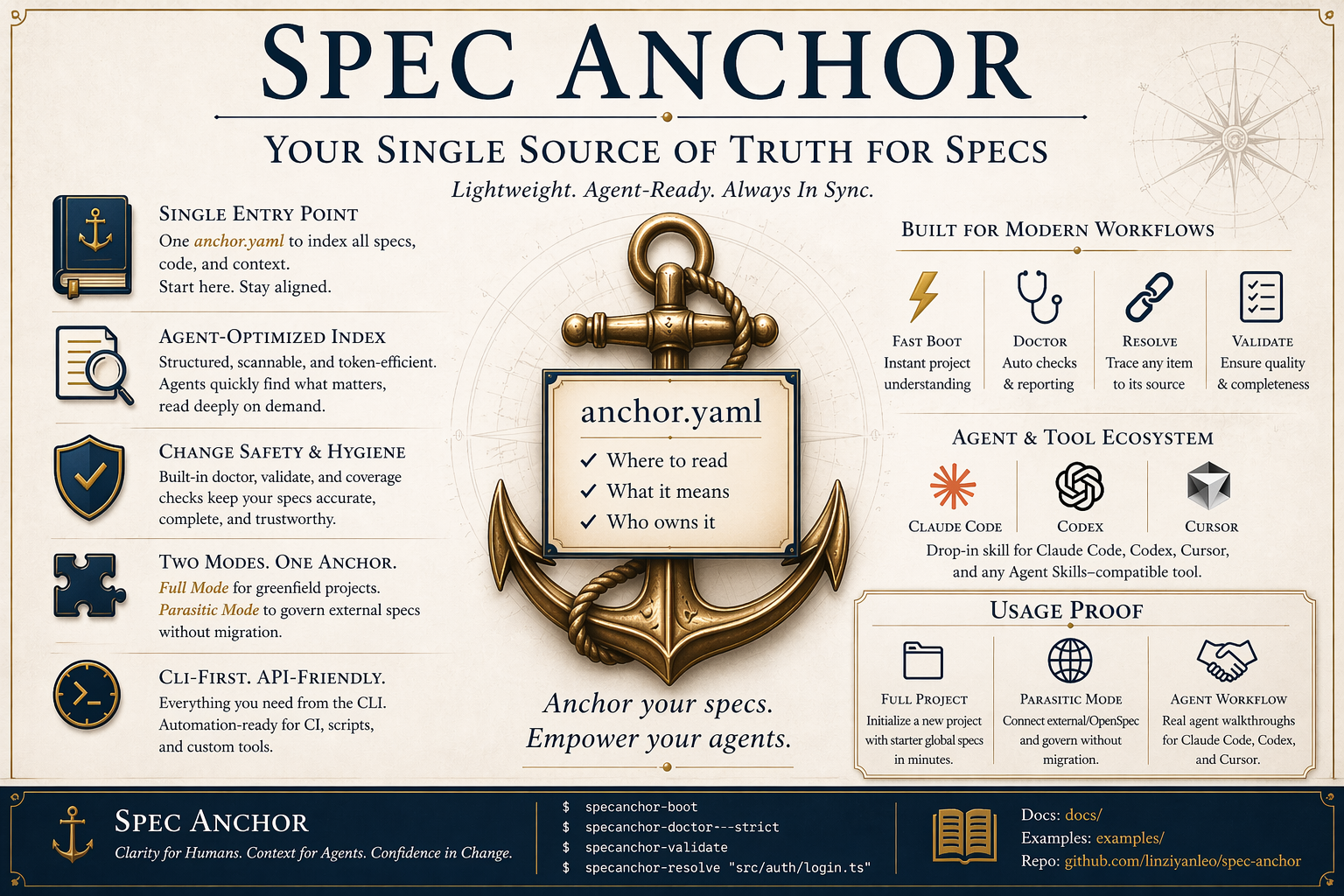
Spec governance and anti-decay layer for AI coding agents.

SpecAnchor
Spec is the anchor, code is the ship.





English · 中文 · WHY · Install · Contributing · Skill
What SpecAnchor Is
SpecAnchor is a three-tier spec system that agents load on boot. It keeps your team's coding rules, module contracts, and task intents in .specanchor/, then agents load the relevant ones into context before any code is generated — and check later whether the code still matches.
Think of it as a Harness Context Control plane for delegated agentic engineering: it organizes context across three categories — Spec / Decision / Evidence — assembles a Spec Landscape that every agent reads before acting, gates progress through Schema Gates, detects drift through an Alignment Surface, sediments checkpoint decisions and verification evidence into the Task Spec, and exports a handoff packet for cross-session continuity. You delegate work to agents; SpecAnchor makes sure they stay anchored.
It ships a bundled spec-driven development (SDD) workflow preset out of the box — the default sdd-riper-one schema gives you Research → Plan → Execute → Review gates — so you don't need Spec-Kit or OpenSpec to use SpecAnchor. If you already have an OpenSpec or custom spec directory, parasitic mode wraps it without migration. Keep your existing authoring, add SpecAnchor as the loader and anti-decay layer.
What Counts as Context
| Category | Source | Typical artifact | Lifecycle |
|---|---|---|---|
| Spec Context | Team / module / task contracts | .specanchor/global/, modules/, tasks/, Assembly Trace |
Static — versioned in git |
| Decision Context | Checkpoint inputs from human reviewers | Task Spec §5.2 Checkpoint Decisions Log; hot/cold filter | Dynamic — sediments per checkpoint, hot view auto-pruned |
| Evidence Context | Verification outputs and acceptance proofs | Task Spec §6.2 Evidence Ledger; auto-pinned acceptance criteria | Dynamic — handoff packet exposes verification status |
Decision and Evidence context live inside the Task Spec (single source of truth); Spec Context is assembled from Global, Module, and Task tiers. All three are assembled into bounded views by specanchor_handoff.
→ Curious about the design philosophy? Read WHY.md.
Warning
SpecAnchor writes.specanchor/, may create or updateanchor.yaml, and may inject Markdown frontmatter. Try it on a clean branch first.
See It In Action
A typical day-two interaction in Claude Code — refactoring the order module to support split-shipping (touches orders, shipping, inventory):
You: Create task: refactor order module to support multi-address split shipping
     (touches orders, shipping, inventory)

Claude: [routes to specanchor_task → specanchor-check.sh coverage]
  ✅ covered:   src/orders/    (modules/orders.spec.md)
  ✅ covered:   src/shipping/  (modules/shipping.spec.md)
  ⚠️  uncovered: src/inventory/ → agent drafts Module Spec via specanchor_infer protocol
  [agent executes specanchor_infer — scans code, writes draft]
  ✓ modules/inventory.spec.md  (status=draft, needs human review)

  ✓ .specanchor/tasks/_cross-module/2026-04-23_split-shipping.spec.md

  Assembly Trace:
    - Global: full → coding-standards, architecture
    - Module: full → orders, shipping, inventory (draft)
    - Task:   tasks/_cross-module/2026-04-23_split-shipping.spec.md
    - Schema: sdd-riper-one | Workflow: standard Task Spec

  Current phase: Research. Execute blocked until Plan is approved.

... (Research → Plan → Execute) ...

You: Check spec-code alignment

Claude: [runs specanchor-check.sh alignment]
  ✅ orders.spec.md    — aligned (sha current)
  ⚠️  shipping.spec.md  — stale: module modified since last spec sync
      → review spec against current code, update if needed
  ✅ inventory.spec.md  — aligned (sha current, just created)
Three things happened that vanilla AI coding, Spec-Kit, and OpenSpec cannot do together:
- Relevant specs loaded before coding — Global + three Module Specs resolved from file paths, reported as an Assembly Trace
- Coverage gap filled by agent — the uncovered
inventory/module triggered thespecanchor_inferprotocol; the agent scanned code and drafted a Module Spec - Module freshness drift caught post-hoc —
shipping.spec.mdwas flagged as stale because the module's code changed since the last spec sync — triggering a review prompt
The Three Tiers
| Tier | What's in it | Who writes it | When loaded |
|---|---|---|---|
| Global Spec | Architecture, coding standards, project setup — team-wide rules | Senior engineers, updated quarterly | Always, at boot |
| Module Spec | Interface contracts, design conventions, dependency boundaries for one module | Module owner, on-touch | When a task targets files under module_path |
| Task Spec | Intent, file changes, gates for one concrete change | Author of the task | Created per task, archived after done |
Each tier is a persistent, reviewable, git-versioned .spec.md file — not a runtime string.
How SpecAnchor Compares
| Capability | Vanilla AI | Spec-Kit | OpenSpec | SpecAnchor |
|---|---|---|---|---|
| Ships an authoring workflow | — | ✅ 6 slash commands | ✅ artifact DAG (fluid-by-design) | ✅ sdd-riper-one built in, swappable |
| Auto-loads relevant specs before AI writes code | ❌ | ❌ (needs community "Memory Loader") | ❌ (only on /opsx:* trigger) |
✅ Assembly Trace every turn |
| Global tier as first-class spec files | — | ✅ constitution.md (single file) |
⚠️ only a context: string in config.yaml |
✅ multiple global/*.spec.md, each independently reviewed |
| Persistent module tier | — | ❌ features are branch-scoped and archived | ✅ specs/<domain>/spec.md |
✅ modules/*.spec.md + indexed via spec-index.md |
| Task / change tier | ❌ | ✅ per-feature directory | ✅ changes/<id>/ |
✅ tasks/<module>/YYYY-MM-DD_*.spec.md |
| Spec ↔ source-code drift detection | ❌ | ⚠️ /speckit.analyze compares spec↔plan↔tasks, not code |
⚠️ /opsx:verify is one-shot, optional |
✅ specanchor-check — command-triggered module freshness, file-change alignment, coverage |
| Module coverage tracking | ❌ | ❌ | ❌ | ✅ specanchor-check coverage |
| Checkpoint decisions captured & filtered | ❌ | ❌ | ❌ | ✅ Decision Log §5.2 + hot/cold lazy view |
| Evidence ledger as first-class | ❌ | ❌ | ❌ | ✅ Evidence Ledger §6.2 + auto-pin acceptance criteria |
| Wrap an existing spec directory | — | ❌ expects to own .specify/ |
❌ expects to own openspec/ |
✅ parasitic mode |
Every tool here has some three-part structure — project context, persistent module contracts, per-change proposals. The real question is how first-class each tier is. Spec-Kit has a solid project and change tier but no persistent module layer. OpenSpec has solid module and change tiers but its project tier is a YAML string, not a reviewable spec file. SpecAnchor makes all three tiers first-class, authored, indexed spec files — which is what makes automatic resolution from file path + intent actually work.
60-Second Quick Start
The point of SpecAnchor is that you talk to your agent in natural language. Installation follows the same principle — hand the folder to any capable AI coding agent (Claude Code, Codex, Cursor, Gemini, …) and let it set itself up.
1. Clone the skill anywhere on your machine.
git clone https://github.com/linziyanleo/spec-anchor.git
2. Open your target project in your agent and say:
Use the SpecAnchor skill at
<path-to-cloned-spec-anchor>. Install it into this project infullmode and run boot.
The agent reads SKILL.md, copies the skill into the conventional skill directory for its platform (.claude/skills/specanchor/, .cursor/skills/specanchor/, …), runs specanchor-init.sh --mode=full, then boots. Success looks like an Assembly Trace printed back in chat:
Assembly Trace:
  - Global: summary → architecture, coding-standards, project-setup
  - Module: none (nothing touched yet)
3. From now on, talk to it in natural language — "Create task: …", "Check spec-code alignment", "Generate coding standards from this codebase". The agent handles script invocation internally.
For manual install via rsync, symlink-based dev setups, or tool-specific skill paths, see docs/INSTALL.md.
What Gets Created
After specanchor-init.sh --mode=full, your project gains:
anchor.yaml
.specanchor/
├── global/
│   ├── architecture.spec.md        # team-wide design conventions
│   ├── coding-standards.spec.md    # style, patterns, anti-patterns
│   └── project-setup.spec.md       # stack, env, tooling
├── modules/                         # filled in on-touch (never all at once)
├── tasks/                           # per-task, per-module spec files
├── archive/                         # completed tasks move here
├── spec-index.md                  # path → module spec lookup
└── project-codemap.md               # high-level code map
The starter Global Specs are intentionally generic; your first real use-case is refining them against your actual codebase. See examples/minimal-full-project/ for the full expected layout.
Day 2 — Talking To It
SpecAnchor's user interface is natural language. Most prompts map to one internal command:
| What you say | What runs | What you get |
|---|---|---|
| "Generate coding standards from the current codebase" | specanchor_global |
.specanchor/global/coding-standards.spec.md refined against real code |
| "Create task: add pagination to order list" | specanchor_task |
coverage check → optional auto-infer → Task Spec + Assembly Trace |
| "Check spec-code alignment" | specanchor_check |
drift report per Module Spec, with suggested action |
"Infer a module spec for src/auth" |
specanchor_infer |
draft Module Spec generated from code, needs human review |
| "What's the spec coverage?" | specanchor_status |
coverage % + module list with staleness timestamps |
| "Hand off this task to a new chat" | specanchor_handoff |
handoff packet (hot decisions + evidence status + read-next list) — paste into the new session |
The full intent-to-command mapping is in references/commands-quickref.md.
Two Modes
fullmode — SpecAnchor owns.specanchor/, ships the authoring flow, and is the single source of truth. Use this if you're starting fresh or have no existing spec system. Example:examples/minimal-full-project/parasiticmode — SpecAnchor sits on top of an existing spec directory (e.g. OpenSpec'sopenspec/specs/) and provides only the loader + anti-decay layer. Your existing authoring tool still owns writing. Example:examples/parasitic-openspec-project/
Further Reading
- WHY.md — design philosophy, roadmap, compiled-vs-retrieved framing
docs/INSTALL.md— all install paths (Cursor, Claude Code, symlinks, other tools)SKILL.md— runtime activation contract (what the AI reads at boot)- docs/USAGE_PROOF.md — end-to-end install verification
- docs/agent-reliability.md — how SpecAnchor behaves across Claude Code / Cursor / Codex / Gemini
- references/agents/agent-contract.md — the shared contract for agent boot, loading, and verification
examples/agent-walkthrough/— per-agent prompt templatesFLOWCHART.md— full Skill invocation flow diagram
Validation
From the repository root, the minimum maintainer checks are:
SPECANCHOR_SKILL_DIR="$PWD" bash scripts/specanchor-boot.sh --format=summary
bash scripts/specanchor-doctor.sh --strict
bash tests/run.sh
git diff --check
Release Status
Current published prerelease: v0.5.0-beta.1.
- Release notes:
docs/release/v0.5.0-beta.1.md - Changelog:
CHANGELOG.md
Contributing
See CONTRIBUTING.md for environment requirements, validation commands, and PR scope.
License
Code is licensed under MIT. Repository images are documented separately in assets/README.md.
Reviews (0)
Sign in to leave a review.
Leave a reviewNo results found