agent-memory-engine
Health Warn
- License — License: MIT
- Description — Repository has a description
- Active repo — Last push 0 days ago
- Low visibility — Only 6 GitHub stars
Code Pass
- Code scan — Scanned 12 files during light audit, no dangerous patterns found
Permissions Pass
- Permissions — No dangerous permissions requested
No AI report is available for this listing yet.
A long-term memory engine for coding agents: two-stage retrieval + gating, hybrid (vector + BM25) search, optional cross-encoder rerank, Ebbinghaus decay, and cross-session collaboration. SQLite-backed, agent-agnostic HTTP memory API, MCP-ready.
Agent Memory Engine


中文文档:README-zh.md
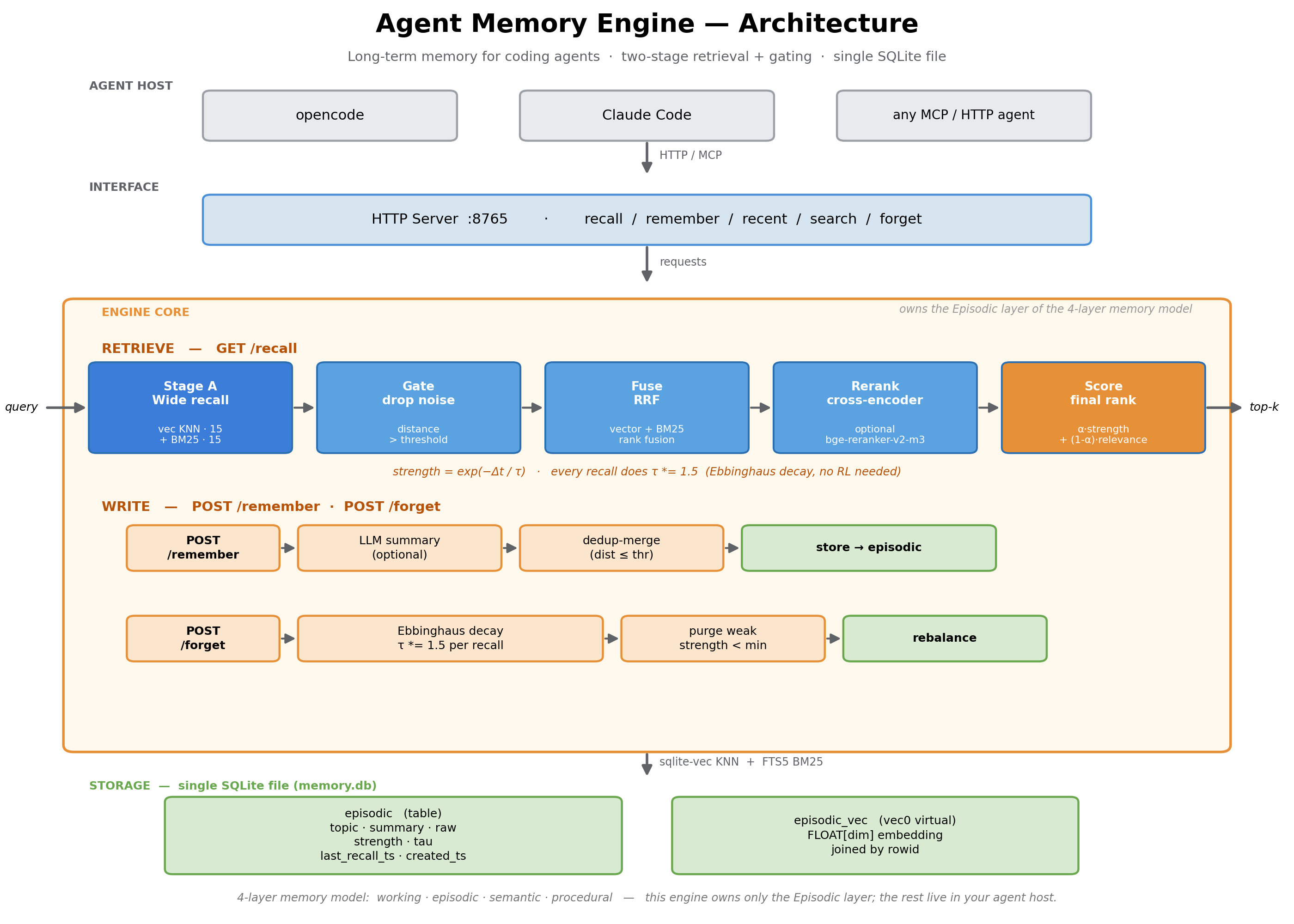
Architecture overview — see docs/architecture.md for the full breakdown.
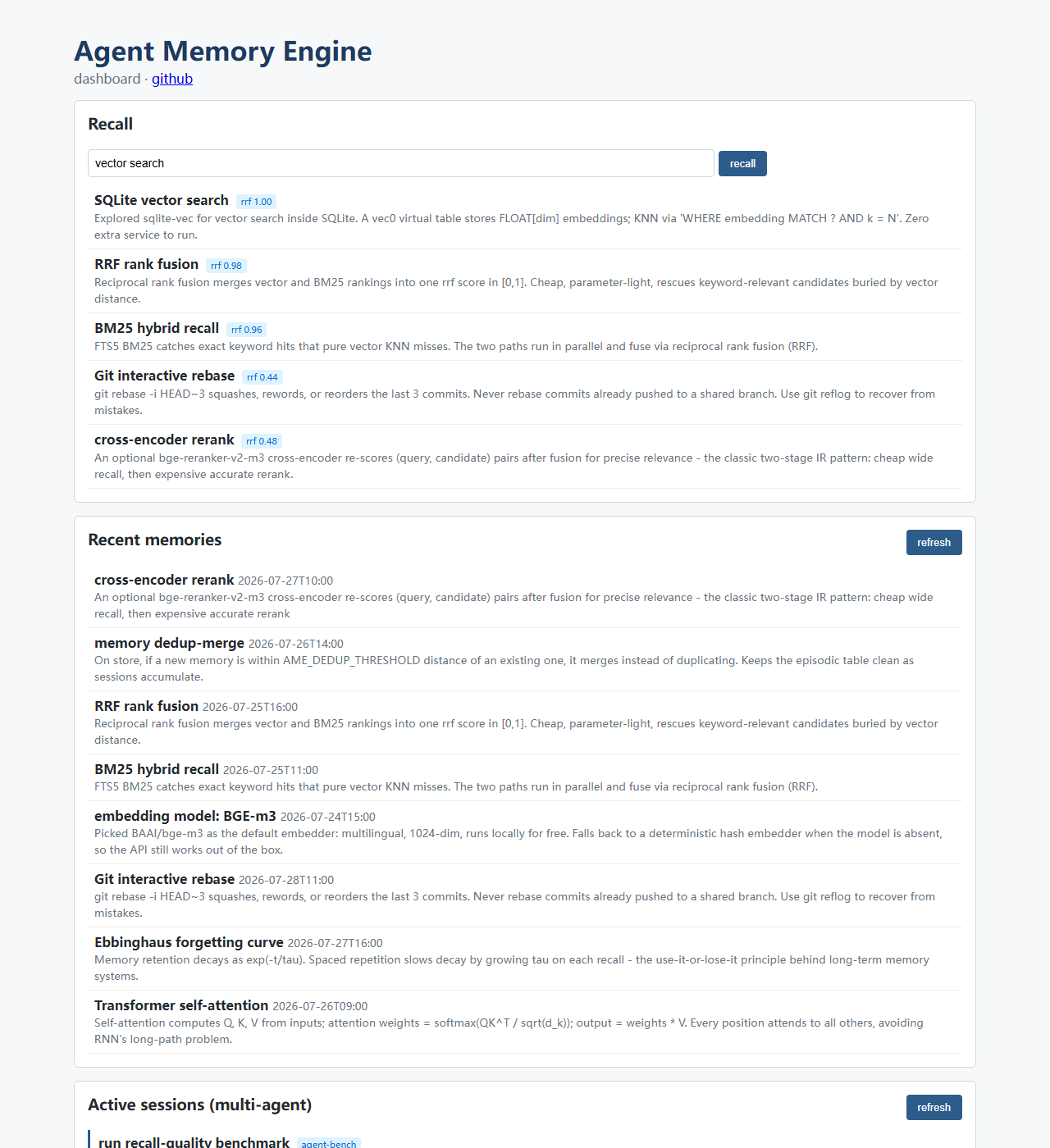
Web dashboard — recall a query, browse recent memories, and watch live multi-agent sessions.
A long-term memory engine for coding agents (opencode / claude-code / any
HTTP-speaking agent). Lets an agent "remember" past sessions across restarts:
each new turn auto-recalls related history, each finished turn auto-stores a new
memory.
Why? Coding agents forget — every new session starts blind, with past
decisions, fixes, and conventions gone. This engine gives them cheap,
persistent memory: each turn auto-recalls related history, each finished turn
auto-stores a new memory.Inspired by SJTU's MemRL paper, with an
engineering tradeoff: borrow its two-stage retrieval + gating, drop the
full RL (dialogue has no clean reward signal - see design.md).
Why it (differs from Mem0 / Chroma)
Most memory layers do pure semantic recall - nearest neighbors go straight
into the prompt. This engine is different:
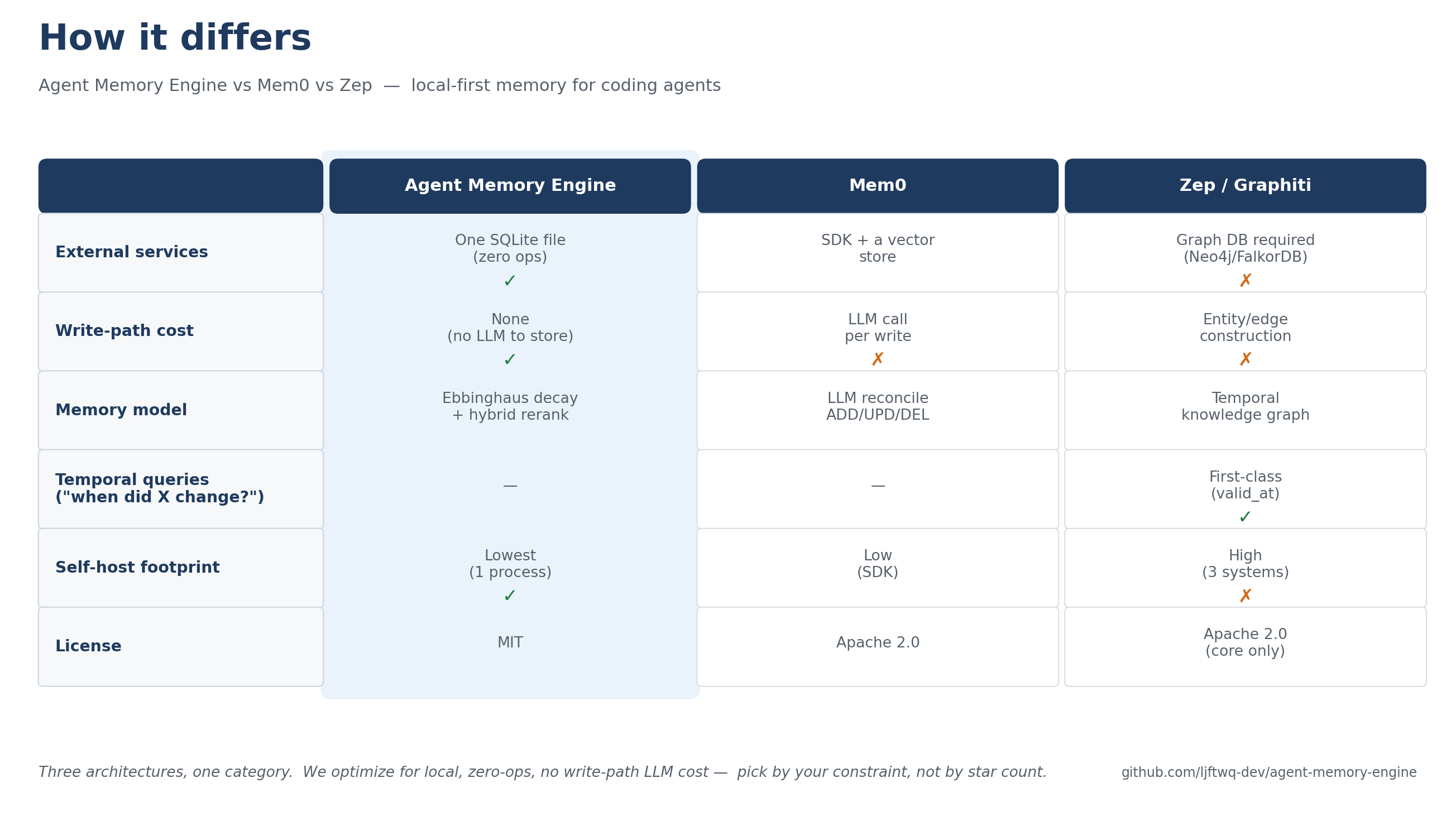
Honest tradeoffs at a glance. We optimize for local, zero-ops, no write-path
LLM cost — pick by your constraint, not by star count.
| Feature | What it buys you |
|---|---|
| Two-stage retrieval + gating | Wide KNN recall (15) → drop pure noise → rerank by score = α·strength + (1-α)·sim → top-k. No more "semantically-adjacent-but-useless" junk in your prompt. |
| Hybrid recall (vector + BM25) | Vector KNN for semantic match + FTS5 BM25 for keyword match, fused via RRF. Catches keyword hits the vector path alone would miss. Disable with AME_HYBRID_ENABLE=0. |
| Cross-encoder rerank (optional) | After hybrid fusion, a cross-encoder (bge-reranker-v2-m3) re-scores (query, candidate) pairs for precise relevance — the classic two-stage IR pattern (cheap wide recall → expensive precise rerank). Off by default; gracefully skipped if the model isn't loaded. Enable with AME_RERANKER_ENABLE=1. |
| Multi-agent collaboration | Sessions register their current task; siblings see "who's doing what" via GET /sessions/active. A fast-finishing agent can pick up a sibling's in-progress work without you writing a handoff doc. |
| LLM summarization | Optionally condenses each turn into a semantic sentence before embedding (better retrieval than raw dialogue). Falls back to raw text if no LLM is configured. |
| Ebbinghaus decay | Frequently-recalled memories decay slower (τ *= 1.5 per recall). Long-unused ones naturally fade. Use-it-or-lose-it, no RL training needed. |
| Single SQLite file | Structured data + vector index in one .db. No separate vector server, no extra process - just copy the file. |
| Agent & LLM agnostic | Plain HTTP. Default embedder is BGE-m3 (local, free); LLM summary uses any OpenAI-compatible endpoint (GLM / OpenAI / Ollama). |
Benchmark
A retrieval-quality ablation on 40 coding-agent memories + 24 hand-labeled
queries (graded relevance). Decay is neutralized so the numbers reflect pure
retrieval/reranking quality. Full method: benchmark/README.md.
| Condition | nDCG@5 | Recall@5 |
|---|---|---|
| pure-vector | 0.842 | 0.875 |
| hybrid (vector + BM25, RRF) | 0.868 | 0.896 |
| hybrid + cross-encoder rerank | 0.927 | 0.979 |
Each stage earns its keep:
| step | nDCG@5 gain | Recall@5 gain |
|---|---|---|
| +hybrid (RRF fusion) | +0.026 | +0.021 |
| +reranker (cross-encoder) | +0.059 | +0.083 |
The cross-encoder is the biggest single win — reading (query, candidate)
jointly beats encoding them separately, exactly as IR theory predicts.
Reproduced 2026-07-28 (BGE-m3 + bge-reranker-v2-m3). Run it yourself:python benchmark/run_benchmark.py.
Quick start
Live demo (no install): https://ljftwq-dev.github.io/agent-memory-engine/demo/
Runsall-MiniLM-L6-v2in your browser — real semantic recall over demo data.
From PyPI:
pip install agent-memory-engine-ljf
From source:
git clone https://github.com/ljftwq-dev/agent-memory-engine
cd agent-memory-engine
pip install -e ".[all]"        # core + real embeddings + dev deps
cp .env.example .env           # adjust if needed (defaults work out of the box)

python -m engine.server        # start HTTP server (default :8765)
One-line install (PyPI + extras, no clone needed):
curl -fsSL https://raw.githubusercontent.com/ljftwq-dev/agent-memory-engine/main/install.sh | bash
Windows (PowerShell, one line too):
irm https://raw.githubusercontent.com/ljftwq-dev/agent-memory-engine/main/install.ps1 | iex
Docker (isolated server, memory DB persisted to a volume):
docker build -t agent-memory-engine .
# publish to localhost only; expose further only together with AME_API_TOKEN
docker run -p 127.0.0.1:8765:8765 -v ame-data:/data agent-memory-engine
The engine works in two modes:
- No embedding model installed → automatic hash-fallback (deterministic,
reproducible, no real semantics). Great for trying the API, bad for recall
quality. To get real semantics install the[embed]extra (BGE-m3). - BGE-m3 installed → full multilingual semantic embeddings.
Any agent talks to it over HTTP:
GET  /health                 service status
GET  /metrics                usage counters (observability)
GET  /recall?q=&k=3          two-stage semantic recall (the core)
GET  /recent?k=5             latest k memories (by time)
GET  /search?q=              keyword LIKE match
POST /remember               store a memory {topic, summary, raw?, ...}
POST /forget                 run an Ebbinghaus decay pass {purge?, threshold?}
Tuning the gate threshold / pool sizes / decay? Watch usage over time:
curl -s http://127.0.0.1:8765/metrics
# {"ok": true, "memories_total": 412, "recalls_served": 89,
#  "avg_results_per_recall": 2.7, "remembers": 64, "remember_merges": 9,
#  "forgets": 12, "last_forget_purged": 3, "embed_mode": "...", ...}
Security
The server binds to 127.0.0.1 only — by default nothing outside your machine
can reach it. Whenever you expose it further (Docker publish beyond localhost,
a reverse proxy, a shared host), switch on bearer-token auth:
export AME_API_TOKEN=$(python -c "import secrets; print(secrets.token_urlsafe(32))")
python -m engine.server
curl -s -H "Authorization: Bearer $AME_API_TOKEN" http://127.0.0.1:8765/recall?q=test
With AME_API_TOKEN set, every endpoint requires the Authorization: Bearer
header — except /health and /metrics, which stay open so health checks
keep working.
Concurrency model
One server process; writes are serialized in-process (SQLite + the vec0 index
are not safe under concurrent writes), reads run on all threads. Connections
are opened in WAL mode with a 5 s busy_timeout, so concurrent readers never
block behind a writer, and accidental cross-process access (e.g. the MCP
stdio server against the same DB file) degrades gracefully instead of raisingdatabase is locked.
(Counters are process-local - they reset on server restart.)
Want LLM summarization? Set AME_LLM_BASE_URL + AME_LLM_API_KEY in .env
(any OpenAI-compatible endpoint). Leave them empty and it's a pure retrieval
engine - still fully usable.
Seed some demo data and try it:
python examples/seed_demo.py
python -m engine.recall "vector search" -k 3
Repository layout
agent-memory-engine/
├── engine/            core engine
│   ├── config.py      .env / env-var loader (no hardcoded paths)
│   ├── db.py          SQLite + sqlite-vec schema
│   ├── embed.py       BGE-m3 embedder + hash fallback
│   ├── recall.py      two-stage retrieval + gating (core)
│   ├── reranker.py    optional cross-encoder precision rerank
│   ├── remember.py    store + optional LLM summary + dedup-merge
│   ├── forget.py      Ebbinghaus decay loop (nightly cron)
│   ├── tokenize.py    pluggable tokenization (jieba word-level / per-char)
│   └── server.py      stdlib HTTP server
├── examples/
│   ├── seed_demo.py              load generic demo data
│   ├── opencode/memory.ts        reference opencode plugin (inject + recall + store)
│   ├── claude-code/              .mcp.json + CLAUDE.md snippet (model-driven)
│   └── cursor/                   mcp.json + agent rules (model-driven)
├── tests/
│   ├── conftest.py               temp DB + forced hash fallback (CI-friendly)
│   ├── test_recall.py            gating / dedup / decay / reinforcement tests
│   └── test_reranker.py          rerank fallback / mock-promote tests
└── docs/
    ├── architecture.md           four-layer memory model + module map
    └── design.md                 why two-stage, why no full RL
How the design works (in one paragraph)
Problem: pure semantic match causes context pollution - "semantically
close" ≠ "useful", so you shovel adjacent junk into the prompt.
Solution (wide in, strict out):
- Gate only kills pure noise (distance > threshold). In hybrid mode, BM25 hits bypass the gate.
- Fuse + rerank decides relevance: in hybrid mode relevance = RRF-fused vector + BM25 rank; otherwise
sim = 1 - distance. If the cross-encoder reranker is on, it replaces that relevance with a precise(query, candidate)score. Finalscore = α·strength + (1-α)·relevance, take top-k. strengthis lightweight utility: Ebbinghausexp(-Δt/τ), where each
recall doesτ *= 1.5. Frequently-recalled memories stay strong. This
replaces MemRL's Q-value without needing reward data.- No full RL: dialogue has no clean reward signal; a fabricated proxy adds
more noise than the Q-value is worth.
Full writeup: docs/design.md.
Configuration (.env)
| Key | Default | Meaning |
|---|---|---|
AME_DB_PATH |
~/.agent-memory/memory.db |
database path |
AME_EMBED_MODEL |
BAAI/bge-m3 |
embedding model (local & free) |
AME_EMBED_DIM |
1024 |
vector dim (must match the model) |
AME_LLM_BASE_URL |
(empty = off) | OpenAI-compatible API base |
AME_LLM_API_KEY |
(empty) | LLM key |
AME_LLM_MODEL |
glm-4-flash |
model name for summarization |
AME_RECALL_THRESHOLD |
0.9 |
distance gate (larger = looser) |
AME_RECALL_POOL |
15 |
stage-A wide recall count |
AME_ALPHA |
0.5 |
strength weight in rerank (0..1) |
AME_MIN_STRENGTH |
0.05 |
drop memories below this real-time strength |
AME_DEDUP_THRESHOLD |
0.45 |
on store, distance ≤ this merges into existing |
AME_HYBRID_ENABLE |
1 |
vector + BM25 hybrid recall (0 = vector only) |
AME_BM25_POOL |
15 |
stage-A BM25 recall count (hybrid mode) |
AME_RERANKER_ENABLE |
0 |
cross-encoder precision rerank after fusion (opt-in) |
AME_RERANKER_MODEL |
BAAI/bge-reranker-v2-m3 |
cross-encoder model (multilingual) |
AME_RERANKER_POOL |
0 |
how many gated candidates to rerank (0 = all) |
AME_BACKUP_ENABLE |
1 |
periodic safe snapshots of the memory DB |
AME_BACKUP_INTERVAL_HOURS |
6 |
how often to snapshot |
AME_BACKUP_KEEP |
5 |
keep only the newest N backups |
AME_SESSION_TIMEOUT_HOURS |
2 |
session goes stale after this long w/o heartbeat |
Tests
pip install -e ".[dev]"
pytest -q
Tests run on the hash-fallback embedder (no model download) so they're fast and
CI-friendly. They cover: create, exact-match recall, gating, dedup-merge,
Ebbinghaus decay, recall-time reinforcement, vector-dim consistency, hybrid
RRF rescue/normalization, and the reranker fallback + mock-promote behavior.
License
MIT
Reviews (0)
Sign in to leave a review.
Leave a reviewNo results found