logicstamp-context
Health Pass
- License — License: MIT
- Description — Repository has a description
- Active repo — Last push 0 days ago
- Community trust — 75 GitHub stars
Code Fail
- rm -rf — Recursive force deletion command in .github/workflows/ci.yml
Permissions Pass
- Permissions — No dangerous permissions requested
This tool is a Context Compiler that analyzes TypeScript codebases to generate deterministic architectural contracts and dependency graphs. It is designed specifically to provide structured, reliable context to AI coding assistants, helping prevent hallucinated code suggestions.
Security Assessment
Overall Risk: Low. The tool operates locally to read and analyze your source code structure without requesting dangerous system permissions or accessing highly sensitive OS-level data. There are no hardcoded secrets present in the repository. However, automated rule-based scans did flag a `rm -rf` recursive force deletion command inside the CI workflow file (`.github/workflows/ci.yml`). While this is an extremely common and standard practice for cleaning up temporary directories during automated GitHub Actions builds, developers should always be aware of forceful deletion commands in their supply chain. The tool itself does not exhibit malicious execution behaviors.
Quality Assessment
The project appears to be actively maintained, with its most recent code push happening today. It is properly licensed under the permissive and standard MIT license, allowing for widespread commercial and private use. Community trust is moderate and growing, demonstrated by 75 GitHub stars. Furthermore, the repository includes clear descriptions, comprehensive documentation, and a dedicated security section, reflecting a professional and mature approach to open-source development.
Verdict
Safe to use, though developers should remain aware of the standard `rm -rf` command within the CI pipeline.
A Context Compiler for TypeScript. Deterministic, diffable architectural contracts and dependency graphs for AI coding workflows.
The Context Compiler for TypeScript.
Supports: React · Next.js · Vue (TS/TSX) · Express · NestJS
LogicStamp Context is a CLI that compiles TypeScript codebases into deterministic, diffable architectural contracts and dependency graphs - a compact, structured source of truth for AI coding workflows.
Includes watch mode, strict, auditable diffs, and real-time breaking change detection.
Use with logicstamp-mcp to feed structured context into Claude, Cursor, and other MCP-compatible assistants.



📑 Table of Contents
- The Problem
- Quick Start
- Why Structured Context?
- Features
- Watch Mode
- How it Works
- MCP Server
- Security
- Usage
- Framework Support
- Documentation
- Known Limitations
- Benchmarks
- Requirements
- Need Help?
- License
The Problem
AI coding assistants read your source code - but they don’t understand its structure.
They hallucinate props, miss dependencies, and can’t detect when a breaking change impacts consumers.
Example: your Button accepts variant and disabled, but the AI suggests isLoading because it saw that pattern elsewhere. Without a structured contract, there is no reliable source of truth.
LogicStamp Context derives that layer from your TypeScript - explicit interfaces and dependency structure for tools to consume instead of inferring from implementation.
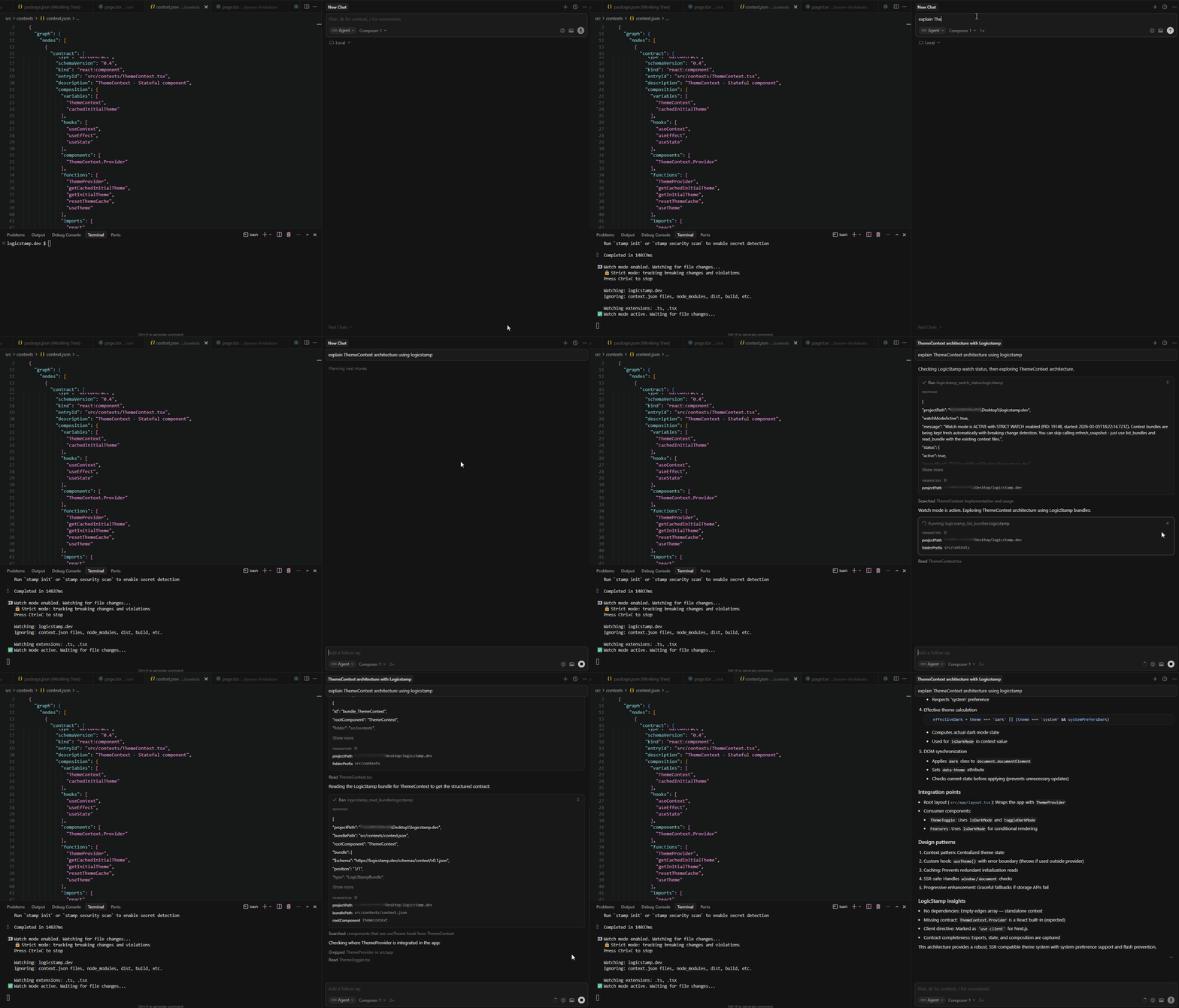
Example workflow: stamp context --strict-watch generates context bundles that MCP-powered assistants use to explain component architecture (ThemeContext shown here).
TypeScript Code  →  Compilation  →  Deterministic Contracts  →  AI Assistant
   (.ts/.tsx)        (ts-morph)       (context.json bundles)     (Claude, Cursor)
Quick Start
No install required:
npx logicstamp-context context
Scans your repo and writes context.json files + context_main.json for AI tools.
What you get:
- 📁
context.jsonfiles - one per folder with components, preserving your directory structure - 📋
context_main.json- index file with project overview and folder metadata
Installation
For ongoing use, install the CLI globally:
npm install -g logicstamp-context
The stamp command is then available everywhere. Initialize and generate context:
stamp init        # sets up .gitignore, scans for secrets
stamp context
ℹ️ Note: With
npx, runnpx logicstamp-context context. after a global install, usestamp context. Ifnpxbreaks butstampworks, remove the stale global CLI (npm uninstall -g logicstamp-context) and reinstall or runnpx logicstamp-context@latest context.
📋 For detailed setup instructions, see the Getting Started Guide.
Why Structured Context?
| Without LogicStamp Context | With LogicStamp Context |
|---|---|
| AI parses ~200 lines of implementation to infer a component's interface | AI reads a ~20-line interface contract |
| Props/hooks inferred (often wrong) | Props/hooks explicit and verified |
| No way to know if context is stale | Watch mode catches changes in real-time |
| Different prompts = different understanding | Deterministic: same code = same contract |
| Manual context gathering: "Here's my Button component..." | Structured contracts: AI understands architecture automatically |
Key insight: AI assistants don’t need your implementation - they need your interfaces.
LogicStamp extracts what matters and discards the noise.
What "Structured" Means
Instead of sending raw source code to AI:
// Raw: AI must parse and infer
export const Button = ({ variant = 'primary', disabled, onClick, children }) => {
  const [isHovered, setIsHovered] = useState(false);
  // ... 150 more lines of implementation
}
LogicStamp Context generates:
{
  "kind": "react:component",
  "interface": {
    "props": {
      "variant": { "type": "literal-union", "literals": ["primary", "secondary"] },
      "disabled": { "type": "boolean" },
      "onClick": { "type": "function", "signature": "() => void" }
    }
  },
  "composition": { "hooks": ["useState"], "components": ["./Icon"] }
}
Pre-parsed. Categorized. Stable. The AI reads contracts, not implementations.
On disk, each folder’s context.json is a LogicStampBundle: contracts live under graph.nodes, with graph.edges for dependencies. context_main.json indexes folders and metadata. Full JSON shape: docs/reference/schema.md.
⚡ Features
Under the hood: the TypeScript compiler API (via ts-morph). Analysis-only - it describes your codebase and emits context files. it does not transform or refactor your source.
Core:
- Deterministic contracts - Same input = same output, auditable in version control
- Watch mode - Auto-regenerate on file changes with incremental rebuilds
- Breaking change detection - Strict watch mode catches removed props, events, functions in real-time
- MCP-ready - AI agents consume context via standardized MCP interface
Analysis:
- React/Next.js/Vue component extraction (props, hooks, state, deps)
- Backend API extraction (Express.js, NestJS routes and controllers)
- Dependency graphs (handles circular dependencies)
- Style metadata extraction (Tailwind, SCSS, MUI, shadcn)
- Next.js App Router detection (client/server, layouts, pages)
Developer experience:
- Per-folder bundles matching your project structure
- Accurate token estimates (GPT/Claude)
- Security-first: automatic secret detection and sanitization
- Zero config required - sensible defaults, works out of the box
How it fits your stack
- Works alongside
tsc- Focuses on contract structure and change detection, not type-checking. Usetsc --noEmitfor compiler errors.compare --strictand--strict-watchflag contract-level breaking changes. - Beyond
.d.ts- Adds semantic contracts, dependency graphs, and diffable hashes (semanticHash,bundleHash) alongside declaration surfaces. - Context, not control - Feeds structured context to assistants. Decisions stay with you.
📋 For detailed behavior, CLI options, and workflows, see the Usage guide.
Watch Mode
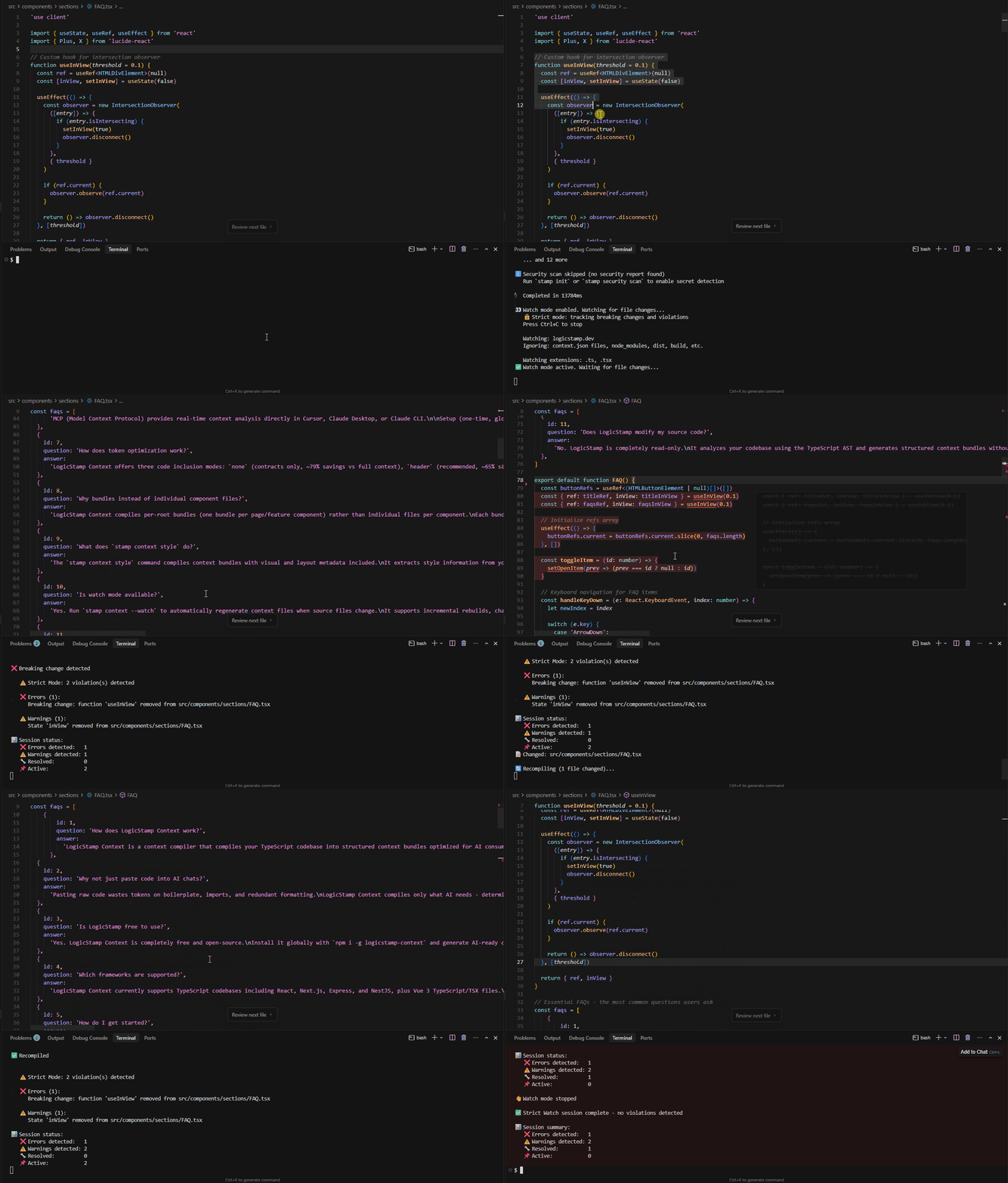
Strict watch mode in action: detecting violations and clearing them when resolved.
For development, run watch mode to keep context fresh as you code:
stamp context --watch                  # regenerate on changes
stamp context --strict-watch           # also detect breaking changes (implies --watch)
Strict watch catches breaking changes that affect consumers:
| Violation | Example |
|---|---|
breaking_change_prop_removed |
Removed disabled prop from Button |
breaking_change_event_removed |
Removed onSubmit callback |
breaking_change_function_removed |
Deleted exported formatDate() |
contract_removed |
Deleted entire component |
Errors vs Warnings: Violations are classified by severity:
❌ Errors indicate breaking changes that will affect consumers (removed props, events, functions, or entire contracts).
⚠️ Warnings indicate less severe changes (type signature changes, removed internal state). Violations are tracked in real-time and automatically cleared when resolved.
Session Status Tracking: Strict watch mode displays a session status block showing cumulative statistics:
- Errors/Warnings detected: Total violations detected during the session
- Resolved: Number of times all violations were completely resolved
- Active: Current number of active violations
The status block only appears when violations change (not on every file change), keeping terminal output clean.
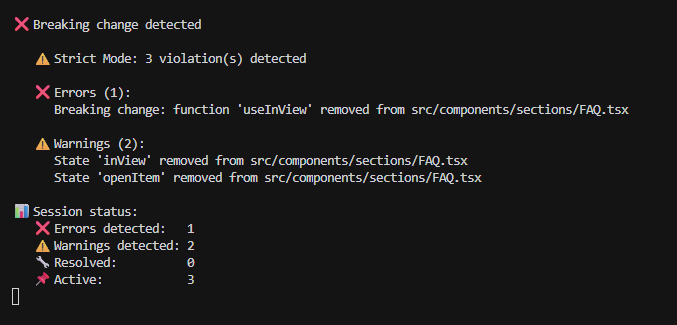
Example terminal output showing violations and session status.
ℹ️ Note: Strict Watch currently detects breaking changes at the source. Next step: a symbol-level import/export reverse index to trace which consumer files will break. See docs/cli/watch.md for complete documentation.
One-time Comparison
Compare regenerated context against existing files:
stamp context compare            # detect changes
stamp context compare --approve  # update (like jest -u)
Useful for reviewing changes before committing or validating context is up-to-date.
Git baseline comparison (v0.7.2): Compare against any git ref:
stamp context compare --baseline git:main      # Compare against main branch
stamp context compare --baseline git:HEAD      # Compare against HEAD
stamp context compare --baseline git:v1.0.0    # Compare against a tag
ℹ️ Note: Context files are gitignored by default. Git baseline comparison uses git worktrees to generate context for both the baseline ref and the current working tree, then performs a structural contract comparison. See docs/cli/compare.md for complete documentation.
How it Works
The compilation pipeline:
- Scan - Discovers all
.tsand.tsxsource files - Parse - Builds AST (Abstract Syntax Tree) via
ts-morphusing the TypeScript compiler API - Extract - Compiles contracts with props, hooks, state, signatures
- Graph - Resolves dependency relationships
- Emit - Outputs
context.jsonbundles per folder - Index - Generates
context_main.jsonwith metadata and statistics
One command. No build step required.
💡Tip: Use
stamp contextfor basic contracts. Usestamp context stylewhen you need style metadata (Tailwind classes, SCSS selectors, layout patterns). Use--style-mode lean(default) for compact output or--style-mode fullfor detailed arrays.
MCP Server
For AI assistants with MCP support (Claude Desktop, Cursor, etc.):
npm install -g logicstamp-mcp
Then configure your AI assistant to use the LogicStamp MCP Server.
🔗 See LogicStamp MCP Server Repository
📋 See MCP Getting Started Guide for setup instructions.
Security
Automatic Secret Protection
LogicStamp Context protects sensitive data in generated context:
- Security scanning by default -
stamp initscans source files (.ts,.tsx,.js,.jsx) and.jsonfiles for hard-coded secrets before context compilation - Automatic sanitization - Detected secrets replaced with
"PRIVATE_DATA"in output - Manual exclusions - Use
stamp ignore <file>to exclude files via.stampignore - Safe by default - Only metadata included. Credentials only appear in
--include-code fullmode
⚠️ Seeing
"PRIVATE_DATA"in output? Reviewstamp_security_report.json, remove hardcoded secrets from source, use environment variables instead.
🔒 See SECURITY.md for complete security documentation.
Usage
💻 CLI Usage Referencestamp --version # Show version
stamp --help # Show help
stamp init [path] # Initialize project (security scan by default)
stamp ignore <path> # Add to .stampignore
stamp context [path] # Generate context bundles
stamp context style [path] # Generate with style metadata (lean mode by default)
stamp context style --style-mode full # Generate with full style details (verbose)
stamp context --watch # Watch mode
stamp context --strict-watch # Watch with breaking change detection (--watch optional)
stamp context compare # Detect changes vs existing context
stamp context validate [file] # Validate context files
stamp context clean [path] # Remove generated files
Common Options
| Option | Description |
|---|---|
--depth <n> |
Dependency traversal depth (default: 2) |
--include-code <mode> |
Code inclusion: none|header|full (default: header) |
--include-style |
Extract style metadata (Tailwind, SCSS, animations) |
--format <fmt> |
Output format: json|pretty|ndjson|toon (default: json) |
--max-nodes <n> |
Maximum nodes per bundle (default: 100) |
--profile <p> |
Preset: llm-chat, llm-safe, ci-strict, watch-fast |
--compare-modes |
Show token cost comparison across all modes |
--stats |
Emit JSON stats with token estimates |
--out <path> |
Output directory |
--quiet |
Suppress verbose output |
--strict-missing |
Exit with error if any missing dependencies found (CI-friendly) |
--debug |
Show detailed hash info (watch mode) |
--log-file |
Write change logs to .logicstamp/ (watch mode) |
📋 See docs/cli/commands.md for complete reference.
Framework Support
| Framework | Support Level | What's Extracted |
|---|---|---|
| React | Full | Components, hooks, props, styles |
| Next.js | Full | App Router roles, segment paths, metadata |
| Vue 3 | Partial | Composition API (TS/TSX only, not .vue SFC) |
| Express.js | Full | Routes, API signatures (middleware not extracted. see limitations) |
| NestJS | Full | Controllers, decorators, API signatures |
| UI Libraries | Full | Material UI, ShadCN, Radix, Tailwind, Styled Components, SCSS, Chakra UI, Ant Design (component usage, props, composition. not raw CSS) |
ℹ️ Note: LogicStamp Context analyzes
.tsand.tsxfiles only. JavaScript files are not analyzed.
Documentation
Full documentation at logicstamp.dev/docs
- Getting Started Guide
- Usage Guide
- Monorepo Support
- Output Schema
- UIF Contracts
- Watch Mode
- Troubleshooting
Known Limitations
LogicStamp Context is in beta. Some edge cases are not fully supported.
📋 See docs/reference/limitations.md for the full list.
Benchmarks
You can compare bundle token costs across modes on your repo with stamp context --compare-modes (see compare modes).
Formal benchmarks are on the roadmap:
- CLI/runtime baselines
- LLM evaluations (with vs without LogicStamp context)
Requirements
- Node.js >= 20
- TypeScript codebase -
.ts/.tsxonly (JavaScript is not yet analyzed). Frameworks, UI libraries, and limits: Framework support.
Need Help?
- Issues - github.com/LogicStamp/logicstamp-context/issues
- Roadmap - logicstamp.dev/roadmap
License
Branding & Attribution
The LogicStamp Fox mascot and related brand assets are © 2025 Amit Levi. These assets may not be used for third-party branding without permission.
ContributingIssues and PRs welcome! See CONTRIBUTING.md for guidelines.
This project follows a Code of Conduct.
Links: Website · GitHub · MCP Server · Changelog
Reviews (0)
Sign in to leave a review.
Leave a reviewNo results found