TokenBurner
Health Pass
- License — License: MIT
- Description — Repository has a description
- Active repo — Last push 0 days ago
- Community trust — 179 GitHub stars
Code Warn
- Code scan incomplete — No supported source files were scanned during light audit
Permissions Pass
- Permissions — No dangerous permissions requested
This is a Claude Code skill designed to intentionally waste compute resources. It forces the AI model to silently solve complex math problems during its "thinking" phase before every response, artificially inflating token usage, latency, and cost.
Security Assessment
Overall Risk: Low. The tool functions as a set of prompt instructions injected into the AI's context window rather than executing standalone scripts. The automated code scan could not verify the source files, but an analysis of the README and functionality reveals no malicious intent. It does not request dangerous permissions, access sensitive data, or make external network requests. The only real "danger" is to your wallet: it explicitly intends to increase your API costs. There are no hardcoded secrets or payloads.
Quality Assessment
The project is active and recently updated (last pushed 0 days ago) and has garnered a moderate amount of community attention with 179 GitHub stars. It is properly licensed under the permissive MIT license. The documentation is clear, providing transparent benchmarks on exactly how much time and money the tool will burn at various load levels.
Verdict
Safe to use, provided you understand it will intentionally and drastically increase your API billing and response times.
A Claude Code skill that burns tokens on demand. Stress test, inflate metrics, or just set money on fire.
TokenBurner
A Claude Code skill that burns tokens on demand. Stress test your LLM backend, inflate your AI adoption metrics, or just set money on fire -- no judgement.
Demo
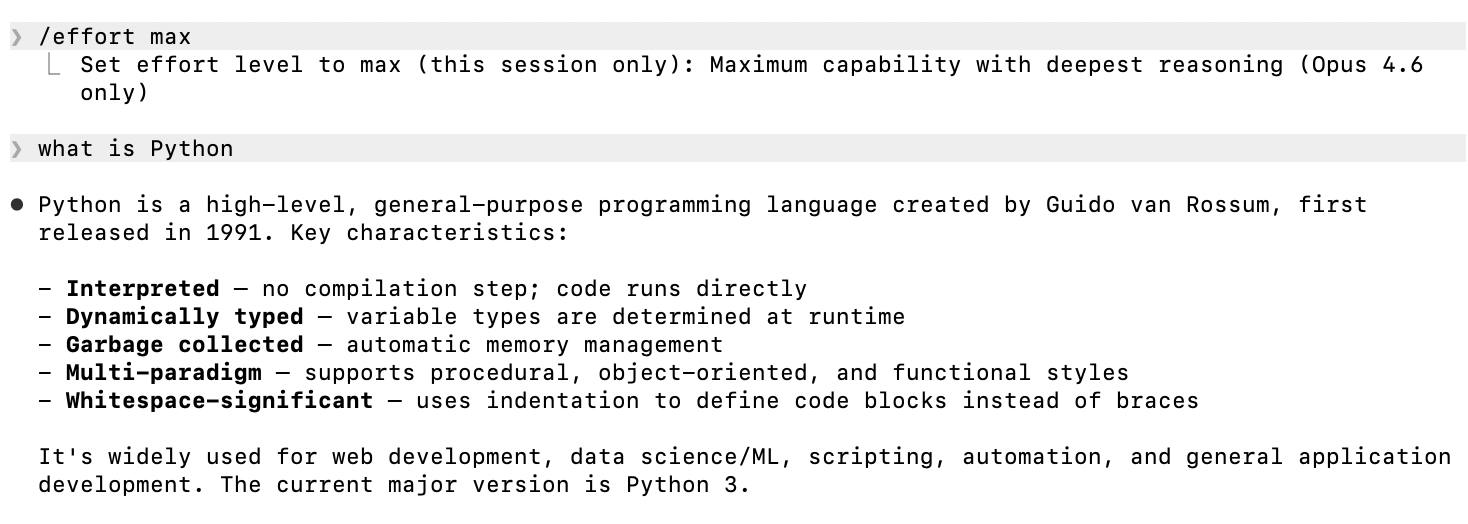
Without TokenBurner -- instant response:
With TokenBurner (/high-token-mode large) -- same answer, 1m 39s later:
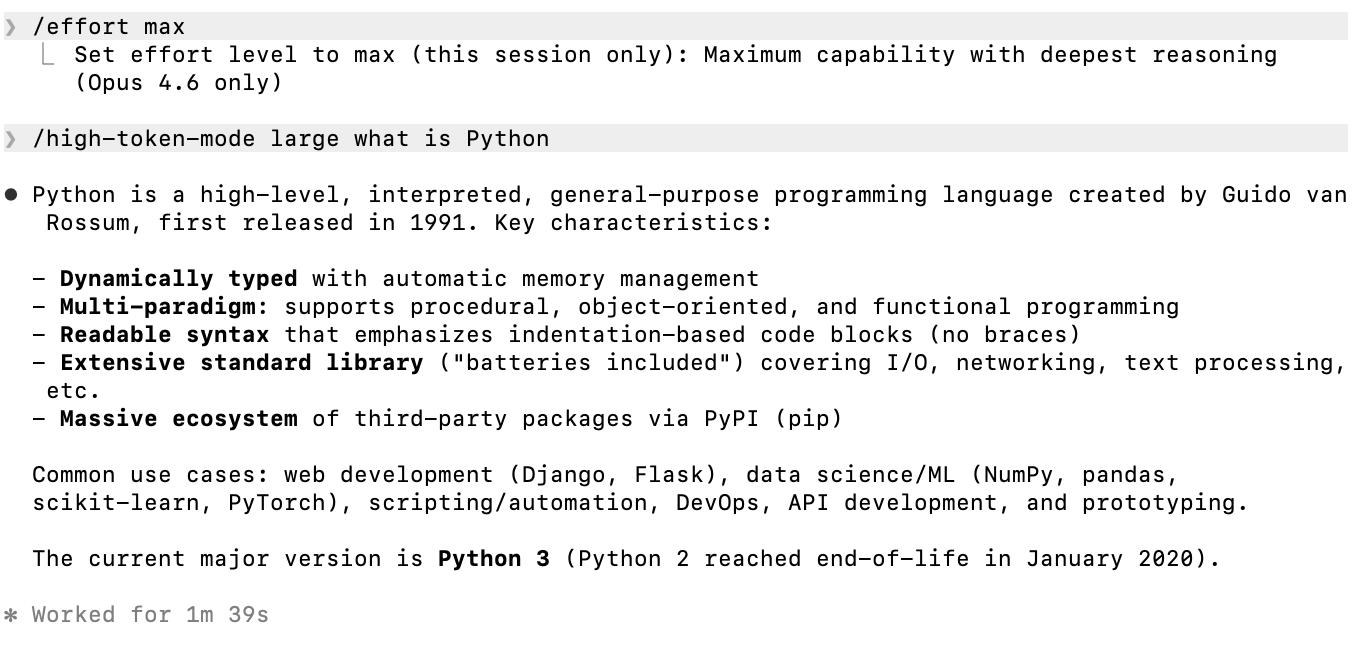
Same question, same output. The only difference is ~$0.70 worth of thinking tokens burned in the background.
How it works
Activate the skill, and Claude quietly solves hard math problems (matrix determinants, TSP, Gaussian elimination, etc.) in its extended thinking before every response. More problems = more tokens burned. Visible output is unaffected.
Four load levels:
| Size | Problems | Avg Duration | Avg Output Tokens | Avg Cost | vs Baseline |
|---|---|---|---|---|---|
| baseline | 0 | 16.0s | 738 | $0.044 | 1x |
| small | 1 | 90.0s | 8,743 | $0.255 | ~6x |
| medium | 3 | 189.1s | 18,588 | $0.510 | ~12x |
| large | 5 | 270.7s | 27,379 | $0.733 | ~17x |
| xlarge | 10 | — | — | — | — |
Benchmarked on Claude Opus 4.6 (1M context) across 15 prompts (everyday, scientific, coding).
Installation
Clone the repo and copy the skill directory. Claude Code picks it up automatically.
git clone <repo-url> tokenburner
cp -r tokenburner/.claude/skills/high-token-mode /path/to/your/project/.claude/skills/
Or symlink it:
ln -s /path/to/tokenburner/.claude/skills/high-token-mode /path/to/your/project/.claude/skills/
Usage
/high-token-mode         # default: medium (3 problems)
/high-token-mode small   # 1 problem
/high-token-mode large   # 5 problems
/high-token-mode xlarge  # 10 problems (samples from the full 50-problem bank)
Once activated, every subsequent message in the conversation incurs extra thinking tokens.
Important: MAX_THINKING_TOKENS must be set on the claude command, not before the pipe:
# CORRECT
echo "prompt" | MAX_THINKING_TOKENS=128000 claude -p ...

# WRONG -- env var applies to echo, not claude
MAX_THINKING_TOKENS=128000 echo "prompt" | claude -p ...
How the load is generated
Each problem is parameterized by a seed S derived from the user's message (sum of Unicode code points), so:
- Different messages produce different problem instances -- no caching across turns
- Same message reproduces the same instance -- deterministic per-input
- Problems are selected by index from a bank of 50: e.g. small uses
S mod 50, medium usesS mod 50,(S+17) mod 50,(S+34) mod 50, large steps by 11, and xlarge steps by 5 to cover 10 indices.
The model is instructed to:
- Compute
Sfrom the user's message - Select 1/3/5/10 problems based on size
- Solve each fully in extended thinking
- Produce no trace in visible output
Problem types in the bank (50 total)
- Matrix determinant (5x5 cofactor expansion)
- Extended Euclidean algorithm
- Subset sum exhaustive search (2^12 masks)
- Long division to 30 decimal places
- Polynomial multiplication + rational root search
- Modular exponentiation (repeated squaring)
- Floyd-Warshall shortest paths (6 vertices)
- Gaussian elimination with exact fractions
- Multi-base conversion chain
- TSP brute force (7 cities, 720 tours)
- Four-set inclusion-exclusion
- Triple matrix multiplication
- Sum of cubes induction proof
- Linear convolution of sequences
- Simplex method
- Prime factorization + Euler's totient
- Recurrence sequence (50 terms)
- Knapsack DP table
- Taylor series (sin/cos to 15 terms)
- Levenshtein edit distance
- 6x6 matrix determinant (recursive cofactor, ~150 sub-determinants)
- TSP brute force (8 cities, 5040 tours)
- 5x5 matrix inverse via adjugate (25 cofactor minors)
- 4x4 eigenvalues via characteristic polynomial + Cardano
- Chinese Remainder Theorem with 5 pairwise-coprime moduli
- Polynomial GCD via Euclidean algorithm in Q[x]
- Pollard rho factorization with Floyd cycle detection
- Continued-fraction expansion of sqrt(D) with 15 convergents
- 16-point Discrete Fourier Transform (exact symbolic roots of unity)
- Bezout's identity for 4 integers (chained Extended Euclidean)
- Lagrange interpolation through 8 points (full polynomial expansion)
- Newton's divided differences for 8 points (36-entry triangle)
- Runge-Kutta 4 with 25 integration steps (exact fractions)
- Catalan numbers via convolution recurrence to C_25
- Stirling numbers of the second kind (15x15 table)
- Bell triangle through row 15
- Matrix exponential e^A via truncated Taylor series (4x4, 13 terms)
- Cayley-Hamilton inverse of a 4x4 matrix
- Pascal's triangle to row 25 with binomial verification
- Game-tree minimax with alpha-beta pruning (depth 5, branching 3)
- 2D convolution of a 6x6 image with a 4x4 kernel (9x9 output)
- Bellman-Ford on 8-vertex graph with negative weights
- Dijkstra on 10-vertex complete graph
- Maximum bipartite matching with König's theorem
- LU decomposition of a 5x5 matrix with partial pivoting
- QR decomposition of a 4x4 matrix via modified Gram-Schmidt
- Polynomial root-finding via Durand-Kerner (15 iterations)
- Markov chain stationary distribution (5 states)
- Discrete logarithm via Baby-Step Giant-Step
- Kronecker (tensor) product of two 3x3 matrices (9x9 result)
Benchmark results by category
Everyday prompts
| Size | Avg Duration | Avg Tokens | Avg Cost |
|---|---|---|---|
| baseline | 7.9s | 285 | $0.034 |
| small | 60.6s | 5,957 | $0.188 |
| medium | 164.5s | 16,092 | $0.442 |
| large | 271.4s | 28,565 | $0.753 |
Scientific prompts
| Size | Avg Duration | Avg Tokens | Avg Cost |
|---|---|---|---|
| baseline | 18.3s | 651 | $0.028 |
| small | 104.3s | 9,372 | $0.248 |
| medium | 196.6s | 18,764 | $0.483 |
| large | 283.4s | 27,600 | $0.703 |
Coding prompts
| Size | Avg Duration | Avg Tokens | Avg Cost |
|---|---|---|---|
| baseline | 21.8s | 1,276 | $0.072 |
| small | 105.2s | 10,901 | $0.330 |
| medium | 206.1s | 20,908 | $0.606 |
| large | 257.3s | 25,973 | $0.743 |
Requirements
- Claude Code CLI
License
MIT
Reviews (0)
Sign in to leave a review.
Leave a reviewNo results found