cache-refund
Health Warn
- License — License: MIT
- Description — Repository has a description
- Active repo — Last push 0 days ago
- Low visibility — Only 6 GitHub stars
Code Fail
- os.homedir — User home directory access in src/actions.ts
- process.env — Environment variable access in src/actions.ts
- exec() — Shell command execution in src/cardimage.ts
Permissions Pass
- Permissions — No dangerous permissions requested
No AI report is available for this listing yet.
A cache doctor for Claude Code: find the money your prompt cache is leaking.
cache-refund




Finds the money your Claude Code cache is leaking.
How to run
npx cache-refund
No install, no account, no config. Node 18+. (The installed command, once you
do install it, is plain cache-refund.) Prefer it conversational? It also
ships as a Claude Code plugin — see Use it inside Claude Code.
100% local. Reads token counts and timestamps only. No conversation content. No network.
Zero runtime dependencies, too — the entire tool is one tsc-compiled TypeScript
CLI, nothing to audit but the code itself.
- API-billed, still on the 5-minute default? The recommender: "you left ~$X
on the table over the last 90 days — one line recovers it. Claim your cache
refund? [y/N]" - API-billed, already on the 1-hour TTL? The validator: confirms 1h is still
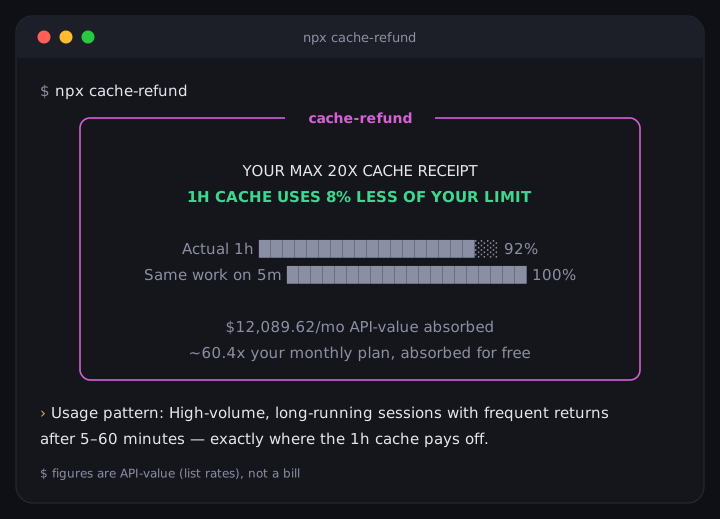
winning, or tells you to revert if your pattern shifted back toward 5m. - On a subscription? The receipt: what your (already-automatic) 1h cache
saved you, plus a leak table for what's still eating your quota.
Below the break-even on any branch, you get "Certified optimal" instead of a
nag — that's also a screenshot worth sharing.
In March 2026, the Claude API silently downgraded some 1-hour cache writes to
5-minute. Settings said 1h; transcripts billed 5m.cache-refundreads the TTL
you received, never the one you set.
How it works
Every cache-write is a token you paid a markup to store (1.25× base input on
the 5-minute TTL, 2× on the 1-hour TTL). cache-refund buckets each write by the
gap since the previous turn in that session. Then it prices a symmetric
counterfactual — what a fully-5m world and a fully-1h world would each have
billed on your tokens — so the verdict is a threshold you cross, not a guess.
| gap since previous turn | bucket | meaning |
|---|---|---|
| session start, or > 60 min | cold | unavoidable — a fresh cache had to be written. Informational. |
| 5–60 min | recoverable | the leak. A 1-hour TTL would still have this cached; a 5-minute TTL made you pay to write it again. |
| ≤ 5 min | warm | cheap re-use — cached under either TTL. |
The one number that decides the recommendation is R/C — the share of your
cache-write tokens that fell in the recoverable bucket. Above 39.5%, the
1-hour TTL is cheaper for your pattern; below it, the 5-minute default already
wins. Not a vibe — it's (2 − 1.25) / (2 − 0.1), derived in
METHODOLOGY.md.
Run npx cache-refund --explain to see every formula with your
numbers substituted in.
The fix, and how to trust it
For an API user whom the math tells to switch:
npx cache-refund enable # adds ENABLE_PROMPT_CACHING_1H=1 to ~/.claude/settings.json
This is the only thing cache-refund ever writes, it asks first (unless you
pass --yes), it backs up settings.json before touching it, and it preserves
every other key. npx cache-refund revert undoes it.
The env flag only applies to sessions started after the change, and Claude
Code has had intermittent flakiness landing it
(anthropics/claude-code#49139),
so the tool verifies itself rather than asking you to trust it:
npx cache-refund verify # after a few turns in a fresh session
verify re-reads your newest transcripts and checks the TTL reality check
— the TTL you are actually receiving per your last few days of usage, read
straight from the ephemeral_5m/ephemeral_1h usage fields, not from whatsettings.json claims. If 1h landed, it says so. Later:
npx cache-refund recheck # the comeback loop
recheck compares against a small baseline saved at enable time and shows
"since switching: $X saved". No external tools at any step — the product
verifies the product.
Why the TTL reality check exists (a cautionary tale)
In March 2026 the Claude API server-side silently downgraded some 1-hour
cache writes to 5-minute for a stretch — settings said 1h, transcripts billed
5m. Anyone reasoning from their config rather than their transcripts was
quietly wrong for weeks.
The sharpest illustration we know of: a public community backtest once modeled
cache-keepalive strategies against an assumed TTL. When the models were
finally checked against real billed tokens, six carefully-modeled strategies
all lost to a one-line heuristic — and part of the modeling had rested on a
TTL that the server wasn't actually honoring. The lesson cache-refund
takes from that story: measure the TTL you received, don't trust the one you set.
That is why every checkup leads with the reality-check line, and why the
regression watchdog (below) is the roadmap's flagship.
Use it inside Claude Code
cache-refund also ships as a Claude Code plugin, so you can run the checkup
conversationally instead of from a terminal:
/plugin marketplace add cache-refund/cache-refund
Then just ask — "am I leaking money on cache?" or "run cache-refund" — and the
agent runs the analyzer, narrates the number, the gap breakdown, and the
verdict in plain language. It never edits settings.json on your behalf: it
only ever surfaces the enable/revert command and asks you to run it — the
tool's own confirmation prompt is the only write path, same as the CLI.
Share your card
npx cache-refund card
Post it with #cacherefund, or drop it in the pinned Discussion.
Other output modes
npx cache-refund share      # deal your card + the share prompt, any time
npx cache-refund card       # the canonical screenshot: section box + top Wrapped line
npx cache-refund --md       # paste-ready markdown block for Slack / Teams
npx cache-refund --compact  # ~7 lines: score, R/C verdict, biggest miss, worst day
npx cache-refund --json     # full machine-readable summary (stable schema, never prompts)
npx cache-refund --explain  # every formula, your numbers substituted (METHODOLOGY, one flag away)
Flags: --days N (default 90) · --project <path> (default: all projects) ·--price <model=$/MTok,...> (override pricing) · --yes / -y (skip confirm) ·--no-color · --all-time · --no-share (silence the share prompt; same as
env CACHE_REFUND_NO_SHARE=1) · --plan <usd> (monthly subscription price;
subscription branch only — turns the receipt into a multiple of that price).
Exit codes: 0 ok · 1 no transcripts found · 2 parse/usage/internal error.
FAQ
I'm on a subscription (Pro/Max) — is there anything to do?
No action, but there is a receipt. Subscribers already get the 1-hour TTL
automatically; cache-refund shows you what it saved you and where your quota is
still leaking (model switches, cold starts). Dollar figures are labeled$-equivalent (API list rates) because the subscription quota formula is
undisclosed — we price your tokens at API list rates so the number is anchored
and reproducible, but it is not a bill. The --plan <usd> flag turns the
receipt into a multiple of your subscription price.
Does it work on Bedrock / Vertex?
Yes. ENABLE_PROMPT_CACHING_1H is an API/Bedrock/Vertex/Foundry feature, so the
enable recommendation applies to all of them. The analyzer reads the same
transcript format regardless of provider.
Does it work with Codex / OpenAI?
There's nothing for cache-refund to advise there. OpenAI's prompt caching is
automatic — writes cost nothing extra, cached reads are discounted, and
retention tiers are priced identically — so there's no 5m-vs-1h decision to
make. A cache-health view for other CLIs is on the roadmap.
Is the efficiency score comparable between people?
Only within a score_version. This is score_version: 1 (printed in --json
and in METHODOLOGY.md). The formula is fully documented; if
it ever changes, the version bumps, so a v1 score is only ever compared to
another v1 score.
A leak row says $0.00 — is that a bug?
Almost certainly not. Subagent-5m overhead is $0 if you ran no sidechains in the
window; compaction rewrites are near-$0 if you rarely /compact; and the
recoverable-leak dollars are net of what a 1h TTL would itself cost, so a row
can legitimately be $0 when the tail write cancels the saving. Zero rows are
honest, not missing data.
Does sharing phone home?
No. The CLI itself makes zero network requests, sharing included. The optional
share prompt (interactive terminal runs only) opens your own browser with a
prefilled post — text you read, and can edit or abandon, before anything is
sent — or copies the markdown block (or the generated card image) to your
local clipboard. Nothing is transmitted by cache-refund, ever. The prompt
appears at the end of every interactive run; Enter skips it, and --no-share
(or env CACHE_REFUND_NO_SHARE=1) silences it entirely, every time.
I think a number is wrong.
That is the highest-priority kind of bug report. Open a
wrong-number issue
— it asks for your --json and --explain output (token counts and timestamps
only, no content) so the exact figure can be reproduced and traced through the
formula.
Roadmap
- v1.1 — the TTL regression watchdog. A
watchmode that alarms the moment
your received TTL flips (the March-2026 incident, turned into a live tripwire).
Pluscard --html(a self-contained dark-mode card for LinkedIn/decks) and
sleep-window learning to split cold gaps into "asleep" vs "abandoned".watchis teased in the checkup footer as coming — it is not a shipped
command yet. - v1.5 —
teamaggregate mode (v1 already ships--json+ a documentedjq
merge for fleets). - v2 — a policy simulator behind the same cost model: price
5m+keepaliveand1h+keepalivefor API users.
The roadmap has one rule (see METHODOLOGY.md and
GOOD-SETTINGS.md): every new check must be computed from
your transcripts, priced, and paired with one concrete fix. Generic
settings-opinion tips are never product.
Relationship to spend dashboards
Spend dashboards report what you spent. cache-refund reports what you
wasted, why, and the fix — it is the decision, not the dashboard. They
compose: watch your spend wherever you already watch it, then run cache-refund
when you want to know whether the cache defaults are costing you and what to
change. (The per-TTL write pricing here comes from Anthropic's published
per-model rates, re-derived in METHODOLOGY.md with the
retrieval date cited in src/pricing.ts.)
Contributing & license
Wrong-number reports get a priority lane — see
CONTRIBUTING.md. MIT licensed, © 2026 Ilan Bar-Magen.
Methodology in full: METHODOLOGY.md · or run npx cache-refund --explain.
Reviews (0)
Sign in to leave a review.
Leave a reviewNo results found