ManifoldKit
Health Warn
- License — License: MIT
- Description — Repository has a description
- Active repo — Last push 0 days ago
- Low visibility — Only 5 GitHub stars
Code Fail
- rm -rf — Recursive force deletion command in .github/workflows/docs.yml
Permissions Pass
- Permissions — No dangerous permissions requested
No AI report is available for this listing yet.
Reusable SwiftUI chat framework for local and cloud LLM inference on Apple platforms
ManifoldKit





The only open-source Swift package that bundles UI, turn-loop runtime, persistence, and multi-backend inference into one drop-in chat product for Apple platforms.
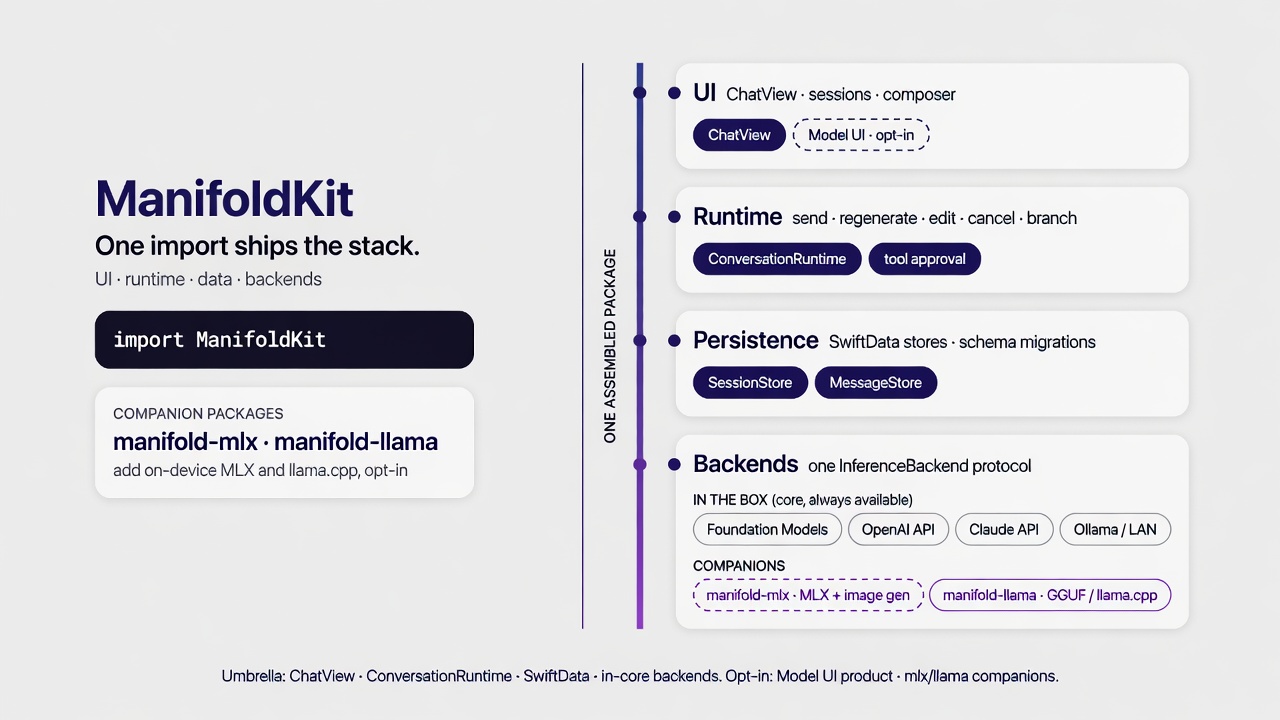
New here? Start with Why ManifoldKit — and how it's built to last for the honest "what it solves and why trust it" narrative, or jump to the docs index for the full guided path from install to first token. Prefer rendered API reference? The full DocC documentation site ties every module's reference together under one navigable root.
ManifoldKit is a full-stack, multi-backend AI chat framework for iOS 18+ / macOS 15+. Import one umbrella package and you get a SwiftUI ChatView, the ConversationRuntime turn loop (send / regenerate / edit / cancel / branch), SwiftData persistence, and the in-core inference backends (Apple Foundation Models, OpenAI, Anthropic, Ollama / LAN) — all behind one InferenceBackend protocol. Model browser / download UI is the opt-in ManifoldUIModelManagement product; on-device MLX and llama.cpp ship as the manifold-mlx / manifold-llama companion packages. Competitors ship a single layer; ManifoldKit ships the assembled product and the wiring between layers. It survives real failures — streaming retries, latest-wins model handoff, memory admission, certificate pinning, and a mock backend for app-level testing. See docs/RELIABILITY.md for the source-backed contract, or docs/POSITIONING.md for the full "why ManifoldKit vs. the field" rationale.
Hello World
Add ManifoldKit (core), then drop this into your app entry point. ManifoldKit.quickStart() builds the SwiftData container and registers the compiled-in backends. On devices with an available Foundation Model, a stored local model that a registered backend can load, or a saved endpoint it selects that model; otherwise, configure a backend or use the optional GGUF starter below. Errors surface as ManifoldKitError.
.package(url: "https://github.com/ManifoldKit/ManifoldKit.git", from: "0.75.0"), // x-release-please-version
// target dependencies: "ManifoldKit"
import SwiftUI
import SwiftData
import ManifoldKit

@main
struct MyChatApp: App {
    @State private var result: QuickStartResult?
    @State private var error: ManifoldKitError?
    @State private var showModelManagement = false

    var body: some Scene {
        WindowGroup {
            if let result {
                ChatView(showModelManagement: $showModelManagement)
                    .environment(result.viewModel)
                    .modelContainer(result.bootstrap.modelContainer)
            } else if let error {
                ContentUnavailableView("Failed to start", systemImage: "exclamationmark.triangle", description: Text(error.errorDescription ?? ""))
            } else {
                ProgressView().task {
                    do {
                        result = try await ManifoldKit.quickStart()
                    }
                    catch let e as ManifoldKitError { error = e }
                    catch { self.error = .from(error) }
                }
            }
        }
    }
}
Optional: on-device GGUF starter
Want the on-device GGUF starter model instead of relying on Foundation Models / a manually-loaded backend? Add the manifold-llama companion package and pass its registrar — otherwise quickStart logs and skips the GGUF seed, because no registered backend can load it:
// + .package(url: "https://github.com/ManifoldKit/manifold-llama.git", from: "0.2.14")
// + target dependency: .product(name: "ManifoldLlama", package: "manifold-llama")
import ManifoldLlama

result = try await ManifoldKit.quickStart(
    backends: [LlamaBackends.self],
    seed: .recommendedSmallModel()
)
One-shot response
Already have a QuickStartResult with a loaded model and just want one reply as a String? respond(to:) sends the message, drives the turn, and returns the assistant's text — no inputText/observation plumbing:
import ManifoldKit

func oneShot(using kit: QuickStartResult) async throws -> String {
    return try await kit.respond(to: "Explain monads in one sentence.")
}
About
seed:— with themanifold-llamacompanion'sLlamaBackendsregistrar,.recommendedSmallModel()downloads Qwen3-0.6B (~400 MB) in the background before returning, so the composer is generating the moment the view appears. Without that registrar the GGUF seed is skipped. The download is also skipped when a model is already available (Foundation on iOS/macOS 26+, or a local model on disk), and it accepts a{ progress in … }closure for a progress indicator.No starter download?
quickStartregisters the backends but loads none when no Foundation Model, compatible stored local model, or saved endpoint is available, so on first run the composer reads "No model loaded" and the empty-state Select Model button only flipsshowModelManagement— nothing is presented until you attach a sheet to that binding. Fastest route: presentModelManagementSheet(from the opt-inManifoldUIModelManagementmodule) with.sheet(isPresented: $showModelManagement), or pass theLlamaBackendsregistrar withseed:. Step-by-step: First-launch backend selection.
Value-typed front door: LLM
Want the LLM.swift feel — construct a value, call .respond(to:)? LLM(from:template:backends:) wraps the same quickStart plumbing in a value type. backends: is a required parameter (no default — explicit registrars over implicit ones, see docs/API-DESIGN.md); pass a registrar that can load the seed type:
import ManifoldKit
import ManifoldLlama

func twoLine() async throws -> String {
    let llm = try await LLM(
        from: .recommendedSmallModel(),
        backends: [LlamaBackends.self]
    )
    return try await llm.respond(to: "Explain monads in one sentence.")
}
Local models need a companion registrar.
ManifoldKit.defaultBackendRegistrarscovers cloud (Ollama / OpenAI / Anthropic) and Apple Foundation Models. For an on-device model, add themanifold-llama(GGUF) ormanifold-mlxpackage and pass its registrar instead —backends: [LlamaBackends.self]— plus the matchingimport. Pass an optionaltemplate: ChatTemplateto override formatting for built-in (enum) templates.
See docs/QUICKSTART.md for backend selection and configuration.
Building a multi-session SwiftUI app with a sidebar, persisted chats, and relaunch restore? See docs/SWIFTUI-MULTI-SESSION.md — the canonical end-to-end guide.
Building a CLI, server, or non-SwiftUI consumer? See docs/QUICKSTART-CLI.md — compile-tested Foundation Models, local GGUF, and Ollama / OpenAI examples.
Running ManifoldKit as a standalone OpenAI-compatible server (for Cursor, Continue, or any OpenAI SDK)? Install via brew tap manifoldkit/manifoldkit https://github.com/ManifoldKit/ManifoldKit.git && brew install manifold-server and see docs/QUICKSTART-SERVER.md.
Want the inference layer with a fully custom SwiftUI UI (no ChatView)? See docs/QUICKSTART-BRING-YOUR-OWN-UI.md.
Registering tools the model can call? See docs/QUICKSTART-TOOLS.md — ToolRegistry, the local-model tool ceiling, approval gates, and streaming results.
Exposing an AppIntent to the model? See docs/QUICKSTART-APPINTENTS.md.
Full runnable: Example/Examples/MinimalExample.
Where each backend lives
As of v0.48 the heavy on-device backends ship as companion packages so a
core-only app never resolves llama.cpp or mlx-swift (SwiftPM traits gate
link, not fetch — see
docs/TRAIT-COSTS.md).
Module names are stable — only the .package(…) line differs. Migrating from
a trait-based 0.47 setup? docs/MIGRATION-0.48.md
is the error-message-indexed guide.
| You want | Module to import | Package |
|---|---|---|
| MLX on-device inference (+ image gen) | ManifoldMLX |
ManifoldKit/manifold-mlx |
| llama.cpp / GGUF on-device inference | ManifoldLlama |
ManifoldKit/manifold-llama |
| Apple Foundation Models (iOS/macOS 26+) | ManifoldKit umbrella (or ManifoldFoundation) |
ManifoldKit (core) |
| OpenAI / Anthropic / LM Studio / custom endpoints | ManifoldKit umbrella (or ManifoldCloudSaaS) |
ManifoldKit (core) |
| Ollama / LAN | ManifoldKit umbrella (or ManifoldOllama) |
ManifoldKit (core) |
| xAI, Groq, Mistral, OpenRouter — incl. Gemini models via OpenRouter (OpenAI-compatible endpoint) | ManifoldKit umbrella (or ManifoldCloudSaaS), APIProvider.custom + OpenAIBackend |
ManifoldKit (core) |
| MCP client / host | ManifoldMCP / ManifoldMCPHost |
ManifoldKit (core) |
Companion backends register through quickStart(backends: [MLXBackends.self, LlamaBackends.self]) (or MLXBackends.register(with:) on a hand-assembled service). The manifold-mlx / manifold-llama packages tag 0.1.0 alongside the core v0.48.0 release.
Building a new backend companion package? See docs/COMPANION-BACKENDS.md for the product/contract-adoption/release-lifecycle guide, and docs/HARDWARE-TOOLCHAIN.md for the cross-repo hardware/CI constraints.
Why ManifoldKit
Full-stack altitude. Import one umbrella package and ship a multi-backend chat app: SwiftUI ChatView, the ConversationRuntime turn loop, SwiftData persistence, and the in-core backends — already wired together. Model browser UI is the opt-in ManifoldUIModelManagement product; MLX / llama.cpp are companion packages. Most alternatives hand you one layer (a UI kit, an engine wrapper, or a thin cloud client) and leave the rest as an exercise. Here the integration is the product.
Backend portability. MLX, llama.cpp/GGUF, Apple Foundation Models, and cloud (OpenAI Chat + Responses, Anthropic, Ollama, LAN, and any OpenAI-compatible endpoint — xAI, Groq, Mistral, OpenRouter via APIProvider.custom, including Gemini models through OpenRouter) all sit behind one InferenceBackend protocol. Streaming, tool calling, thinking/reasoning tokens, RAG, and structured output behave identically across every backend, so swapping engines is a config change, not a rewrite. See How ManifoldKit compares to AnyLanguageModel.
n-1 OS reach — everything above the model layer. At WWDC 2026 Apple opened the Foundation Models framework to any LLM provider via the LanguageModel protocol, with first-party Claude (anthropics/ClaudeForFoundationModels, beta) and Gemini (via Firebase, preview) packages arriving on top. That validates the multi-backend idea — and commoditizes it: model access is becoming a platform primitive. But it all lands on the newest OS only — Foundation Models itself is iOS 26+ / macOS 26+, and the opened provider layer is iOS 27+ (in beta now) — while ManifoldKit already serves the iOS 18 / macOS 15 installed base those APIs can't reach, wrapping Foundation Models as just one more backend behind InferenceBackend. ManifoldKit's value was never the abstraction; it's everything above the model layer: the turn loop, persistence, MCP client+server, tool approval, and RAG. The companion-package split means one codebase yields either an App-Store-lean build with no heavy ML dependencies at all (core only — just don't add the companion packages) or the full local + cloud + RAG + voice stack, and the pre-wired stub traits (SystemAIProviderExtension, CoreAI) mean adopting Apple's new provider protocols is one more backend, not a migration. See AGENTS.md → Platform policy.
Reliability and security as product. TLS pinning, SSRF and DNS-rebind guards, a throwing Keychain, a documented threat model, a fuzz harness, 6,500+ tests, capability-routed structured output, human-in-the-loop tool approval (ToolApprovalGate), and cost/metrics observability ship in the box. These are the things that go wrong between the demo and App Store review — see docs/RELIABILITY.md for the implementation-backed guarantees.
ManifoldKit is decomposable, not monolithic: 28 libraries across a layered module graph. Take just the engine (CLI / server path), just the UI (bring-your-own-runtime), or the whole stack — the umbrella is a convenience, not a requirement.
Drop in ChatView, or compose the primitives
ChatView is a complete reference integration, not the only door in. ManifoldUI ships as composable pieces you can assemble into a custom layout while still driving the same ChatViewModel / ConversationRuntime (SessionListView and SessionManagerViewModel are also in the Key Types table below):
- Message rendering —
MessageBubbleView, theMessageBubbleStyleprotocol (withPlainMessageBubbleStyle,IMessageMessageBubbleStyle,CardMessageBubbleStylebuilt in),StreamingCursorView,ToolInvocationView,CitationsView. - Input —
ChatInputBar,VisionInputButton(cross-platform),PhotoAttachmentButton(iOS only — preferVisionInputButtonfor a codebase that also targets macOS). - Session chrome —
SessionListView,SessionRowView, backed bySessionManagerViewModel;ContextIndicatorView,MemoryIndicatorView,ModelLoadingIndicatorView,TypingIndicatorView. - Pickers & sheets —
PersonaPickerView,SamplerPresetPickerView,VoicePickerView,ChatExportSheet,SessionExportSheet.
Bring your own layout and swap in only the pieces you need — a custom message list with MessageBubbleView and a bespoke input bar is a valid integration, not an unsupported one.
What's already in the box
Table-stakes capabilities that ship today (verified in source):
- Token streaming across every backend (
GenerationStream/GenerationEvent). - Multi-provider abstraction — one
InferenceBackendprotocol, local + cloud. - Tool / function calling with a per-request tool ceiling guide for local models.
- Tool-call evaluation & conformance — score how reliably a model calls tools (incl. a bundled BFCL AST track) via the
manifold-toolsCLI andConformanceScorer, plus a bootstrap-exposed, SwiftData-backedToolCallConformanceCacheport for persisting verdicts. See Beyond chat. - Structured / typed output, capability-routed by
StructuredOutputRouteracross GBNF, Foundation guided-generation, JSON-Schema, and JSON-prompting. - Reasoning / thinking tokens surfaced as first-class events.
- MCP client and server (ManifoldMCP + the
Servertrait). - On-device RAG with citations — a full document subsystem (parse
.txt/.md/.pdf→ chunk → embed → retrieve), wired into the turn loop, with an optional cross-encoder rerank stage (Rerankerport — on-deviceLlamaReranker, or cloudCloudRerankerfor Cohere / Jina) and a Document Library UI. See docs/QUICKSTART-RAG.md. - Embeddings & semantic search —
EmbeddingBackendprotocol with on-deviceNLEmbeddingBackend(Apple NaturalLanguage, no companion package) and an OpenAI-compatible/v1/embeddingsserver endpoint. - Human-in-the-loop tool approval via
ToolApprovalGate. - Metrics + cost estimation for observability.
- On-device image generation —
FluxDiffusionBackend(FLUX.1 Schnell) andMLXDiffusionBackend(SDXL Turbo), via themanifold-mlxcompanion package.
Status: ManifoldKit is pre-1.0; breaking changes can land between minor versions. Deferred reliability features (e.g. mid-stream resume) are tracked in docs/RELIABILITY.md.
Dev-tool products — ManifoldTools, ManifoldTestSupport, ManifoldPersistenceTestSupport, and ManifoldBackendTestKit — are semver-exempt and may break in any minor release. Each provides published APIs for real external consumers (eval repo, companion packages, local apps) and every break receives a migration note, but they are not bound to the core stability promise: they are developer tooling, and linking one means accepting the looser promise. See docs/API-DESIGN.md § 7 for the complete policy and consumer list.
Maturity tiers. Not every product carries the same stability promise. docs/PRODUCTION-READINESS.md is the normative page assigning every published product — Core guarantee, Supported first-party integration, Experimental, or Labs — so you know what you can build on today vs. what may move under you.
Beyond chat
The same backend, model-management, persistence, and download infrastructure that powers the chat UI is reusable for non-chat consumers. The framing is "chat-first" because that's the most complete reference integration, but the public surface explicitly supports:
On-device image generation —
FluxDiffusionBackend(FLUX.1 Schnell, 1024×1024 in 4 steps) andMLXDiffusionBackend(SDXL Turbo) conform toImageGenerationBackendand streamImageGenerationEvents exactly like text inference streamsGenerationEvent. The diffusion backends ship in themanifold-mlxcompanion package; theImageGenerationBackendprotocol and records stay in core. See docs/QUICKSTART-IMAGE-GEN.md for the end-to-end walkthrough (download → load → generate).Cloud video generation — Any cloud service that conforms to
VideoGenerationBackendwires intoVideoGenerationServiceandVideoGenerationRuntime, which persist the result viaMessageStoreand expose real-time progress throughChatViewModel.videoGenerationProgress. The sameManifoldBootstrapinit that accepts animageGenerationServicealso accepts avideoGenerationService, so adding video is one extra parameter:let backend = MyVideoBackend() backend.configure(baseURL: videoAPIURL, tokenProvider: tokenProvider, modelName: "my-video-model") let service = VideoGenerationService(backend: backend) let kit = try ManifoldBootstrap( configuration: config, videoGenerationService: service ) // Trigger a generation from anywhere you hold the view model: try await kit.viewModel.generateVideo( prompt: "a sun rising over mountains", config: VideoGenerationConfig(duration: 5, aspectRatio: VideoGenerationConfig.AspectRatio.landscape) )The full walkthrough lives with the generation backends in the
manifold-mlxcompanion package docs; theVideoGenerationBackendprotocol,VideoGenerationService, and persistence wiring above are core.Standalone speech-to-text / text-to-speech —
ManifoldVoicewraps AppleSpeech+AVFoundationbehind a chat-agnosticVoiceConversationControllerthat anything (image-gen prompt fields, search bars, CLI dictation) can drive. See docs/QUICKSTART-VOICE.md.On-device embeddings, semantic search & RAG — the
EmbeddingBackendprotocol with on-deviceNLEmbeddingBackend(Apple NaturalLanguage, zero extra dependencies) powers a complete retrieval subsystem:RAGService.ingest(url:)parses (.txt/.md/.pdf), chunks, embeds into a flat-file vector index, and retrieves the top passages before each turn (semantic when an embedding backend is loaded, keyword-fallback otherwise) — with inlineCitations inChatView, an optional cross-encoder rerank, and a Document Library UI (DocumentLibrarySheet). Opt in viaManifoldBootstrap(ragConfiguration:). The sameEmbeddingBackendsurface backs the OpenAI-compatible/v1/embeddingsserver endpoint. See docs/QUICKSTART-RAG.md and docs/RAG-TUNING.md.Tool-call evaluation & conformance — measure how well a model actually calls tools before shipping. The
manifold-toolsCLI drives a bundled BFCL (Berkeley Function-Calling Leaderboard) AST slice against a live backend (manifold-tools bfcl --model … --category simple), andConformanceScorer/MatrixRenderer(in theManifoldToolslibrary) render a deterministic conformance matrix you can gate on. A bootstrap-exposed, SwiftData-backedToolCallConformanceCacheport is available for persisting per-model verdicts — the seam a host needs to avoid re-running the eval — though no built-in UI consumes it yet. The CLI lives atSources/manifold-toolsand the scoring library atSources/ManifoldTools(runswift run manifold-tools bfcl --help).CLI / server / non-SwiftUI consumers — backends, model management, and persistence work without
ChatView. See docs/QUICKSTART-CLI.md.
Feature Matrix
Capabilities scope by which products and companion packages you link, not by traits. The full capability table is generated from Sources/ManifoldKit/FeatureMatrix.swift and rendered to docs/FeatureMatrix.md.
v0.48 retires the trait architecture in favour of library products. There are no default traits — plain swift build is the full core build. The surviving opt-in traits are Server and Macros (genuine build-cost levers: Hummingbird and swift-syntax respectively) plus the forward-declared WWDC stubs (SystemAIProviderExtension, CoreAI). Everything else is retired: MCP, MCPBuiltinCatalog, Voice, Tools, AppIntents, Skills, Ollama, CloudSaaS, and AnyLanguageModel became always-compiled modules or explicit products, and the local-backend traits (MLX, Llama, HuggingFace, Fuzz, FoundationOnly) died with the companion-package split — MLX and llama.cpp now arrive by adding manifold-mlx / manifold-llama. See docs/MIGRATION-0.48.md for the full mapping and docs/QUICKSTART.md → Customizing backends for install steps.
For a quantified breakdown of what the remaining opt-in traits (Server, Macros) cost in binary size and dependency weight — heavy ML is companion-optional since v0.48 — see docs/TRAIT-COSTS.md.
ManifoldKit vs. the field
Most Swift AI projects are excellent at one layer. ManifoldKit's claim is narrow and checkable: it's the only open-source package that fills every column.
| Project / category | Chat UI | Turn-loop runtime | Persistence | Multi-backend local + cloud | Reusable as a package |
|---|---|---|---|---|---|
| ManifoldKit | ✅ | ✅ | ✅ | ✅ | ✅ |
| UI-only kits (Exyte/Chat, MessageKit, SwiftyChat) | ✅ | ❌ | ❌ | ❌ | ✅ |
| Engine-only (LocalLLMClient, AnyLanguageModel, swift-transformers, LLM.swift) | ❌ | ❌ | ❌ | partial¹ | ✅ |
| Ecosystem-bound (SpeziLLM — Stanford Spezi) | ❌ | partial | ❌ | partial² | ✅ (requires Spezi) |
| Thin cloud clients (MacPaw/OpenAI, SwiftAnthropic) | ❌ | ❌ | ❌ | ❌ (one provider) | ✅ |
| Apple Foundation Models (+ opened provider layer, WWDC26) | ❌ | ❌ | ❌ | ✅ via LanguageModel (iOS 27+ only, beta) |
✅ |
| Cross-platform (Cactus) | ❌ (engine/bindings, no chat-UI kit) | ❌ | ❌ | ✅ (hosted-service cloud fallback) | ✅ (Swift binding less mature) |
| Full-stack apps (fullmoon, Enchanted) | ✅ | ✅ | ✅ | partial | ❌ (fork, not a package) |
¹ LocalLLMClient is the closest multi-engine analog (multiple local engines behind one interface) but ships no UI, persistence, or cloud backends, and is explicitly labelled experimental (tool calling and multimodal included). ² SpeziLLMFog adds mDNS-discovered local-network inference ManifoldKit doesn't have.
Each row is genuinely strong at its own layer — a UI kit renders beautiful bubbles, a cloud client is a clean SDK, Foundation Models is free and on-device. The point isn't that they're weak; it's that assembling them into a shipping chat product is the work ManifoldKit already did. Apple validated the category at WWDC 2026 by opening Foundation Models to third-party providers — which raises the value of everything above the model layer, not below it. Cross-language demand for that "above" layer is proven (React's assistant-ui has ~11k stars; Vercel ships a chatbot template) — there is still no Swift equivalent until this one. Full rationale in docs/POSITIONING.md.
Install
.package(
    url: "https://github.com/ManifoldKit/ManifoldKit.git",
    from: "0.75.0" // x-release-please-version
)
Most apps add a single product — the ManifoldKit umbrella — which re-exports the runtime, persistence, backends, UI, and inference surface in one import:
.target(name: "MyApp", dependencies: [
    .product(name: "ManifoldKit", package: "ManifoldKit"),
])
Specialised modules (ManifoldUIModelManagement, ManifoldMCP, ManifoldVoice, ManifoldHuggingFace, ManifoldAppIntents) stay opt-in — add them explicitly when you need that surface. ManifoldVoice in particular is usable outside chat: it wraps Apple Speech / AVFoundation behind a chat-agnostic VoiceConversationController, so anything from an image-gen prompt field to a CLI dictation tool can drive it. See docs/QUICKSTART-VOICE.md for the standalone STT path; the chat composer accessory is the other consumer of the same controller. For finer-grained dependency control (e.g. a UI-only target that doesn't link a backend family), depend on the individual products instead. See docs/QUICKSTART.md for backend selection and the bring-your-own-UI path.
Requirements
- Swift 6.1+ (
swift-tools-version: 6.1in this package'sPackage.swift) - If your app's own manifest declares
.macOS(.v26)/.iOS(.v26), use Swift 6.2+ there — those platform entries were introduced in PackageDescription 6.2. - iOS 18+ / macOS 15+
- Apple Foundation Models require iOS 26+ / macOS 26+
ManifoldKit follows an n-1 platform policy: the current Apple OS release and the one immediately before it. When Apple ships a new major OS each September, both minimums bump by one. See AGENTS.md → Platform policy for the rationale.
Compatibility matrix
Most of the surface builds and runs down to the package floor (iOS 18 / macOS 15). A few modules and symbols carry a higher floor because they wrap OS-26-only frameworks — they still compile and link fine on older deployment targets; only using the gated symbol requires an OS check.
| Module / symbol | Min iOS | Min macOS | Notes |
|---|---|---|---|
Package floor (ManifoldKit, ManifoldInference, ManifoldRuntime, ManifoldUI, …) |
18 | 15 | The n-1 baseline everything below is measured against. |
ManifoldFoundation / FoundationBackend |
26 | 26 | Re-exported by the ManifoldKit umbrella, so apps targeting iOS 18–25 / macOS 15–25 link it fine — but FoundationBackends.register(with:) registers a factory that yields no usable backend below the floor, and quickStart with only this registrar throws ManifoldKitError.noBackendsRegistered on iOS 18–25 / macOS 15–25. Guard usage with if #available(iOS 26, macOS 26, *). |
ManifoldAppIntents — AppIntentToolExecutor (the ToolExecutor bridge) |
26 | 26 | Separate opt-in product (not re-exported by the umbrella). Gate registration behind #available(iOS 26, macOS 26, *). |
ManifoldAppIntents — AskManifoldIntent / AskManifoldHandler |
18 | 15 | Same opt-in product as above, but the sample intent and its handler protocol only need the package floor. |
Demo
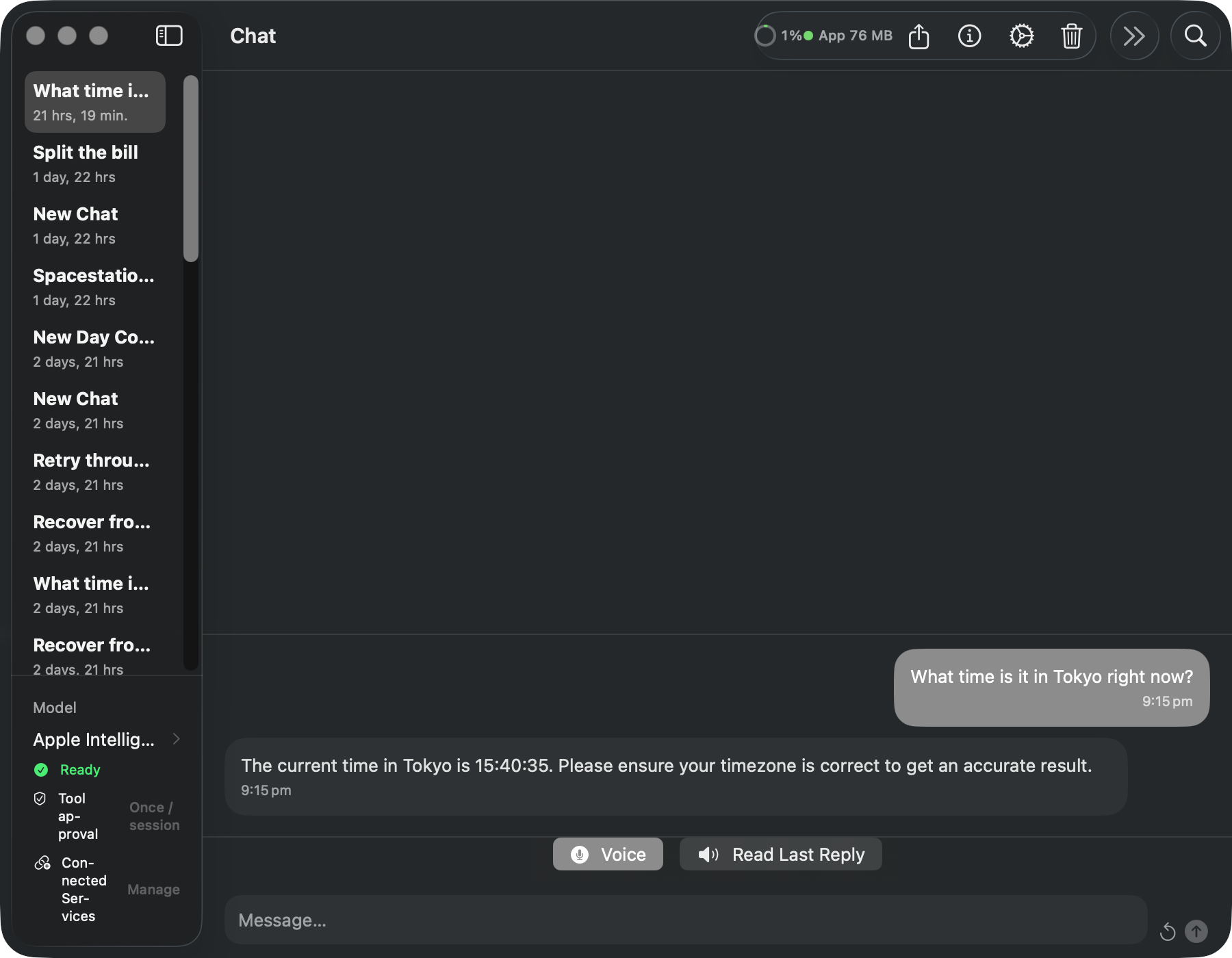
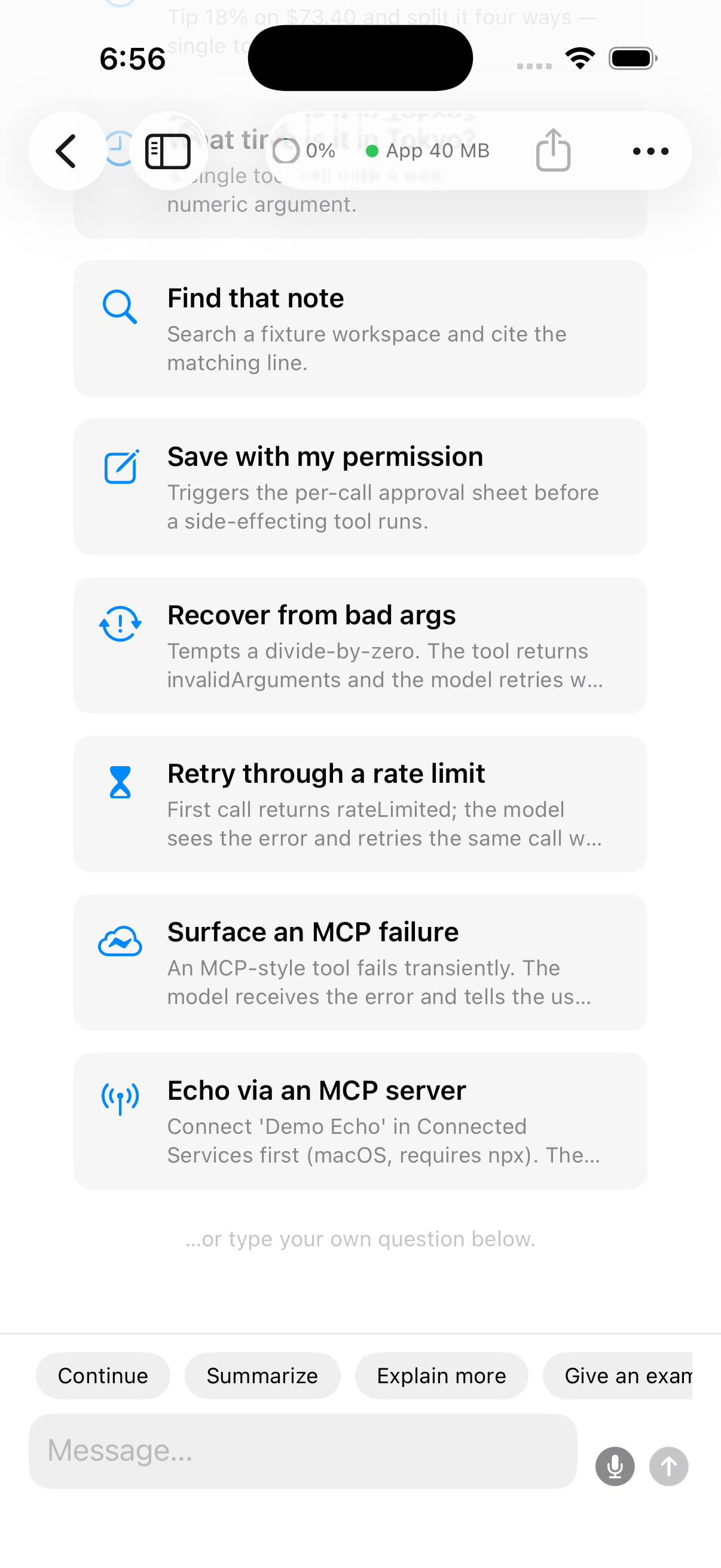
Start with Example/Examples/MinimalExample if you're new — it's the canonical Hello World. The full-featured reference app lives at Example/Advanced (sessions, model management, custom composer accessories); open it once the minimal example makes sense.
Architecture
ManifoldKit ships 28 libraries, 3 executables, and 1 macro plugin. The core runtime stack is six libraries; the rest are optional sibling modules you link explicitly. The MLX and llama.cpp backend families live in the manifold-mlx and manifold-llama companion packages.
ManifoldVoice              ManifoldUIModelManagement
(speech I/O)               (model browser + endpoint UI)
        │                          │
        └────────► ManifoldUI ◄────┘
                       │
                       ▼
            ManifoldPersistenceSwiftData
            (SwiftData schema, ManifoldBootstrap)
                       │
                       ▼
                 ManifoldRuntime
                 (Ports, use cases, ConversationRuntime)
                       │
                       ▼
                ManifoldInference  ◄─── backend families
                (Protocols, services)   (ManifoldFoundation,
                       ▲                 ManifoldOllama,
                       │                 ManifoldCloudSaaS; MLX /
                       │                 llama.cpp via companions)
                       │
                ManifoldMCP
                (MCP descriptors, client, tool bridge)
The backend families (ManifoldFoundation / ManifoldOllama / ManifoldCloudSaaS) and ManifoldMCP depend on ManifoldInference directly, not via ManifoldRuntime — that keeps them free of SwiftData so host apps can wire backends or MCP into a non-SwiftData runtime. The full target list lives in AGENTS.md → Targets.
Turn-loop orchestration
ConversationRuntime (Sources/ManifoldRuntime/Services/ConversationRuntime.swift) is the single turn loop for chat. It owns all turn-flow operations — send, regenerate, edit, cancel, and branch — dispatched through processTurn(TurnInput(...)) with the corresponding TurnKind case. There is no alternative path. Host apps get a configured runtime from ManifoldBootstrap (exposed as bootstrap.conversationRuntime) and forward user actions to it. See CONTRIBUTING.md → Architecture invariants for the full list of dependency rules the lint enforces.
Supported Model Types
| Type | Backend | Format | Source | Image input |
|---|---|---|---|---|
| GGUF | LlamaBackend (llama.cpp, via manifold-llama) |
Single .gguf file |
HuggingFace, local | Not yet; tracked in #416 |
| MLX | MLXBackend (mlx-swift, via manifold-mlx) |
Directory with config.json + .safetensors |
HuggingFace, local | Vision models only |
| Foundation | FoundationBackend |
ModelInfo.builtInFoundation (built-in, no download) |
Apple Intelligence | No public FoundationModels image-input API yet |
| OpenAI | OpenAIBackend |
Cloud API | api.openai.com | Vision-capable models |
| Claude | ClaudeBackend |
Cloud API | api.anthropic.com | Vision-capable models |
| Ollama | OpenAIBackend |
Local API | localhost:11434 | Vision-capable OpenAI-compatible models |
| LM Studio | OpenAIBackend |
Local API | localhost:1234 | Vision-capable OpenAI-compatible models |
Model storage scoping
ModelStorageService() stores and discovers local models under <Application Support>/<ManifoldConfiguration.shared.bundleIdentifier>/<modelsDirectoryName> by default. This keeps multiple ManifoldKit-based apps on the same machine from seeing each other's downloaded models. Hosts that intentionally share a model pool can opt in by passing ModelStorageService(baseDirectory: sharedModelsDirectory).
Discovery additionally surfaces any .gguf files (or MLX model directories) in ~/Documents/Models so users who follow the CLI quickstart and drop files there see them in the SwiftUI ModelManagementSheet without extra setup. App-scoped storage always wins on a collision. See docs/LOCAL-GGUF.md for the full storage contract and the typed error surface (ModelDiscoveryError) the sheet uses to explain load failures.
Key Types
| Type | Purpose |
|---|---|
ManifoldKit.quickStart |
One-call bootstrap — returns QuickStartResult { bootstrap, viewModel, sessionManager }. |
ManifoldBootstrap |
SwiftData-backed bootstrap — installs configuration, builds persistence adapters, holds shared services. Drop down to this when you need a custom inference service or model container. |
ChatViewModel |
Central chat controller — messages, generation, model loading, settings. |
SessionManagerViewModel |
Chat session CRUD and selection. |
ModelManagementViewModel |
HuggingFace search, downloads, local model management (ManifoldUIModelManagement). |
InferenceService |
Backend orchestrator — selects and delegates to the right backend. |
ConversationRuntime |
Single turn loop — all turn-flow operations dispatched via processTurn(TurnInput(...)) with ConversationEvent hooks. |
ChatView |
Main chat interface with message list and input bar. |
SessionListView |
Sidebar session list with rename/delete. |
ModelManagementSheet |
Combined model browser + storage management. |
InferenceBackend |
Common interface for all inference engines — implement this to add a custom backend. |
ManifoldKitError |
Unified error rim — every public throws normalises to this type. |
For the full surface (protocols, services, views), browse Sources/ or read the DocC catalogues in each module's *.docc/ directory.
Tool Calling
[!WARNING]
The@ToolSchemamacro is gated behind theMacrosSwiftPM trait (default-off). Default builds skip swift-syntax (~647 source files) and@ToolSchemais invisible. To use the macro, opt in with--traits Macros. Without it, declareJSONSchemaValueby hand onToolDefinition.parameters.
Register tools with ToolRegistry and pass toolRegistry.definitions as GenerationConfig.tools:
let registry = ToolRegistry()
registry.register(MyWeatherTool())

let (_, stream) = try inferenceService.enqueue(
    messages: history,
    tools: registry.definitions
)
Local backend tool ceiling: Local instruct models (3B–8B) degrade sharply when given more than ~5 tool definitions per request. For cloud backends (OpenAI, Anthropic, large Ollama models) 20+ tools is fine. When targeting a local backend, curate tools per request and keep definitions at or below 5 per call.
For the complete guide — tool definition shape, TypedToolExecutor, streaming tool results, approval gates, and the preToolUseHook — see docs/QUICKSTART-TOOLS.md.
MCP
import ManifoldInference
import ManifoldMCP

let client = MCPClient()
let source = try await client.connect(descriptor)
await source.register(in: registry)
For a complete walkthrough (descriptor setup, lifecycle, and built-in catalog), see Sources/ManifoldMCP/ManifoldMCP.docc/Articles/MCPGettingStarted.md.
ManifoldKit also supports running as an MCP server — exposing your app's live state and tools to external MCP clients such as Claude Desktop, other agents, or any MCP-aware host. Import ManifoldMCPHost and follow the setup guide at Sources/ManifoldMCPHost/ManifoldMCPHost.docc/Articles/MCPHostServer.md. This is the entry point for agent-platform builders who want to surface their app's capabilities to the broader MCP ecosystem rather than consuming external tools.
MCP capability coverage
Honest expectations — ManifoldKit's MCP surface is tool-and-resource first, with full OAuth 2.1. What ships today, verified against Sources/ManifoldMCP / Sources/ManifoldMCPHost:
| Capability | Client (consume) | Host (expose) | Notes |
|---|---|---|---|
Tools (tools/list, tools/call) |
✅ | ✅ | MCPToolSource / MCPToolExecutor; bridged into the ToolRegistry. |
Resources (resources/list, resources/read) |
⚠️ partial | ✅ | Host serves list + read; client detects supportsResources but no outbound resources/* call is wired yet (only tools/* is consumed). |
Prompts (prompts/list, prompts/get) |
⚠️ partial | ❌ | Capability is detected (supportsPrompts) but not yet consumed — no client call wired. |
| OAuth 2.1 | ✅ | — | Authorization-server discovery, token exchange, PKCE, secured token store. |
Sampling (sampling/createMessage) |
✅ | ❌ | Client parses the request off the wire and routes it through the host-supplied MCPClientConfiguration.samplingHandler; ManifoldMCP itself runs no inference. Host-side (accepting sampling requests from external MCP clients) not implemented. Closed #1925. |
Elicitation (elicitation/create) |
✅ | ❌ | Client parses the request off the wire and routes it through the host-supplied MCPClientConfiguration.elicitationHandler; ManifoldMCP itself renders no UI. Host-side (accepting elicitation requests from external MCP clients) not implemented. Closes #1926. |
| Transports | stdio, streamable-HTTP (SSE) | stdio, streamable-HTTP | Both client and host support both transports. |
Handoffs and Hooks
Two session-scoped extension points complement MCP for non-MCP hosts:
- Agent handoffs — multi-persona sessions where the model emits
transfer_to_<name>to swap the active agent. SeeSources/ManifoldRuntime/ManifoldRuntime.docc/Articles/AgentHandoffs.md. - Hook system — synchronous
preToolUse(sanitize/block) andpreCompact(observe) hooks distinct from the observational event stream. SeeSources/ManifoldRuntime/ManifoldRuntime.docc/Articles/HookSystem.md.
ManifoldSkills (filesystem-discovered Claude-Code-compatible SKILL.md skills) was retired 2026-08-06 for zero adoption — see docs/MIGRATION-skills-removed.md. Its AGENTS.md ambient-instruction loading survives as the separate ManifoldAgentInstructions product, wired via ConversationRuntimeOptions.addAgentInstructions(currentDirectory:stoppingAt:) — see the migration note for the recipe.
Custom Backends
Implement InferenceBackend and register it. The protocol takes a precomputed ModelLoadPlan so the caller's memory-admission verdict and effective context size flow through to the backend instead of being recomputed:
class MyBackend: InferenceBackend, @unchecked Sendable {
    var isModelLoaded = false
    var isGenerating = false
    var capabilities: BackendCapabilities { /* ... */ }

    func loadModel(from url: URL, plan: ModelLoadPlan) async throws { /* ... */ }
    func generate(prompt: String, systemPrompt: String?, config: GenerationConfig)
        throws -> GenerationStream { /* ... */ }
    func stopGeneration() { /* ... */ }
    func unloadModel() { /* ... */ }
}

inferenceService.registerBackendFactory { modelType in
    switch modelType {
    case .gguf: return MyBackend()
    default: return nil
    }
}
plan.effectiveContextSize carries the resolved context window and plan.verdict is one of .allow / .warn / .deny. Callers must check the verdict before invoking loadModel; conformers may rely on that precondition.
Cloud API Configuration
Cloud endpoints flow through storage-neutral APIEndpointRecord values. APIConfigurationView persists records through the runtime's EndpointStore:
let endpoint = APIEndpointRecord(
    name: "My OpenAI",
    provider: .openAI,
    baseURL: "https://api.openai.com",
    modelName: "gpt-4o-mini"
)
try KeychainService.store(key: "sk-...", account: endpoint.keychainAccount)
try await runtime.endpointStore.insertEndpoint(endpoint)
KeychainService.store / .delete and the SwiftData APIEndpoint.setAPIKey / .deleteAPIKey helpers throw KeychainError on failure. Deleting a non-existent item is non-throwing (errSecItemNotFound is treated as success), so tearDown / deinit cleanup can keep its try? idiom.
Prompt Templates
GGUF models require explicit chat formatting. ManifoldKit includes templates for ChatML, Llama 3, Mistral, Alpaca, Gemma, and Phi. Templates auto-detect from GGUF metadata when available. User content is sanitised to strip special tokens and prevent prompt injection.
Security
See docs/THREAT_MODEL.md for the full threat model. A quick summary:
- API keys stored in Keychain with
kSecAttrAccessibleWhenUnlockedThisDeviceOnly. - Keys read just-in-time from Keychain rather than cached as long-lived properties; during an in-flight
URLSessionrequest the key bytes do exist in process memory as a SwiftStringand are not zeroized after use (see docs/FIPS.md §non-mitigations). - Certificate pinning via
PinnedSessionDelegate;api.openai.comandapi.anthropic.comfail closed if pin sets are missing/empty. Credentialed requests to non-loopback hosts without SPKI pins also fail closed by default (allowUnpinnedCredentialedHosts = false) — add pins for custom endpoints or opt in to residual DNS-rebinding risk. TLS for unpinned custom hosts can be further hardened viacustomHostTrustPolicy = .requireExplicitPins. - HTTPS enforced for non-localhost endpoints.
- User content sanitised in prompt templates to prevent injection.
- Sensitive data uses
privacy: .privateinos.Loggercalls; error response bodies filtered before logging.
For regulated deployments (healthcare, federal-adjacent, finance), see docs/FIPS.md for the full answer to "are your cryptographic primitives FIPS 140-3 validated?".
Binary Dependencies
Core ManifoldKit has no pre-built binary dependencies — the heavy xcframeworks moved out with the v0.48 companion-package split:
- llama.swift (pre-built llama.cpp xcframework) is pinned by
manifold-llama. For source-verified builds, follow the llama.swift build instructions to compile your own. - mlx-swift (Apple's MLX framework, pre-built xcframework from ml-explore/mlx-swift) is pinned by
manifold-mlx. Source builds supported via that upstream repo.
Review each companion package's Package.resolved for the exact versions in use.
Troubleshooting
"XCFramework Info.plist not found" or "workspace-state.json desync"
This typically happens after changing the active trait set. SwiftPM caches binary-target paths in .build/workspace-state.json and does not auto-re-resolve stale paths. Run:
scripts/clean-build.sh
Stale "No such module 'ManifoldPersistenceSwiftData'" in the editor
SourceKit can retain stale module-not-found diagnostics from a previous trait-set build. Restart the SourceKit language server (Xcode: Product → Clean Build Folder, then reopen; VS Code: "Swift: Restart SourceKit-LSP" from the command palette). If that's insufficient, run scripts/clean-build.sh. For non-destructive investigation see docs/SOURCEKIT_DIAGNOSTICS.md.
Example App
Start with Example/Examples/MinimalExample — the canonical Hello World. The full-featured reference app lives at Example/Advanced; open it once the minimal example makes sense.
cd Example
open Advanced.xcodeproj
How ManifoldKit compares to AnyLanguageModel
AnyLanguageModel is HuggingFace's Swift package — it mirrors Apple's FoundationModels API and exposes many providers behind a single protocol. ManifoldKit and AnyLanguageModel occupy adjacent niches: AnyLanguageModel optimises for provider coverage and API familiarity; ManifoldKit optimises for production reliability and drop-in chat UI (ChatView + SessionListView + ModelManagementSheet on day one). Pick the one whose axis matches the problem you're solving.
WWDC 2026 validated AnyLanguageModel's bet: Apple opened Foundation Models itself to third-party providers behind a near-identical shape (LanguageModel / LanguageModelExecutor, driving LanguageModelSession), with Anthropic's ClaudeForFoundationModels (beta) and Google's Gemini-via-Firebase (preview) shipping on top — both iOS 27+ only, both currently pre-GA. That's real validation for the "one API over many models" idea, and it's a reason ManifoldKit doesn't compete on that axis either: reaching Claude or Gemini on the OSes ManifoldKit actually targets (iOS 18+ / macOS 15+) still means ManifoldKit's own cloud backends, not the new OS-gated provider layer.
ManifoldKit previously consumed AnyLanguageModel as a backend via the ManifoldAnyLanguageModel product. That bridge was retired in #2435 — zero adoption, plus dependency coupling to a pre-1.0 external package — and most of the providers it named (xAI, Groq, Mistral, OpenRouter — Gemini's own OpenAI-compatible endpoint is not reachable this way, but its models are available through OpenRouter) are reached the same way any OpenAI-compatible endpoint is: APIProvider.custom + the native OpenAIBackend pointed at the provider's base URL. That path has tool calling and structured output the bridge never advertised, and retry + circuit-breaking every ManifoldCloudCore-backed family gets. Certificate pinning is not automatic for these hosts, though — APIProvider.custom isn't in the default pin set, and ManifoldKit fails a credentialed request closed rather than sending it unpinned; populate PinnedSessionDelegate.pinnedHosts or opt out via ManifoldConfiguration.allowUnpinnedCredentialedHosts before the first request. See docs/MIGRATION-anylanguagemodel-retired.md for the full recipe.
Coming from Apple's LanguageModelSession / @Generable or AnyLanguageModel's provider abstraction? docs/MIGRATING-FROM-FOUNDATION-MODELS.md maps those idioms onto ManifoldKit's quickStart() / ChatViewModel / ToolDefinition surface.
Migrating from BaseChatKit
This package was renamed from BaseChatKit to ManifoldKit in v0.20. The old GitHub URL redirects, but:
- Update SPM dependencies to
.package(url: "https://github.com/ManifoldKit/ManifoldKit.git", ...)withfrom: "0.75.0" - Update imports:
import BaseChatKit→import ManifoldKit(and similarly for sub-modules). - Renamed public types:
BaseChatBootstrap→ManifoldBootstrap,BaseChatConfiguration→ManifoldConfiguration,BaseChatSchemaV3/4/5→ManifoldSchemaV3/4/5,BaseChatMigrationPlan→ManifoldMigrationPlan,BaseChatBackgroundTaskIdentifiers→ManifoldBackgroundTaskIdentifiers. - BREAKING — local SwiftData stores reset. Apps upgrading from 0.19.x create fresh databases on first launch. We chose this clean break over preserving data with
@Model.originalNamebecause v0.20 is pre-1.0. - Cache directories
~/Library/Caches/BaseChatKit/and~/Library/Application Support/BaseChatKit/are orphaned; users get fresh state. - Background-task identifiers
com.basechatkit.background.*→com.manifoldkit.background.*— updateBGTaskSchedulerPermittedIdentifiersin Info.plist.
License
MIT License. See LICENSE for details.
Reviews (0)
Sign in to leave a review.
Leave a reviewNo results found