laya-router
Health Warn
- License — License: MIT
- Description — Repository has a description
- Active repo — Last push 0 days ago
- Low visibility — Only 5 GitHub stars
Code Fail
- process.env — Environment variable access in eval/route.ts
- network request — Outbound network request in eval/route.ts
- exec() — Shell command execution in hooks/register.ts
- network request — Outbound network request in hooks/register.ts
Permissions Pass
- Permissions — No dangerous permissions requested
No AI report is available for this listing yet.
Auto-route each Claude Code session to Haiku, Sonnet, Opus or Fable from its first prompt. Classified locally, zero tokens.
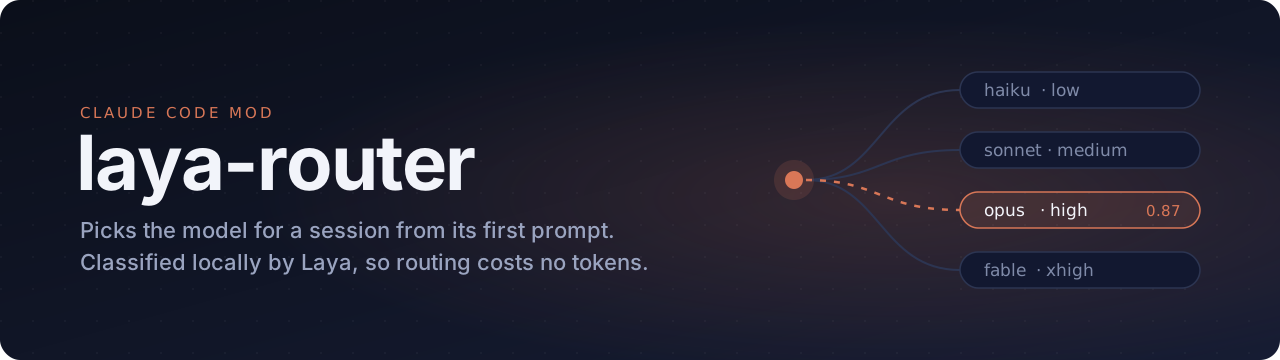
A Claude Code mod that picks the model for a session from its first prompt. Laya classifies the prompt on your own machine through laya-serve, so routing costs no tokens.
| Laya reads the prompt as… | Model | Default effort |
|---|---|---|
| trivial: quick question, translation, rename, typo, version bump | claude-haiku-5-5 |
low |
| routine: new feature, refactor, tests, script, query, email, summary | claude-sonnet-5-5 |
medium |
| hard: subtle bug, flaky test, memory leak, performance regression, architecture, migration plan, security audit | claude-opus-5-5 |
high |
| research: new theory, hypothesis, formal proof, mathematical bound | claude-fable-5-1 (opt-in, enableFable; otherwise Opus) |
xhigh |
How it behaves
- First prompt only. Switching models mid-session drops the prompt cache, so the whole conversation is re-read at full price. The mod routes once and stays on that model. A first prompt under three words, like "hi", says too little to route, so the session stays on
/model. - Skill calls are read by what they do. A first prompt like
/implement-issue 12345is routed once the skill expands, from the typed text plus the first 2000 characters of the skill. Where theskill.prompthook isn't available (e.g. some team or organization accounts), it's routed from the typed text alone. If that text is under three words, like a bare/commit, the session stays on/model. - Main thread only. Subagents keep the model their definition names.
- Falls back to
/model. When Laya's confidence is below 0.475 (0.375 with Fable, since four options spread it thinner), orlaya-serveis unreachable, requests go out unchanged. /modelwins. Change the model by hand after routing and the mod stops overriding for the rest of the session./effortalone doesn't: the mod can't read the session's effort, so it keeps sending the routed one.- The status line shows what happened:
laya → opus 0.87,laya: unsure (0.39), using /model(orlaya: unsure, using /modelfor a prompt too short to send),laya: offline, using /model./modelkeeps showing the session's own model, because a mod rewrites each request and can't set the session's model.
Install
Start laya-serve, e.g. with this repo's compose.yaml:
docker compose up -d --wait # http://localhost:8000
Then, in Claude Code:
/plugin marketplace add marcreichel/laya-router
/plugin install laya-router@laya-router
Install asks for layaUrl (default http://localhost:8000) and an optional layaApiKey, which is sent as a Bearer token.
Fable isn't included in every subscription, so enableFable is off by default. While it's off, Laya chooses between Haiku, Sonnet and Opus only.
Each model's effort is a picker in /config (haikuEffort, sonnetEffort, opusEffort, fableEffort), from low to max. Claude Code lowers a level the model doesn't support.
Develop
claude plugin validate .
claude plugin test .
claude --plugin-dir .
node eval/route.ts   # scores the tier descriptions against a running laya-serve (LAYA_URL)
The thresholds are the lowest that keep about 90% of routed prompts on the expected tier in eval/route.ts. Re-run it after touching hooks/tiers.ts.
Reviews (0)
Sign in to leave a review.
Leave a reviewNo results found