loanword
Health Warn
- License — License: MIT
- Description — Repository has a description
- Active repo — Last push 0 days ago
- Low visibility — Only 5 GitHub stars
Code Pass
- Code scan — Scanned 12 files during light audit, no dangerous patterns found
Permissions Pass
- Permissions — No dangerous permissions requested
No AI report is available for this listing yet.
A Claude Code plugin that turns the words you reach for while working into your own study material. Instead of someone else's word list, you learn the language your real projects speak, and you review it right where you work. Everything stays on your computer. Build your own Quizlet or Duolingo out of your own data.

The words you actually needed




Your own Quizlet, Duolingo and Memrise, on one machine. The drills are the
ones you already know — a flashcard pile, four-choice learn mode, matching, a
graded test, a daily goal, a streak, typed production before anything counts as
learned. The cards are generated from your Claude Code sessions — the words you
actually reached for, in the wording you reached for them. Out of those the
trainer assembles a study plan no one else could be handed: unique to you,
unrepeatable, and impossible to buy.
A Claude Code plugin. It captures the language you reach for while you work,
turns those words into flashcards, and schedules them with FSRS.
- Cards are written by the Claude you already pay for — no API key.
- No server, no account, no telemetry. The trainer binds
127.0.0.1. - One deck per language pair, several capturing at once.
- 35 languages in 13 scripts: Latin, Cyrillic, Greek, Hebrew, Arabic,
Devanagari, Bengali, Thai, Ethiopic, Armenian, Georgian, Han, Hangul.
See it work

Open the trainer — localhost:4747:
- In Claude Code:
/loanword:start - In a terminal:
loanword
How it works
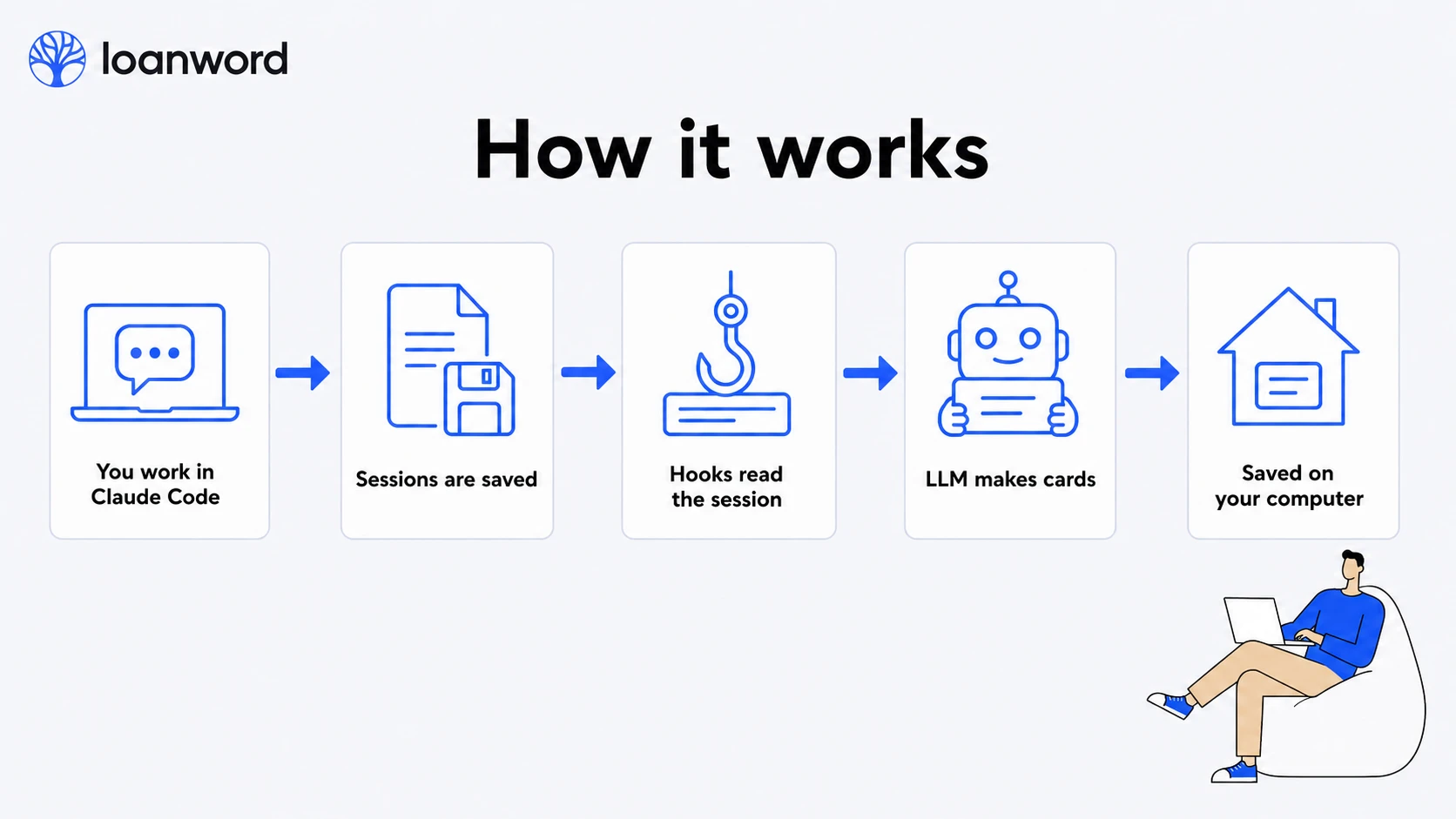
- A
UserPromptSubmithook collects the phrases you reached for. Code, diffs
and tool output are never captured. - At session end Claude turns the queue into cards — word, meaning, example,
CEFR level, category, topic. A gate checks each one and sends the broken
ones back once for repair. - You open the trainer and review. FSRS decides when a card comes back.
Install
/plugin marketplace add MarcSky/loanword
/plugin install loanword
Asks for your native language, the language you are learning and the capture
mode. Needs Node 22.13 or newer.
Inside Claude Code
| Command | What it does |
|---|---|
/loanword:start |
Opens the trainer at localhost:4747 |
/loanword:stats |
Progress: learned, streak, hardest words |
/loanword:ticker |
Claude Code widget with flashcards in the status line under your prompt |
No build command. The Overview says how many records are waiting, and Build
now opens the list first: one row per captured phrase, per language, so you
throw away what you already know before it costs a model call. Turn on Make
cards automatically in Settings if you would rather a session ending with ten
or more records build them by itself. loanword build forces it, and the very
first run — an empty deck with a full queue — builds without asking so the
trainer has something to show.
Ticker

/loanword:ticker puts the open deck into Claude Code's status line: one card
under the prompt, weakest first, a new one every ticker_every seconds. You
watch the words you actually reached for go by while Claude works — no tab to
open, no session to start. /loanword:ticker off takes it back out.
The trainer
Six screens, served off disk, no build step, no framework, no network.
| Screen | What it holds |
|---|---|
| Overview | What is due, the daily-goal ring, categories, eight weeks of rhythm, the build queue |
| Practice | Flashcards, Learn mode, and a graded Test — none of them touch the FSRS schedule |
| Deck | Search, filters, edit in place, star, remove with undo; Chapters groups by category and topic |
| Study | A planned session; a new card is shown once with both sides, then returns as a typed question |
| Analytics | Your review log, a table behind every chart, Markdown or CSV export |
| Settings | Languages, categories, capture, study, appearance, your data |
Many languages at once
- One queue per language —
queue.<code>.jsonl, all appended in the same
hook pass, so two languages cost the same keystrokes as one. - One switch per language — Settings → Collect words for pauses a language
without deleting its deck or schedule. - One schedule per deck — studying
en → denever moves a card inen → es. - Builds run side by side — one lane per target;
loanword build --target=kanarrows it to one. - Decks seed each other — Sync copies the concepts you already learned and
asks the builder for the new side. The schedule is never copied. - Offline speech only — the browser's local voices, then Piper, macOS
sayor eSpeak NG.loanword speech --lang=kaprints the one command that
fetches a voice.
Interface language is separate from the pair you learn: English, Spanish,
French, Portuguese, Russian, Hindi and Chinese ship in the box — seeui/i18n/README.md to add one.
Your level
One CEFR estimate per deck, Elo over the first graded answer to each card.
No model call, no placement test. A band is named after a hundred first
answers, never above the hardest band the deck has tested ten times. A floor
set in Settings beats the arithmetic.
What the cards cost
claude -pon this machine, as a bare completion: no tools, no project
context, no session history.- Sonnet writes cards by default; Haiku and Opus are in Settings. Filing always
runs on Haiku. - The Claude subscription you are already signed into pays for it. Settings →
Use my API key takes an Anthropic key instead; it is kept beside your deck
insettings.json, and the trainer only ever shows its first and last
characters. - Every call's tokens and cost are logged, per model, over 1, 7 or 30 days.
- Nothing is asked twice: only cards the gate marked go back, one call a batch.
- A call over
MAX_CALL_USD(3, orLOANWORD_MAX_CALL_USD) halves its batch
instead of retrying.scripts/tune.mjsanswers a failure with one change and
remembers what worked intuning.json.
Two hooks, and nothing else
| Hook | Runs | Budget |
|---|---|---|
UserPromptSubmit |
scripts/capture.mjs --source=prompt |
10 s |
SessionEnd |
scripts/capture.mjs --source=session |
30 s |
Declared in hooks/hooks.json. The prompt hook scrubs
secrets, splits the text against the stop-list and a snapshot of what you know,
and appends one line per active language — it never opens SQLite. At session
end only candidate words are taken from the assistant's replies, never the
sentences, and tool results and code blocks are skipped. A queue over 4 MB
stops accepting until loanword build drains it.
Privacy
- Data lives in
~/.claude/plugins/data/loanword*, orCLAUDE_PLUGIN_DATA. - Code, diffs and tool output are never captured.
- Secrets are stripped before anything is written
(scripts/scrub.mjs); removed text leaves a▮. - To keep client repositories out: install at
userscope andclaude plugin disable loanwordwhere it does not belong, or setmode: active.
Found a leak in queue.jsonl? That is a P0 — report it privately, see
SECURITY.md.
Settings
Set at install time, changeable from the trainer. Stored in settings.json in
the plugin data directory; the stored value wins.
| Option | Default | Meaning |
|---|---|---|
native_lang |
es |
The language you write prompts in |
target_lang |
en |
The language you are learning |
mode |
both |
active: your prompts; passive: assistant replies |
daily_limit |
15 |
New cards per day, 3 to 100. Reviews are never capped |
auto_build |
false |
Build cards when a session ends, without asking |
level |
— | A1…C2: words below this level never become cards |
peek |
false |
Print one card into the session while you wait for an answer |
peek_pick |
— | Which cards may appear: starred, slipping, leech, new, and any CEFR levels |
peek_every |
15 |
Minutes between those cards, 1 to 120 |
ticker_every |
30 |
Seconds a word stays in the status line, 5 to 300 |
node scripts/store.mjs config # effective settings
Language detection is local: different scripts by script, same-script pairs by
a function-word vote, Japanese and Chinese by kana, inscripts/lang.mjs. Writing systems without spaces are
queued as short sentences rather than split into words.
The loanword command
npm link # once, from the plugin folder; puts `loanword` on PATH
| Command | What it does |
|---|---|
loanword |
Serves the trainer and opens the browser |
loanword stop |
Closes it and releases the port |
loanword build |
Turns the queue into cards now |
loanword build --target=ka |
Builds one language instead of all of them |
loanword clone --from=en --to=ka |
Queues the concepts of one deck for another |
loanword vet |
Which cards break the lexis rules; --apply repairs them |
loanword speech --lang=ka |
Says which offline voice would speak, and how to get one |
loanword peek |
Prints one card the way the hook does; --pick=starred,B1 narrows it |
loanword tidy |
Lists migrated leftovers and old backups; --remove deletes them |
loanword migrate |
Moves a JSONL deck into SQLite; --dry-run shows what would happen |
loanword --stats |
Progress as JSON, for scripts |
loanword --where |
Which plugin copy and which deck it reads |
| Flag | Meaning |
|---|---|
--no-open |
Do not open the browser |
--host=lan |
Bind every interface and print a URL with a one-off token. Without it, loopback only |
--idle=<minutes> |
Close after that long without a request. Default 30, 0 never. LOANWORD_IDLE_MINUTES sets the same thing |
LOANWORD_PORT=<port> |
Move off 4747 |
NO_COLOR=1 |
Plain startup banner |
Ctrl+C, SIGTERM or loanword stop close it cleanly: connections finished,
database closed, port released.
Export to Anki
The Export to Anki button in Settings downloads a CSV, and every build
writes export/loanword.csv into the data directory.
- Anki → File → Import
- Field separator: semicolon
; - Fields in order:
front,back,reading,example,tags - Treat the first line as a header
Tags look like loanword lang:en from:es cefr:B1 cat:process type:word topic:code_review, plus project:<repo> when the card knows where it was met.
Stop-lists
Words from the stop-list never become cards. Every language in the picker ships
with one, in data/freq/ — see the
README there for where they came from and how to swap in
a counted frequency list.
Development
npm ci
npm test                             # unit, storage, migration, analytics, HTTP
npm run test:perf                    # 50k cards, 500k reviews, against the budget
npm run i18n                         # dictionaries complete and well-formed
npm run tokens                       # export the palette as design tokens
npm run icons                        # regenerate ui/icons.svg from the Phosphor map
npm run vendor                       # regenerate ui/vendor/ from node_modules
npm run stem                         # regenerate the Snowball stemmers
claude plugin validate . --strict
See CONTRIBUTING.md before opening a pull request.
Storage is one SQLite file, loanword.db. Copy it while the trainer is closed
and you have a backup. Older decks migrate themselves on first start;node scripts/migrate.mjs --rollback puts the old files back. Schema changes go
through the numbered ladder in scripts/db.mjs: the deck is
copied into backup/ first, and every step is its own transaction.
Assets are vendored so the trainer works with zero network:
Phosphor icons (MIT) in ui/icons.svg,
General Sans by Indian Type Foundry
(ITF Free Font License) in ui/fonts/, and three
Web Awesome components (MIT) in ui/vendor/.
MIT.
Reviews (0)
Sign in to leave a review.
Leave a reviewNo results found