Task-Scheduler-Studio
Health Warn
- License — License: MIT
- Description — Repository has a description
- Active repo — Last push 0 days ago
- Low visibility — Only 7 GitHub stars
Code Pass
- Code scan — Scanned 1 files during light audit, no dangerous patterns found
Permissions Pass
- Permissions — No dangerous permissions requested
No AI report is available for this listing yet.
A modern, Fluent WinUI 3 reimagining of Windows Task Scheduler, with natural-language task creation and a local MCP server for AI agents.
Task Scheduler Studio
A modern, Fluent WinUI 3 reimagining of Windows Task Scheduler, with natural-language task creation and a local MCP server for AI agents.
Overview • Solution layout • Script library • Build & run • MCP server • License
Overview
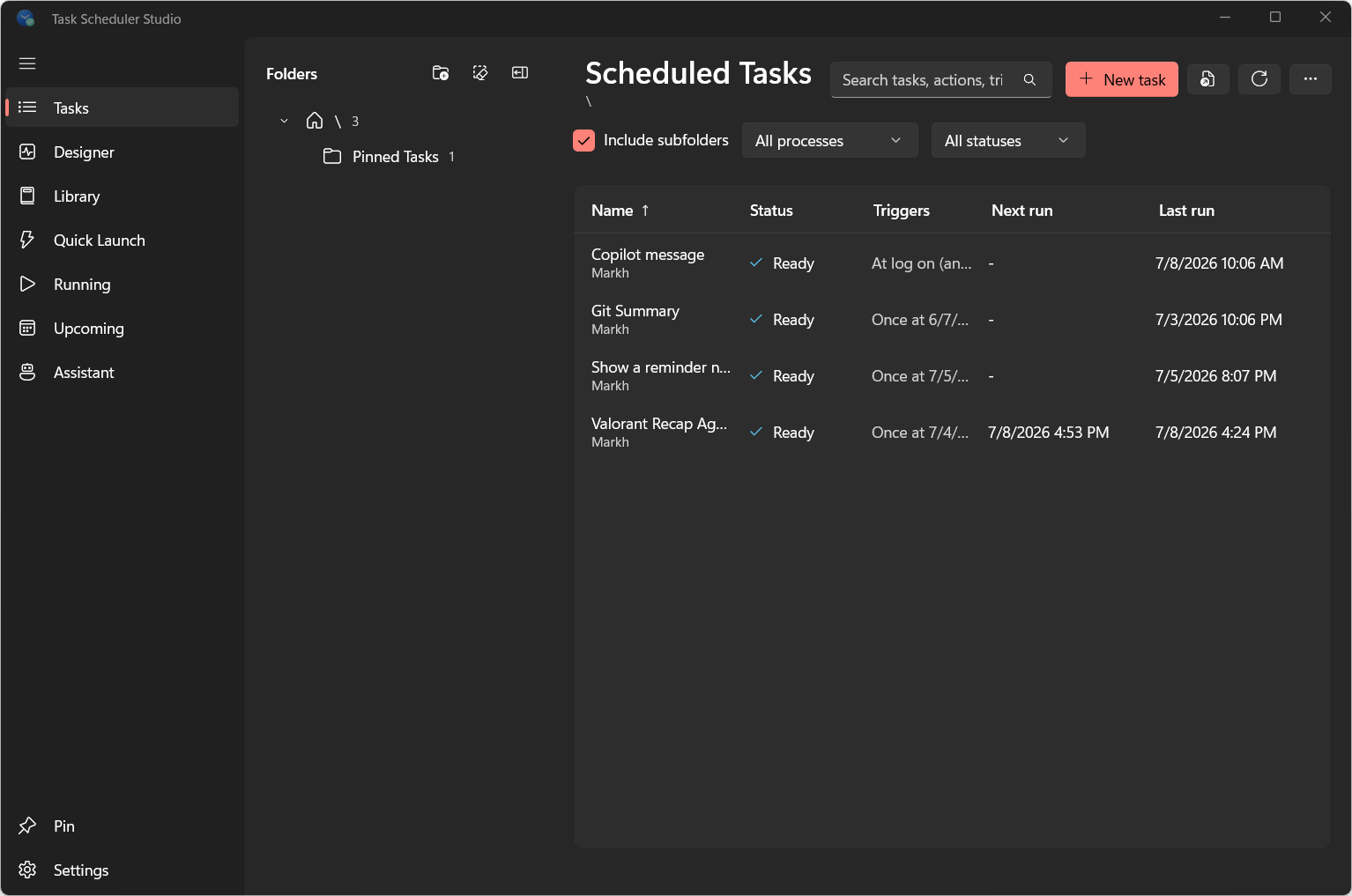
Task Scheduler Studio is a modern WinUI 3 reimagining of the built-in Windows Task Scheduler. It reads and writes the live Windows Task Scheduler store through the Task Scheduler V2 COM API, so everything you create is a normal scheduled task: visible in taskschd.msc, queryable with schtasks, and fully interoperable with the built-in tool. There is no separate database — create a task in either tool and it appears, runs, and edits identically in the other.
The app pairs that engine with a clean Fluent interface and, optionally, AI. A built-in GitHub Copilot assistant lets you create and manage tasks in plain English, and a bundled local MCP server exposes the same engine to your favorite AI agents, so both the UI and agents always behave identically.
Disclaimer: Task Scheduler Studio was created by a Microsoft employee as an individual personal
project and proof of concept. It is not an official Microsoft product, service, or offering,
and it is not affiliated with, endorsed by, or supported by Microsoft. All work and opinions
are the developer's own.
This project was built with the help of AI coding tools (GitHub Copilot).
Why it's cross‑compatible
Task Scheduler Studio talks to the Task Scheduler V2 COM API (Schedule.Service) through the matureMicrosoft.Win32.TaskScheduler managed wrapper. That is the same API and the same task store
the built‑in Task Scheduler uses — there is no separate database. Anything Task Scheduler Studio creates is
a normal scheduled task: visible in taskschd.msc, queryable with schtasks, and backed by the
standard Task Scheduler XML interchange format (Import/Export compatible).
Solution layout
| Project | Type | Purpose |
|---|---|---|
Tasker.Core |
class library | The single source of truth: TaskerService wraps the COM API and exposes serializable DTOs (folders, tasks, triggers, actions, settings). |
Tasker.App |
WinUI 3 app | The desktop UI — folder tree, searchable task table, rich detail pane, a tabbed create/edit editor with a raw‑XML escape hatch, and a natural‑language Copilot assistant. |
Tasker.Mcp |
console app | A local stdio MCP server exposing the same engine to agents. |
Because the UI and the MCP server both call into Tasker.Core, they always behave identically.
Script library
The Library page offers ~20 ready-made, safe PowerShell automation scripts (cleanup, backup,
maintenance, monitoring, and system tasks) plus your own saved scripts. Each built-in script opens with
a clearly-commented settings block for easy tweaks, exposed as friendly inputs in the preview. When
you pick Create task, the (possibly edited) script is written to a real .ps1 under%LOCALAPPDATA%\WindowsTasker\scripts and handed to the visual Designer as a pre-built action, so
you just choose a schedule. You can also add a script mid-flow from the Designer's Add action →
From script library.
- Safe by design: deletions of your files go to the Recycle Bin; only transient caches/temp are
hard-deleted (scoped, best-effort). Every script runs-NoProfile -ExecutionPolicy Bypassand is
shown for review before a task is created. Scripts that need elevation are flagged and switch on
"Run with highest privileges". - Notifications: the reminder and low-disk-space scripts raise real Windows 11 toasts without
installing a module or registering an app (they borrow Task Scheduler Studio's own AUMID, falling back
to File Explorer's). - Your own scripts: create, edit, duplicate (from a built-in), and delete your scripts; they are
stored as JSON at%LOCALAPPDATA%\WindowsTasker\script-library.json.
Create tasks with natural language (GitHub Copilot SDK)
The Assistant page embeds the official GitHub Copilot SDK
(GitHub.Copilot.SDK). Describe what you want in plain English — "run backup.cmd every weekday at
6pm" — and the Copilot agent runs a guided flow: it asks for anything that's missing (name, the
program to run, the schedule), confirms, then calls the Task Scheduler Studio tools (create_task,create_task_from_xml, list_folders, list_tasks) — the same tools the MCP server exposes,
backed by the shared engine — to write the task into the live Windows store.
- Authentication: click Sign in with GitHub on the Assistant page — it uses the GitHub CLI
(gh) to authenticate interactively, reusing an existingghsession when present or opening the
GitHub web sign-in otherwise. You can also paste a GitHub token, or just start chatting to use your
existing Copilot session. A Copilot subscription is required. - Locked down: the assistant is hardened on multiple layers — a dedicated AGENTS.md and
system prompt restrict it to scheduled-task work, and a strict permission handler allows ONLY
the Task Scheduler Studio task tools to execute, rejecting shell, file, web, memory and every other
built-in capability (verified: a jailbreak prompt asking it to run a shell command was refused and
nothing happened). Tool inputs are validated, and destructive actions require confirmation. - Suggested prompts: quick chips like Scan tasks for red flags (runs
analyze_taskover your
tasks and reports evidence-based findings), What runs at startup?, and Run Notepad daily.
Build & run
Prerequisites: Windows 10 1903+, .NET 10 SDK, Developer Mode, and the winapp CLI
(winget install Microsoft.WinAppCli).
# Build everything
dotnet build WinTaskScheduler.slnx -c Debug

# Run the desktop app (uses the WinUI dev workflow helper)
cd Tasker.App
./BuildAndRun.ps1          # or: winapp run <build-output-folder>
Elevation: Creating tasks that Run with highest privileges, or editing protected system
tasks under\Microsoft\Windows\…, requires running Task Scheduler Studio (or the MCP server) as
administrator — exactly like the built‑in tool. Everyday per‑user tasks work without elevation.
The MCP server
Tasker.Mcp speaks the Model Context Protocol over stdio (newline‑delimited JSON‑RPC 2.0).
Tools
| Tool | Description |
|---|---|
list_folders |
The Task Scheduler folder tree with task counts. |
list_tasks |
Tasks in a folder (optionally recursive / filtered) with state, next/last run, result, and trigger/action summaries. |
get_task |
Full definition of one task incl. raw XML. |
export_task_xml |
Portable Task Scheduler XML for a task. |
analyze_task |
Grounded, evidence-based assessment of a task — a risk level plus findings that each cite the exact command/trigger/principal/setting they're based on (e.g. encoded PowerShell, download-and-run, runs from a user-writable path, hidden+elevated+autostart). |
run_task / stop_task |
Start / end a task on demand. |
enable_task / disable_task |
Toggle a task. |
delete_task |
Permanently delete a task. |
get_running_tasks |
Currently running instances (with engine PID). |
create_task |
Create or update a task from structured triggers+actions or raw xml. |
Register it with an MCP client
Easiest: open the app's About page and click Install for Copilot CLI or Install for
VS Code — each merges a wintask-scheduler entry into the right config file (preserving anything
already there) pointing at the bundled server. Restart the CLI/editor afterward.
To do it manually, set the MCP client's launch command. When the app is installed (from the
Microsoft Store or an MSIX package) it registers a stable app-execution alias, so the command is
simply WinTaskSchedulerMcp.exe — Windows resolves it from %LOCALAPPDATA%\Microsoft\WindowsApps
(on PATH) to the installed server, and it keeps working across app updates regardless of install
location. For an unpackaged dev run, use the absolute path to the built Tasker.Mcp.exe.
GitHub Copilot CLI — ~/.copilot/mcp-config.json:
{
  "mcpServers": {
    "wintask-scheduler": {
      "type": "stdio",
      "command": "WinTaskSchedulerMcp.exe",
      "args": [],
      "tools": []
    }
  }
}
The one-click installers write this alias automatically. For an unpackaged dev build, replace the
command with the absolute path to the built server, e.g.Tasker.App\bin\x64\Debug\net10.0-windows10.0.26100.0\win-x64\mcp\Tasker.Mcp.exe.
VS Code (Agent mode) — %APPDATA%\Code\User\mcp.json (or per-workspace .vscode/mcp.json):
{
  "servers": {
    "wintask-scheduler": {
      "type": "stdio",
      "command": "WinTaskSchedulerMcp.exe",
      "args": []
    }
  }
}
Generic / other clients — any MCP host that launches a local stdio server works:
{
  "mcpServers": {
    "wintask-scheduler": {
      "command": "dotnet",
      "args": ["run", "--project", "D:\\Windows Tasker\\Tasker.Mcp\\Tasker.Mcp.csproj", "-c", "Debug"]
    }
  }
}
Example agent call
// tools/call create_task
{
  "name": "Nightly backup",
  "folder": "\\MyApps",
  "description": "Runs the backup script every night",
  "principal": { "runWithHighestPrivileges": false },
  "triggers": [
    { "kind": "daily", "startBoundary": "2026-01-01T02:00:00", "daysInterval": 1 }
  ],
  "actions": [
    { "command": "C:\\Scripts\\backup.cmd", "arguments": "--full" }
  ]
}
The structured editor and create_task understand the common trigger kinds (oneTime, daily,weekly, monthly, atStartup, atLogOn, onIdle). For anything else — event triggers, COM
handler actions, exotic settings — pass full raw XML (UI: Advanced tab; MCP: the xml field),
which is registered verbatim for 100% fidelity.
Quality-of-life extras (beyond the built-in Task Scheduler)
- Natural-language task creation & management via the Copilot assistant — it can also run,
enable/disable, delete, and answer questions about your tasks ("what runs at startup?"). - Run History — per-task event log (from
Microsoft-Windows-TaskScheduler/Operational) in the
detail pane. - Folder picker when creating/editing, plus create/delete folders from the tree toolbar.
- Duplicate task, and templates ("New task" ▾) for common recipes.
- Sortable columns (click a header) and live search across name, action, trigger, author.
- Multi-select bulk actions — run / enable / disable / delete several tasks at once.
- Rich trigger editor — one-time, daily, weekly, monthly (by day), monthly (by day-of-week),
at startup, at logon, on idle, on an event, on session state change, plus repetition and expiry. - Run as a different user — interactive, stored-password, S4U, or SYSTEM.
- Backup / restore a whole folder of tasks as a zip of XML.
- Upcoming runs view (everything sorted by next run time) and toast notifications when a
task you started finishes. - Restart as administrator for elevated operations; auto-refresh when the assistant changes
tasks; markdown-rendered assistant replies. - Appearance (About page) — switch the window backdrop (Mica Alt · Mica · Acrylic) and the
theme (System · Light · Dark); choices persist across restarts. - Resizable details pane — drag the splitter on the Tasks page to grow the inspection/XML area.
Tests
ui-tests.ps1 drives the running app through winapp ui automation (navigation, the editor, an
end‑to‑end create verified against schtasks, and an AutomationId accessibility audit):
./ui-tests.ps1 -AppPid <pid-of-running-app>
License
Task Scheduler Studio's own source code is released under the MIT License — seeLICENSE. It depends only on permissive (MIT) libraries plus the
Microsoft Windows App SDK / Windows SDK build tools, which Microsoft's license
terms allow redistributing inside applications you build. Third-party components
and their licenses are listed in THIRD-PARTY-NOTICES.md.
Privacy
The app runs locally and the developer collects no personal data. Optional
features (the GitHub Copilot assistant and GitHub sign-in) send data only to
GitHub when you choose to use them. See PRIVACY.md for the full
privacy policy.
Reviews (0)
Sign in to leave a review.
Leave a reviewNo results found