predictorlab
Health Pass
- License — License: MIT
- Description — Repository has a description
- Active repo — Last push 0 days ago
- Community trust — 67 GitHub stars
Code Pass
- Code scan — Scanned 12 files during light audit, no dangerous patterns found
Permissions Pass
- Permissions — No dangerous permissions requested
No AI report is available for this listing yet.
Self-hosted tabular ML that doesn't lie. Leakage Guard, conformal intervals, profit-optimized thresholds, counterfactuals & instant REST/MCP API.
PredictorLab
English | Русский









Upload your data. Say what you want to predict. Get an honest model with a confidence interval,
a profit-optimized threshold, and a REST API — in 5 minutes.
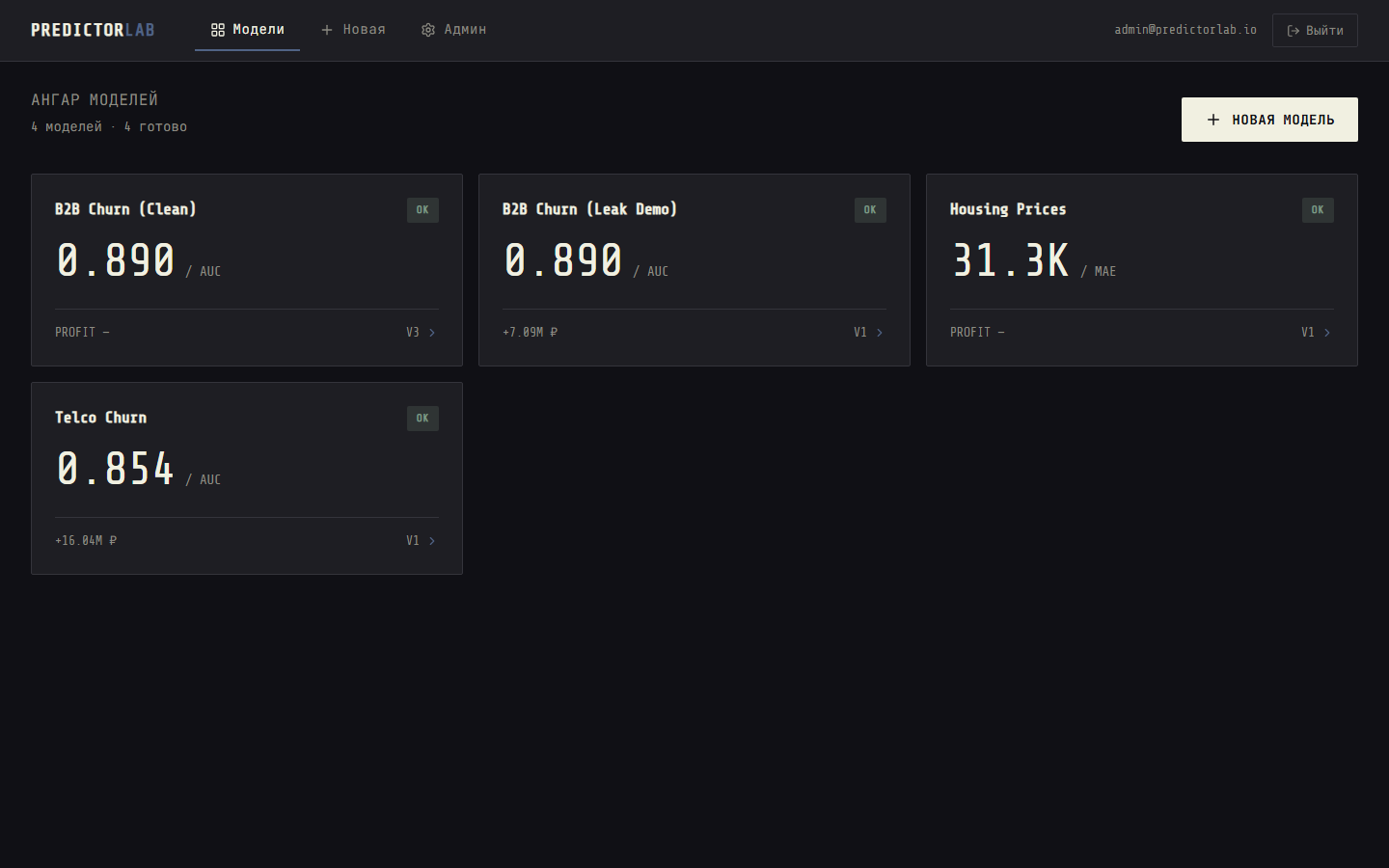
PredictorLab is self-hosted tabular ML for analysts who need ML but don't have a DS team.
You know your data, you know your business costs — PredictorLab handles the ML: catches leakage,
splits correctly, calibrates probabilities, and converts them into decisions in rubles.
Spoiler: the model that shows 99% accuracy on your first upload is almost certainly broken.
This tool will tell you exactly why — and fix it for you.
Who this is for
| You are | You have | PredictorLab gives you |
|---|---|---|
| Analyst / product manager | A CSV with historical outcomes, business intuition about costs | A working ML model without learning scikit-learn. The tool asks the right questions (What's a false negative worth? Which features can you actually change?) and turns answers into a decision system |
| Consultant / data engineer | Clients with data, no time to hand-hold | A self-hosted tool you can deploy for a client in 5 minutes, share a prediction form, and hand over an API. No SaaS dependency, no data leaving the client's server |
| Solo DS practitioner | ML knowledge, but no time to build the full pipeline | The boring parts are done: out-of-time splits, conformal intervals, calibration, monitoring, versioning. You focus on features and business logic |
What you need: a dataset with a labeled outcome column, and rough numbers for what a correct
prediction earns vs what a wrong one costs. That's it.
What you don't need: Python, scikit-learn, or a DS degree. But if you have them — the REST API
and MCP server give you full programmatic control.
The Problem
I've watched this scenario play out dozens of times:
- A business team uploads a customer churn dataset to a mass-market "no-code ML" tool
- They get ROC-AUC 0.98 — everybody celebrates
- The model goes to production, predicts nothing useful, and dies quietly
The 0.98 was never real. The dataset had a cancel_date column — filled in only after a customer
had already churned. The model learned to read the future, not to predict it. Mass-market no-code
tools don't block on this — at best they show a yellow warning that nobody clicks.
Enterprise tools like DataRobot do detect leakage, but they cost $$$ and require an implementation team.
The second problem is even more insidious: even with a "good" model, business people get
probabilities — not decisions. "This customer has a 73% churn probability." Great. What do I do
with that? Call them? Offer a discount? The tool never says, because the tool doesn't know
what a phone call costs or what a saved customer is worth.
PredictorLab solves both — in the gap between "too simple to trust" and "too expensive to buy":
| Problem | Mass-market no-code tools | Enterprise (DataRobot) | PredictorLab |
|---|---|---|---|
| Target leakage | Yellow warning icon (nobody clicks) | Detects it, requires setup | BLOCK verdict with explanation in plain language + one-click "Exclude and retrain" |
| Random split on time-series data | Random split → contamination | Configurable, manual setup | Automatic out-of-time split when a date column exists |
| Bare probability, no uncertainty | "73% churn" (and then what?) | Confidence intervals (model-specific) | Conformal interval with coverage guarantee + OOD flag |
| Threshold at 0.5 or by F1 | "Here's your AUC" | Configurable, manual tuning | Cost matrix → profit-maximizing threshold: "At 0.27, treating top-500 customers nets +84,000₽/month" |
| No actionable next step | SHAP values in a chart | Good, but $$$ | Counterfactuals: "Reduce discount by 5% → probability drops 0.81→0.31, ROI: 21,400₽" |
| Dead model after training | One-and-done | Built-in monitoring | PSI drift + live metrics + webhooks + one-click retrain |
| Price | $99/mo SaaS, data leaves your server | $50k+/year, needs a team | MIT, self-hosted, Docker |
How it looks
Leakage Guard in action — the killer feature. Upload the leaky demo dataset, and the system
doesn't just warn — it refuses to show results and tells you what to do:
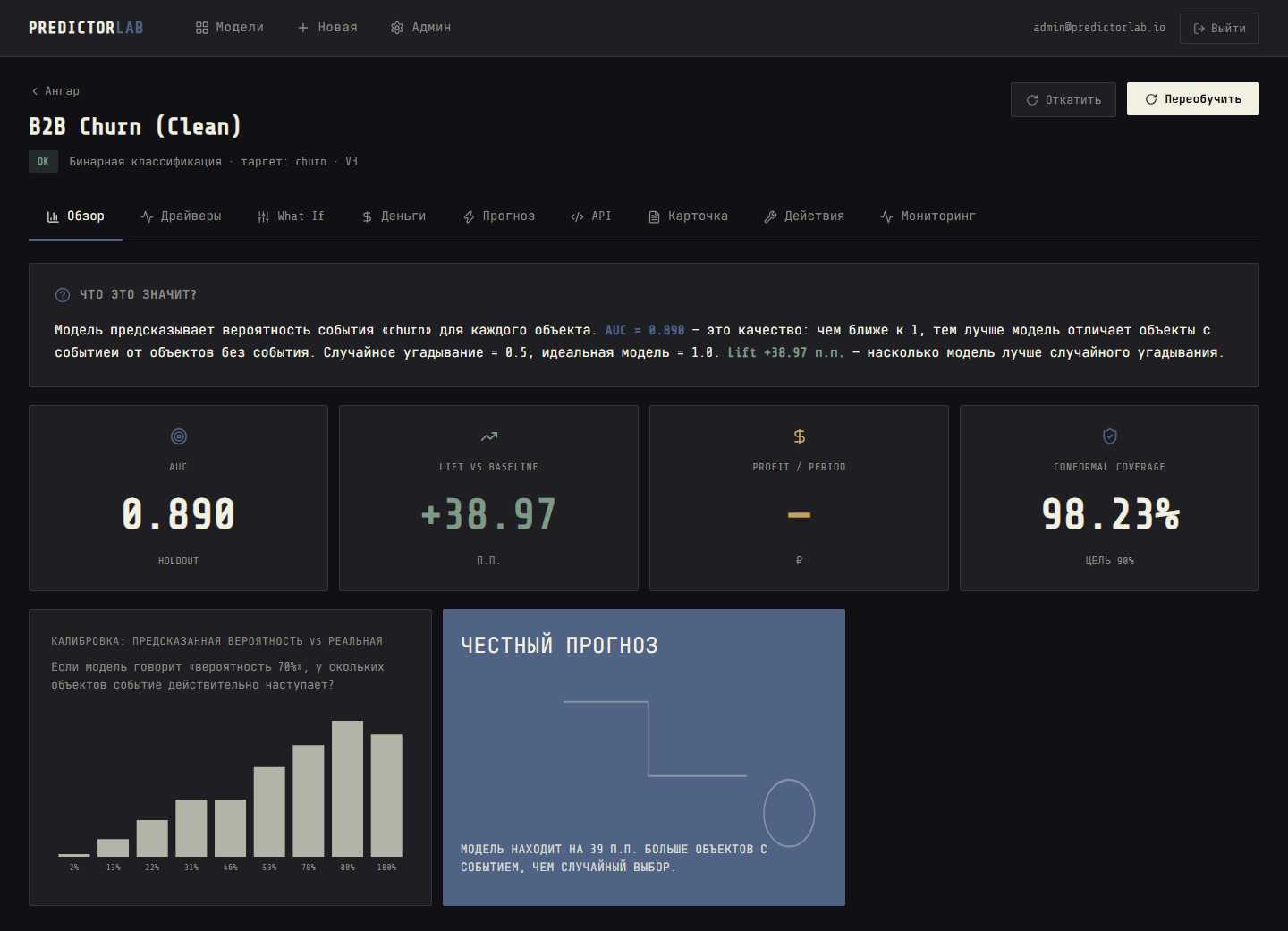
The "What does this mean?" block explains AUC, lift, and conformal coverage in business terms — not jargon.
Training panel — real-time SSE progress, 7 stages with descriptions, live leaderboard, elapsed/remaining time:
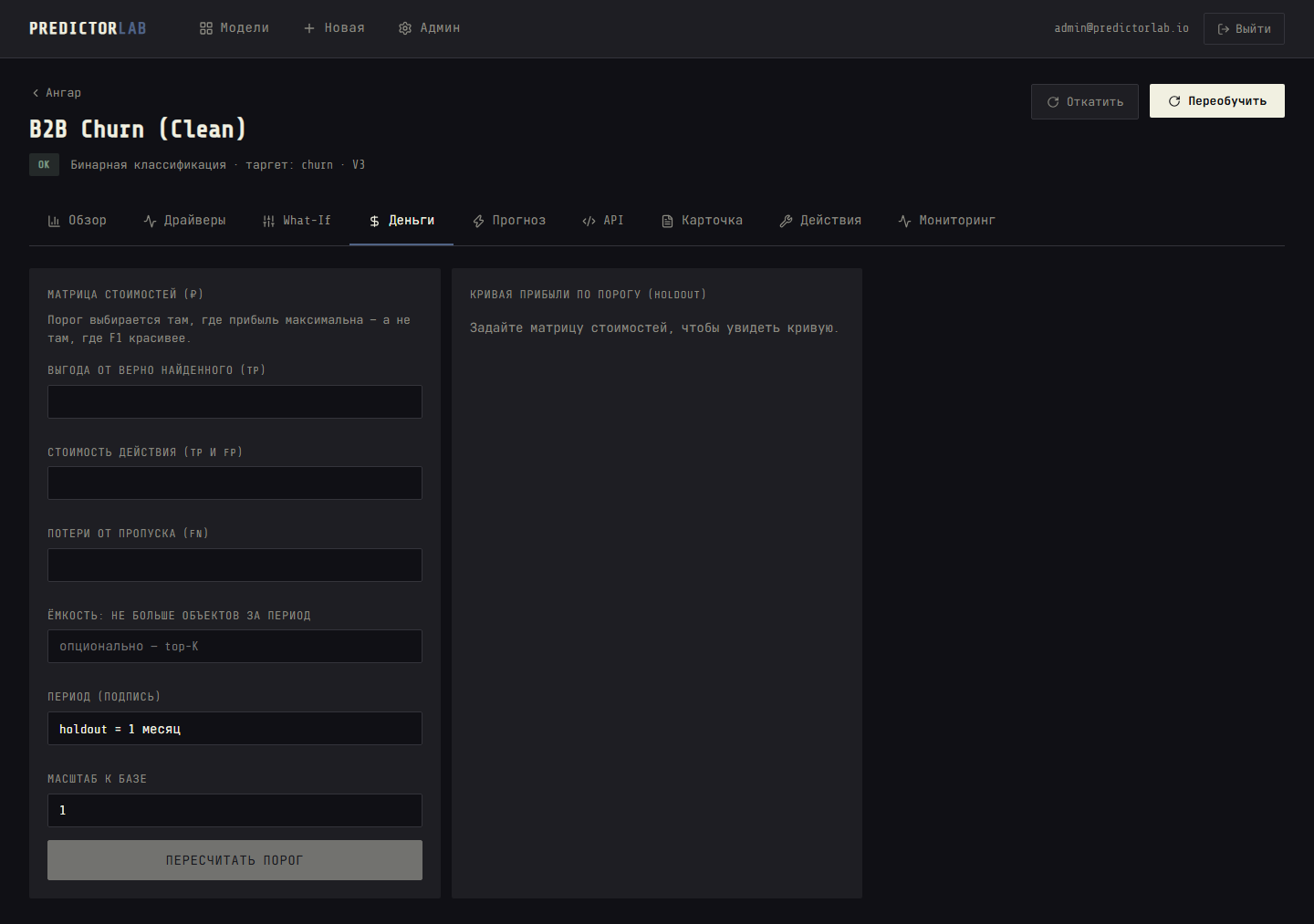
Profit optimization — the threshold is set where your money is maximized, not where F1 looks pretty:
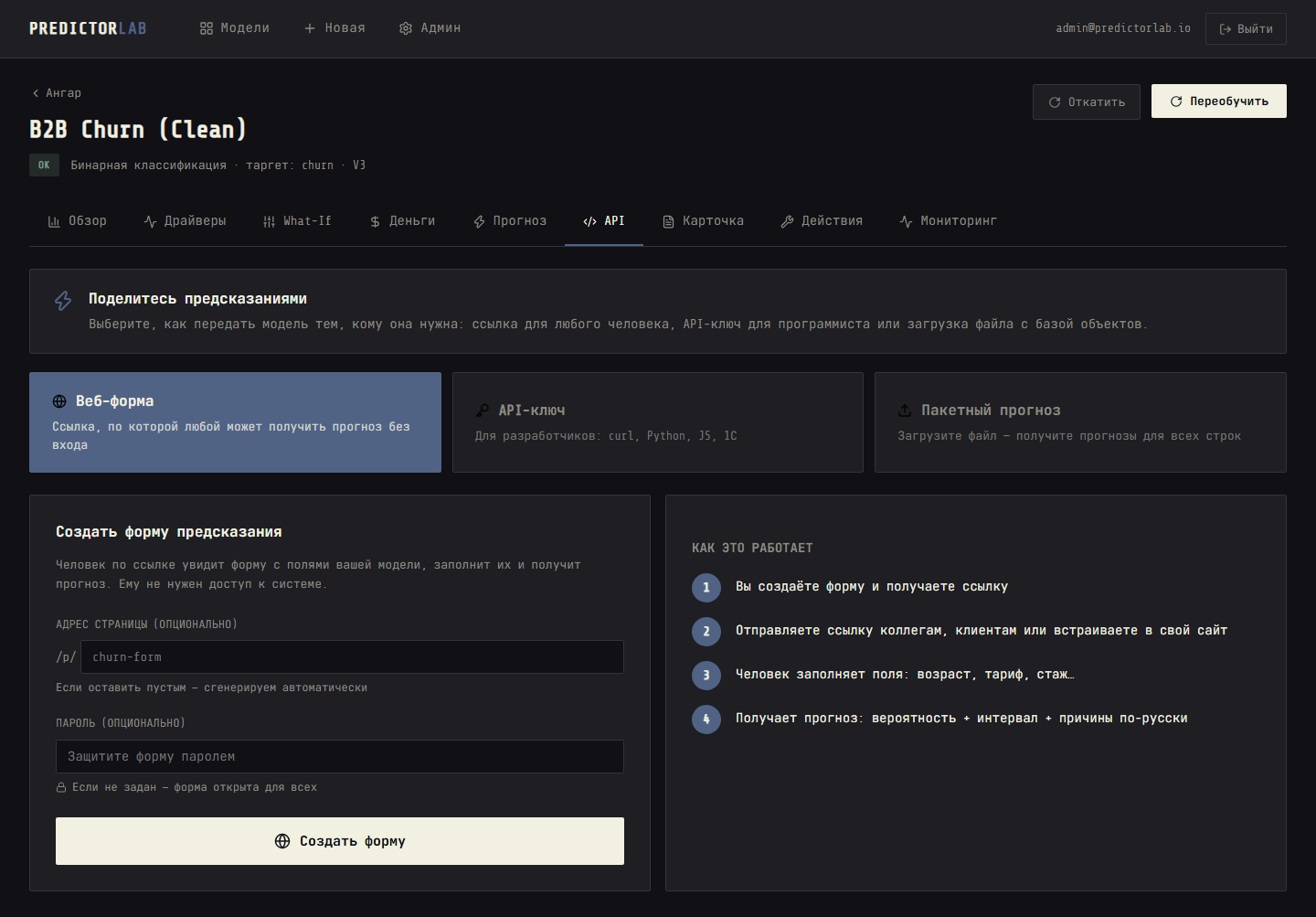
Sharing predictions — three ways, each one click. Web form for non-technical users, API key for developers, batch for processing your entire customer base:
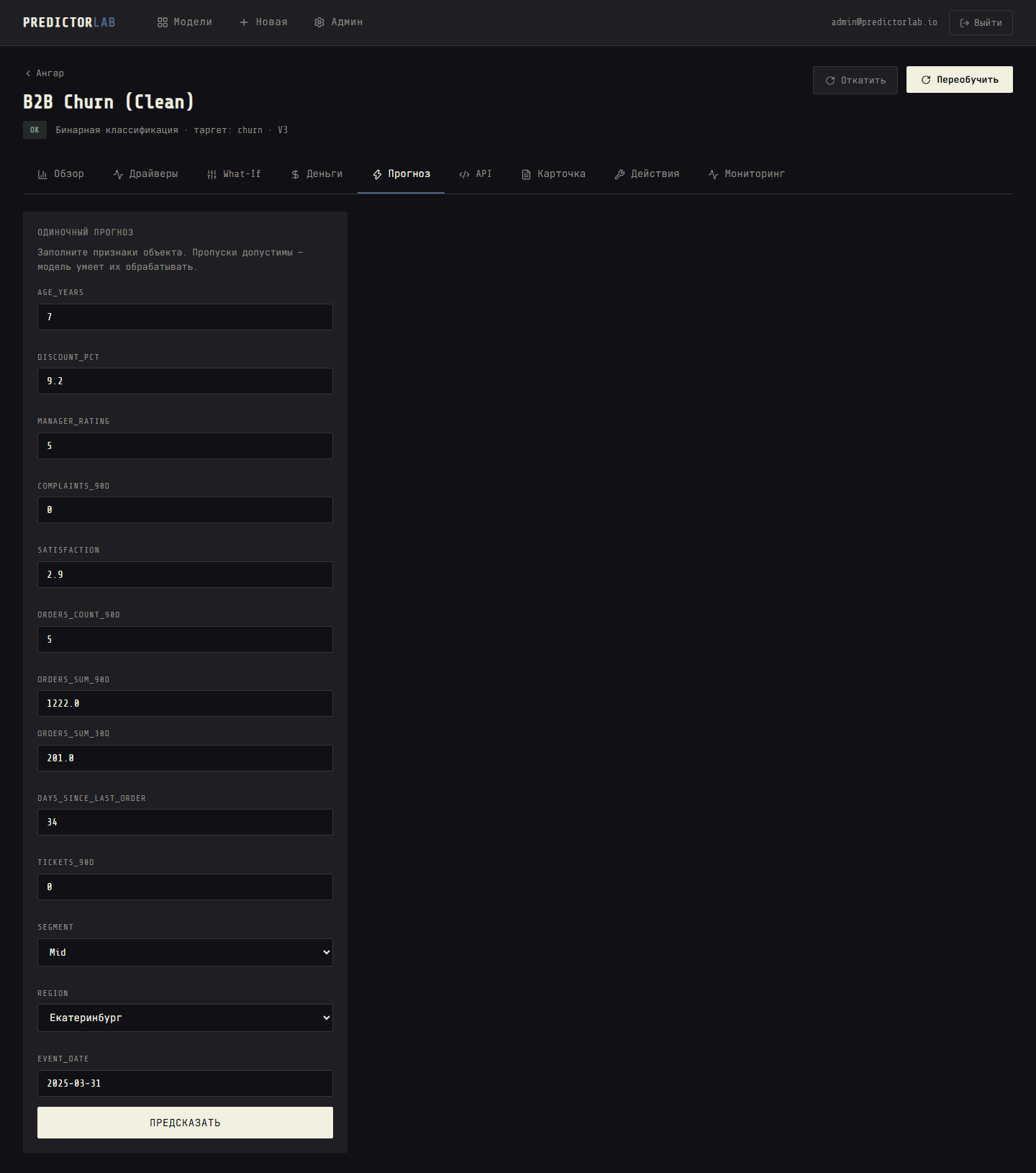
Single prediction — probability, conformal interval, reasons in plain language, OOD flag:
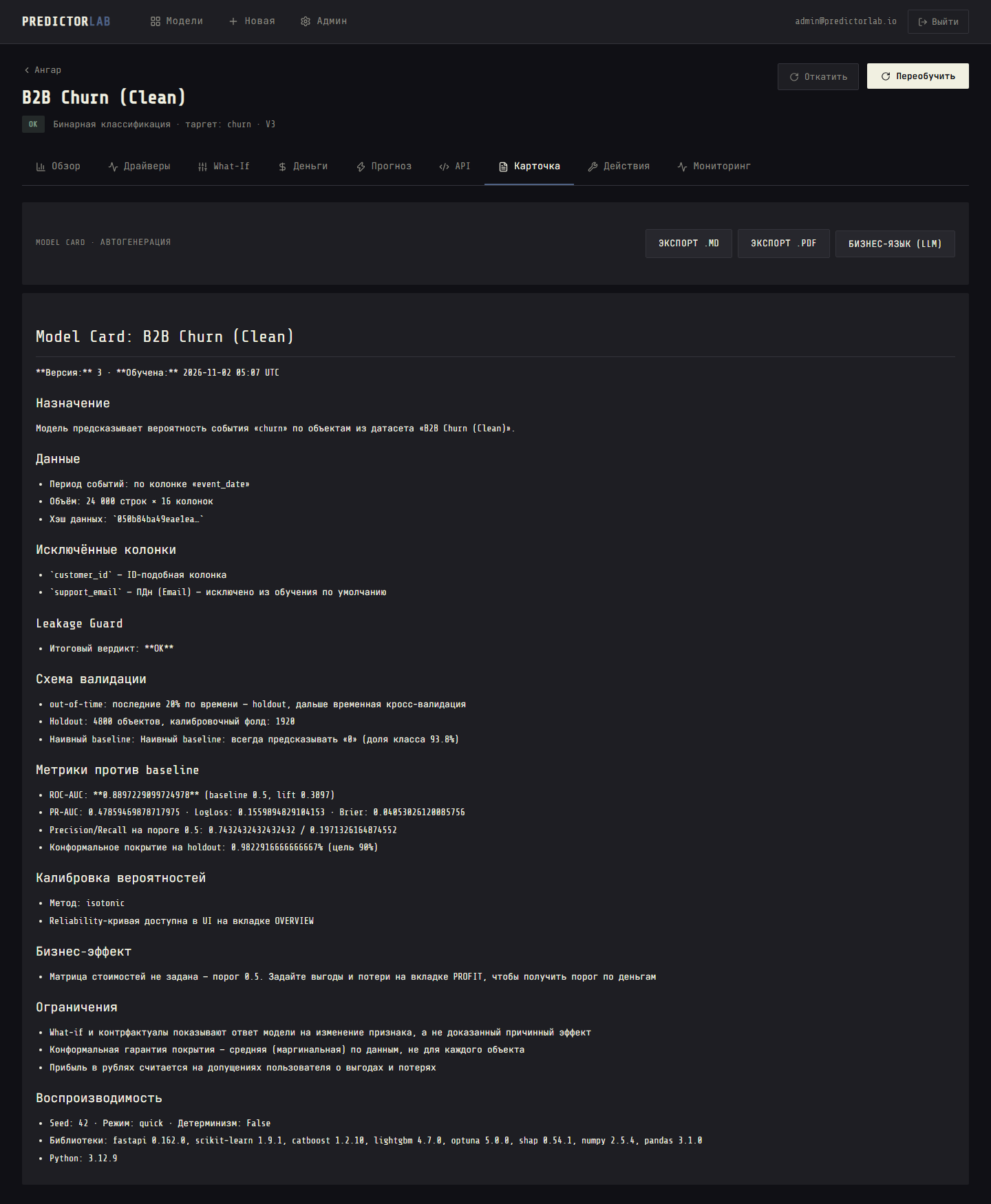
Model Card — auto-generated with leakage report, assumptions, limitations. Exportable to Markdown and PDF:
How it works
  ┌────────────────── Web Interface ──────────────────┐
  │  React UI ←SSE→ FastAPI + asyncio jobs + ProcessPool │
  │         │                                          │
  │         │   ┌─────── REST API :8000 ────────┐      │
  │         │   │  /api/v1/models/{id}/predict  │      │
  │         │   │  /api/v1/models/{id}/whatif   │      │
  │         │   │  /api/v1/jobs/{id}            │      │
  │         │   └───────────────────────────────┘      │
  │         │                                          │
  │         │   ┌─────── MCP Server :8100 ──────┐      │
  │         │   │  predict, explain, what_if,   │      │
  │         │   │  counterfactual, model_card   │      │
  │         │   └───────────────────────────────┘      │
  │         │                                          │
  │         ▼                                          │
  │  ┌─── Core Pipeline ──────────────────────────┐    │
  │  │                                            │    │
  │  │  CSV/XLSX/Parquet ← PII scanner            │    │
  │  │       ↓                                    │    │
  │  │  Feature Builder (point-in-time SQL)       │    │
  │  │       ↓                                    │    │
  │  │  Leakage Guard (9 deterministic checks)    │    │
  │  │       ↓                                    │    │
  │  │  Splits (OOT / group / stratified)         │    │
  │  │       ↓                                    │    │
  │  │  Training (CatBoost + LightGBM + Optuna)    │    │
  │  │       ↓                                    │    │
  │  │  Calibration + Conformal + OOD + SHAP       │    │
  │  │       ↓                                    │    │
  │  │  Profit → Threshold → Counterfactuals       │    │
  │  │       ↓                                    │    │
  │  │  Monitoring (PSI drift + live metrics)      │    │
  │  │                                            │    │
  │  └────────────────────────────────────────────┘    │
  │                                                    │
  │  DuckDB (data) · SQLite (metadata) · joblib       │
  │  PostgreSQL / MySQL / ClickHouse / SQLite (RO)     │
  └────────────────────────────────────────────────────┘
- Upload CSV, XLSX or Parquet — encoding and delimiter detected automatically (including cp1251).
PII columns (email, phone, INN, SNILS, passport, card) are detected and excluded from training by default. - Pick a target — from a dropdown or describe it in words (LLM suggests the column and SQL).
- Leakage Guard runs 9 deterministic checks. If BLOCK — you see exactly which columns leak and why.
One click: "Exclude and retrain". Advanced users can override (recorded in Model Card). - Train — Quick (CatBoost + linear, ~2 min) or Full (Optuna searches CatBoost + LightGBM within a time budget).
Watch live progress: stages, candidate leaderboard, elapsed time. - Result — AUC/MAE vs baseline, conformal coverage, calibration curve, SHAP drivers.
Set the cost matrix → profit curve → optimal threshold. Try What-If sliders. - Share — create a web form link, an API key, or batch-predict an entire file.
- Monitor — PSI drift alerts, live metrics on real outcomes, webhooks, one-click retrain.
Leakage Guard: the demo that sells the product
The demo-data/b2b_leaky.csv dataset contains a deliberate trap:cancel_date is filled only for customers who already churned. Here's what happens:
Leakage Guard — Verdict: BLOCK

[x] cancel_date almost perfectly predicts the target (AUC 0.998).
    Value appears to be known only after the event has occurred.
[x] final_status: column name resembles a post-event feature.
[x] cancel_date contains dates after the event time (100% of rows) — feature from the future.

Results will not be shown.
[ Exclude (cancel_date, final_status) and retrain ]
After "Exclude and retrain", AUC drops to 0.85. That's the real model.
It's still good — but it's honest. The 0.998 was never yours.
Quick Start
git clone https://github.com/MarkIvor/predictorlab.git
cd predictorlab
cp .env.example .env    # change ADMIN_EMAIL / ADMIN_PASSWORD / secrets
docker compose up -d
| UI | http://localhost:3000 |
| API | http://localhost:8000 |
| OpenAPI docs | http://localhost:8000/docs |
Default admin is created from .env on first boot. Password change is required on first login.
Dev without Docker:
python -m venv .venv && .venv/bin/pip install -r backend/requirements.txt
cd backend && uvicorn app.main:app --port 8000
# second terminal:
cd frontend && npm install && npm run dev
Works fully offline and without LLM. When LLM_BASE_URL is empty, all LLM features are hidden.
Training, predictions, intervals, thresholds — everything is deterministic code.
LLM is only for: natural-language target suggestion, semantic column checking, and Model Card text.
Raw data rows never leave the system (enforced by code + tested by a spy test).
Predict in 60 seconds
# Create a key in the UI (API tab) — shown once, stored as SHA-256 hash
export KEY=pl_live_...

# Get the model's input schema
curl http://localhost:8000/api/v1/models/1/schema -H "Authorization: Bearer $KEY"

# Predict with reasons
curl -X POST http://localhost:8000/api/v1/models/1/predict \
  -H "Authorization: Bearer $KEY" -H "Content-Type: application/json" \
  -d '{"data": [{"days_since_last_order": 75, "satisfaction": 2.1}], "include": ["reasons"]}'
Response:
{
  "predictions": [{
    "prediction_id": "prd_01J...",
    "label": "churn",
    "probability": 0.81,
    "decision": true,
    "threshold": 0.27,
    "conformal": {"coverage": 0.9, "prediction_set": ["churn"]},
    "out_of_distribution": false,
    "top_reasons": [
      {"feature": "days_since_last_order", "value": 75,
       "text": "No orders in 75 days: +18pp to risk"}
    ]
  }],
  "latency_ms": 62
}
Snippets for curl, Python, JavaScript, and 1C are auto-generated per model schema — they work without edits.
Share predictions
| Method | What it is | For whom |
|---|---|---|
| Web form | One click → shareable URL. Anyone can predict without login. Optional password. | Colleagues, clients |
| API key | pl_live_... key with per-model access, hash-stored, shown once |
Developers |
| Batch | Upload CSV → background job → download predictions with intervals | Processing the full customer base |
| MCP | predict, explain, what_if, counterfactual, get_model_card, get_drift_status — right in Claude Desktop or Cursor |
AI power users |
What-If and Counterfactuals
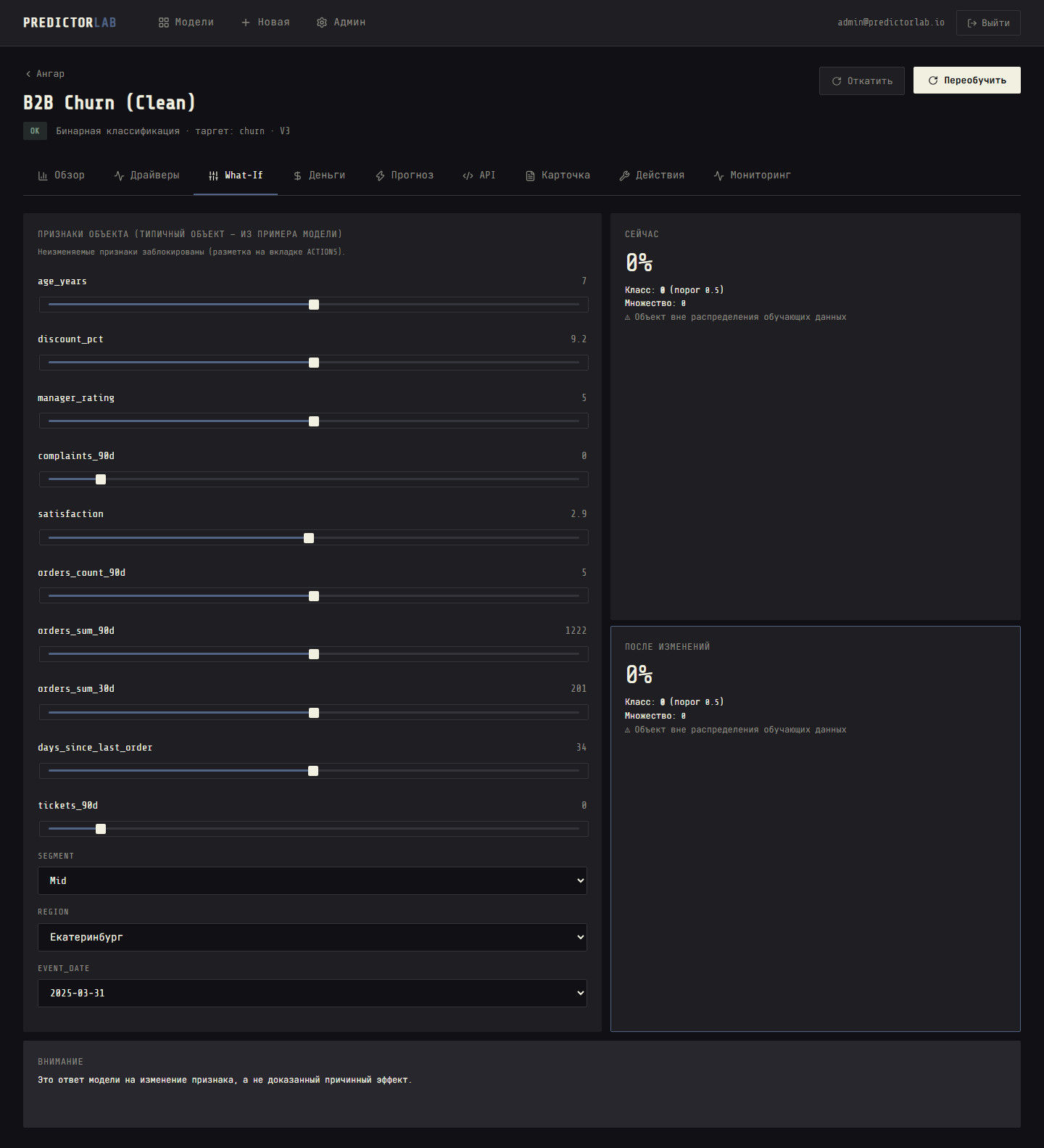
What-If sliders let you change any feature and watch the prediction and interval recalculate in real time
(150ms debounce). A permanent disclaimer: "This is the model's response to a feature change, not a proven causal effect."
Counterfactuals go further: they find the minimum-cost change to actionable features
that flips the prediction across the threshold. You define: allowed range, direction (only up / only down),
and cost per unit of change. The system searches (greedy + random restarts, with a timeout)
and returns:
Action: reduce discount_pct from 12% to 5%
Cost: 3,000 ₽
Probability before: 0.81 → after: 0.31
Expected ROI: 21,400 ₽
If the model says "change the customer's age" — it won't, because you marked it as immutable.
Monitoring
After the model is in production:
- Every prediction is logged (PII masked, TTL configurable)
- PSI drift computed per feature and per prediction distribution (7/30-day windows)
- Live metrics: real AUC/MAE from feedback vs validation numbers
- Webhooks fire on DRIFT or live-metric drop
- One-click retrain on fresh data; version comparison and rollback
Benchmarks
| Operation | Budget | Measured |
|---|---|---|
predict, 1 record |
< 300 ms | 62 ms |
predict + SHAP reasons |
< 1 s | 79 ms |
| Batch 10k rows | < 2 min | 14 s |
| Train quick, 50k × 50 | ~2 min | 155 s |
| Counterfactual, 1 object | < 10 s | 6.4 s |
Full results: BENCHMARKS.md · Run: make bench
Tests & CI
make check     # lint + typecheck + unit + property + integration + llm + security + frontend (~2 min)
make test-e2e  # Playwright end-to-end
make test-ml   # ML quality: golden datasets, determinism, invariants
make bench     # performance benchmarks → BENCHMARKS.md
| Layer | Tools |
|---|---|
| Lint + format | ruff (check + format) |
| Typecheck | mypy (strict for core/) |
| Unit tests | pytest — 51 tests: guard, profit, conformal, splits, PII, sql_guard, counterfactuals, signing |
| Property tests | hypothesis — 12 tests: profit monotonicity, conformal coverage, PII masking, CF bounds |
| Integration | TestClient — upload → train → predict → batch → keys → 422 errors |
| LLM contract | mock client, fixtures, spy test ("raw rows don't leave"), number validator, causal-word stop-list |
| Security | key hash, 401/403, sql_guard DML/DDL/CTE injection, PII exclusion + masking |
| Frontend | vitest + eslint + tsc — 10 component tests |
| ML quality | golden datasets (Telco AUC range), leak detection, determinism, robustness, invariance |
| CI | GitHub Actions: ruff → mypy → tsc/eslint → pytest → coverage ≥ 60% → e2e smoke |
Honesty & Limitations
- Counterfactuals ≠ causality. "Reduce discount → probability drops" is the model's response
to a feature change, not proof that the discount caused the churn. - Conformal guarantee is marginal. 90% coverage holds on average across predictions,
not for every individual object. For heavily imbalanced classes, set coverage may exceed α —
that's a mathematical property of the method (see DECISIONS.md D-12). - Small datasets give wide intervals. 200 rows → the interval is nearly useless.
We show this honestly instead of hiding it behind a single number. - Profit in rubles is only as good as your assumptions. All formulas and coefficients
are expandable in the UI. The "+1.84M ₽" is true exactly to the extent your
cost/benefit estimates are true. - LLM never affects the numbers. Training, probabilities, intervals, thresholds, profit —
all deterministic code. LLM writes texts only, and those pass a number validator
that rejects any number not present in the computed fields. - Time-series forecasting (v0.3) is pragmatic: lags + rolling stats + calendar features,
one series at a time. Strong exotic seasonality is not modeled (DECISIONS.md D-10).
Tech Stack
| Layer | |
|---|---|
| Backend | Python 3.12, FastAPI, Pydantic v2, SSE, asyncio jobs + ProcessPool |
| ML | scikit-learn, CatBoost, LightGBM, Optuna, SHAP, own split-conformal |
| Data | DuckDB (data), SQLite (metadata), PostgreSQL / MySQL / ClickHouse / SQLite connectors (read-only) |
| Frontend | React 19, TypeScript, Vite, Recharts, CSS custom properties (no UI kits) |
| MCP | FastMCP (stdio + HTTP, Bearer auth) |
| Infra | Docker, docker-compose, GitHub Actions, pre-commit |
| Testing | pytest + hypothesis + vitest + Playwright + ruff + mypy + bandit |
License
MIT — like all Ivor's Lab repositories.
Telco Customer Churn © IBM (Apache 2.0 mirror), California Housing from A. Géron's course —
both included in demo-data/ for offline demos.
Reviews (0)
Sign in to leave a review.
Leave a reviewNo results found