Claude-Code-Dev-Studio
Health Warn
- License — License: MIT
- Description — Repository has a description
- Active repo — Last push 0 days ago
- Low visibility — Only 6 GitHub stars
Code Fail
- rm -rf — Recursive force deletion command in .claude/hooks/scripts/dangerous-guard.js
- rm -rf — Recursive force deletion command in .claude/settings.json
Permissions Pass
- Permissions — No dangerous permissions requested
No AI report is available for this listing yet.
A full-stack Claude Code studio — 37 agents, Studio Brain onboarding, game dev track, design phase. Bring an idea, the studio handles the rest.
Claude Code Dev Studio
A full-stack development studio for building anything.
Web, mobile, SaaS, API, game, content, research — bring an idea, the studio handles the rest.
Inspired by Claude-Code-Game-Studios by Donchitos.
Why This Exists
Most Claude Code setups are a single CLAUDE.md file with some instructions.
This studio gives Claude Code the structure of a real development team —
37 specialized agents, a guided onboarding sequence that takes any idea
from one sentence to a configured project, and a sprint system that
keeps builds disciplined from start to launch.
You bring the idea. The studio handles the rest.
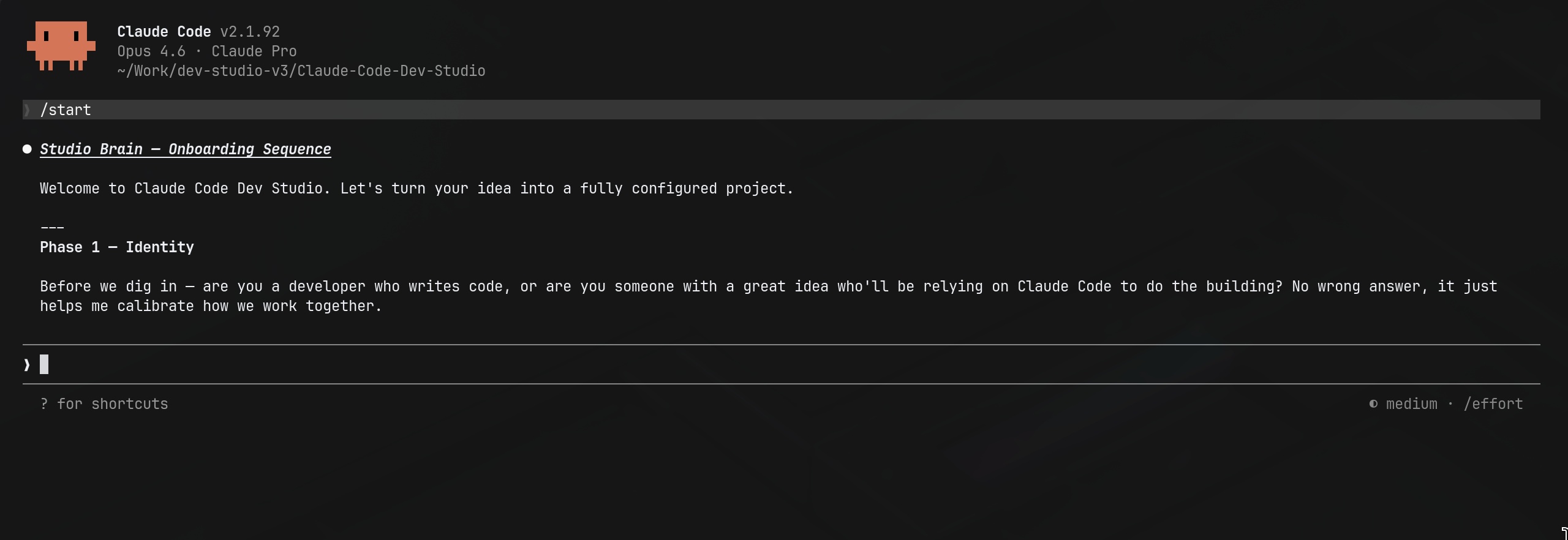
Start Here
# Clone
git clone https://github.com/marko-builds/Claude-Code-Dev-Studio my-project
cd my-project && rm -rf .git && git init

# Open Claude Code
claude

# That's it. The studio takes it from here.
/start
You only need an idea. /start interviews you, challenges your concept, detects or builds the right track, produces all project documents, plans your sprints, and hands you a configured project.
Works for non-developers and experienced engineers alike.
What's In Here
Studio Brain (new)
The /start command is now a full orchestration sequence. From raw idea to configured project in one conversation:
- Identifies whether you're a developer or idea-first founder — adapts accordingly
- Interviews you about your concept (5-8 questions)
- Challenges it honestly before writing anything (Go / Refine / Pivot)
- Detects the right track — or generates a custom one if needed
- Produces all documents with your approval at each step
- Plans your full sprint roadmap
- Hands off with "Sprint 0 starts now"
Design Phase (new in v3)
Take any idea from one sentence to a dependency-ordered sprint plan
before writing a single line of code.
/design → Guided ADD authoring — every system, every decision mapped
/map-systems → Dependency graph — optimal build order, no mid-project blockers
/design-index → Living decision record — every architectural choice with rationale
Full flow: /start → /design → /map-systems → /sprint-plan → /sprint-start 0
Three-Tier Agent Hierarchy (37 agents)
Tier 0: Studio Brain
  studio-brain, track-architect

Tier 1: Directors
  product-director, architecture-director, tech-lead

Tier 2: Department Leads
  frontend-lead, mobile-lead, backend-lead, devops-lead,
  design-lead, qa-lead, security-lead, launch-lead, content-lead, game-director

Tier 3: Specialists — Software Track
  frontend-developer, mobile-developer, backend-developer,
  database-architect, auth-specialist, payments-specialist,
  devops-engineer, code-reviewer, accessibility-specialist,
  performance-engineer, documentation-writer

Tier 3: Specialists — Game Dev Track
  game-designer, level-designer, narrative-director,
  unity-developer, godot-developer, unreal-developer,
  gameplay-programmer, ai-programmer, tools-programmer

Tier 3: Specialists — Content & Research
  content-writer, research-analyst
24 Commands
Studio:     /start /concept-review /new-track /dashboard /onboard
Sprints:    /sprint-plan /sprint-start /sprint-end
Building:   /spec /new-project /review /test /refactor /debug
Quality:    /audit /deploy /launch
Knowledge:  /wiki-update /wiki-query /reflect /research /docs /status
Tracks
| Track | Activated for |
|---|---|
software |
Web, mobile, SaaS, API, CLI, desktop |
game-dev |
Unity, Godot, Unreal, any engine |
content |
Prompt libraries, courses, newsletters |
research |
Competitive analysis, knowledge bases |
custom:[name] |
Dynamically generated for novel types |
20 Skills (auto-load by file context)
tdd-workflow, api-design, saas-patterns, mobile-patterns, auth-patterns, security-review, database-patterns, performance, sprint-methodology, concept-validation, launch-strategy, game-design-patterns, unity-patterns, godot-patterns, unreal-patterns, content-production, research-methodology, track-generation, systematic-debugging, two-stage-review
Karpathy Wiki (project + personal)
Every project gets a wiki/ directory — persistent, compounding knowledge maintained by /wiki-update:
- Architecture decisions with rationale
- Session-by-session log
- Gotchas and discoveries
- Open questions
Personal cross-project learning at ~/.claude/wiki/:
- Velocity data across all projects
- Recurring patterns and their fixes
- Studio improvement suggestions
6 Rescue Prompts
For difficult development moments: prompts/stuck-on-bug.md, scope-creep.md, handover.md, second-opinion.md, fresh-eyes.md, reset-session.md
Repository Layout
.
├── CLAUDE.md                     ← Master config
├── README.md                     ← This file
├── .claude/
│   ├── settings.json
│   ├── agents/     (37 agents)
│   ├── commands/   (24 commands)
│   ├── skills/     (20 skills)
│   ├── hooks/scripts/ (4 hooks)
│   └── rules/      (5 rule sets)
├── docs/
│   ├── COLLABORATIVE-DESIGN-PRINCIPLE.md
│   ├── SPRINT-METHODOLOGY.md
│   ├── TRACK-SYSTEM.md
│   ├── GAME-DEV-GUIDE.md
│   ├── STUDIO-BRAIN-GUIDE.md
│   ├── LEARNING-LOOP.md
│   ├── quick-start.md
│   ├── agent-roster.md
│   └── coordination-map.md
├── wiki/                         ← Project wiki scaffold
│   ├── dashboard.md
│   ├── index.md
│   ├── log.md
│   ├── open-questions.md
│   ├── architecture.md
│   ├── decisions/
│   └── discoveries/
├── prompts/                      ← Rescue prompts
│   ├── stuck-on-bug.md
│   ├── scope-creep.md
│   ├── handover.md
│   ├── second-opinion.md
│   ├── fresh-eyes.md
│   └── reset-session.md
└── templates/
    ├── web-saas/CLAUDE.md
    ├── mobile-app/CLAUDE.md
    ├── api-backend/CLAUDE.md
    ├── fullstack/CLAUDE.md
    ├── game/CLAUDE.md
    ├── content/CLAUDE.md
    └── research/CLAUDE.md
Philosophy
Collaborative, not autonomous. Every significant action: Question → Options → Decision → Draft → Approval → Execute.
Idea-first. You only need an idea. The studio handles classification, tech stack, documents, and sprint planning.
Prescriptive. The studio tells you what to build next, in what order, and why — not just gives you tools.
Compounding. Sessions build on each other. Projects build on each other. The studio gets smarter about you over time.
Credits
- Structural inspiration: Claude-Code-Game-Studios by Donchitos
- Wiki pattern: Andrej Karpathy's LLM-Wiki
- Hook + rules patterns: everything-claude-code by affaan-m
- Best practices: claude-code-best-practice by shanraisshan
- Community: awesome-claude-code by hesreallyhim
- Templates: claude-code-templates by davila7
- Workflow methodology: superpowers
by Jesse Vincent — systematic debugging and two-stage review patterns
MIT License
Reviews (0)
Sign in to leave a review.
Leave a reviewNo results found