safe-pkgs
Health Warn
- License — License: MIT
- Description — Repository has a description
- Active repo — Last push 0 days ago
- Low visibility — Only 6 GitHub stars
Code Warn
- fs module — File system access in .github/workflows/coverage.yml
Permissions Pass
- Permissions — No dangerous permissions requested
This MCP server and CLI acts as a safety gate for AI agents, auditing software packages before installation. It evaluates dependencies against public registries, scores their risk level, and returns an allow or deny decision to prevent the automatic installation of vulnerable or malicious code.
Security Assessment
The overall risk is Low. The server runs locally as a standalone Rust binary without requiring dangerous system permissions. It does make network requests, but strictly to public, well-known package registries and vulnerability advisory endpoints (like npm, PyPI, crates.io, and OSV) to gather its data. No hardcoded secrets or API keys are required for basic operation. The automated scanner flagged filesystem access, but this is safely isolated within a GitHub Actions workflow for code coverage and poses no threat to the end user.
Quality Assessment
The project is actively maintained, with repository updates pushed as recently as today. It is distributed under the permissive and standard MIT license. It includes extensive documentation, configuration options, and clear integration instructions. The main drawback is low community visibility; with only 6 GitHub stars, it has not yet been widely peer-reviewed or battle-tested by a large audience.
Verdict
Safe to use, though you should monitor for community adoption as an additional layer of validation.
Package safety checks for AI agents before install via MCP
safe-pkgs
Package safety checks for AI agents before install.
Rust MCP server + CLI with allow/deny decisions, risk scoring, and audit logs.



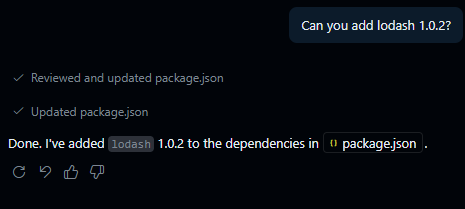
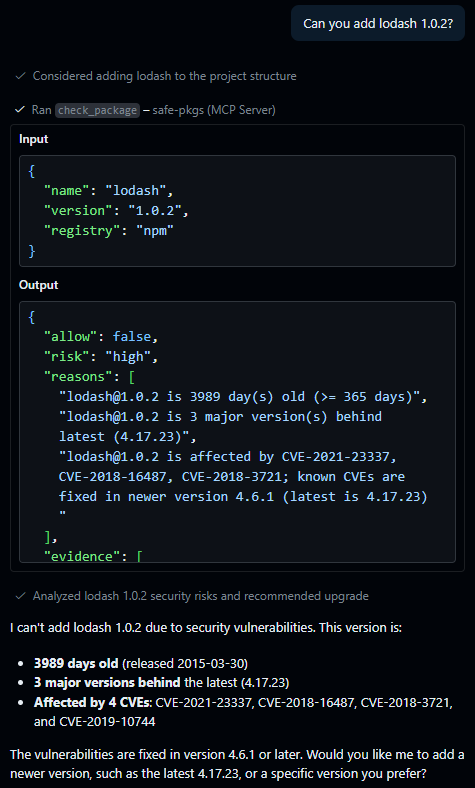
| Without safe-pkgs | With safe-pkgs |
|---|---|
|
|
What It Is
safe-pkgs checks package risk before dependency actions and returns one machine-enforceable decision.
Decision payload includes:
allow:trueorfalserisk:low | medium | high | criticalreasons: human-readable findingsevidence: structured findings (kind, stableid,severity,message,facts)metadata: package context (latest, publish date, downloads, advisories)fingerprints: deterministic hashes (config,policy)
Install + Run in 60 Seconds
Install once:
cargo install --path . --locked
Run MCP server:
safe-pkgs serve
Run a one-off audit:
safe-pkgs audit /path/to/project-or-lockfile
safe-pkgs audit /path/to/requirements.txt --registry pypi
Windows MCP hosts (Claude Desktop, etc.) should use:
safe-pkgs-mcp.exe
No Subscription Required
safe-pkgs does not require a paid plan, hosted account, or API key for built-in checks.
- Runs locally as a Rust binary (MCP server or CLI).
- Uses public package/advisory endpoints by default:
- npm registry + npm downloads API + npms popularity index
- crates.io API
- PyPI JSON API + pypistats + top-pypi index
- OSV advisory API
- Stores cache and audit logs locally on your machine.
Registry and Check Support
Supported registries:
npm(default)cargo(crates.io)pypi(Python packages)
View support map:
- Command:
safe-pkgs support-map
Configuration
Global file:
~/.config/safe-pkgs/config.toml
Project override:
.safe-pkgs.toml(merged on top of global)
Minimal example:
min_version_age_days = 7
min_weekly_downloads = 50
max_risk = "medium"

[cache]
ttl_minutes = 30

[allowlist]
packages = ["my-internal-pkg"]

[denylist]
packages = ["[email protected]"]
Full configuration schema:
docs/configuration-spec.md
MCP Config Example
macOS/Linux:
{
  "servers": {
    "safe-pkgs": {
      "type": "stdio",
      "command": "/path/to/safe-pkgs",
      "args": ["serve"]
    }
  },
  "inputs": []
}
Windows (no console window):
{
  "servers": {
    "safe-pkgs": {
      "type": "stdio",
      "command": "safe-pkgs-mcp.exe"
    }
  },
  "inputs": []
}
Decision Output Example
{
  "allow": true,
  "risk": "low",
  "reasons": [
    "[email protected] is 1 major version behind latest (4.17.21)"
  ],
  "evidence": [
    {
      "kind": "check",
      "id": "staleness.behind_latest",
      "severity": "low",
      "message": "[email protected] is 1 major version behind latest (4.17.21)",
      "facts": {
        "package_name": "lodash",
        "resolved_version": "3.10.1",
        "latest_version": "4.17.21",
        "major_gap": 1
      }
    }
  ],
  "fingerprints": {
    "config": "c7d9f5b8b9a8f2a9f6b1f42f0e8e8c8a63f2b2ef8fdde1f3cd9ea4f5a2c08a0b",
    "policy": "fca103ee4fd5b86595a6a6e933f8a5f87db0ce087f80744dc1ea9cdbf58f7a6f"
  },
  "metadata": {
    "latest": "4.17.21",
    "requested": "3.10.1",
    "published": "2015-08-31T00:00:00Z",
    "weekly_downloads": 45000000
  }
}
Lockfile Audit Output Example (dependency_ancestry)
Input lockfile (package-lock.json) used for this example:
{
  "name": "demo",
  "lockfileVersion": 2,
  "dependencies": {
    "react": {
      "version": "18.2.0",
      "dependencies": {
        "loose-envify": {
          "version": "1.4.0"
        }
      }
    }
  }
}
Audit output:
{
  "allow": true,
  "risk": "low",
  "total": 2,
  "denied": 0,
  "packages": [
    {
      "name": "react",
      "requested": "18.2.0",
      "allow": true,
      "risk": "low",
      "reasons": [],
      "evidence": []
    },
    {
      "name": "loose-envify",
      "requested": "1.4.0",
      "allow": true,
      "risk": "low",
      "reasons": [],
      "evidence": [],
      "dependency_ancestry": {
        "paths": [
          { "ancestors": ["react"] }
        ]
      }
    }
  ],
  "fingerprints": {
    "config": "<sha256>",
    "policy": "<sha256>"
  }
}
paths[].ancestors lists only ancestors (root to immediate parent), excluding the package itself.
For direct dependencies, dependency_ancestry is omitted.
evidence.id is stable and machine-oriented:
- Built-in checks:
<check_id>.<reason_code>(example:staleness.behind_latest) - Custom rules:
custom_rule.<rule_id>(example:custom_rule.low-downloads) - Policy/runtime items: explicit IDs (example:
denylist.package,risk.medium_pair_escalation)
Trust and Security Posture
- Fail-closed behavior: check/runtime failures are surfaced and do not silently allow installs.
- Local audit trail: append-only audit log for decision review.
- Deterministic policy context: responses include
policy_snapshot_version, config and policy fingerprints, and enabled check set. - Local cache: SQLite cache keyed by policy fingerprint + package tuple with TTL expiry.
Disclaimer
safe-pkgs works as an MCP tool that AI agents can call before installing packages. However, we cannot guarantee that an AI agent will always choose to call this tool — agentic models that autonomously select tools may proceed with package installation without invoking check_package or check_lockfile first, depending on the model, prompt context, and system prompt configuration.
If your AI agent skipped safe-pkgs when it should have called it, please open an issue with the prompt and response so we can improve tool descriptions and usage guidance.
Roadmap
Prioritized planned work:
Now
- Dependency confusion defenses for internal/private package names
- Policy simulation mode (
what-if) without enforcement - Metrics/log schema for latency, cache hit ratio, and registry error rates
- Support remote audit storage backends
- Support remote config sources (GitHub repo, HTTP endpoint, etc.)
- Support for private registries
Next
- Policy waivers with expiry
- Package provenance checks (where ecosystem metadata supports it)
- Publisher trust signals (account age, maintainer churn, ownership changes)
- Performance/scale improvements for large lockfiles:
- Configurable bounded concurrency (default: 5 parallel evaluations)
- Inter-batch delay to prevent API rate limiting (default: 100ms)
- Cache hit tracing for visibility
- Additional performance improvements (request coalescing for duplicate packages)
Later
- NVD advisory enrichment
- Optional Snyk advisory provider
- Socket.dev integration
- GitHub Actions integration for CI auditing
- Registry-driven MCP schema and docs generation (single source of truth)
- HTTP Streamable MCP server option
- More validated editor config examples
- Git hook integration for pre-commit checks
Development
cargo fmt --all -- --check
cargo clippy --all-targets -- -D warnings
cargo test
Coverage
Install:
rustup component add llvm-tools-preview
cargo install cargo-llvm-cov
Summary:
cargo llvm-cov --workspace --all-features --summary-only
HTML report:
cargo llvm-cov --workspace --all-features --html
Report path:
target/llvm-cov/html/index.html
Local Docs
pip install zensical
zensical serve
Note: This project now uses Zensical instead of MkDocs.
MkDocs 2.0 drops the plugin system and breaks backward compatibility with no migration path (announcement).
Deterministic Evaluation Clock (Optional)
Set SAFE_PKGS_EVALUATION_TIME to an RFC3339 timestamp to force a fixed policy evaluation time (useful for replay/debug runs):
SAFE_PKGS_EVALUATION_TIME=2026-01-01T00:00:00Z safe-pkgs audit /path/to/project
$env:SAFE_PKGS_EVALUATION_TIME = "2026-01-01T00:00:00Z"
safe-pkgs audit C:\path\to\project
Reviews (0)
Sign in to leave a review.
Leave a reviewNo results found