capbar
Health Warn
- License — License: MIT
- Description — Repository has a description
- Active repo — Last push 0 days ago
- Low visibility — Only 5 GitHub stars
Code Fail
- rm -rf — Recursive force deletion command in scripts/package_app.sh
Permissions Pass
- Permissions — No dangerous permissions requested
No AI report is available for this listing yet.
A compact macOS menu bar app for tracking AI coding-agent rate limits at a glance
CapBar

CapBar is a compact macOS menu bar app for tracking AI coding-agent usage limits at a glance.

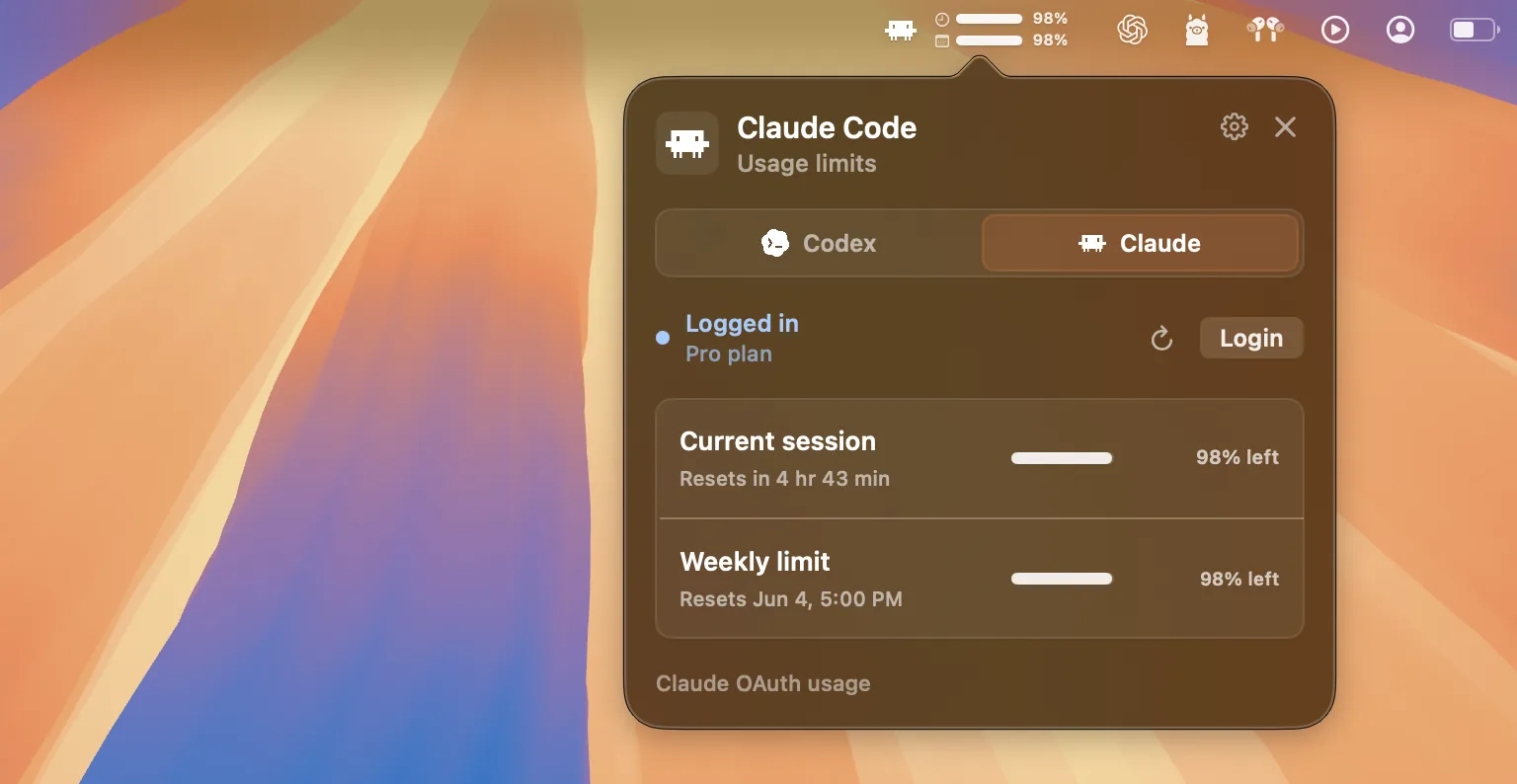
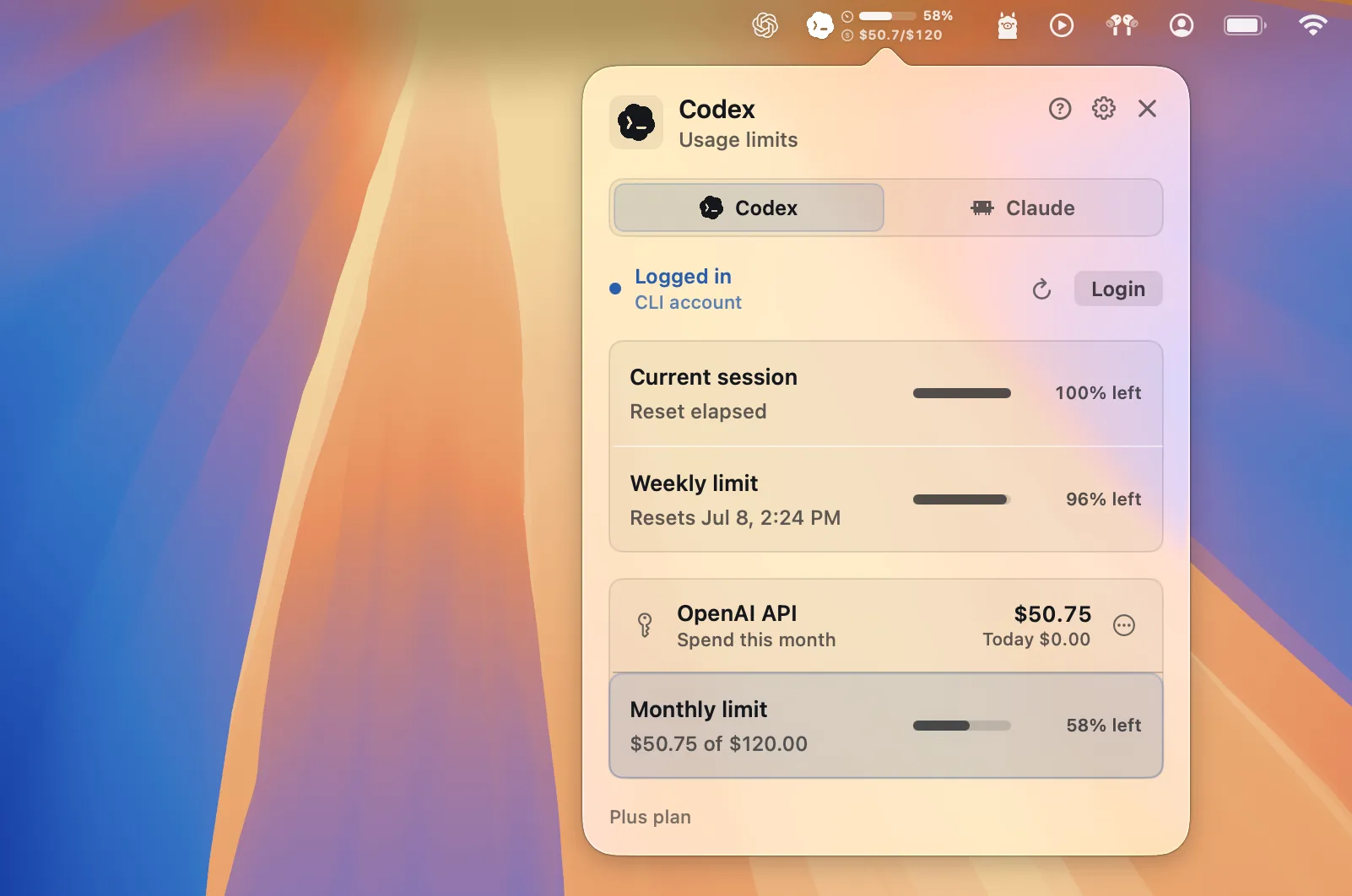
It currently supports Codex and Claude Code. The menu bar item shows the selected provider's current-session and weekly remaining usage, and the popover gives a fuller view with account status, reset times, manual refresh, login actions, provider switching, and lightweight settings.
CapBar is intentionally small: it does not proxy requests, store usage history, or send telemetry. It uses your existing local CLI sign-ins to check provider usage, with local Codex session files as a fallback.
Installation
Option 1: Download The App
This is the easiest option for most users.
- Open the latest CapBar release.
- Download
CapBar-macOS.zip. - Double-click the downloaded zip to extract
CapBar.app. - Open Finder and drag
CapBar.appinto theApplicationsfolder. - Open
Applications, then openCapBar.
CapBar runs in the macOS menu bar and does not appear in the Dock. Look for the CapBar icon near the top-right corner of the screen.
If macOS blocks the first launch, right-click CapBar.app, choose Open, and confirm. You can also allow it from System Settings > Privacy & Security if macOS shows an Open Anyway button.
[!WARNING]
CapBar is not yet signed with an Apple Developer ID, so macOS Gatekeeper may refuse to open the downloaded app even after the steps above. If you cannot get the release build to launch, use Option 2: Build And Install From Source instead, which builds the app locally.
Set Up A Provider
CapBar reads account and usage information written by the provider CLIs. Install and log in to at least one provider before using CapBar:
codex login
claude auth login
Run each CLI you want to track at least once after logging in. CapBar does not install Codex or Claude Code for you.
Option 2: Build And Install From Source
Building from source requires:
- macOS 13 or newer
- Git
- Xcode Command Line Tools with Swift 6
- Codex CLI and/or Claude Code CLI for the providers you want to track
Install Apple's command-line tools if needed:
xcode-select --install
Clone and package CapBar:
git clone https://github.com/mattialoszach/capbar.git
cd capbar
chmod +x scripts/package_app.sh
scripts/package_app.sh
The script creates the application here:
dist/CapBar.app
Open the build folder in Finder:
open dist
Then drag CapBar.app from the dist folder into your Applications folder. Open CapBar from Applications after the copy finishes.
To rebuild an installed copy later, quit CapBar, run the package script again, and replace the existing app in Applications with the new dist/CapBar.app. The Makefile automates this whole flow (see below).
Updating From Source With The Makefile
CapBar is not signed with an Apple Developer ID, so it does not ship in-app auto-updates. Instead, a Makefile in the repository root pulls the latest source, rebuilds the app, and installs it into Applications for you.
To update an existing source install, run this from the repository:
make update
This will:
- Run
git pullto fetch the latest changes. - Rebuild the app with
scripts/package_app.sh. - Detect whether
CapBar.appis already inApplications, show the installed and newly built version numbers, and ask before replacing it. - Quit the running app, replace the installed copy, and relaunch it.
If you only want to install or reinstall the current build without pulling, use:
make install
Other available targets:
make build       # build dist/CapBar.app only
make run         # build, then launch from dist without installing
make reinstall   # reinstall the existing dist build without rebuilding
make uninstall   # quit and remove CapBar from Applications
make clean       # remove .build and dist
make help        # list all targets
Because the build is ad-hoc signed rather than notarized, macOS may still warn on the first launch after an update. If it does, right-click CapBar.app, choose Open, and confirm.
Run Without Installing
For development, launch CapBar directly from the repository:
swift run CapBar
Features
- macOS menu bar accessory app with no Dock icon.
- Codex and Claude Code provider selector.
- Compact menu bar display with:
- provider icon
- current-session and weekly subscription usage by default
- optional today and month-to-date API spend
- optional single-bar API monthly budget usage when a manual budget is set
- Popover with:
- account login status
- current-session usage limit
- weekly usage limit
- reset text and reset date where available
- manual refresh button
- CLI login button
- settings panel
- quit button
- Configurable auto-refresh: manual, 30 seconds, 1 minute, 5 minutes, or 15 minutes.
- Optional provider rotation: off, 5 seconds, 10 seconds, 20 seconds, or 30 seconds.
- Optional low-usage warning colors for remaining limits.
- Optional API console spend tracking per provider (see below).
- Remembers the selected provider, per-provider menu bar data mode, rotation interval, refresh interval, and low-usage color preference in
UserDefaults. - Uses existing local CLI credentials for subscription usage checks.
API Console Spend (Optional)
Besides subscription limits, CapBar can show your API platform spend for each provider — useful if you also use the Anthropic Console or OpenAI Platform with prepaid credits or monthly billing.
In the popover, the Anthropic API / OpenAI API panel accepts an API key and then shows what your key is allowed to read:
- Anthropic: requires an Admin API key (
sk-ant-admin...), created in the Claude Console under organization settings. CapBar queriesGET https://api.anthropic.com/v1/organizations/cost_reportand shows month-to-date and today's spend. If Anthropic's daily cost report has not published the current UTC day yet, CapBar estimates today fromGET https://api.anthropic.com/v1/organizations/usage_report/messagesand folds that estimate into the month-to-date total until the official cost bucket appears. The Admin API is unavailable for individual accounts — your Console account must belong to an organization, and regular API keys cannot read billing data. - OpenAI: Admin keys (
sk-admin-...) use the documentedGET https://api.openai.com/v1/organization/costsendpoint for month-to-date and today's spend. For non-admin keys, CapBar can still try the undocumented legacyGET https://api.openai.com/v1/dashboard/billing/credit_grantsandGET https://api.openai.com/v1/dashboard/billing/subscriptionendpoints. Automatic legacy probes stop after two failures; replacing the key or refreshing manually retries them.
Anthropic does not expose the remaining credit balance through any API, so for Anthropic CapBar shows spend rather than balance.
Anthropic's current-day estimate uses one daily usage bucket, grouped by model, service tier, geography, and speed. Prices were checked against the official pricing table on September 9, 2026: Sonnet 5 remains $2/$10 per million input/output tokens, Opus 5 uses $5/$25, and Fable/Mythos 5.1 cache reads use the reduced rate. Fast mode on Opus 5/4.8 is included. Unknown model versions, unsupported pricing tiers, or incomplete reports leave the estimate unavailable until official cost data arrives.
Monthly Limit Bar
When spend data is available, the API panel can draw a limit bar (with the same orange/red low-remaining warning colors as the usage bars) showing month-to-date spend against a monthly limit:
- OpenAI: if your key can read the legacy
GET https://api.openai.com/v1/dashboard/billing/subscriptionendpoint, CapBar uses the organization's configured monthly hard limit automatically. - Anthropic: the monthly spend limit shown in the Claude Console is not exposed by any API, so set it manually via the panel's
…menu →Set Monthly Budget….
A manually set budget always takes precedence over the API-provided limit. If only the credit balance is available (OpenAI legacy keys), the bar shows used credits against the total granted instead.
Keys are stored locally in ~/Library/Application Support/CapBar/api-keys.json with owner-only file permissions — the same approach the provider CLIs use for their own credentials (~/.claude/.credentials.json, ~/.codex/auth.json). CapBar deliberately avoids the macOS Keychain here: the app is not signed with a stable Apple Developer ID, so every rebuild would trigger a new Keychain access prompt. Keys are only ever sent to the respective provider's API. Automatic API-spend requests are cached for five minutes; manual refresh bypasses that cache and requests fresh data immediately. Remove or replace a key at any time via the panel's … menu.
Supported Providers
Codex
CapBar first queries the documented Codex app-server account API through the installed codex executable. It calls account/read and account/rateLimits/read without starting a conversation or model turn. Codex handles its own authentication, including file and Keychain storage. API-key accounts are identified explicitly; subscription limits require a ChatGPT login.
Live queries are cached in memory for five minutes. Manual refresh bypasses this cache. The CLI exchange has a ten-second timeout and runs off the UI thread alongside the other provider checks.
If the CLI or account query is unavailable, CapBar falls back to local Codex session files:
~/.codex/sessions/**/*.jsonl
It selects the codex quota bucket (or the legacy unnamed bucket) and maps:
primarytoCurrent sessionsecondarytoWeekly limitplan_typeto the source line, such asPlus plan
The fallback uses this file for login detection:
~/.codex/auth.json
CODEX_HOME is respected when set in CapBar's environment; otherwise these paths default to ~/.codex. Other metered buckets and empty session metadata cannot overwrite the main usage bars. If a stored reset time has passed, CapBar treats that window as reset locally until a new sample arrives. A successful live account check reporting no login or an API-key login takes precedence over old session files.
Claude Code
CapBar normally gets Claude Code plan details from its OAuth credentials. If credentials are unavailable, it checks account status with:
claude auth status --json
For Claude usage limits, CapBar uses Claude Code OAuth credentials and Anthropic's OAuth usage endpoint:
GET https://api.anthropic.com/api/oauth/usage
It checks these local credential sources in order:
~/.claude/.credentials.json
macOS Keychain item: Claude Code-credentials
CapBar respects CLAUDE_CONFIG_DIR for credential files and Claude Code's corresponding Keychain namespace, including CLAUDE_SECURESTORAGE_CONFIG_DIR overrides. These environment variables must be available to the CapBar process. An expired credential file does not prevent checking the Keychain for a newer login.
It maps:
five_hourtoCurrent sessionseven_daytoWeekly limitextra_usageis decoded for future use but is not displayed yet
CapBar calls the OAuth usage endpoint on the selected auto-refresh cadence, down to once every 30 seconds. Manual refresh bypasses the normal successful-response cooldown. It caches the latest successful response locally for up to 24 hours and uses exponential backoff when Anthropic returns HTTP 429, so a temporary throttle does not replace valid values with Unavailable. The cache is stored at:
~/Library/Caches/CapBar/claude-usage.json
The cache contains usage values, reset timestamps, and a one-way token fingerprint. It does not contain the OAuth token. Changing credentials or logging out discards the previous token's usage and retry state. Manual refresh rechecks credentials and usage while still respecting active rate-limit backoff. Both seconds and HTTP dates in Retry-After are honored. Claude usage remains best-effort because Anthropic's OAuth usage endpoint and Claude Code credential locations are not public stable contracts.
Release Packaging
The same package script used for a source install also creates a zip archive suitable for distribution:
chmod +x scripts/package_app.sh
scripts/package_app.sh
The package script creates:
dist/CapBar.app
dist/CapBar-macOS.zip
dist/CapBar.app includes the app icon generated from:
docs/images/capbar-icon.png
Optional Code Signing
The package script always signs the app bundle before zipping it. If no signing identity is provided, it uses an ad-hoc signature that is suitable for local testing only. Do not publish an ad-hoc signed zip as a public GitHub Release asset.
If you have an Apple Developer ID certificate, pass it through CODESIGN_IDENTITY:
CODESIGN_IDENTITY="Developer ID Application: Your Name (TEAMID)" scripts/package_app.sh
For a public GitHub release, build a Developer ID signed and notarized zip. Use either a notarytool keychain profile:
CODESIGN_IDENTITY="Developer ID Application: Your Name (TEAMID)" \
NOTARIZE=1 \
NOTARY_KEYCHAIN_PROFILE="notarytool-profile-name" \
scripts/package_app.sh
Or use Apple ID credentials:
CODESIGN_IDENTITY="Developer ID Application: Your Name (TEAMID)" \
NOTARIZE=1 \
APPLE_ID="[email protected]" \
APPLE_TEAM_ID="TEAMID" \
APPLE_APP_SPECIFIC_PASSWORD="xxxx-xxxx-xxxx-xxxx" \
scripts/package_app.sh
The notarized build staples the ticket to dist/CapBar.app, recreates dist/CapBar-macOS.zip, and verifies the result with Gatekeeper before printing the artifact paths.
Publish A GitHub Release
- Build the notarized release artifact:
CODESIGN_IDENTITY="Developer ID Application: Your Name (TEAMID)" \
NOTARIZE=1 \
NOTARY_KEYCHAIN_PROFILE="notarytool-profile-name" \
scripts/package_app.sh
- Create a GitHub Release, for example
v0.3.1. - Upload this file as the downloadable macOS asset:
dist/CapBar-macOS.zip
The generated app has LSUIElement enabled, so it runs as a menu bar accessory and does not show a Dock icon.
How To Use
- Open
CapBarfrom theApplicationsfolder. - Click the CapBar item in the macOS menu bar.
- Choose
CodexorClaudein the provider selector. - Use the refresh button to update immediately.
- Use the login button to open the provider's CLI login flow in Terminal.
- Click
?to open Help/About or start the quick tour. - Click the gear button to open settings.
- Choose a provider rotation interval, or leave rotation set to
Off. - Choose an auto-refresh interval, or set auto-refresh to
Manual. - Toggle low-usage colors on or off.
- Click
Xto fully quit the app.
The selected provider controls what appears in the menu bar. Double-click a provider field to choose what that provider shows: the subscription limits panel, the API spend row, or the API monthly limit row when a manual monthly budget is set. The popover always lets you switch between supported providers.
What The Menu Bar Shows
The menu bar label is intentionally dense:
- Provider logo on the left.
- Subscription mode: a clock row for the current-session window and a calendar row for the weekly window.
- API spend mode: today and month-to-date spend.
- API monthly limit mode: one remaining-limit bar with percentage, plus month-to-date spend over the manual limit.
If a metric is unavailable, CapBar shows --%.
Settings And Refresh
Provider rotation automatically switches the menu bar display between Codex and Claude. It pauses while the popover is open.
Available rotation intervals:
Off5 sec10 sec20 sec30 sec
CapBar refreshes automatically based on the selected interval. The default is 1 min.
This interval controls subscription checks and UI updates. Claude usage follows the selected interval down to 30 sec; live Codex queries and API spend retain separate five-minute caches. Manual refresh bypasses successful-response caches, while Claude rate-limit backoff still applies.
Available intervals:
Manual30 sec1 min5 min15 min
Set auto-refresh to Manual to disable the timer.
Manual refresh uses the same refresh path and updates both:
- the menu bar display
- the popover rows
If a refresh is already running, CapBar skips overlapping refresh requests.
Provider reads run off the main actor so the UI does not block while local commands or network calls are running.
Low-usage colors can be toggled from settings. When enabled, remaining usage changes color when a limit is low:
- warning at 30% remaining or less
- danger at 15% remaining or less
Privacy And Security
CapBar is local-first:
- It does not send telemetry.
- It does not persist subscription OAuth tokens; optional API keys are stored in the local file described above.
- It does not log full tokens.
- It reads provider credentials only when needed.
- Claude OAuth credentials are cached briefly in memory to reduce Keychain access.
- Codex account queries run through the local CLI; session files provide a fallback.
Claude credential reads may access:
~/.claude/.credentials.json
macOS Keychain item: Claude Code-credentials
Codex reads may access:
~/.codex/auth.json
~/.codex/sessions
Limitations
- CapBar is not affiliated with OpenAI or Anthropic.
- Claude usage support depends on an undocumented/best-effort OAuth usage endpoint.
- Claude may temporarily return overload or rate-limit errors. CapBar keeps the latest successful values while backing off, provided that cache is no more than 24 hours old.
- Codex live usage requires an installed CLI with the account app-server API. The local fallback depends on the latest
rate_limitsevent written by Codex and may be stale. - CapBar currently displays two windows per provider: current session and weekly.
- Settings currently cover provider rotation, auto-refresh, and low-usage colors.
- No usage history, charts, or notifications are implemented yet.
Troubleshooting
The app does not appear in the Dock
That is expected. CapBar is a menu bar accessory. Look in the macOS menu bar.
I rebuilt, but the UI did not change
You may still be running the old copy from Applications. The simplest fix is to rebuild and reinstall in one step:
make update
Or do it manually by quitting CapBar and rebuilding it:
pkill -x CapBar
scripts/package_app.sh
open dist
In Finder, replace the existing CapBar.app in Applications with the newly built dist/CapBar.app, then reopen CapBar from Applications.
Codex shows no usage
Check that Codex is installed and signed in with ChatGPT, then use CapBar's manual refresh. An API-key login does not expose subscription limits. For the local fallback, check for session files:
ls ~/.codex/sessions
Then run Codex once so it writes fresh session metadata.
Codex reset time passed but usage looks stale
CapBar clamps expired local Codex windows to reset locally. If it still looks stale, restart the installed app:
pkill -x CapBar
open /Applications/CapBar.app
Claude shows logged in but usage unavailable
Confirm Claude Code login:
claude auth status --json
Check whether the Keychain item exists:
security find-generic-password -s "Claude Code-credentials"
If Claude's OAuth usage endpoint is temporarily overloaded or throttled, wait and refresh again.
The refresh button spins briefly but values do not change
Values may remain unchanged if usage has not changed, Codex is using the local fallback, or Claude's usage cooldown/backoff is still active.
Compatibility Checks
Run the offline regression suite with swift test. It covers the Codex account protocol, multiple quota buckets, timeouts, Claude cache isolation, and pricing calculations. Optional integration checks use your installed CLI sign-ins and print no credentials:
CAPBAR_TEST_LIVE_CODEX=1 swift test --filter CodexLiveUsageReaderTests.testInstalledCodexSmokeTestWhenEnabled
CAPBAR_TEST_LIVE_CLAUDE=1 swift test --filter ClaudeUsageReaderTests.testInstalledClaudeSmokeTestWhenEnabled
The Claude integration check uses the normal usage cache and requires an available subscription usage response. Default tests use fixtures and do not contact provider APIs.
Project Structure
Sources/CapBar/
  CapBarApp.swift              App entry point and accessory activation policy
  StatusItemController.swift   NSStatusItem and popover wiring
  PopoverView.swift            Main SwiftUI popover UI
  StatusBarLabel.swift         Compact menu bar label
  Models.swift                 Provider and usage models
  UsageStore.swift             Shared settings, refresh state, and auto-refresh timer
  CodexLiveUsageReader.swift   Cached Codex account API and bounded CLI transport
  CodexUsageReader.swift       Codex local session reader
  ClaudeUsageReader.swift      Claude CLI/OAuth reader
  ProviderLoginRunner.swift    Terminal login launcher
  ProviderLogoView.swift       Provider logo rendering
  Support.swift                Paths, date parsing, formatting helpers

scripts/
  package_app.sh               Builds dist/CapBar.app

Makefile                       Build, install, and update targets (see Updating From Source)
Logos
Provider logo assets live here:
Sources/CapBar/Resources/Logos/codex.png
Sources/CapBar/Resources/Logos/claude.png
If either image is missing, CapBar falls back to an SF Symbol.
Development Notes
Useful commands:
swift build
swift run CapBar
scripts/package_app.sh
Because this is a menu bar accessory app, use pkill -x CapBar when you need to stop the packaged build from the terminal.
License
CapBar is released under the MIT License.
Reviews (0)
Sign in to leave a review.
Leave a reviewNo results found