contextmatrix
Health Warn
- License — License: MIT
- Description — Repository has a description
- Active repo — Last push 0 days ago
- Low visibility — Only 6 GitHub stars
Code Warn
- network request — Outbound network request in web/src/api/client.ts
Permissions Pass
- Permissions — No dangerous permissions requested
No AI report is available for this listing yet.
ContextMatrix is a kanban-style task coordination system designed for AI agents and humans
ContextMatrix
[!WARNING]
This project is under heavy development. Breaking changes should be expected
at the current stage.
Kanban-style task coordination for AI agents and humans. Cards are markdown
files with YAML frontmatter in a git repository; every mutation is
auto-committed, so the board is its own audit trail.
ContextMatrix is a coordination layer only. It holds the board, exposes it over
a REST API, an MCP server, and a web UI, and dispatches cards to pluggable
execution backends that do the coding inside disposable containers. It never
clones, builds, or touches your project code.
The ecosystem
flowchart LR
  UI[Web UI] -->|REST + SSE| CM[ContextMatrix]
  CM -->|commit, pull, push| Boards[(Boards git repo)]
  CM -->|HMAC webhooks| Agent[Agent backend]
  CM -->|HMAC webhooks| Chat[Chat backend]
  CM -->|HMAC webhooks| Architect[Architect backend]
  Agent --> Worker[Card worker container]
  Chat --> ChatWorker[Chat worker container]
  Worker -->|MCP, Bearer| CM
  ChatWorker -->|MCP, Bearer| CM
  Architect -->|MCP, Bearer| CM
  Worker -->|clone, push, PR| GitHub[(GitHub)]
  Architect -->|read-only fetch| GitHub
  CM -->|issue import, boards remote| GitHub
You only need this repo to get started. Add a backend when you want unattended
or chat execution.
| Repository | Role |
|---|---|
| contextmatrix (this repo) | Coordination server: board, web UI, REST API, MCP hub. |
| contextmatrix-agent | Task backend. A Go harness with per-role model selection over OpenRouter or any OpenAI-compatible gateway, or Claude Code on a subscription. Executes cards only. |
| contextmatrix-chat | Chat backend for the global /chat surface: long-lived, board-aware sessions on the same LLM endpoint or Claude Code subscription. |
| contextmatrix-architect | Blueprint backend for the same chat panel. Interviews you about a need, then slices, designs and reviews it into contract-checked cards it creates in ContextMatrix, with a playbook for two or more. |
Four shared Go modules underpin them:
contextmatrix-protocol
(webhook wire types),
contextmatrix-harness
(the agentic tool-use loop),
contextmatrix-backendkit
(serve plumbing: webhook auth, worker lifecycle, metrics, log streaming), and
contextmatrix-vendorkit
(runs the unmodified Claude Code CLI as an executor, so the backends can run on
a Claude subscription).
A blueprint, step by step
The
architect guide
shows the whole stack at work. It follows one real blueprint, a family recipe
web app, from the first message to the final pull request, one short chapter
per step with screenshots from that run. On the way it covers starting a
blueprint (directly or from a chat hand-off), the interview, trying a mockup of
the screen, slicing, design, checking the plan against the code, writing and
signing off the cards, the playbook run that builds them on the board, and
learning from cards that struggled. Beside it, the
reference
lists every reply you can type, the modes and the settings, and
Installing the architect
says what you need and how to get it running.
Features
Each bullet links to the document that covers it in full.
Board and cards
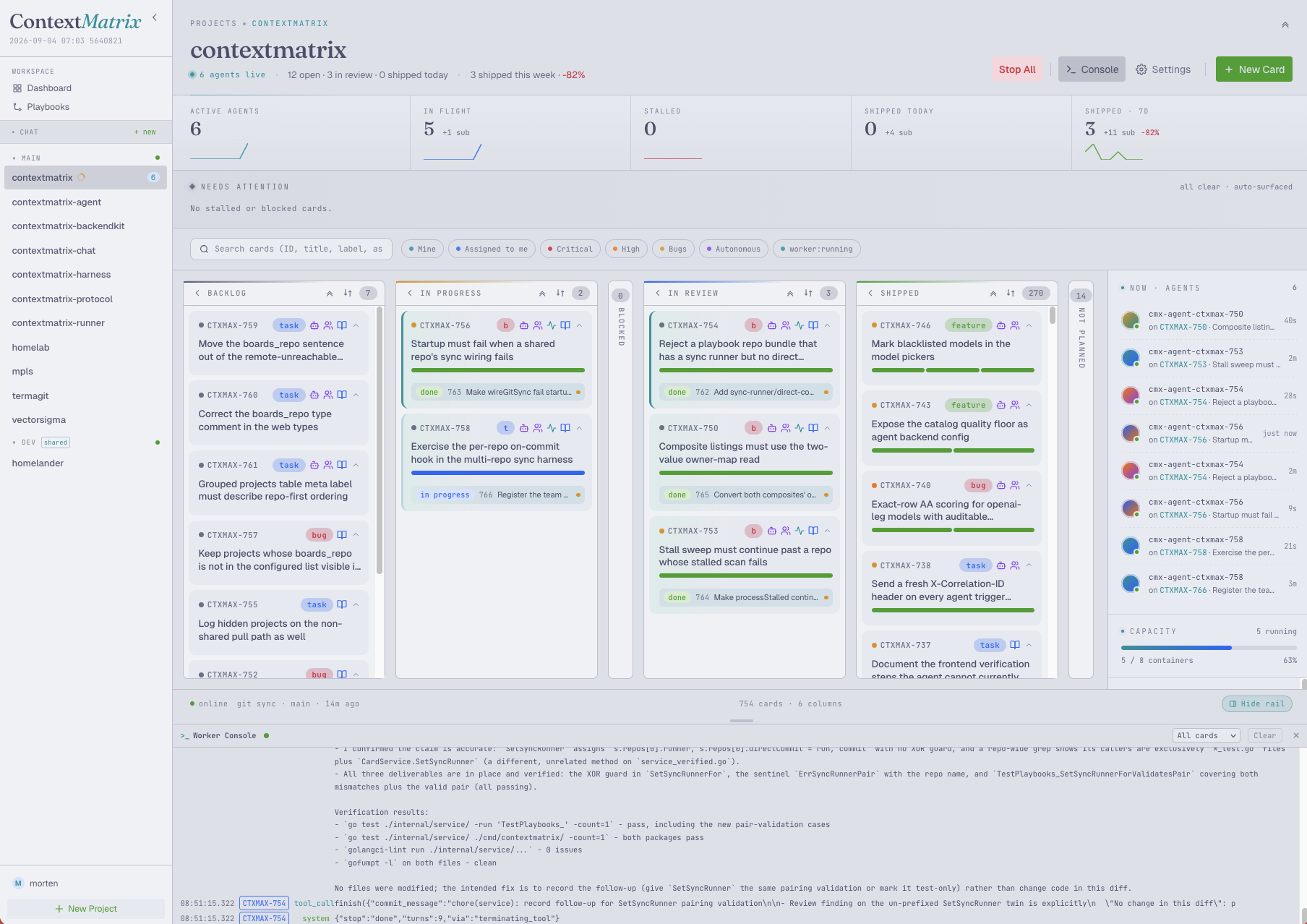
- Kanban web UI - drag-and-drop board per project with live SSE updates,
per-column sort modes and manual ordering, collapsible columns and cards, a
filter bar, and a metrics ribbon with the active agents.
Web UI - Markdown-native cards - one file per card, YAML frontmatter plus a
markdown body, diffable, no database required.
Card file format - Git audit trail - every mutation commits with an attributed message;
deferred batching folds an agent's whole session into one commit.
Async-commit consistency - Customizable workflow - one
.board.yamlper project defines states,
types, priorities, and transitions. Six state names are the contract; add
states freely, never rename those. Boards - Image attachments - paste or drop screenshots into a card; uploads are
resized, content-hashed, and handed to agents inline over MCP.
Image attachments - Playbooks - cross-project runbooks that mix live card references with
manual gate steps, stored as YAML in the boards repo.
Playbooks - GitHub issue import - open issues become unvetted cards, deduplicated by
external id, one-way. GitHub issue import
Agents and execution
- MCP-first agent interface - MCP tools and slash commands give
agents structured access to the board. Agents work through MCP, never the
REST API. MCP integration - Agent coordination - exclusive claims, heartbeats, automatic stall
detection, anddepends_onenforcement keep parallel agents apart.
Key domain rules - Pluggable execution backends - one click runs a card in a sandboxed
container on the agent backend, driven over HMAC-signed webhooks; the
worker reports back over MCP.
Running cards,
Remote execution - Autonomous and HITL runs - Run Auto drives plan, execute, document,
review, done with no gates; Run HITL opens a per-card chat with approval
gates and a one-click switch to autonomous. Every run streams its transcript
into the card's Chat tab. Running cards - Guardrails - pushes to
mainormasterare refused, review cycles are
capped, heartbeat timeouts stall the card, and a run that needs a human
parks the card instead of failing.
Guardrails,
Parked cards - Best-of-N -
best_of_nraces N coder models in parallel worktrees; a
judge picks the one branch that is pushed.
Best-of-N - Mob sessions (A2A) -
mob_participantsturns chosen phases into
moderated multi-model discussions over the A2A protocol, with optional
registered guest agents. Mob sessions - Model selection - ContextMatrix rates served models with Artificial
Analysis and ships candidates, favorites, and the blacklist in every
trigger; the agent picks per complexity tier. Pin per card, favor per tier,
delist from the admin page. Model selection - Task skills - point the agent at your own repo of
SKILL.mdfiles and
select them per card or per project.
Task skills - Cost tracking - workers report measured token usage per card; the board
prices it and breaks it down by model and agent.
Cost tracking - Global chat -
/chattiles up to four long-lived, board-aware sessions
backed by the chat backend. Global chat
Teams and operations
- Multi-user login - invite-only accounts, one flat team plus an admin
flag, private chats, and an encrypted GitHub credential pool bound per
project.auth.mode: nonerestores zero-login single-user operation.
Authentication - Shared boards - several instances work one boards repo through its
remote: merge-only sync, card-aware conflict rules, per-instance claims with
leases, images stored in the repo. Shared boards - Several boards repositories - a shared team repo next to a private one
on the same instance.
Several boards repositories - Observability - Prometheus metrics and pprof on a loopback-only admin
listener; liveness and readiness probes.
Admin listener - Single binary - the React frontend is embedded with
embed.FS. Build
once, deploy anywhere.
Quick start
Requires Go 1.27 and Node.js 26 (the versions CI and the Docker image build
with).
make install-frontend
make build
mkdir -p ~/.config/contextmatrix
cp config.yaml.example ~/.config/contextmatrix/config.yaml
cp -r workflow-skills ~/.config/contextmatrix/
For a managed local install of the whole stack (server, agent, chat, services,
updates) use contextmatrix-setup
instead of the manual copy.
Edit ~/.config/contextmatrix/config.yaml. The boards directory is created
and git-initialised on first start; a GitHub auth mode is required even if you
never import issues:
port: 8080
mcp_api_key: "" # Bearer token for /mcp; set it for anything beyond localhost

boards:
  dir: ~/contextmatrix-boards

github:
  auth_mode: pat # or "app"; see docs/github-auth-setup.md
  pat:
    token: github_pat_...

# auth:
#   mode: none # zero-login single-user mode
./contextmatrix
Open http://localhost:8080. Login is required by default: the log prints a
one-time bootstrap link (/auth/token/<token>, valid 48 hours) that creates
the admin account. Create a project with the New Project button in the
sidebar.
To let Claude Code work the board, add the MCP server to ~/.claude.json or a
project .mcp.json (drop headers while mcp_api_key is empty):
{
  "mcpServers": {
    "contextmatrix": {
      "type": "http",
      "url": "http://localhost:8080/mcp",
      "headers": { "Authorization": "Bearer your-mcp-api-key" }
    }
  }
}
Then /contextmatrix:create-task creates a card and/contextmatrix:start-workflow <card_id> drives it through its lifecycle. To
run cards unattended in containers, add an agent backend; see
Running cards and
Remote execution.
Documentation
| Document | Covers |
|---|---|
| Configuration | Config discovery, env overrides, CLI, data directories, troubleshooting |
| Authentication | Auth modes, bootstrap, invites, roles, credential pool, security posture |
| Boards | Creating a project, .board.yaml, templates, built-in states, custom skills |
| Web UI | Routes, board view, sorting, dashboard, console, chat, images, appearance |
| Playbooks | Cross-project runbooks: entries, detail view, storage, API and MCP |
| MCP integration | Connecting a client, every MCP tool, slash commands, payload rules |
| Running cards | Run Auto / Run HITL, guardrails, Best-of-N, mob, PR gates, parking, cost |
| Agent workflow | Orchestration model, workflow and task skills, phases, heartbeat, model allocation |
| Remote execution | Backend webhook protocol, worker lifecycle, log streaming, kill switch |
| Model selection | Candidate catalog, tiers, pins, favorites, blacklist, outcome ledger |
| Shared boards | Multi-instance sync, merge rules, per-instance claims, several boards repos |
| GitHub issue import | Importer config, owner/repo resolution, vetting, Enterprise hosts |
| GitHub auth setup | GitHub App vs PAT, permissions, Enterprise, common mistakes |
| GitHub auth topologies | Where credentials live for single-host, worker-VM, and Kubernetes layouts |
| Deployment | Docker image, Kubernetes manifests, reverse proxy and TLS, worker VM, secrets |
| Architecture | Trust model, data flow, commit consistency, components, git repository scope |
| Data model | Card format, domain rules, Go types, validation limits, .board.yaml fields |
| API reference | Every REST endpoint, request and response shapes, SSE events, error format |
| Integration tests | The real-binary harness: scenarios, prerequisites, runlogs |
| Gotchas | YAML, go-git, SSE, MCP, Vite, and stdlib quirks for contributors |
Security
ContextMatrix is built for self-hosted deployment on a trusted network (LAN,
VPN, or behind an authenticating reverse proxy). It terminates no TLS: put
Nginx, Caddy, or a Cloudflare Tunnel in front, and never expose anauth.mode: none instance to the internet. MCP uses a Bearer token, backend
webhooks are HMAC-SHA256 signed in both directions, unsafe REST methods need
the X-Requested-With: contextmatrix header, and the admin listener binds to
loopback. Details:
Security posture and the
trust model.
Development
make test               # Go tests (stubs web/dist for the embed; run first in a fresh clone)
make lint               # golangci-lint, read-only
make build              # binary with embedded frontend (make install-frontend first)
make test-frontend      # vitest
make lint-frontend      # eslint
make test-race          # race detector on the concurrency-heavy packages
make test-integration   # real-binary harness with a stub LLM; needs Docker
cd web && npm run dev   # frontend hot reload, proxies /api to :8080
CI lives in .github/workflows/. Pull requests run the checks on GitHub-hosted
runners: vet, tests, the race suite, golangci-lint, the frontend checks,
govulncheck, hadolint, and a Trivy image scan. A push to main runs the Go
checks (vet, tests, race suite, golangci-lint) before building and pushing the
Docker image; nightly.yaml runs the full race suite daily.
Acknowledgments
workflow-skills/brainstorming.md and workflow-skills/systematic-debugging.md
are adopted from the superpowers plugin
for Claude Code by Jesse Vincent, adapted to run inline inside the create-plan
orchestrator and to use ContextMatrix MCP tools for card updates.
License
MIT
Reviews (0)
Sign in to leave a review.
Leave a reviewNo results found