mcp-gateway
Health Pass
- License — License: MIT
- Description — Repository has a description
- Active repo — Last push 0 days ago
- Community trust — 585 GitHub stars
Code Pass
- Code scan — Scanned 12 files during light audit, no dangerous patterns found
Permissions Pass
- Permissions — No dangerous permissions requested
This tool acts as a reverse proxy and management layer for MCP servers. It is designed to provide scalable, session-aware routing, authorization, and lifecycle management within Kubernetes environments.
Security Assessment
Overall Risk: Low. As an enterprise gateway, the tool is specifically designed to handle network requests, routing traffic between clients and backend servers. It requires standard authentication tokens for access control but does not inherently access sensitive personal data. The automated code scan found no hardcoded secrets or dangerous patterns, and it does not request any risky system permissions. Developers should note that because it manages routing, securing the gateway's own authentication tokens and configuring RBAC properly is essential to prevent unauthorized backend access.
Quality Assessment
Overall Quality: High. The project is actively maintained, with its most recent updates pushed today. It has earned nearly 600 GitHub stars, reflecting a strong and growing level of community trust. Furthermore, the repository is properly documented and operates under the permissive and standard MIT license, making it highly accessible for integration.
Verdict
Safe to use.
MCP Gateway is a reverse proxy and management layer for MCP servers, enabling scalable, session-aware stateful routing and lifecycle management of MCP servers in Kubernetes environments.
MCP Gateway
MCP Gateway is a reverse proxy and management layer for Model Context Protocol (MCP) servers, enabling scalable, session-aware routing, authorization and lifecycle management of MCP servers in Kubernetes environments.
Table of Contents
- Overview
- Key Concepts
- Architecture
- Features
- Getting Started – Local Deployment
- Getting Started – 1-Click Deploy to Azure
Overview
This project provides:
- A data gateway for routing traffic to MCP servers with session affinity.
- A control plane for managing the MCP server lifecycle (deploy, update, delete).
- Enterprise-ready integration points including telemetry, access control and observability.
Key Concepts
- MCP Server: A server implementing the Model Context Protocol, which typically a streamable HTTP endpoint.
- Adapters: Logical resources representing MCP servers in the gateway, managed under the
/adaptersscope. Designed to coexist with other resource types (e.g.,/agents) in a unified AI development platform. - Tools: Registered resources with MCP tool definitions that can be dynamically routed via the tool gateway router. Each tool includes metadata about its execution endpoint and input schema.
- Tool Gateway Router: An MCP server that acts as an intelligent router, directing tool execution requests to the appropriate registered tool servers based on tool definitions. Multiple router instances may run behind the gateway for session affinity.
- Session-Aware Stateful Routing: Ensures that all requests with a given
session_idare consistently routed to the same MCP server instance.
Architecture
flowchart LR
    subgraph Clients[" "]
        direction TB
        DataClient["🔌 Agent/MCP<br>Data Client"]
        MgmtClient["⚙️ Management<br>Client"]
    end

    subgraph Gateway["MCP Gateway"]
        direction TB

        subgraph Auth1["Authentication & Authorization"]
            Auth["🔐 Data Plane Auth<br>Bearer Token / RBAC"]
            Auth2["🔐 Control Plane Auth<br>Bearer Token / RBAC"]
        end

        subgraph DataPlane["Data Plane"]
            Routing["🔀 Adapter Routing<br>/adapters/{name}/mcp"]
            ToolRouting["🔀 Tool Router Gateway<br>/mcp"]
        end

        subgraph ControlPlane["Control Plane"]
            direction LR
            AdapterMgmt["📦 Adapter Management<br>/adapters CRUD"]
            ToolMgmt["🔧 Tool Management<br>/tools CRUD"]
        end

        subgraph Management["Backend Services"]
            DeploymentMgmt["☸️ Deployment Manager"]
            MetadataMgmt["📋 Metadata Manager"]
        end
    end

    subgraph Cluster["Kubernetes Cluster"]
        direction TB

        subgraph ServerRow[" "]
            direction LR

            subgraph MCPServers["MCP Servers"]
                direction TB
                PodA["mcp-a-0"]
                PodA1["mcp-a-1"]
                PodB["mcp-b-0"]
            end

            subgraph ToolRouters["Tool Gateway Routers"]
                direction TB
                Router1["toolgateway-0"]
                Router2["toolgateway-1"]
            end
        end

        subgraph ToolServers["Registered Tool Servers"]
            direction LR
            Tool1["tool-1-0"]
            Tool2["tool-2-0"]
        end
    end

    Metadata[("💾 Metadata Store<br>Server & Tool Info")]

    DataClient -->|"MCP Requests"| Auth
    MgmtClient -->|"API Calls"| Auth2

    Auth --> Routing
    Auth --> ToolRouting
    Auth2 --> AdapterMgmt
    Auth2 --> ToolMgmt

    AdapterMgmt & ToolMgmt --> DeploymentMgmt
    AdapterMgmt & ToolMgmt --> MetadataMgmt

    Routing -.->|"Session Affinity"| MCPServers
    ToolRouting -.->|"Session Affinity"| ToolRouters
    ToolRouters ==>|"Dynamic Routing"| ToolServers

    DeploymentMgmt -->|"Deploy & Monitor"| Cluster
    MetadataMgmt <-->|"Read/Write"| Metadata

    style Gateway fill:#e1f5ff
    style Cluster fill:#fff4e1
    style Metadata fill:#f0f0f0
Features
Control Plane – RESTful APIs for MCP Server Management
MCP Server Management (Adapters)
POST /adapters— Deploy and register a new MCP server.GET /adapters— List all MCP servers the user can access.GET /adapters/{name}— Retrieve metadata for a specific adapter.GET /adapters/{name}/status— Check the deployment status.GET /adapters/{name}/logs— Access the server's running logs.PUT /adapters/{name}— Update the deployment.DELETE /adapters/{name}— Remove the server.
Tool Registration and Management
POST /tools— Register and deploy a tool with MCP tool definition metadata.GET /tools— List all registered tools the user can access.GET /tools/{name}— Retrieve metadata and tool definition for a specific tool.GET /tools/{name}/status— Check the tool deployment status.GET /tools/{name}/logs— Access the tool server's running logs.PUT /tools/{name}— Update a tool deployment and definition.DELETE /tools/{name}— Remove a registered tool.
Data Plane – Gateway Routing for MCP Servers
Direct MCP Server Access
POST /adapters/{name}/mcp— Establish a streamable HTTP connection.
Dynamic Tool Routing via Tool Gateway Router
POST /mcp— Route requests to the tool gateway router, which dynamically routes to registered tools based on tool definitions. The router itself is an MCP server with multiple instances hosted behind the gateway for scalability.
Authentication & Authorization Support
The gateway provides entra id authentication and basic application role authorization for mcp servers and tools:
- Read access is granted to the resource creator, principals assigned the configured role values (for example
mcp.engineer), and anyone holding the mandatory administrator rolemcp.admin. - Write access is restricted to the resource creator or principals holding the
mcp.adminrole.
For step-by-step guidance on configuring Azure Entra ID (creating mcp.admin and other role values, assigning them to users or service principals, and supplying those values in adapter/tool payloads), see docs/entra-app-roles.md.
Additional Capabilities
- New: Support for Proxying Local & Remote MCP Servers. See examples and usage.
- Stateless reverse proxy with a distributed session store (production mode).
- Kubernetes-native deployment using StatefulSets and headless services.
Tool Registration and Dynamic Routing
The MCP Gateway now supports tool registration with dynamic routing capabilities, enabling a scalable architecture for managing and executing MCP tools.
How It Works
Tool Registration: Developers register tools via the
/toolsAPI endpoint, providing:- Container image details (name and version)
- MCP tool definition (name, description, input schema)
- Execution endpoint configuration (port and path)
- Deployment configuration (replicas, environment variables)
Tool Gateway Router: A specialized MCP server that acts as an intelligent router:
- Runs as multiple instances behind the gateway for high availability
- Maintains awareness of all registered tools and their definitions
- Dynamically routes tool execution requests to the appropriate tool server
- Accessed via
POST /mcpendpoint (without adapter name)
Dynamic Routing: When clients send MCP requests to
/mcp:- The gateway routes requests to available tool gateway router instances with session affinity
- The router analyzes the tool call in the request
- Based on the tool definition, it forwards the execution to the correct registered tool server
- Results are returned through the router back to the client
Getting Started - Local Deployment
1. Prepare Local Development Environment
2. Run Local Docker Registry
docker run -d -p 5000:5000 --name registry registry:2.7
3. Build & Publish MCP Server Images
Build and push the MCP server images to your local registry (localhost:5000).
docker build -f sample-servers/mcp-example/Dockerfile sample-servers/mcp-example -t localhost:5000/mcp-example:1.0.0
docker push localhost:5000/mcp-example:1.0.0
4. Build & Publish MCP Gateway and Tool Gateway Router
(Optional) Open dotnet/Microsoft.McpGateway.sln with Visual Studio.
Publish the MCP Gateway image:
dotnet publish dotnet/Microsoft.McpGateway.Service/src/Microsoft.McpGateway.Service.csproj -c Release /p:PublishProfile=localhost_5000.pubxml
Publish the Tool Gateway Router image:
dotnet publish dotnet/Microsoft.McpGateway.Tools/src/Microsoft.McpGateway.Tools.csproj -c Release /p:PublishProfile=localhost_5000.pubxml
5. Deploy MCP Gateway to Kubernetes Cluster
Apply the deployment manifests:
kubectl apply -f deployment/k8s/local-deployment.yml
6. Enable Port Forwarding
Forward the gateway service port:
kubectl port-forward -n adapter svc/mcpgateway-service 8000:8000
7. Test the API - MCP Server Management
Import the OpenAPI definition from
openapi/mcp-gateway.openapi.jsoninto tools like Postman, Bruno, or Swagger Editor.Send a request to create a new adapter resource:
POST http://localhost:8000/adapters
Content-Type: application/json
{ "name": "mcp-example", "imageName": "mcp-example", "imageVersion": "1.0.0", "description": "test" }
8. Test the API - MCP Server Access
After deploying the MCP server, use a client like VS Code to test the connection. Refer to the guide: Use MCP servers in VS Code.
Note: Ensure VSCode is up to date to access the latest MCP features.
- To connect to the deployed
mcp-exampleserver, use:http://localhost:8000/adapters/mcp-example/mcp(Streamable HTTP)
Sample
.vscode/mcp.jsonthat connects to themcp-exampleserver{ "servers": { "mcp-example": { "url": "http://localhost:8000/adapters/mcp-example/mcp", } } }- To connect to the deployed
For other servers:
http://localhost:8000/adapters/{name}/mcp(Streamable HTTP)
9. Test Tool Registration and Dynamic Routing
Build & Publish a Tool Server Image
First, build and push a tool server image to your local registry:
docker build -f sample-servers/tool-example/Dockerfile sample-servers/tool-example -t localhost:5000/weather-tool:1.0.0
docker push localhost:5000/weather-tool:1.0.0
Register a Tool
Send a request to register a tool with its definition:
POST http://localhost:8000/tools
Content-Type: application/json
{
  "name": "weather",
  "imageName": "weather-tool",
  "imageVersion": "1.0.0",
  "description": "Weather tool for getting current weather information",
  "toolDefinition": {
    "tool": {
      "name": "weather",
      "title": "Weather Information",
      "description": "Gets the current weather for a specified location.",
      "type": "http",
      "inputSchema": {
        "type": "object",
        "properties": {
          "location": {
            "type": "string",
            "description": "The city and state, e.g. San Francisco, CA"
          }
        },
        "required": ["location"]
      }
    },
    "port": 8000
  }
}
Verify Tool Deployment
Check the tool deployment status:
GET http://localhost:8000/tools/weather/status
Test Tool Routing via Tool Gateway Router
Use an MCP client (like VS Code) to connect to the tool gateway router:
Sample .vscode/mcp.json that connects to the tool gateway router:
{
  "servers": {
    "tool-gateway": {
      "url": "http://localhost:8000/mcp"
    }
  }
}
The router will automatically route tool calls to the appropriate registered tool servers based on the tool name in the MCP request.
10. Clean the Environment
To remove all deployed resources, delete the Kubernetes namespace:
kubectl delete namespace adapter
Getting Started - Deploy to Azure
Cloud Infrastructure
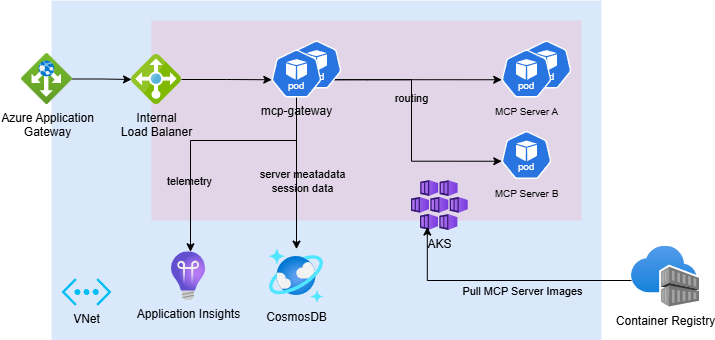
1. Prepare Cloud Development Environment
- An active Azure subscription with Owner access
- Install Azure CLI
2. Setup Entra ID (Azure Active Directory)
The cloud-deployed service requires bearer token authentication using Azure Entra ID. Follow these steps to configure an app registration.
Create and Configure the App Registration
Go to App Registrations
Click + New registration
- Name: Choose a meaningful name, e.g.,
mcp-gateway - Supported account types: Select Single tenant
- Click Register
- Name: Choose a meaningful name, e.g.,
Go to the app registration Overview and copy:
- Application (client) ID — this is your API Client ID for deployment
Expose an API (Define a Scope)
In the left menu, go to Expose an API
Click Add next to Application ID URI, and leave it as the default value:
api://<your-client-id>Click + Add a scope
- Scope name:
access - Admin consent display name:
Access MCP Gateway - Admin consent Description: Any brief description
- Click Add scope
- Scope name:
Authorize Azure CLI & VS Code as a Client Application
To allow Azure CLI & VS Code to work as the client for token acquisition.
- Still in Expose an API, scroll down to Authorized client applications
- Click + Add a client application
- Client ID:
04b07795-8ddb-461a-bbee-02f9e1bf7b46(Azure CLI) - Client ID:
aebc6443-996d-45c2-90f0-388ff96faa56(VS Code) - In Authorized scopes, select the scope
access - Click Add
- Client ID:
Configure Application Role for Authorization
3. Deploy Service Resources
Parameters
| Name | Description |
|---|---|
resourceGroup |
The name of the resource group. Must contain only lowercase letters and numbers (alphanumeric). |
clientId |
The Entra ID (Azure AD) client ID from your app registration. |
location |
(Optional) The Azure region where resources will be deployed. Defaults to the resource group's location. |
resourceLabel |
(Optional) A lowercase alphanumeric string used as a suffix for naming resources and as the DNS label. If not provided, it will be the resourceGroup name. Recommendation: Set this value as the default the same with resource group name and make sure resource group name contains only lower alphanumeric. |
The deployment will:
Deploy Azure infrastructure via Bicep templates
Resource Name Resource Type mgreg<resourceLabel> Container Registry mg-storage-<resourceLabel> Azure Cosmos DB Account mg-aag-<resourceLabel> Application Gateway mg-ai-<resourceLabel> Application Insights mg-aks-<resourceLabel> Kubernetes Service (AKS) mg-identity-<resourceLabel> Managed Identity mg-pip-<resourceLabel> Public IP Address mg-vnet-<resourceLabel> Virtual Network Deploy Kubernetes resources (including
mcp-gateway) to the provisioned AKS cluster
Note: It's recommended to use Managed Identity for credential-less authentication. This deployment follows that design.
4. Build & Publish MCP Server Images
The gateway service pulls the MCP server image from the newly provisioned Azure Container Registry (ACR) during deployment.
Build the MCP server image in ACR:
az acr build -r "mgreg$resourceLabel" -f sample-servers/mcp-example/Dockerfile sample-servers/mcp-example -t "mgreg$resourceLabel.azurecr.io/mcp-example:1.0.0"
5. Test the API - MCP Server Management
Import the OpenAPI spec from
openapi/mcp-gateway.openapi.jsoninto Postman, Bruno, or Swagger EditorAcquire a bearer token locally:
az account get-access-token --resource $clientIdSend a POST request to create an adapter resource:
POST http://<resourceLabel>.<location>.cloudapp.azure.com/adapters
Authorization: Bearer <token>
Content-Type: application/json
{ "name": "mcp-example", "imageName": "mcp-example", "imageVersion": "1.0.0", "description": "test", "requiredRoles": [] // Add entra id application role to restrict access }
6. Test the API - MCP Server Access
After deploying the MCP server, use a client like VS Code to test the connection. Refer to the guide: Use MCP servers in VS Code.
Note: Ensure VSCode is up to date to access the latest MCP features.
- To connect to the deployed
mcp-exampleserver, use:http://<resourceLabel>.<location>.cloudapp.azure.com/adapters/mcp-example/mcp(Streamable HTTP)
Sample
.vscode/mcp.jsonthat connects to themcp-exampleserver{ "servers": { "mcp-example": { "url": "http://<resourceLabel>.<location>.cloudapp.azure.com/adapters/mcp-example/mcp", } } }Note: Authentication is still required to access the MCP server, VS Code will help handle the authentication process.
- To connect to the deployed
For other servers:
http://<resourceLabel>.<location>.cloudapp.azure.com/adapters/{name}/mcp(Streamable HTTP)
7. Test Tool Registration and Dynamic Routing
Build & Publish a Tool Server Image
Build and push a tool server image to ACR:
az acr build -r "mgreg$resourceLabel" -f sample-servers/tool-example/Dockerfile sample-servers/tool-example -t "mgreg$resourceLabel.azurecr.io/weather-tool:1.0.0"
Register a Tool
Acquire a bearer token:
az account get-access-token --resource $clientId
Send a request to register a tool with its definition:
POST http://<resourceLabel>.<location>.cloudapp.azure.com/tools
Authorization: Bearer <token>
Content-Type: application/json
{
  "name": "weather",
  "imageName": "weather-tool",
  "imageVersion": "1.0.0",
  "useWorkloadIdentity": true,
  "description": "Weather tool for getting current weather information",
  "requiredRoles": [], // Add entra id application role to restrict access
  "toolDefinition": {
    "tool": {
      "name": "weather",
      "title": "Weather Information",
      "description": "Gets the current weather for a specified location.",
      "type": "http",
      "inputSchema": {
        "type": "object",
        "properties": {
          "location": {
            "type": "string",
            "description": "The city and state, e.g. San Francisco, CA"
          }
        },
        "required": ["location"]
      },
      "annotations": {
        "readOnly": true
      }
    },
    "port": 8000
  }
}
Verify Tool Deployment
Check the tool deployment status:
GET http://<resourceLabel>.<location>.cloudapp.azure.com/tools/weather/status
Authorization: Bearer <token>
Test Tool Routing via Tool Gateway Router
Use an MCP client (like VS Code) to connect to the tool gateway router:
Sample .vscode/mcp.json that connects to the tool gateway router:
{
  "servers": {
    "tool-gateway": {
      "url": "http://<resourceLabel>.<location>.cloudapp.azure.com/mcp"
    }
  }
}
Note: Authentication is required. VS Code will handle the authentication process.
The router will automatically route tool calls to the appropriate registered tool servers based on the tool name in the MCP request.
8. Clean the Environment
To remove all deployed resources, delete the resource group from Azure portal or run:
az group delete --name <resourceGroupName> --yes
9. Production Onboarding
TLS Configuration
Set up HTTPS on Azure Application Gateway (AAG) listener using valid TLS certificates.Network Security
Restrict incoming traffic within the virtual network and configure Private Endpoints for enhanced network security.Telemetry
Enable advanced telemetry, detailed metrics, and alerts to support monitoring and troubleshooting in production.Scaling
Adjust scaling formcp-gatewayservices and MCP servers based on expected load.Authentication & Authorization
Set up OAuth 2.0 with Azure Entra ID (AAD) for authentication.
Implement fine-grained access control using RBAC or custom ACLs foradapterlevel permissions.
Contributing
This project welcomes contributions and suggestions. Most contributions require you to agree to a
Contributor License Agreement (CLA) declaring that you have the right to, and actually do, grant us
the rights to use your contribution. For details, visit https://cla.opensource.microsoft.com.
When you submit a pull request, a CLA bot will automatically determine whether you need to provide
a CLA and decorate the PR appropriately (e.g., status check, comment). Simply follow the instructions
provided by the bot. You will only need to do this once across all repos using our CLA.
This project has adopted the Microsoft Open Source Code of Conduct.
For more information see the Code of Conduct FAQ or
contact [email protected] with any additional questions or comments.
Trademarks
This project may contain trademarks or logos for projects, products, or services. Authorized use of Microsoft
trademarks or logos is subject to and must follow
Microsoft's Trademark & Brand Guidelines.
Use of Microsoft trademarks or logos in modified versions of this project must not cause confusion or imply Microsoft sponsorship.
Any use of third-party trademarks or logos are subject to those third-party's policies.
Data Collection
The software may collect information about you and your use of the software and send it to Microsoft. Microsoft may use this information to provide services and improve our products and services. You may turn off the telemetry as described in the repository. There are also some features in the software that may enable you and Microsoft to collect data from users of your applications. If you use these features, you must comply with applicable law, including providing appropriate notices to users of your applications together with a copy of Microsoft’s privacy statement. Our privacy statement is located at https://go.microsoft.com/fwlink/?LinkID=824704. You can learn more about data collection and use in the help documentation and our privacy statement. Your use of the software operates as your consent to these practices.
Reviews (0)
Sign in to leave a review.
Leave a reviewNo results found