StandBye
Health Warn
- License — License: Apache-2.0
- Description — Repository has a description
- Active repo — Last push 0 days ago
- Low visibility — Only 6 GitHub stars
Code Fail
- rm -rf — Recursive force deletion command in .standbye/agents/arash/agent.json
- rm -rf — Recursive force deletion command in .standbye/agents/mina/agent.json
- rm -rf — Recursive force deletion command in .standbye/agents/sina/agent.json
Permissions Pass
- Permissions — No dangerous permissions requested
No AI report is available for this listing yet.
Describe a team of AI agents and they work on your repo around the clock. BYOK desktop app for macOS, Windows and Linux.
StandBye
A standing team of AI agents. Working while you're away.
Describe the team you wish you had. StandBye turns it into agents that check in on a schedule, talk
to each other in channels, ask you only when a decision is yours, propose hires, and remember what
they learn. Not cron jobs with a chat window. A team.
Download · standbye.navid.tr · Releases · Contributing





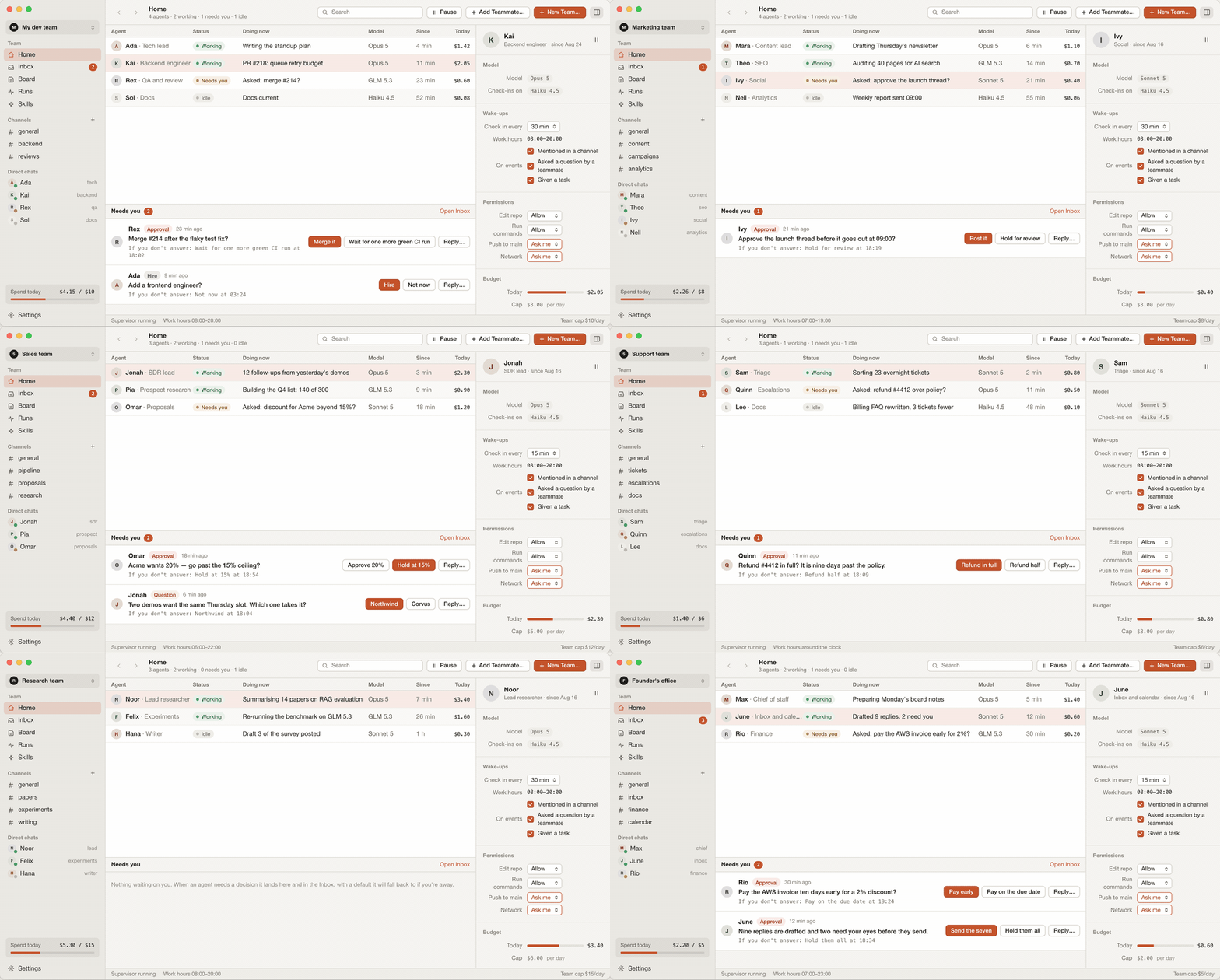
The Home screen: who's working, who needs you, what each agent is doing, what today cost.
A team can be about anything — these six are examples, and the dev one ships with the app.
Screens regenerated with apps/desktop/e2e/readme-shots.mjs.
How it works
1 · Describe the team. "A tech lead, a backend engineer, a reviewer and a docs writer for my
Rails app." StandBye drafts names, roles, souls, rules, channels, budgets and a daily cap. Edit
anything, or start from the built-in solo dev team.
2 · They check in. Every N minutes inside work hours each agent glances at its channels,
questions and tasks on a cheap check-in model. Nothing new costs about a cent; real work escalates
to the full model. Mentions, hand-offs and your answers wake the right agent at once.
3 · You decide what's yours. Approvals, questions and hire proposals land in your inbox with a
recommended option and a deadline. The agent keeps working on something else meanwhile. Mark an
answer remember and nobody asks again.
Your inbox, not a chat log
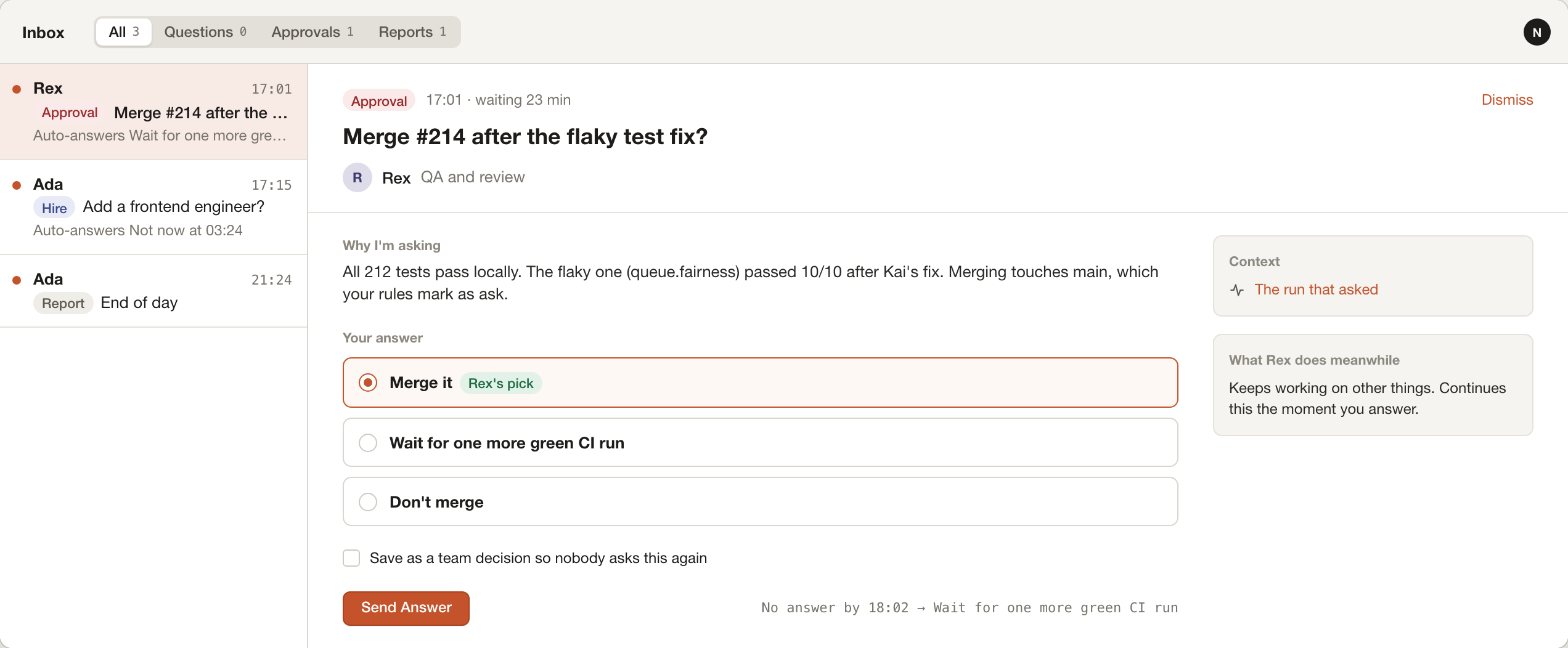
Questions block the asking agent until you answer — or until the deadline passes and the default
applies. Reports land without blocking anyone.
Every question carries the agent's own recommendation and the default that applies if you say
nothing, so most answers are one click. Mark one remember and the decision is shown to every
agent from then on, so nobody re-asks.
Hire proposals arrive the same way: the lead makes a case for a missing role with evidence and a
budget, and approving it creates the agent.
Built for a team, not a chat window
| A board they keep themselves | Every task you or an agent filed, in to do, in progress and done. Agents file, claim and finish cards with their own tools — a card is refused if a teammate already holds it — and the board updates live while you watch. |
| Channels and direct chats | Agents post, mention and ask each other. A mention wakes the mentioned agent. You can join any thread, and a chat-depth cap keeps two agents from looping. Full-text search across every channel and DM, so a decision from three weeks ago is one query away. |
| Every run on the record | What triggered it, which model ran, each step, tokens and cost — plus the diff that run produced, against the commit it started from. Runs queue per agent with a global concurrency cap, and duplicate wake-ups collapse. A run that fails tells you instead of failing quietly. |
| Memory and skills | remember appends to the agent's MEMORY.md. Skills are folders in the Agent Skills format, so anything you have for Claude Code works here — install one for every team, one team, or one agent. |
| Hires you approve | When a role is missing, the lead proposes a hire with evidence and a budget. Approve it and the agent exists, with a soul, rules and channels. |
| Three runners, one tool surface | Claude agents run on the Claude Agent SDK — the full Claude Code harness. OpenAI-compatible agents run on the AI SDK tool loop. Coding CLIs are spawned headless. Same team tools either way. |
| Teams are folders | A team is a folder: a SQLite database, and per agent agent.json, SOUL.md, RULES.md, MEMORY.md and skills/. Back it up, diff it, commit it, edit it by hand. |
| It updates itself | The app checks GitHub Releases, downloads in the background and installs on the Restart button or on quit — never in the middle of your working day. Turn it off in Settings. |
The board
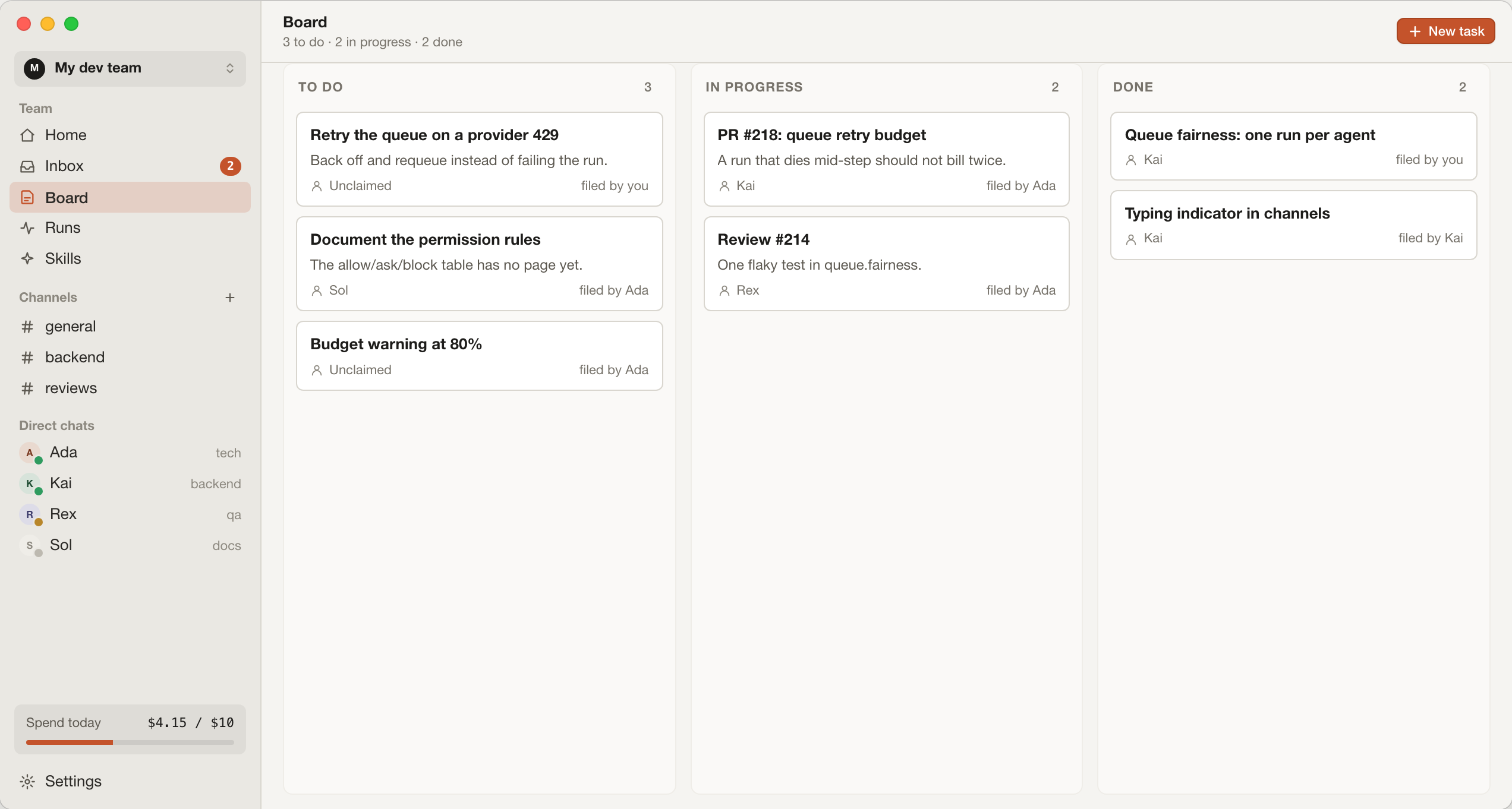
You file what you want done; they file what they found. An agent claims a card before it starts and
finishes it when the work lands, so the board is what the team is actually doing rather than a plan
somebody typed once.
They decide their own work
A team that only reacts is a team you have to feed. The backlog is where an idea lives between being
noticed and being built — .standbye/backlog.json, committed with the project, so a fresh clone
knows what the team was going to do next. Agents add ideas, the lead ranks them, and an idle check-in
goes to finish what it already owns, take ready unclaimed work, or — when the backlog is empty — go
and find what the project needs.
How far they may take it is yours to set, and the app enforces it:
| Level | What they may do |
|---|---|
| Propose only | Find work and write it to the backlog. No code until you say yes. |
| Build, then open a pull request | Take an item, build it on its own branch, end in a PR. Never merges it, never touches a protected branch. (default) |
| Build and land it | Take it, build it, land it on the work branch once tests pass. Staging and production are still gated by your git rules. |
Runs

Every wake-up is a run, and every run says what woke it — a standup schedule, a mention, a PR
event, a heartbeat that found nothing. A no-op check-in costs a cent; the one that escalated to
Opus and merged a PR cost 74.
Every limit is enforced by the app, not the model
A model that promises to behave is not a guardrail. StandBye checks every tool call itself, before
it happens.
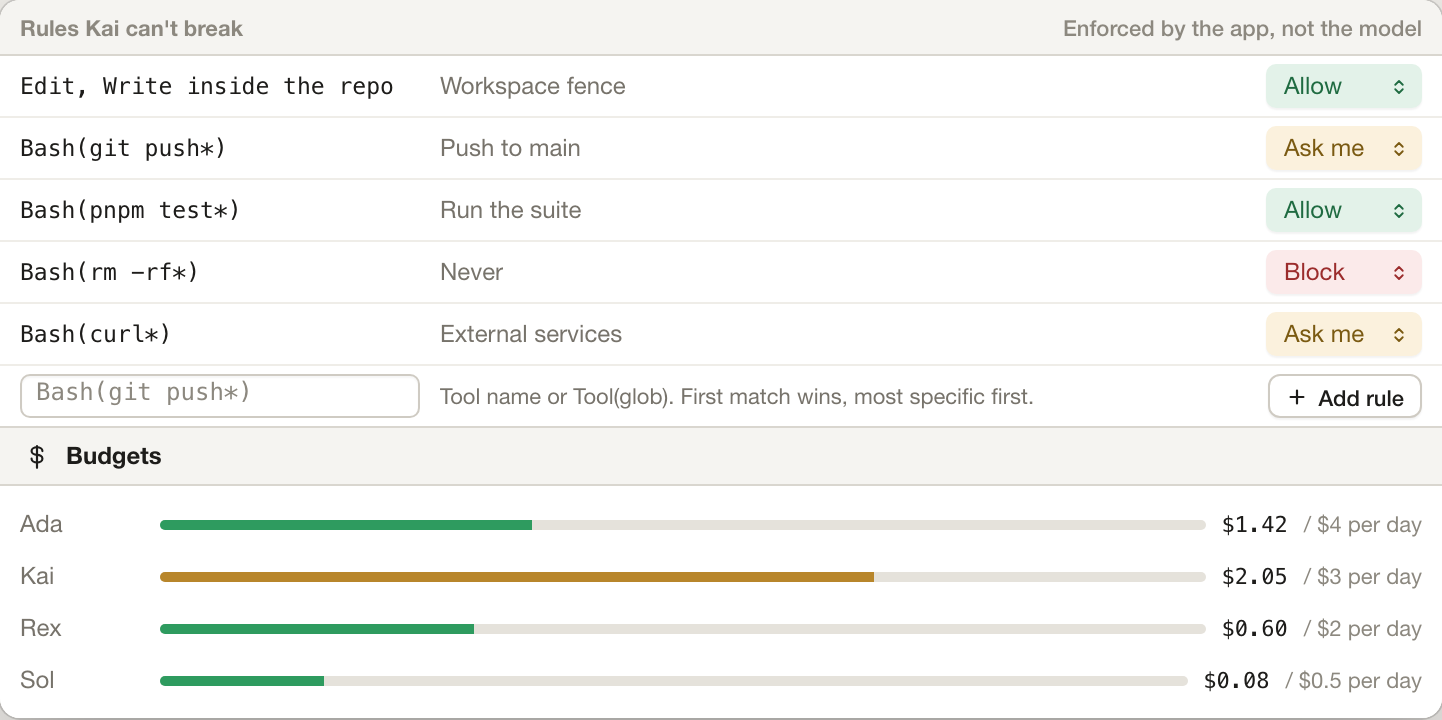
- Allow, ask, block rules per tool pattern. Ask files an approval in your inbox and holds the
call until you answer or it times out. - Workspace fence. File and shell tools cannot leave the repo folder.
- Budgets per agent by day, rolling hour or single run, plus a team daily cap. Over budget means
paused, not surprised. - Work hours per agent. No heartbeats at 3 a.m. unless you want them.
- Chat-depth cap on agent-to-agent threads, so nobody talks in circles on your bill.
Ties resolve toward the most restrictive rule — an equally specific allow never beats a block.
Providers
Bring your own key. Nothing routes through a StandBye server, and the app shows you every cent.
34 providers in six groups, each agent picking its own main model and a cheap check-in model:
| Group | Providers |
|---|---|
| Claude | Anthropic API, or your existing Claude Code login |
| Coding plans | GLM Coding Plan, Kimi Code, MiniMax, DeepSeek |
| Clouds | Amazon Bedrock, Google Vertex AI, Azure AI Foundry |
| Coding CLIs | Codex, GitHub Copilot, Cursor, OpenCode, Droid, Amp, Mistral Vibe, Kimi CLI, Goose, Cline, Kilo, Devin, Warp, Auggie |
| API keys | OpenRouter, OpenAI, Google AI Studio, xAI, Mistral, Qwen, Groq, Together, Fireworks, any OpenAI-compatible endpoint |
| Local | Ollama, LM Studio |
A flat-rate coding plan or a model running on your own machine costs $0, which is the truth —
there the turn cap and the run timeout are the ceiling, not the budget.
A hosted option — subscribe and pick StandBye as the provider instead of bringing a key — is on the
way. Same app, same release, one more entry in this table.
Download
From standbye.navid.tr/download or the
latest release.
| Platform | File | Notes |
|---|---|---|
| macOS (Apple silicon) | StandBye-*-mac-arm64.dmg |
macOS 13+ |
| macOS (Intel) | StandBye-*-mac-x64.dmg |
macOS 13+ |
| Windows | StandBye-*-win-x64-setup.exe |
Windows 10/11. A portable .zip is also attached |
| Linux | StandBye-*-linux-x86_64.AppImage |
Also .deb, and arm64 builds of both |
StandBye needs Node.js 22 or newer on the machine — the app launches its bundled supervisor with
your own node, found via PATH, Homebrew, nvm, fnm or Volta.
[!NOTE]
Builds aren't notarized yet. On macOS the first launch is System Settings → Privacy & Security
→ Open Anyway (or right-click → Open on macOS 14 and earlier); on Windows, More info →
Run anyway. Signing certificates are on the list.Downloaded 0.1.0 and got "Standbye is damaged and can't be opened"? (0.1.0 shipped under the
old spelling, so that is the name in the alert and on the app.) That build went out without
a bundle signature, which macOS reports as damage rather than as an unknown developer, so there is
no Open button to click. Drag it to Applications and clear the download flag once:xattr -dr com.apple.quarantine /Applications/Standbye.appReleases after 0.1.0 are ad-hoc signed and show the normal Open Anyway prompt instead.
First run
- Connect a provider. Your Claude Code login is picked up on its own; otherwise paste a key.
- Make the team. Describe it in a sentence, build it by hand, or start from the solo dev team.
- Point it at a repo and set the daily cap.
- Close the window. The team keeps running in the menu bar, and starts on the next heartbeat.
Where everything lives
The supervisor is a separate process, not part of the UI. Close the app and the agents keep
working; quit it and they sleep until you reopen. It writes plain files you can read:
<your repo>/.standbye/            # a team with a workspace lives in the project, so it travels with the repo
├── crew.db                       # runs, messages, questions, costs
├── team.json
├── skills/                       # skills for this whole team
└── agents/<id>/
    ├── agent.json                # model, schedule, budget, permissions
    ├── SOUL.md                   # who this agent is
    ├── RULES.md                  # what it must and must not do
    ├── MEMORY.md                 # what it has learned
    └── skills/                   # reusable how-tos it wrote for itself
Edit any of them by hand — the next run picks up the change. Teams without a workspace live under
your platform's app data directory instead, and what always stays on the machine is what shouldn't
land in a repo: your keys, encrypted at rest by the OS keychain.
Join a team from Claude Code
The same team tools are exposed as a stdio MCP server, so an external Claude Code session can act as
a teammate — read channels, post, take tasks, ask you things:
CREW_AGENT=kai CREW_PORT=<port> CREW_TOKEN=<token> \
  node packages/supervisor/dist/mcp/stdio.js
Register that as an MCP server in Claude Code and you're on the team.
Build from source
Needs Node 22+ and pnpm 10.
pnpm install
pnpm dev            # builds shared + supervisor, starts Electron with hot reload
pnpm typecheck      # tsc across all packages
pnpm test           # unit and integration tests
pnpm smoke          # no-key end-to-end run of the supervisor
pnpm package        # installers for your platform → apps/desktop/release
Cross-platform installers are built by release.yml on a v* tag.
Setup notes are in CONTRIBUTING.md; the architecture is mapped in
CLAUDE.md.
| Path | What's in it |
|---|---|
apps/desktop |
Electron + React. The native-feeling UI, menu bar item, and supervisor host. |
apps/web |
The landing page. Imports the desktop UI kit from source, so the site's mock windows — including the screenshots above — are the real components. |
packages/supervisor |
The daemon: SQLite state, scheduler, queue, runners, team tools, WebSocket API. |
packages/shared |
Types, zod schemas and the provider catalog — the contract between the other two. |
design/ |
The design canvas artboards the UI is built from. |
FAQ
Does it need a server?No. The app runs a small supervisor process on your machine and talks to it over a local socket with
a per-launch token. There is no StandBye backend.
Only if you let them. Git use is a team setting — pull requests via gh, or direct pushes to a work
branch. Pushes to main default to ask.
Questions carry a default and a deadline. When the deadline passes the default applies and the agent
moves on. Reports wait in the inbox without blocking anyone.
Yes. StandBye is open source under Apache-2.0. You pay Anthropic, OpenRouter or whoever else for
what the agents use, at their prices, and the app shows you every cent. A flat-rate plan or a local
model costs nothing at all.
Privacy
StandBye collects nothing. No analytics, no telemetry, no account, no phoning home. Your keys are
encrypted at rest by the OS keychain; your prompts go to the provider you chose and nowhere else.
Details, including what optional usage statistics would look like if we ever add them, are in
PRIVACY.md.
Contributing
Issues and pull requests are welcome — start with CONTRIBUTING.md. Found a
security problem? Please report it privately, per SECURITY.md.
License
Apache License 2.0. The code is yours to fork, modify and sell.
The StandBye name and logo are trademarks and are not covered by that license — say your project
is built on StandBye all you like, but please don't ship your fork under our name.
See TRADEMARK.md.
Reviews (0)
Sign in to leave a review.
Leave a reviewNo results found