Engram
Health Pass
- License — License: MIT
- Description — Repository has a description
- Active repo — Last push 0 days ago
- Community trust — 24 GitHub stars
Code Warn
- network request — Outbound network request in api/server.ts
- network request — Outbound network request in examples/basic.ts
- process.env — Environment variable access in lib/config.ts
Permissions Pass
- Permissions — No dangerous permissions requested
This tool provides a persistent memory layer for AI agents, allowing them to store observations and retrieve relevant context using semantic similarity. It automatically manages data by pruning expired entries based on configurable time-to-live (TTL) settings.
Security Assessment
Overall risk: Low. The server makes outbound network requests to communicate with its required vector database backend (either a local ChromaDB instance or an in-memory store). It accesses environment variables strictly for loading standard configuration settings, such as choosing the storage backend. The codebase does not execute arbitrary shell commands, does not request dangerous permissions, and contains no hardcoded secrets. All inputs are validated with Zod schemas, which safely prevents injection vulnerabilities.
Quality Assessment
The project demonstrates strong health indicators. It is actively maintained (last push was today), uses a permissive MIT license, and provides a clear, detailed README with robust quickstart and integration guides. While it has a modest community footprint with 24 GitHub stars, the codebase relies on a solid, modern stack (Bun, Zod, Docker) and includes dedicated tests that run without external dependencies.
Verdict
Safe to use — a well-structured, actively maintained memory utility with low security risks, provided you securely configure your environment variables.
Persistent RAG memory layer for AI agents - store observations, retrieve context by semantic similarity, self-prune on TTL
Engram



A RAG memory system for AI agents. Store observations, retrieve relevant context by semantic similarity, and let your agents learn from what they've seen before.
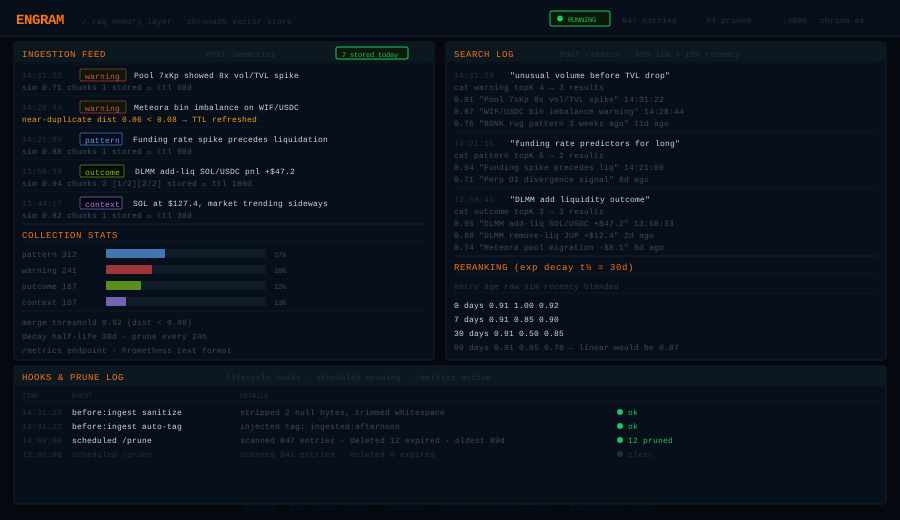
What it solves
Stateless agents repeat the same mistakes. They evaluate the same bad pool twice, miss a pattern they've seen forty times, and have no way to carry knowledge from one cycle to the next.
Engram gives agents a persistent memory layer with a simple contract: POST what you observe, GET what's relevant when you need to decide. Entries expire automatically, near-duplicates merge, and results are reranked by both semantic relevance and recency.
API
# Store a memory
POST /memories
{
  "category": "warning",
  "content": "Pool 7xKp showed 8x volume/TVL spike before 31% TVL drop",
  "poolAddress": "7xKp...",
  "tags": ["wash-trading", "volume-spike"]
}

# Retrieve relevant memories
POST /search
{
  "query": "unusual volume before TVL drop",
  "topK": 4,
  "category": "warning"
}

# Prune expired entries
POST /prune

# Store statistics
GET /stats
Memory categories & TTL
| Category | TTL | Use for |
|---|---|---|
pattern |
90 days | Recurring market behaviours |
warning |
60 days | Pool-specific red flags |
outcome |
180 days | Execution results with PnL |
context |
30 days | Ephemeral shared state |
Entries with cosine similarity > 0.92 are merged instead of duplicated.
Quickstart
git clone https://github.com/YOUR_USERNAME/engram
cd engram
bun install
docker-compose up chromadb -d
bun run dev
No Chroma? Set STORE_BACKEND=memory in .env to use the in-memory backend — no Docker needed. Tests always use the in-memory backend.
bun run example    # run examples/basic.ts against the live server
bun run test       # vitest — no external dependencies required
Hooks
Register lifecycle hooks to transform data before/after storage:
import { registerHook } from "./hooks/index.js";

// Enrich every memory with a source tag before storing
registerHook("before:ingest", (req) => ({
  ...req,
  tags: [...(req.tags ?? []), "auto-tagged"],
}));
Available events: before:ingest · after:ingest · before:search · after:search
Reranking
Search results blend cosine similarity (85%) with a recency signal (15%). This prevents old high-similarity patterns from dominating over fresh warnings. The weights are tunable in retrieval/ranker.ts.
Stack
- Runtime: Bun 1.2
- Vector store: ChromaDB
- Schemas: Zod — full validation on all inputs
- Deduplication: cosine similarity merge at 0.92 threshold
- Chunking: 1000-char chunks with 100-char overlap
Technical Spec
Vector Store — ChromaDB HNSW
Engram uses ChromaDB's default HNSW index (hnswlib). Relevant parameters:
| Parameter | Default | Effect |
|---|---|---|
M |
16 | Graph connectivity — higher = better recall, more RAM |
ef_construction |
200 | Build-time search width — higher = better index quality, slower build |
ef_search |
100 | Query-time search width — raise for higher recall at cost of latency |
For a store with < 50k entries, defaults are fine. Above 100k entries, raise ef_search to 150–200 to maintain recall.
Near-Duplicate Merge
Chroma returns cosine distance (0 = identical, 2 = maximally dissimilar). The merge threshold is:
similarity = 1 − distance
merge if distance < 1 − 0.92 = 0.08
When a near-duplicate is detected, Engram refreshes the existing entry's expiresAt rather than inserting a duplicate. This prevents the same recurring observation (e.g., pool warning seen 20× in a week) from bloating the collection with semantically identical entries.
Reranking Formula
Results blend cosine similarity with a recency signal using exponential decay (half-life 30 days):
recencyScore = exp(−age / 30d_in_ms)
blended = similarity × 0.85 + recencyScore × 0.15
A 90-day-old entry scores exp(−3) ≈ 0.05 on recency. With linear decay it would score 0.33 — enough to displace a fresh warning with slightly lower similarity. Exponential decay prevents this.
TTL Enforcement
TTL is applied at two points:
- On search — entries past
expiresAtare filtered out before results are returned (no Chroma re-query needed) - On prune —
POST /prune(or scheduledPRUNE_INTERVAL_HOURS) does a full collection scan and deletes expired IDs in batch
Prune is O(n) on collection size, so schedule it during low-traffic periods on large stores.
Chunking Strategy
Input text is split at sentence boundaries (. followed by space) to preserve semantic coherence:
- Max chunk size: 1000 chars (~250 tokens — well within the 512-token embedding model limit)
- Overlap: 100 chars — ensures context at chunk boundaries doesn't vanish
- Multi-chunk entries are prefixed
[1/3],[2/3], etc. for debugging
/metrics Endpoint
GET /metrics returns Prometheus-compatible text:
engram_entries_total 847
engram_entries_by_category{category="pattern"} 312
engram_entries_by_category{category="warning"} 241
engram_entries_by_category{category="outcome"} 187
engram_entries_by_category{category="context"} 107
engram_pruned_total 94
License
MIT
Reviews (0)
Sign in to leave a review.
Leave a reviewNo results found