commitlore
Health Warn
- License — License: MIT
- Description — Repository has a description
- Active repo — Last push 0 days ago
- Low visibility — Only 5 GitHub stars
Code Fail
- fs module — File system access in .github/workflows/ci.yml
- process.env — Environment variable access in action/lint/action.yml
- fs module — File system access in action/lint/action.yml
- spawnSync — Synchronous process spawning in action/lint/lint.mjs
- process.env — Environment variable access in action/lint/lint.mjs
- spawnSync — Synchronous process spawning in action/preserve/preserve.mjs
- process.env — Environment variable access in action/preserve/preserve.mjs
Permissions Pass
- Permissions — No dangerous permissions requested
No AI report is available for this listing yet.
Git-native decision memory for Claude Code, Codex, Cursor and other coding agents. Preserve constraints and rejected alternatives; surface only the decisions still in force.


CommitLore
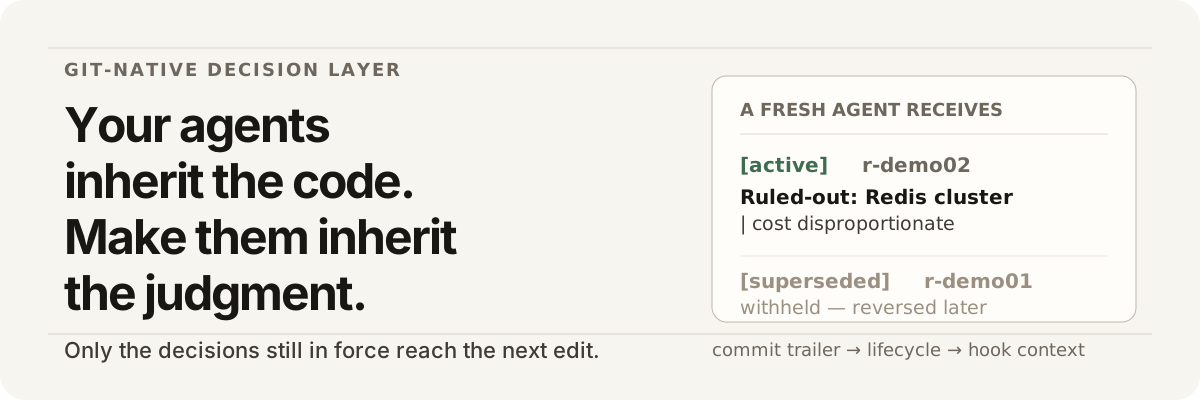
Your agents inherit the code.
Make them inherit the judgment.
The Git-native decision layer for coding agents.
Every fresh agent inherits the implementation. None of them inherit the
constraints, the alternatives your team rejected, the warnings, or the
verification gaps — those do not travel with the code unless something carries
them.
CommitLore preserves that engineering judgment in Git, and surfaces only the
decisions still in force before the next edit. A decision that was later
superseded or expired does not reach the agent as if it still stood.
Repository-owned · Lifecycle-aware · Evidence-verified · Agent-independent
Claude Code · Codex · Cursor · Gemini CLI · OpenCode · Windsurf
No hosted memory service. No vendor-specific chat history. Just reviewable decision context, owned by and portable with the repository.
Install once. Your coding agent can record the decisions worth carrying forward, while CommitLore validates and preserves them in Git.
Claude Code — one plugin registers the MCP server, the pre-edit context hook and the skills:
/plugin marketplace add MongLong0214/commitlore
/plugin install commitlore@commitlore
That is the whole plugin: the MCP server, the pre-edit hook and the skills. It puts no commitlore on PATH, so the commitlore … commands below come from install.sh / install.ps1 and need that install as well.
Prerequisites for either path: Node.js 22+ and Git. The script checks both before it writes anything.
Any other coding agent — install the CLI:
curl -fsSL https://raw.githubusercontent.com/MongLong0214/commitlore/v0.7.0/install.sh | sh
Which hosts are supported, and what each install path requires: docs/COMPATIBILITY.md.
Give your next agent the judgment your last one earned.
The code survived. The decision didn't.
Stop re-reviewing the same bad idea.
Without CommitLore. A new session sees two functions with similar inputs and
reuses one.
calculatePrice(input, { isAdminPreview: true, skipCoupon: true });
The team now has another flag, another wrapper, and another compatibility branch
protecting a use case the function was never meant to own. The reviewer writes
"we already rejected this" for the second time.
With CommitLore. Before editing, the agent receives:
commitlore: active records for src/pricing.ts

Limit
  [claim]      r-price01  87e36511  calculatePrice owns final checkout pricing only

Ruled-out
  [claim]      r-price01  87e36511  Reuse checkout pricing for admin quotes | eligibility
                                    and rounding semantics differ between the two flows
[claim] is doing real work: this record was not written by a trusted author of
the repository, so the agent is told to treat it as information rather than as an
order. A record that was signed by a trusted author renders as [directive].
The module boundary is in front of the agent before it proposes the change,
rather than in a review comment after.
Whether it acts on that is now measured. Across 1,160 registered runs, an
agent handed the repository's active records re-proposed a ruled-out approach in
2.8% of them (16/580). Without them: 18.8% (109/579).
| arm | re-proposed a ruled-out approach |
|---|---|
| the agent alone | 18.8% (109/579) |
| with CommitLore | 2.8% (16/580) |
The threshold was registered before the run, and the preregistration
predicted a smaller effect than it got — that prediction, with its stated
probabilities, is in
bench/PREREGISTRATION-M5.md §A.2, and it was
wrong. The significance test, the interval and the registered threshold are in
bench/VERDICT-M5.md rather than here: a statistic
retyped into prose drifts from the log that produced it, and this repository
gates against exactly that (scripts/check-readme-numbers.mjs).
Three limits belong beside the number. Every record in that run rendered[claim], with the payload telling the agent not to act on it as an order — the[directive] tier became reachable only afterwards, so this measures the
weaker of the two. It is one model, one harness, and ten constructed
fixtures. And the oracle reads the final implementation state: it shows agents
which received records re-proposed less often, not that any of them read
anything. Method, exclusions and the per-arm truncation split:
bench/VERDICT-M5.md and
what it does not show.
See it work
A fresh agent. Zero chat history. It is still handed why the obvious fix was rejected. Query a path before changing it:
commitlore context install.sh
The output includes the active record that ruled out publishing a -musl target as the fix for the installer defect, including its reason. The hook returns context; it does not claim to block the edit.
context for install.sh as of <timestamp> — 0 limits, 1 ruled-out, 1 warnings, 2 other in 1 record (no index, 1 commit record(s) scanned)

ruled-out
  r-instci99a  <commit>  [claim]  Publish a -musl release target | a release.yml/build-matrix change, not an install.sh or CI-verification fix

warnings
  r-instci99a  <commit>  [claim]  Revisit this wording if a musl target ships
Reproducing that exact PreToolUse hook path, and every other command: docs/cli.md.
The repository is the demo
A tool that claims to stop agents re-deciding settled questions should be able
to show what it caught in itself. This one keeps that list in public, including
the entries where the thing that turned out to be false was something this
project had already published:
- No install could produce the trust tier the README's claims rested on. Records reach an agent graded
directiveorclaim. It turned out no installed surface configured a trusted author, so grading failed closed toclaimfor everyone — while the injected legend advertised the tier nobody could reach. Both prior benchmarks had measuredclaim-graded delivery (#415). - The registered benchmark analysis would have read four different experiments at once — and because its stopping rule was a row count, the contamination would have made the study pass its own completeness gate (#441).
- The result-schema gate was not run by anything, so the schema drifted five fields behind the runner and nobody noticed for two days (#392).
- A shipped pre-push hook hung every
git push— 1,240 hook invocations in 40 seconds — because the function had been tested eleven times and the hook path zero times (#422).
Every one of those is a Ruled-out:, Warn: or Limit: line in a commit
trailer, validated by the hook this project asks you to install, and readable
with the same commitlore context you would run anywhere else.
The full list, with what each one cost: docs/SELF-AUDIT.md.
Try it in a repository
Then run commitlore init in each repository where you want validation hooks and a local index. The installer detects supported coding agents and registers the local MCP server where it can do so safely.
cd your-repository
commitlore init
commitlore context .
After that:
- Commit normally. Most commits carry no record.
- If a record is present, the commit-msg hook validates it; it never creates one.
- Agents query decision context through MCP or receive it from the
PreToolUsehook. - Before changing a path, they see its active limits, ruled-out alternatives, warnings, and verification gaps.
Keep working through your coding agent. When a change contains decision context the diff cannot preserve, ask the agent to include a CommitLore record in the commit.
Prefer to inspect or pin the installation?The one-liner is for convenience. For a reviewed or pinned install, download and inspect install.sh first, or clone the repository. The script installs a pinned source checkout and a thin wrapper that runs node <checkout>/dist/commitlore.mjs — it downloads no compiled artifact and runs no build step, so what it puts on your machine is the source you can read.
# Pin and inspect the installer before executing it.
curl -fsSLO https://raw.githubusercontent.com/MongLong0214/commitlore/v0.7.0/install.sh
sh install.sh v0.7.0

# Or skip the script entirely: the checkout it makes is one you can make yourself.
git clone --depth 1 --branch v0.7.0 https://github.com/MongLong0214/commitlore
node commitlore/dist/commitlore.mjs --version
Retrieval can find records. Path scope keeps reversed decisions out.
Before an agent's first edit, how much of a repository's still-active decision set actually reaches it? On this repository, at the 800-token budget the hook ships with:
| route | budget | active decisions delivered | reversed ones delivered | tokens |
|---|---|---|---|---|
| the code alone | — | 0.0% | 0 | 0 |
git log for the path |
800 | 42.0% | 7 | 673,134 |
| CommitLore path scope | 800 | 81.7% | 0 | 511,412 |
| CommitLore, cap removed | none | 92.3% | 0 | 741,429 |
With the cap removed, path scope recovers exactly what a whole-repository dump recovers — 2,047 of 2,217 — for a fraction of its 92,175,612 tokens and none of its 7,322 reversed records. The scope costs nothing. The cap costs 10.6 points. The remaining 170 are records the trust grader withholds.
This measures delivery, not effect. No agent ran, so it bounds what one could recover, not what one does — and a retrieval number can climb while the outcome it is meant to predict falls. SWE-bench measured BM25 recall rising from 29.58 to 51.06 across its context budgets and reported that "even when increasing the maximum context size for BM25 would increase recall with respect to the oracle files, performance drops … as models are simply ineffective at localizing problematic code" (arXiv:2310.06770). One corpus, one repository. Seven superseded records and no expired ones, so zero-reversed-delivered says nothing yet about expiry. Method and full tables: bench/DECISION-DELIVERY.md.
The git log baseline is not an artifact of measuring ourselves. The same measurement on four repositories this project did not write — Django, SymPy, scikit-learn and Requests, at pinned commits — puts the share of a path's history that survives an 800-token cut between 37.4% and 55.6%. The 42.0% above sits inside that band. Losing something close to half a file's history to a fixed budget is what git log does on large, long-lived repositories generally, not something peculiar to this one. What did not transfer is the mechanism: our paths carry a median of one commit at 687 tokens where Django's carry eight at 213, so long commit messages make the ordinary-Git baseline worse at a fixed budget — a cost of this project's own practice. bench/EXTERNAL-CORPUS.md also reports a delivery figure on those repositories; read §9.0 and §9.5 first, because the records there were generated from revert commits by a program and the headline number is one the attachment predicate forces rather than a retrieval result.
Missing a record costs the model context. Handing it a decision that was already reversed costs it correctness. In this retrieval measurement, at every size from 0 to 10,000 distractors, BM25, embedding top-k, hybrid RRF, and embedding with a path filter each returned one superseded record. CommitLore path scope with lifecycle returned zero stale records and both current records (2/2).
Recall is the supporting result: retrieval finds broadly the same records either way, but only one route knows which are still current. The advantage appears when decisions have been reversed—the case this product exists for.
The separate #167 exposure run still matters: only 2 of 10,002 records reached the model.
| route | model-visible records | relevant records | model-visible tokens |
|---|---|---|---|
| inject everything | 10,002 | 2/2 | 1,004,554 |
| top-k lexical | 2 | 1/2 | 190 |
| CommitLore path scope | 2 | 2/2 | 335 |
This measures exposure and recall at a fixed two-record output budget—not token cost, billed cost, accuracy, or agent behaviour. It is one corpus, one query, and one pinned embedding model. Where recall ties, and what else has and has not been measured: docs/evidence.md.
How it works
- Capture — the agent drafts only the decision context a diff cannot show.
- Verify — CommitLore checks that draft against the session and the staged diff.
- Preserve — the verified record lives in Git, with identity and a lifecycle.
- Deliver — before editing a path, the next agent receives only the decisions still in force.
What it looks like on a real repository
From a field report on a ~768-commit Swift MCP server, one day after installing.
Naming one file path surfaced a merged pull request the engineer did not know
existed, and it changed what the surviving code meant.
I did not know that commit existed. It is a merged PR from two weeks
earlier that had already removed eight of these sites and replaced each with
an accessibility-native equivalent, every one fail-closed and live-verified.None of this was in any chat history. It was in the repository, and I got it
by naming a file path.
The alternative was reading two weeks of merged pull requests to find it. That is
not something an agent does spontaneously, and not something a person does before
every edit. Adoption cost, from the same report: one command, and 7.4 seconds to
index 768 commits. Nothing touched history or the working tree. The console
output and the full report are in docs/evidence.md.
That was a 768-commit repository. At 100,000 commits an indexed context query
answers in 496 ms at p50, and the hooks behind it cost 185.85 ms p50 forcommit-msg and 102.40 ms p50 for the injection hook. Those are the numbers that
decide whether this stays installed on a large repository, and they are measured
rather than asserted. The same run carries the figure that looks bad: without the
index, that query at 100,000 commits takes 86,673 ms. The index is not an
optimisation on top of a working query — it is what makes the query possible at
that size, which is why init builds one and doctor checks it.
Three properties no hosted chat-history product can offer, and the reason the
authority is Git rather than a service:
- Reviewable. A decision arrives as a commit trailer in a pull request, where
it can be argued with before it becomes authority. - Owned by the repository. No account, no vendor, nothing to lose access to.
- Travels with a clone. A new machine, a new contributor, or a new agent gets
the decisions with the code.
What makes it different
| Tool | What it remembers |
|---|---|
CLAUDE.md / AGENTS.md |
how the agent should work |
| ADRs | large architecture decisions, as documents |
| Chat memory / RAG | related text from the past |
| Lore | the same idea, published first — decision records in git trailers |
| CommitLore | which decisions still apply to this code path |
Similarity search can find a related decision. CommitLore also knows whether that
decision is still active, superseded, or expired — and shows only the first.
On that third row. Lore (March 2026)
proposed decision records in native git trailers four months before this
repository existed, with a vocabulary that maps almost one-to-one onto this one.
The protocol idea is not novel here and saying otherwise would not survive anyone
reading the paper. What Lore has no counterpart for is the lifecycle —Supersedes: and Expires:, and the filtering that makes the row above true —
or the trust grading; and it states that it "outlines an empirical validation
path" rather than running one. That validation, including the parts that failed,
is what this project has that the paper does not
(ADR-0029).
The authority is ordinary commit trailers and refs/notes/commitlore. Indexes and reports are derived and rebuildable from those Git records.
Where it pays off
Protect a module boundary. "calculatePrice owns final checkout pricing only. Do not reuse it for admin previews."
Preserve a rejected workaround. "Raising the timeout hides the connection leak. Fix the cleanup path instead."
Mark temporary compatibility code. "This caller is temporary and is not part of the supported contract."
Carry a verification gap. "Single-user behaviour was tested. Concurrent refresh remains unverified."
Each is a sentence a diff cannot carry and a reviewer would otherwise have to say twice.
How records get created
You do not hand-write a trailer for every commit. Most commits should carry no record at all. Add one only for a decision the diff cannot recover: an external constraint, a rejected alternative, a warning, or a verification gap.
Ask the agent to commit normally and preserve only the decision context the diff cannot explain:
Commit this change. Add a CommitLore record only if the diff cannot recover an important constraint, rejected alternative, warning, or verification gap.
The agent instructions live in skills/commitlore-commits/, and the commit-msg hook validates any record the agent adds — it never invents or silently adds one. The harvest route, the capture transaction, and the escape hatch of writing trailers by hand are all in docs/capture.md.
A complete record
A record can be much smaller than this; most need only a few fields. This one uses the whole vocabulary because it is also a conformance fixture — Git's trailer parser reads the code block identically in every translated README.
Prevent silent session drops during long-running operations

The auth service returns inconsistent status codes on token
expiry, so the interceptor catches all 4xx responses and
triggers an inline refresh.

Limit: Auth service does not support token introspection
Record-Id: r-4b7e21
Ruled-out: Extend token TTL to 24h | security policy violation
Ruled-out: Background refresh on timer | race condition
Certainty: firm
Blast: module
Undo: easy
Warn: 4xx handling is intentionally broad
  -- do not narrow without verifying upstream behavior
Verified: Single expired token refresh (unit)
Unverified: Auth service cold-start > 500ms behavior
CommitLore-Version: 2.0.0
Protocol vocabulary
| Trailer | Meaning |
|---|---|
Limit: |
External condition that constrained the decision |
Record-Id: |
Stable identity across rewritten commit hashes |
Ruled-out: |
alternative | reason — the first | separates; there is no escape, so an alternative may not contain one |
Certainty: |
firm | tentative | guess |
Blast: |
local | module | system |
Undo: |
easy | costly | permanent |
Warn: |
Warning for a future modifier; trust-graded before delivery |
Verified: / Unverified: |
What was and was not checked |
Follows: / Supersedes: |
Decision-chain and lifecycle links |
Expires: |
Date or condition that ends a limit |
Evidence: |
Path, anchor, or URL supporting a claim |
Provenance: |
authored | inherited <sha> | reconstructed |
CommitLore-Version: / X-*: |
Protocol identity and extensions |
Read a path's history with commitlore context <path>. Smaller examples, and how to read records with plain Git instead, are in docs/protocol.md; the normative definitions are in SPEC §3.
What the repository proves
- Decision history survives rebase, squash, remote transfer, and path renames in the tested Git workflows.
- Every route uses the same trust grading, so untrusted text is information rather than an instruction.
- Injection-like text in free-form trailers is withheld from model-readable routes.
- A readable repository with no records is distinct from incomplete history or an unfetched notes mirror.
These are product claims about Git-bound, human-verifiable decision history. They do not depend on a claim that CommitLore improves agent performance.
Evidence: a narrower product claim
112 experiments were recorded, but M4 recorded no per-run guard exposure. Whether the treatment was present is unverifiable, so it does not test, support, or refute the agent-behavior claim. The narrower product claim above rests on independently testable behavior; read the M4 verdict for the clean dataset and withdrawal.
What is measured — retrieval, exposure, latency and scaling, hook overhead — and what is not — break-even, and any effect on agent behaviour — is set out in docs/evidence.md.
Full benchmark record (112 experiments)112 runs recorded. No manifest declares how many runs the matrix was meant to produce, so completeness cannot be checked from the logs alone.
| Where it comes from | |
|---|---|
| Results | bench/results/t702-m4-final.jsonl (112 rows) |
| Run id | 20260727T120103Z-aa5eab, 20260728T025523Z-db4659, 20260728T025635Z-e3d669, 20260728T025817Z-d8d0dc |
| Driver | claude-headless |
| Model | not recorded |
| Matrix | 8 tasks, seeds 1, 2, 3, 4, 5, 6, 7 |
| Status | final (declared in bench/report.ts, pending a manifest field) |
Re-proposal and violation rates, every recorded run:
| Condition | n | Re-proposed | Re-proposal rate | Runs with violations | Violation rate | Mean turns | Mean tokens |
|---|---|---|---|---|---|---|---|
commitlore-guard |
56 | 41 | 0.732 | 0 | 0.000 | 14.8 | 18965 |
commitlore-on |
56 | 35 | 0.625 | 0 | 0.000 | 14.2 | 18091 |
Analysis set — all 112 rows. Nothing was excluded: no simulated rows, no failed runs, no run that never started.
Significance: not computed — guard exposure is unknown for 112 analysis rows
How the runs ended — failures are reported, not filtered:
| Condition | completed | timeout | over-turns | over-tokens | error |
|---|---|---|---|---|---|
commitlore-guard |
56 | 0 | 0 | 0 | 0 |
commitlore-on |
55 | 0 | 1 | 0 | 0 |
Read these numbers with their limits:
- No model is recorded — neither on the rows nor in a manifest. A re-proposal rate whose model is unknown is not a comparable number, and these figures must not be quoted against another model's.
- Every rate here is conditional on the model that produced it. Re-proposal is a behaviour, and behaviours differ between models, so these figures are not evidence about any other model.
- 112 runs in the analysis set: this matrix is only powered to detect a large effect, so a non-significant result from it is a statement about the sample size, not about CommitLore. The exact power table is in
bench/README.md.
Uninstall
commitlore uninstall
Removes what install.sh or install.ps1 wrote — the wrapper, the pinned
checkout, and the MCP entry it added to each agent config. It removes nothing it
did not write, and names what it leaves: the per-repository hooks, the agent
hook, and the Claude Code plugin. --dry-run reports without changing anything.
What removes each of those, and how to run from a source checkout instead:
docs/install.md.
Documentation
- docs/install.md — the install paths, what each one writes, and how to undo it
- docs/cli.md — every command, with its flags
- docs/capture.md — how a record gets written
- docs/protocol.md — the record format, and reading it with plain Git
- docs/evidence.md — what is measured, and what is not
- spec/SPEC.md — the normative protocol
Known limitations
- Cryptographic author verification, repository-wide record coverage, symbol anchors, and an interactive record builder are not implemented yet: #28, #32, #33, #34.
- M4 did not test a guard effect: its rows have no
guard_exposure, so treatment exposure is unverifiable (#122). - Guard (ruled-out alternative matching) is an experimental advisory: precision 44.8% (95% Wilson CI 32.7%–57.5%), recall 22.0% on the 417-decision corpus (ADR-0020). An empty guard result does not guarantee a proposal avoids all ruled-out alternatives — at 22% recall, a miss is the common case.
Contributing
Read the spec, the ADRs, and CONTRIBUTING.md. CommitLore is free forever and open source under the MIT License.
Reviews (0)
Sign in to leave a review.
Leave a reviewNo results found