claude-vibe-squad
Health Warn
- License — License: AGPL-3.0
- Description — Repository has a description
- Active repo — Last push 0 days ago
- Low visibility — Only 5 GitHub stars
Code Pass
- Code scan — Scanned 12 files during light audit, no dangerous patterns found
Permissions Pass
- Permissions — No dangerous permissions requested
No AI report is available for this listing yet.
Markdown-first multi-model AI orchestration in one tmux session. A single coordinator (Chrono) routes scoped markdown task packets across 4 frontier model lanes (GPT-5.6 Sol / Claude Fable-5 / Gemini 3.5 / Kimi K2.7) and 67 role-based specialists — with cross-family review gates, git-snapshot safety rails, and no server. Dogfooded.
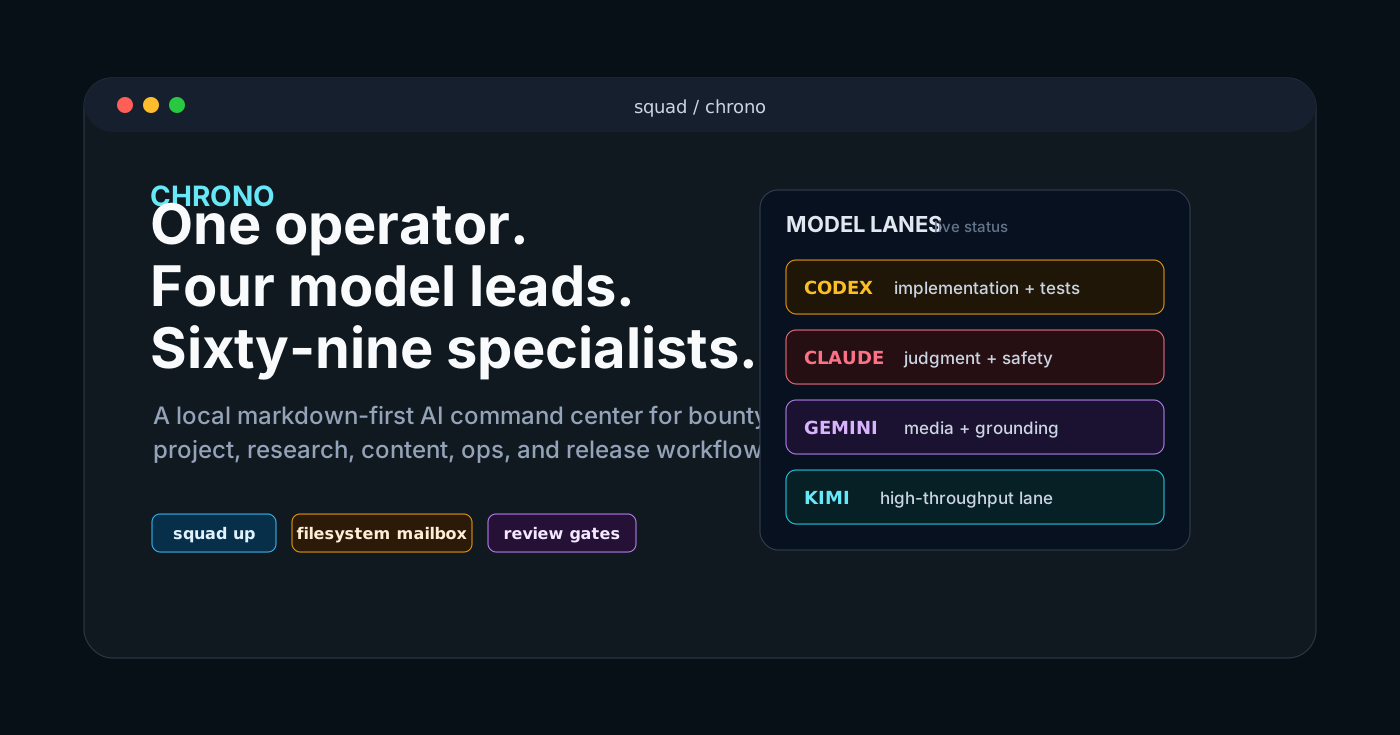
Vibe Squad
A swarm of frontier-model specialists that reviews its own work — and built itself.





You talk to one coordinator, Chrono, in plain language. It turns your request into a scoped, inspectable task packet, routes it to whichever of 69 role-based specialists fits best across four live model lanes, can fan the work out to parallel specialist panels, and sends the risky parts to a different model family for review before you ever see the result — with a git checkpoint before every dispatch.
In plain English: it makes several different AIs behave like one coordinated team, with a built-in second opinion on anything that matters — and a paper trail for all of it.
A "panel" runs inside one lane's model family — Claude or Codex. The multi-model story is cross-lane coordination plus a different-family reviewer, not four families debating in one panel.
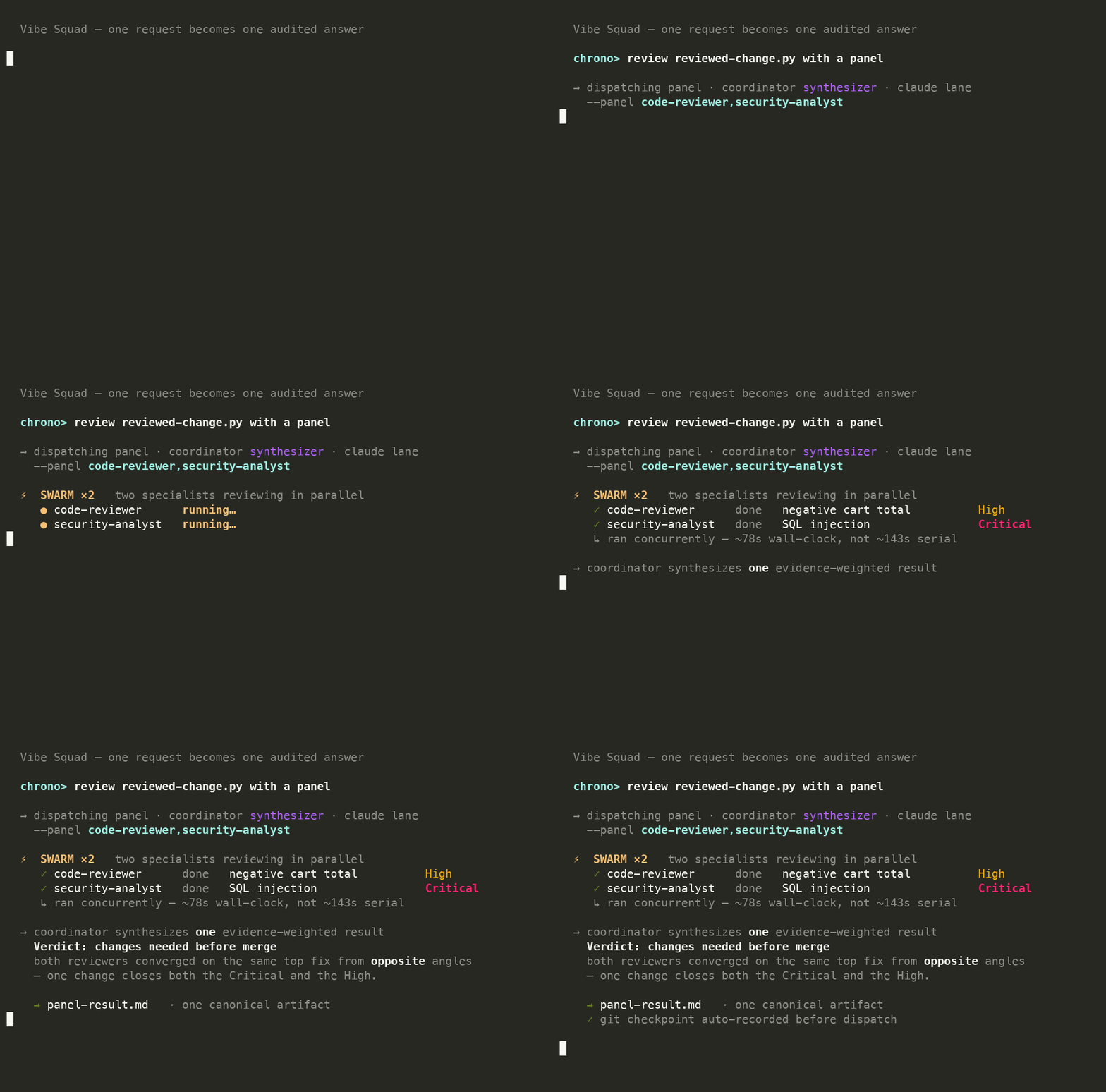
Watch it work
One request becomes one audited answer, in four beats:
- You ask, in plain language. Chrono writes a typed markdown task packet and checkpoints the repo.
- Specialists light up in parallel. For panel work, 2–3 canonical specialists run concurrently inside one lane — the terminal shows
⚡SWARM ×Nand each member's live state. - A different model family reviews the risky part. High-stakes work carries a cross-family reviewer; the dispatcher refuses to send a
safety_level: highjob without one. - You get one synthesized result — evidence-weighted, with dissent and coverage gaps preserved, written to a single
outbox/artifact.
▶ The demo above is a real, unedited panel run: two specialists (code-reviewer + security-analyst) review a change in parallel, then the coordinator synthesizes one evidence-weighted result. Its full reproducible trace — the change under review, both raw specialist returns, the panel-activity ledger, and the synthesis — is in
examples/demo-run/. (Beat 3's cross-family review is a separate hop, shown in the safety-model diagram below.)
Why this is different — the moat
Most multi-agent demos optimize for more conversation. Vibe Squad optimizes for bounded execution, independent review, visible failure, and inspectable artifacts.
| What it is | Proof | |
|---|---|---|
| 🐝 Real parallel panels → one accountable artifact | 2–3 specialists run concurrently inside a lane; only the coordinator writes the result, and it preserves dissent, timeouts, and missing coverage. Panel collection is deadline-bounded (monotonic and wall-clock) — overdue members become explicit coverage gaps. | shared/modes/panel.md · bin/panel-activity.sh |
| 🔁 A different model family reviews the risky work | An LLM is the worst judge of its own output. The canonical map assigns every high-safety role a reviewer from a different model family, and dispatch rejects high-safety work that names no reviewer. Independent, not a logo collage. | shared/routing.md · shared/protocol.md |
| 🧾 Git-verifiable self-building | Every dispatch checkpoints first. The routing redesign, the panel/swarm feature, and the pre-public cleanup were all dispatched by the squad — the history is the receipt. | git log --oneline --grep='auto-snapshot: before TASK-' |
| 🎛️ One coordinator over four live lanes | A persistent tmux control room keeps model families observable and separately routable instead of hidden behind one opaque chat. | bin/launch-squad.sh |
| 🛡️ Safety failures stay visible | A genuine refusal, a gate hold, or a timeout surfaces as state; the coordinator never "shops" a refused request to a more permissive model. | shared/routing.md (safety model) |
Built by vibe coding
Vibe Squad was directed in plain natural language — "build the swarm," "add independent review," "make the state visible," "clean it up for public release." The same system translated those goals into scoped task packets, routed them to specialist roles, ran parallel analysis where it helped, requested cross-family review, executed tests, and checkpointed every dispatch in git. It did not choose its own mission and real-world actions stayed operator-gated — you supply the goals and the approvals; the system does the dispatch, the review, and the bookkeeping.
The evidence is this repository: 100+ of its commits are auto-snapshot: before TASK-… checkpoints (count them yourself — git log --oneline --grep='auto-snapshot' | wc -l).
A multi-agent system, vibe-coded through the multi-agent system itself.
How it works
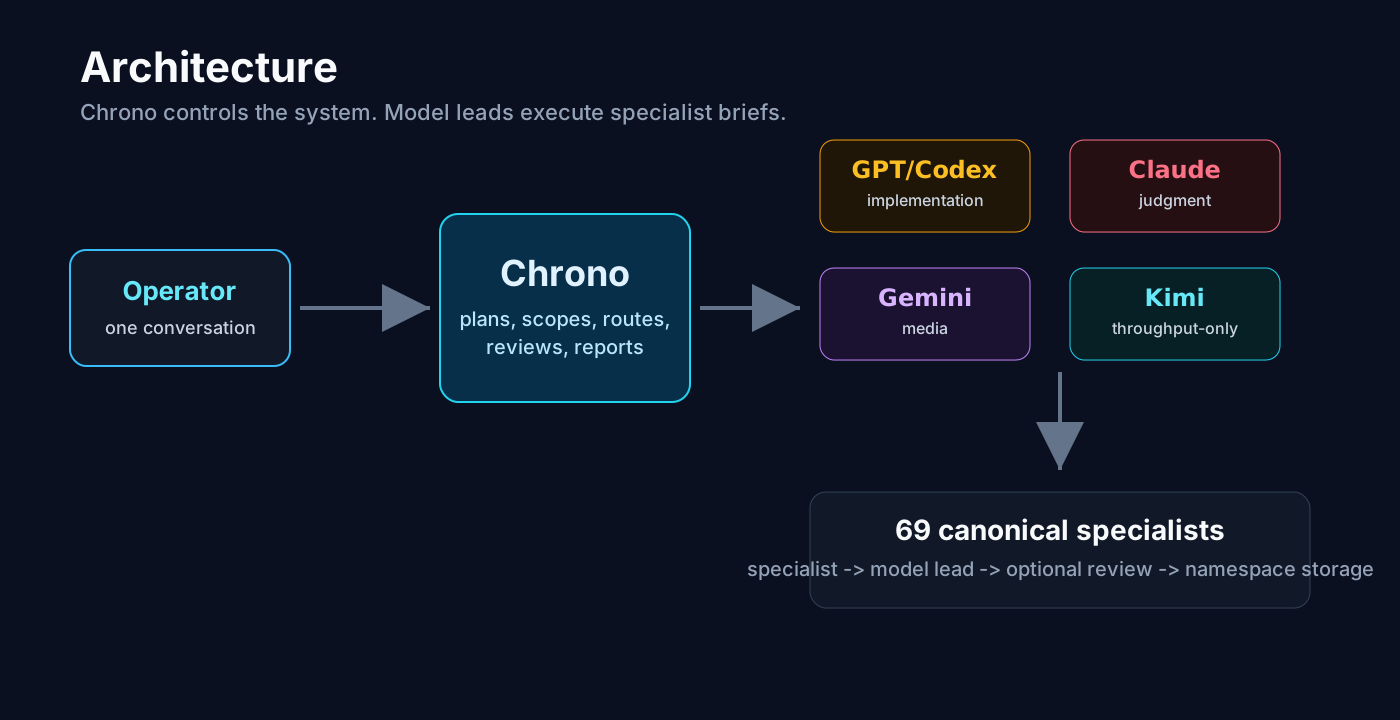
Operator ──one voice──▶  Chrono (coordinator)
                              │  chooses mode · specialist · model lane · write scope · reviewer
                              ▼
                   typed markdown task packet   ──▶ inbox/TASK-*.md   (+ git snapshot)
                              │  capability-fit routing over one 69-row map
        ┌─────────────────────┼─────────────────────┬─────────────────────┐
        ▼                     ▼                     ▼                     ▼
   gpt-codex               claude                gemini                 kimi
  (GPT-5.6 Sol)         (Claude Fable-5)      (Gemini 3.5)          (Kimi K2.7)
  implementation        judgment / safety     content / media      throughput-only
        │                     │                                  (0 primary roles)
        │  opt-in: 2–3 specialists run in parallel → one synthesis
        └─────────────────────┴───────┬─────────────────────────────────────┘
                                       │  high-stakes → cross-family reviewer
                                       ▼
                          outbox/TASK-*-response.md ──▶ Chrono ──▶ Operator
- You ask Chrono for something in plain language.
- Chrono picks the mode, the specialist, the model lane, the write scope, and — if the work is high-stakes — a cross-family reviewer (or a parallel panel of specialists).
- It writes a markdown task packet to that namespace's
inbox/— after a git snapshot and a write-scope conflict check. - The target lane reads the packet and its specialist brief, does the work, and writes a response to the
outbox/. - Chrono runs any required review, then surfaces one result to you.
Routing is
specialist → model, nevernamespace → model. A specialist's folder is only a mailbox label. Every routing decision — primary lane, a cross-family backup, an escalation profile, and a separate reviewer — is one explicit row inshared/specialist-runtime-map.tsv, foreign-keyed into versioned profile and policy registries.
Quick start
[!IMPORTANT]
squad updefaults to an autonomous "daily-driver" profile that launches each model-lane CLI with bypass/yolo-style permissions (Codex--dangerously-bypass-approvals-and-sandbox, Claude--permission-mode bypassPermissions, Gemini/Kimi--yolo) — the lanes run tools without per-action prompts. It's gated only by a one-time warning marker plus adoctorhealth check (a printed warning and a sentinel file, not an interactive confirmation). Start with--safe, which uses conservative per-lane permissions — Claude prompts (no bypass), Codex runs sandboxed workspace-write, and Gemini/Kimi launch non-yolo — until you understand the workflow and trust your scopes.
git clone https://github.com/mtarcure/claude-vibe-squad
cd claude-vibe-squad

bin/vibe-squad up --safe     # conservative permissions — recommended first run
# bin/vibe-squad up          # autonomous daily-driver profile (bypass/yolo perms)
This starts (or re-attaches) a tmux session named squad with six windows — the coordinator you talk to, the four model lanes, and a watchers/status window:
Ctrl-b 0 → chrono      Ctrl-b 3 → gemini
Ctrl-b 1 → gpt-codex   Ctrl-b 4 → kimi
Ctrl-b 2 → claude      Ctrl-b 5 → watchers/status
Ctrl-b d → detach (lanes keep running)
bin/vibe-squad doctor     # health check
bin/vibe-squad status     # what each lane is doing
# ...in the chrono window, just ask for something in plain language...
bin/vibe-squad stop       # tear down
Prerequisites: macOS · tmux · fswatch · jq · curl · logged-in Claude Code / Codex / Gemini / Kimi CLIs · Python 3.13 (required by pyproject.toml and .python-version; needed for the MCP servers and the optional daemon).
Under the hood
Routing & the specialist map — the 28-column source of truth, profiles, and policiesshared/specialist-runtime-map.tsv is the canonical routing table: 69 rows, 28 columns, one row per specialist. Rather than duplicating raw model IDs, each routing slot references a profile (codex.sol.high, claude.fable.xhigh, gemini.flash.default, kimi.k2.7.bulk, …) that resolves — in shared/registries/profiles.tsv — to an exact model + effort + flags. Failover, escalation, and throughput behaviour are likewise versioned policy IDs (shared/registries/policies.tsv), not per-row prose.
- Each specialist declares a
capability_class(implementation · judgment · code_review · security_reasoning · security_defense · content_text · media_production · research_synthesis · extraction · game_design), asafety_level, and — for media roles — atool_profilethat pins the lane to whichever pane hosts the required generation tools. - The 69 roles span seven mailbox namespaces (coding 19 · content 11 · content-engineering 10 · security 10 · sysmgmt 8 · shared 6 · research 5). Kimi is a throughput-only lane and holds zero primary roles — bulk/mechanical passes under a strict downshift gate only.
bin/validate-specialists.shfail-closes on schema, foreign-key, sort, and rule violations — it enforces, among others, "kimi holds no primary roles" and "high/heightened-risk roles get the safety-floor escalation policy and never a throughput downshift." (The map assigns each high-safety role a different-family reviewer viaanti_affinity: author_family; that family relationship is a map/authoring convention, not a validator- or dispatcher-enforced check.) The current roster passes 69/69.- Adding a specialist = one TSV row + a markdown brief under
departments/<namespace>/specialists/, then run the validator.
Narrative source of truth: shared/routing.md · architecture: docs/architecture.md.
Panels are an opt-in task shape, not a new mode — without --panel, dispatch is unchanged.
bin/send-task.sh <task-file> \
  --panel code-reviewer,security-analyst \
  --panel-quorum all --panel-timeout 900
- Supported lanes:
claude,gpt-codex. 2–3 members (the coordinator consumes the fourth thread). Nested panels are prohibited. - A panel's member subagents share the parent lane's model family — so a single panel runs inside Claude or Codex. The multi-model story is cross-lane coordination and review, not four families debating in one panel.
- All members launch before the coordinator waits. Polling is non-blocking and bounded by a monotonic + wall-clock deadline; failed, refused, late, and timed-out members stay visible as coverage gaps.
- Synthesis is evidence-weighted, not majority vote. The coordinator is the only writer and emits exactly one canonical artifact. Members are read-only w.r.t. the response and staging.
bin/panel-activity.showns atomic per-task activity state, quorum/deadline closure, archiving, and stale cleanup;bin/vs-lane-status.shrenders member states and the global⚡SWARM ×Nsignal from local state (one daemon fetch per tick, zero network per render).panel-activityand the status renderer are covered by tests that run in CI (squad-validate.yml).
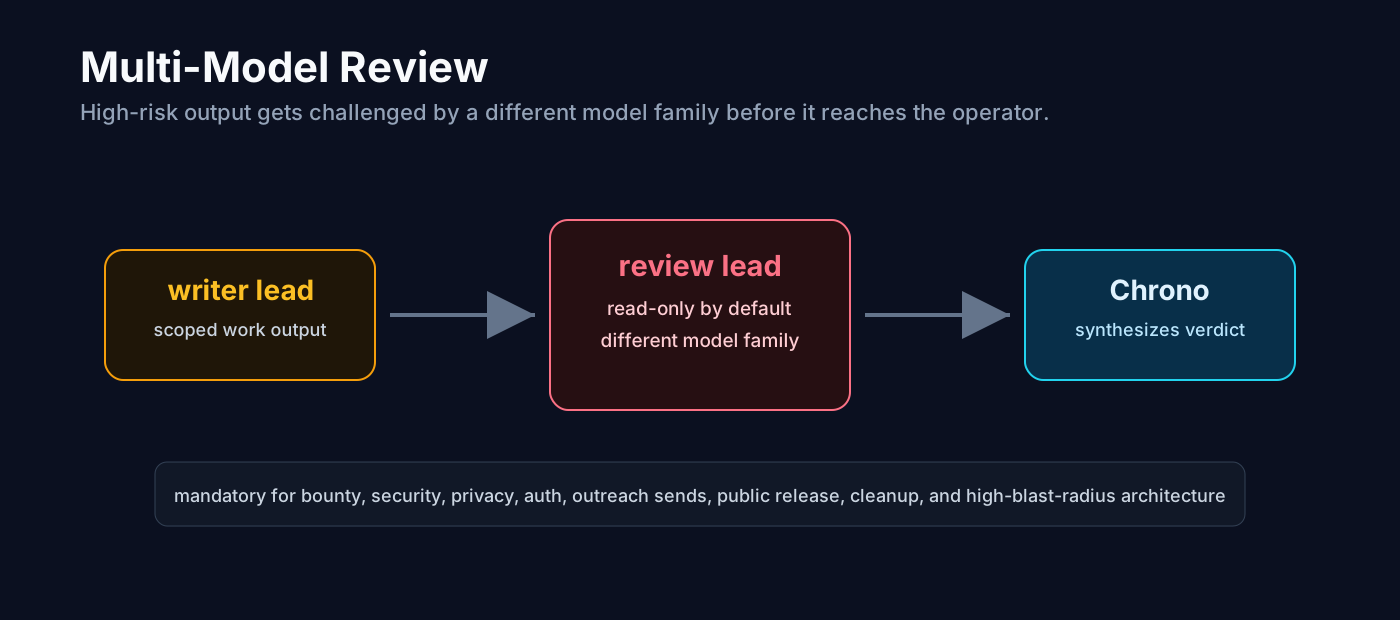
Capability is separated from authorization — "can do" is not "may do."
- Global safety-refusal invariant. A genuine safety refusal on any lane surfaces to the operator and is never cross-family re-dispatched in either direction. Operational failures (an overloaded lane, a timeout) may fail over; refusals may not. Refusals are classified by structured policy event → typed status → content heuristic (only to downgrade certainty).
- Operator gates (Hard Rule 6). A closed set of actions require explicit approval before execution:
delete · cleanup · credential_change · public_release · paid_media · live_outreach · production_mutation · offensive_execution · malware_detonation. Therequires_approvalfield is limited to actual tool names, so domain approvals can't hide there. - Pre-publication gates.
content-verifier(fact/citation truth) andasset-provenance-and-rights-auditor(license/consent/rights) each emit a hash-bound PASS/HOLD/FAIL record; a non-PASS or a stale content hash blocks publication. - Cross-family mandatory review is a dispatch-time contract, not automation. The canonical map gives every high-safety specialist a different-family reviewer, and dispatch rejects high-safety work that names no reviewer — but the family difference itself is a map assignment, not a dispatcher comparison. Same-family reviews run in-lane before "done," and cross-family reviews are Chrono-coordinated after the response lands — there is no watcher that auto-launches every review (see
shared/protocol.md).
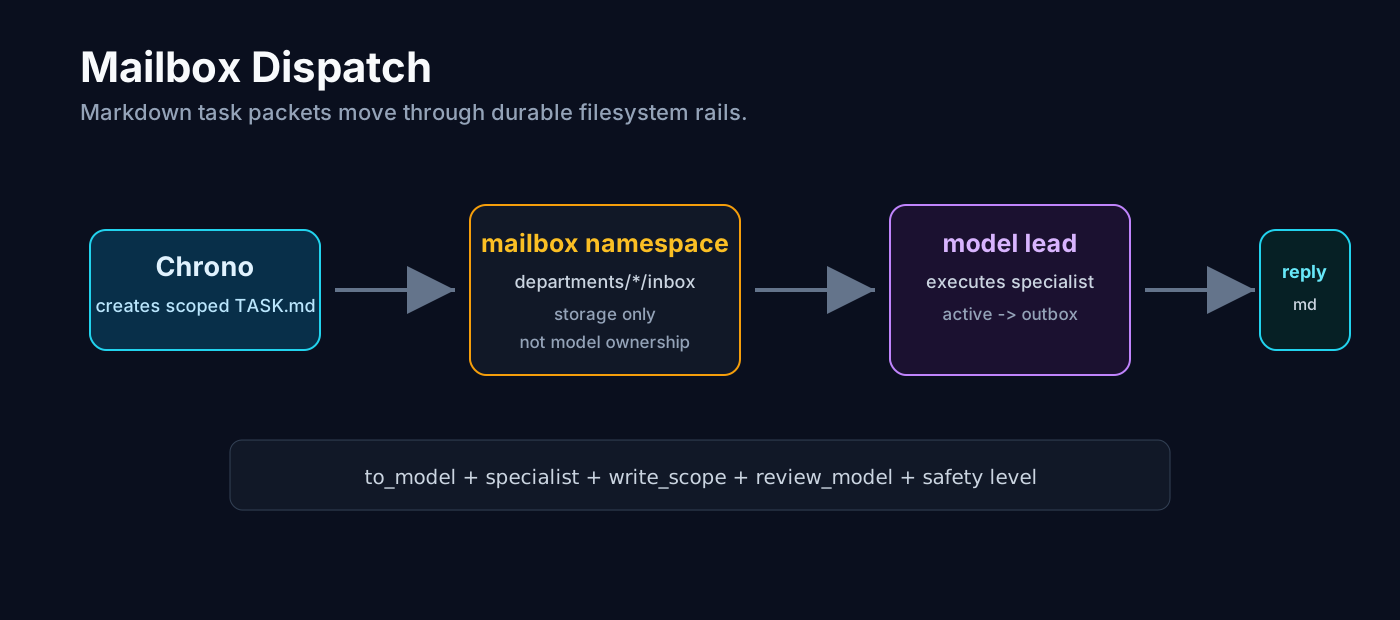
Every dispatch is a markdown file with the frontmatter schema in shared/protocol.md (to_model, specialist, source_namespace, write_scope, review_model, mandatory_review, operator_approved, return_artifact, …). source_namespace selects the specialist markdown; compatibility_namespace selects the mailbox folder; to_model selects the runtime lane. Dispatch is asynchronous — senders don't block on lane-to-lane work, and one writer owns a write_scope at a time.
| Path | Purpose |
|---|---|
bin/squad, bin/launch-squad.sh |
Lifecycle CLI + tmux launcher (six windows) |
scripts/send-task.sh, bin/send-task.sh |
Dispatch: frontmatter generation + hardened writer (snapshot, write-scope check, nudge) |
shared/specialist-runtime-map.tsv |
Canonical routing (69 rows) + shared/registries/*.tsv (profiles, policies) |
shared/routing.md, shared/protocol.md |
Routing model + packet schema / lifecycle / review behaviour |
shared/modes/*.md |
Operator-approved workflows (project, bounty, incident, content, research, triage, …) |
departments/*/specialists/, shared/specialists/ |
Specialist markdown briefs |
departments/*/inbox/, departments/*/outbox/ |
The dispatch board (packets + responses) — private/local, git-ignored |
bin/validate-specialists.sh |
Fail-closed schema/routing validator |
daemon/ |
Optional FastAPI service (status, summaries, triggers) — not on the dispatch path |
- The primary tool path is direct per-CLI MCP registration (
~/.claude/settings.json,~/.codex/config.toml,~/.kimi/mcp.json,~/.gemini/settings.json); the optional daemon also exposes a/mcp/{server}/{tool}proxy route. Four vendored plugins ship with the repo: chrono-vault (knowledge graph + Obsidian + auto-capture), chrono-research-arsenal (an arXiv/xAI wrapper plus the official Perplexity sibling MCP), chrono-content-engineer (image/video/audio), and chrono-recon (DNS / WHOIS / certificate-transparency / Wayback / GitHub-secret helpers). Availability varies by credential and lane;shared/api-catalog.mdtracks averified:state per capability, and a specialist may only cite verified entries. - A library of reusable skill modules lives under
shared/skills/(indexed inshared/skills/catalog.txt); specialist briefs reference them and the validator checks they exist. - The optional FastAPI daemon (
daemon/) exposes authenticated status/summary/trigger endpoints with circuit breakers and a watcher, covered by tests indaemon/tests/. It supports the system; it is not the dispatch spine.
What's shipped vs. what isn't
- Shipped: the tmux + markdown-mailbox runtime; the 69-specialist canonical map with profile/policy registries and a fail-closed validator (69/69); opt-in parallel specialist panels with a live status UI; per-CLI MCP tooling; auto-snapshot + write-scope dispatch rails; the safety/approval model.
- Automatic failover: built and cross-family-reviewed, but ships dormant/opt-in — not part of the default workflow.
- Historical design: an earlier Ink-TUI + FastAPI-daemon dispatch-spine proposal was not implemented and is retained only as a curated narrative under
docs/design/. The shipped spine is the markdown mailbox.
License
AGPL-3.0. See LICENSE.
This README, and the roster redesign and cleanup it describes, were produced through the squad's own multi-model workflow — dispatched, cross-reviewed, and checkpointed in this repo's own git history.
Reviews (0)
Sign in to leave a review.
Leave a reviewNo results found