ATLAS
Health Warn
- License — License: NOASSERTION
- No description — Repository has no description
- Active repo — Last push 0 days ago
- Low visibility — Only 5 GitHub stars
Code Pass
- Code scan — Scanned 12 files during light audit, no dangerous patterns found
Permissions Pass
- Permissions — No dangerous permissions requested
No AI report is available for this listing yet.
ATLAS
A failure-mode taxonomy layer for agents: reflect at meaningful boundaries, catch recurring mistakes, and learn from traces.




Paper: Adaptive Failure Taxonomies as Feedback for LLM-Agent Improvement Procedures
Documentation: multi-agent-systems-failure-taxonomy.github.io/ATLAS · Concepts · Getting started
Procedures that improve LLM agents act on the failures in execution traces: a
best-of-N selector picks the best of several attempts, a program-search loop
rewrites the agent after failed runs, and a runtime monitor reflects before an
action commits. All three need feedback that names why a trajectory failed, in
a form that aggregates across runs. Scalar rewards discard the reason. Free-form
reflections are unstructured and per-trace. Hand-authored taxonomies such as
MAST, from "Why Do Multi-Agent LLM Systems Fail?" (Cemri et al., 2025),
fix the vocabulary before observing the agent, its roles, or the target domain.
ATLAS induces the vocabulary instead. It reads a target system's own traces and
generates a compact set of evidence-grounded failure codes, with no
hand-authored codes and no per-trace annotation, then passes those codes back to
the improvement procedure alongside each trace. This repository packages that
idea as a runtime skill: it supervises an agent against a taxonomy at meaningful
boundaries, records the failures that actually occur, and generates or refines a
taxonomy specialized to your own traces. When no taxonomy is configured it starts
from a built-in 14-code adaptation of MAST.
ATLAS is not a task solver. It is a diagnostic feedback layer that gives an agent
a structured way to ask, "what mistake am I about to repeat?"
Adaptive failure taxonomies
An ATLAS taxonomy is a set of 15 to 30 failure codes induced from a system's own
traces, organized along three fixed axes. The axes follow MAST's empirical
clustering of failure modes; the concrete codes, role labels, descriptions, and
evidence patterns are induced per system:
| Axis | Scope | Example code |
|---|---|---|
| System-level | Arises in any agent system | Context_Exhaustion, Premature_Termination |
| Role-specific | Tied to a discovered component role | Checker_Rubber_Stamps_Solver's_Output |
| Domain-specific | Requires task knowledge | Algorithm_Mismatch, Physical_Law_Violation |
The same induced vocabulary is a reusable feedback interface for more than one
improvement procedure. The paper,
Adaptive Failure Taxonomies as Feedback for LLM-Agent Improvement Procedures,
evaluates three:
- Best-of-N trajectory selection. As judges on Terminal-Bench 2.0,
ATLAS-Judge reaches 89.9% accuracy (+15 points over Pass@1) and beats judges
that use a fixed taxonomy or none. - Evolutionary agent-system optimization. As mutation feedback,
taxonomy-coded diagnoses beat free-form reflection across competitive
programming, math, STEM QA, and discrete reasoning (OlympiadBench 87.9% to
91.9% on a 655-problem held-out set). - Runtime feedback. For SWE-agent on SWE-bench Verified Mini, codes improve
over free-form reflection in both in-prompt and external-judge use. This
runtime setting is what the skill in this repository implements.
On TRAIL (117 expert-annotated GAIA traces), induced codes align with the human
gold at Cohen's kappa 0.725, more faithfully than TRAIL's hand-crafted
vocabulary.
How it works
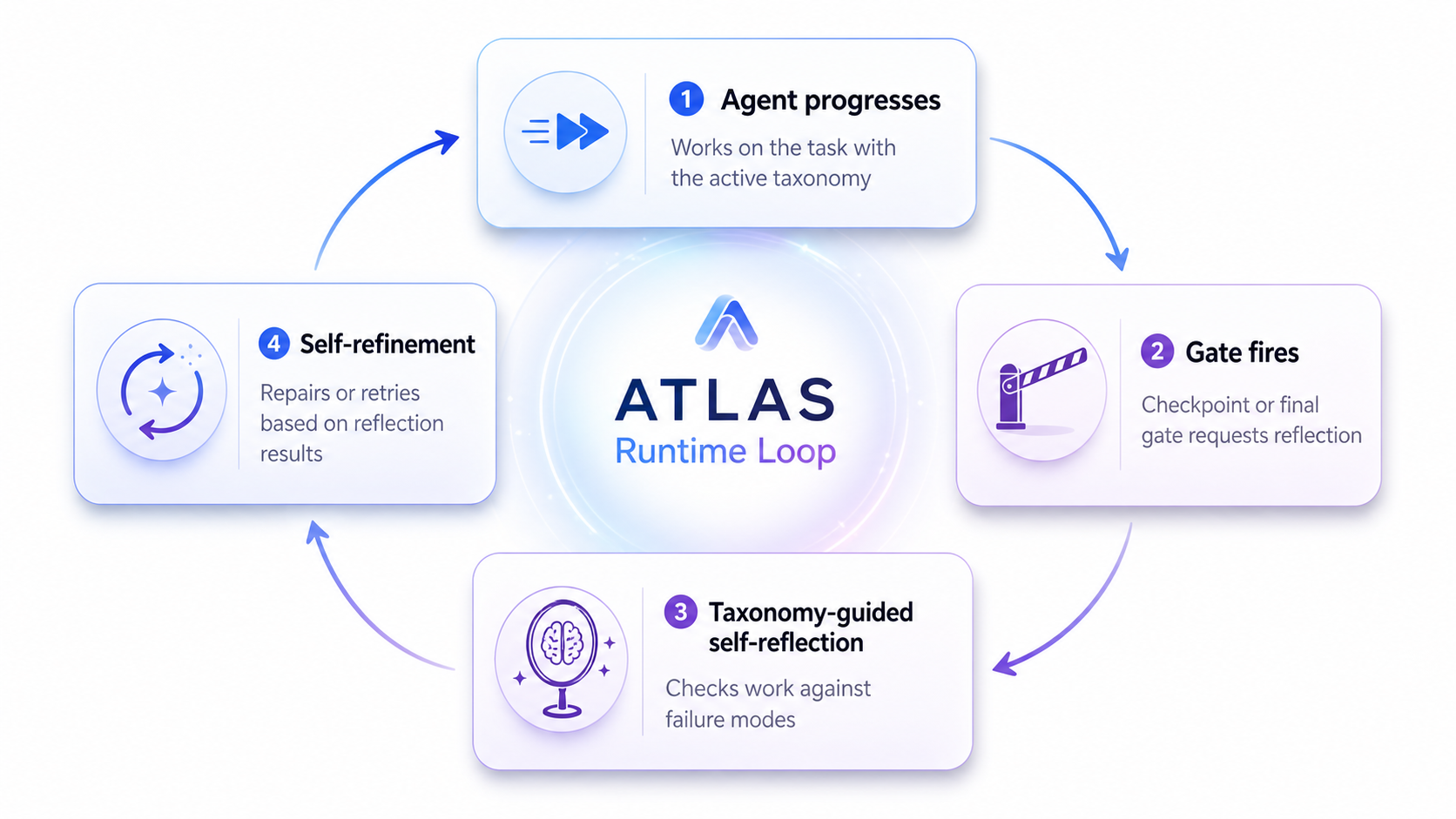
- A task starts. ATLAS selects the active taxonomy: an inherited stored
taxonomy, or built-in MAST when none is configured. - At configured boundaries (checkpoints, tool failures, subagent stops), the
agent reflects against the taxonomy and repairs when evidence demands it. - A final submission gate blocks completion until the reflection passes or
retries are exhausted honestly. - One canonical trace is recorded at session end.
- After enough traces, ATLAS generates a task-specific taxonomy (or refines
the active one). Accepted taxonomies become inheritable records for future
runs.
New to the terminology? Start with docs/CONCEPTS.md.
What it looks like
At a checkpoint, the agent reflects on its recent trajectory against the
active taxonomy in a fixed shape:
Observe:   The last two Bash runs failed with the same ImportError; no
           dependency check ran between attempts.
Correlate: Retrying an identical command without new information.
Map:       MAST-3 (Step repetition); evidence supports the match.
Decide:    One focused repair: verify the installed package version
           before the next run.
Mapping no codes ("none apply") is a valid outcome. Before the final answer is
released, a blocking gate requires the same reflection and allows a bounded
number of repairs. Everything the gates record is browsable live in the
dashboard.
A full walkthrough with dashboard screenshots is in
docs/EXAMPLE_RUN.md. Try the dashboard yourself withpython -m examples.dashboard_demo.
Install
Requirements: Python 3.10 or newer.
python -m pip install "git+https://github.com/multi-agent-systems-failure-taxonomy/ATLAS.git"
From a local checkout: python -m pip install .
ATLAS's own learning calls support Anthropic, OpenAI(-compatible), Gemini, and
AWS Bedrock model IDs. Optional extras ([anthropic], [bedrock]) and
credential setup live in docs/INSTALLATION.md.
Quick start
Create atlas.json in the project that will run the agent:
{
  "version": 1,
  "trace_output": "./atlas-program",
  "atlas_model": "gpt-5"
}
Every field, its default, and when to change it:
docs/CONFIGURATION.md.
Then choose the integration that matches your pipeline:
| Use case | Command | Full docs |
|---|---|---|
| Claude Code project | atlas-claude-install --project-dir . --config atlas.json |
Claude Code |
| Codex project | atlas-codex-install --project-dir . --config atlas.json |
Codex |
| One LLM call from a script | atlas-single-run --config atlas.json --task "..." --model gpt-5 |
Single LLM |
| Existing trace folder | atlas-import-traces --config atlas.json --traces ./traces |
Taxonomies |
| Your own harness | from atlas_runtime import start_session, ... |
Integration |
Check the setup:
atlas-doctor --config atlas.json
Results
Full evaluation artifacts (per-question result rows, the exact taxonomies used,
and replication steps) live in runs/:
| Experiment | Headline |
|---|---|
| OfficeQA Pro, agent harness | 44.4% → 51.9% official scorer (Bedrock Haiku 4.5, 133 questions, same harness both arms) |
| Circle packing (n=26) | On SkyDiscover's search harness: baselines never reach 0.997 of AlphaEvolve's record; with ATLAS the search reaches it in 20 evals (peak 0.999735) |
Documentation
| Topic | Page |
|---|---|
| Vocabulary and the runtime loop | docs/CONCEPTS.md |
| Real reflections, gates, and dashboard output | docs/EXAMPLE_RUN.md |
| First successful run | docs/GETTING_STARTED.md |
Every atlas.json field |
docs/CONFIGURATION.md |
| Install options and credentials | docs/INSTALLATION.md |
| Claude Code hooks | docs/CLAUDE_CODE.md |
| Codex hooks | docs/CODEX.md |
| Single-call / benchmark integration | docs/SINGLE_LLM.md |
| Harness-author contract and privacy | docs/INTEGRATION.md |
| Config files, prompts, hooks, judges | docs/CUSTOMIZATION.md |
| Taxonomy records and inheritance | docs/TAXONOMIES.md |
| Traces, generation, refinement | docs/TRACES_AND_LEARNING.md |
| Live dashboard and UID filtering | docs/DASHBOARD.md |
| Local dashboard Web API | docs/WEB_API.md |
| Harness-neutral runtime API | docs/API_OR_RUNTIME.md |
| Common failures and fixes | docs/TROUBLESHOOTING.md |
| Documentation index | docs/README.md |
Main commands
| Command | Purpose |
|---|---|
atlas-find |
List stored taxonomies or pick one interactively. |
atlas-dashboard |
Open the read-only localhost dashboard. |
atlas-traces |
Inspect trace state. |
atlas-import-traces |
Generate/store a taxonomy from existing traces. |
atlas-register-taxonomy |
Add a taxonomy JSON record to the store. |
atlas-doctor |
Validate config, paths, integrations, and optional dependencies. |
atlas-status |
Show program health: active taxonomy, pending traces, learning state, usage totals, and recent decisions. |
atlas-claude-install / atlas-claude-uninstall |
Manage Claude Code hooks. |
atlas-codex-install / atlas-codex-uninstall |
Manage Codex hooks. |
atlas-single-run |
Wrap one direct LLM task call with ATLAS. |
Contributing
Development setup, verification commands, and package maps are in
CONTRIBUTING.md.
Related
The original ATLAS taxonomy-induction pipeline (the research code this skill
builds on) lives on thepaper-pipeline
branch and is vendored unchanged under vendor/atlas.
License
Apache-2.0. See LICENSE.
Reviews (0)
Sign in to leave a review.
Leave a reviewNo results found