MusePi
Health Warn
- License — License: MIT
- Description — Repository has a description
- Active repo — Last push 0 days ago
- Low visibility — Only 6 GitHub stars
Code Pass
- Code scan — Scanned 12 files during light audit, no dangerous patterns found
Permissions Pass
- Permissions — No dangerous permissions requested
No AI report is available for this listing yet.
MusePi — 桌面优先的 AI 编程助手:Electron GUI + TUI/CLI + daemon 服务 + 桌面伙伴。原生视频理解、MCP、advisor、记忆、七域技能、自有更新渠道。
MusePi — a desktop-first AI coding agent
musepi CLI · Electron desktop GUI · always-on desktop pet · daemon service




English | 中文
MusePi is a standalone coding-agent platform with an Electron desktop GUI, a daemon service, and an always-on desktop pet. It shares an agent-engine lineage and keeps its own TUI command surface (/ commands, !/!! shell, @ file mentions, # references) wired into the GUI. MusePi is its own upstream — oh-my-pi / Pi / DSH / opencode etc. are reference sources absorbed on demand (see UPSTREAM.md).
Current app version 0.4.6 (independent of upstream versioning).
Install (one command)
curl -fsSL https://raw.githubusercontent.com/MuseLinn/MusePi/main/scripts/install.sh | sh
musepi --version
The installer uses Bun (bun install -g @musepi/pi-coding-agent) when Bun matches your host architecture; otherwise it fetches the prebuilt release binary from GitHub Releases. Options:
--binary— always fetch the prebuilt release binary--source— always install via Bun (installs Bun if missing)--ref <tag|commit|branch>— pin an exact version (source mode)
Download (three surfaces)
| Surface | Get it |
|---|---|
| 🖥️ Desktop client (Electron GUI, auto-update) | macOS arm64 .dmg · Windows setup.exe · Linux .AppImage/.deb — grab the version-matched assets on the releases page |
| 📱 Android companion (Capacitor, LAN pairing) | app-debug.apk on the releases page (adb install -r app-debug.apk) |
| ⌨️ Terminal TUI | npm i -g @musepi/pi-coding-agent then musepi — or the curl installer above |
Website: https://muselinn.github.io/MusePi/ (bilingual, download guides for all three surfaces).
Screenshots
| Welcome | Session | Settings |
|---|---|---|
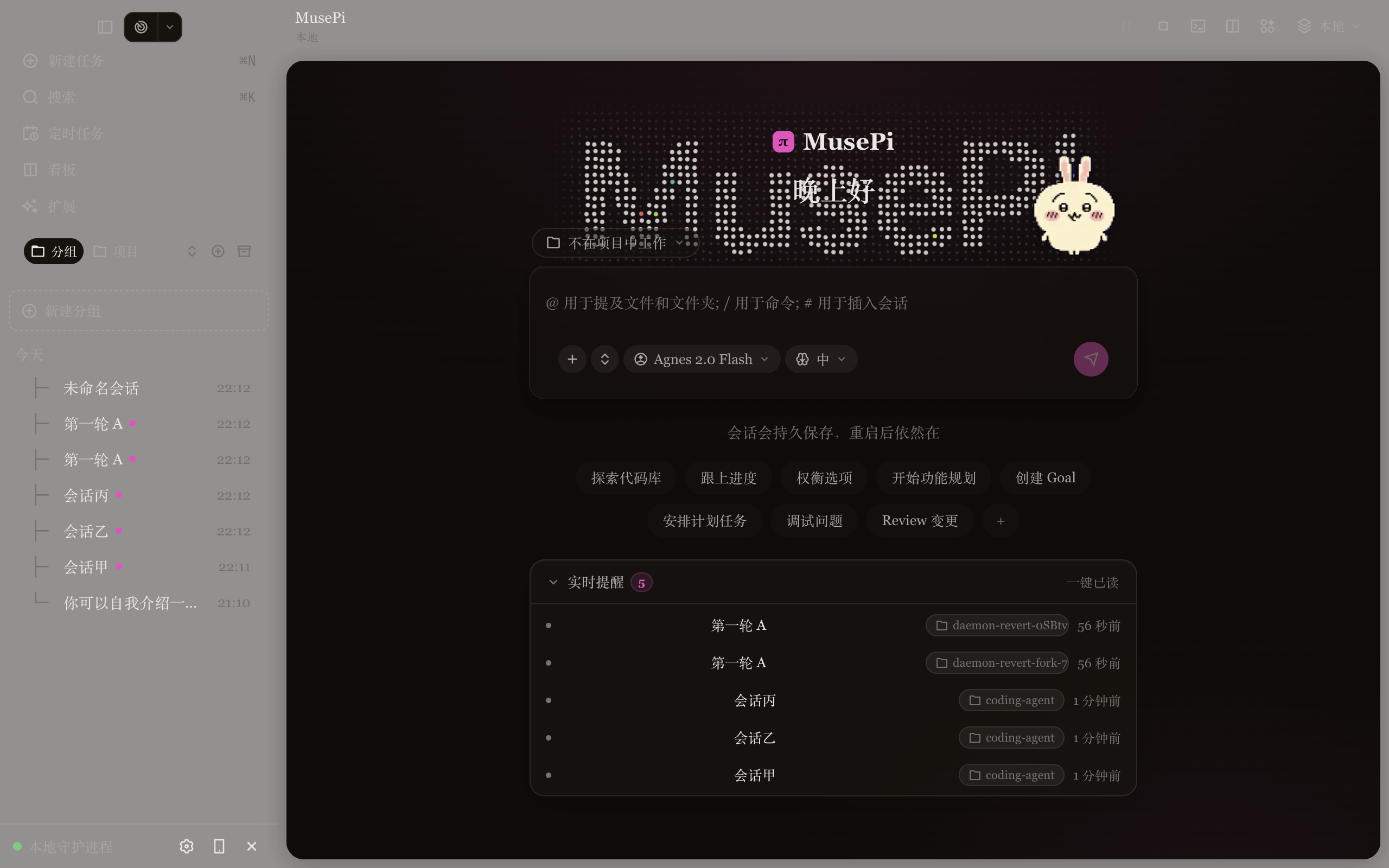 |
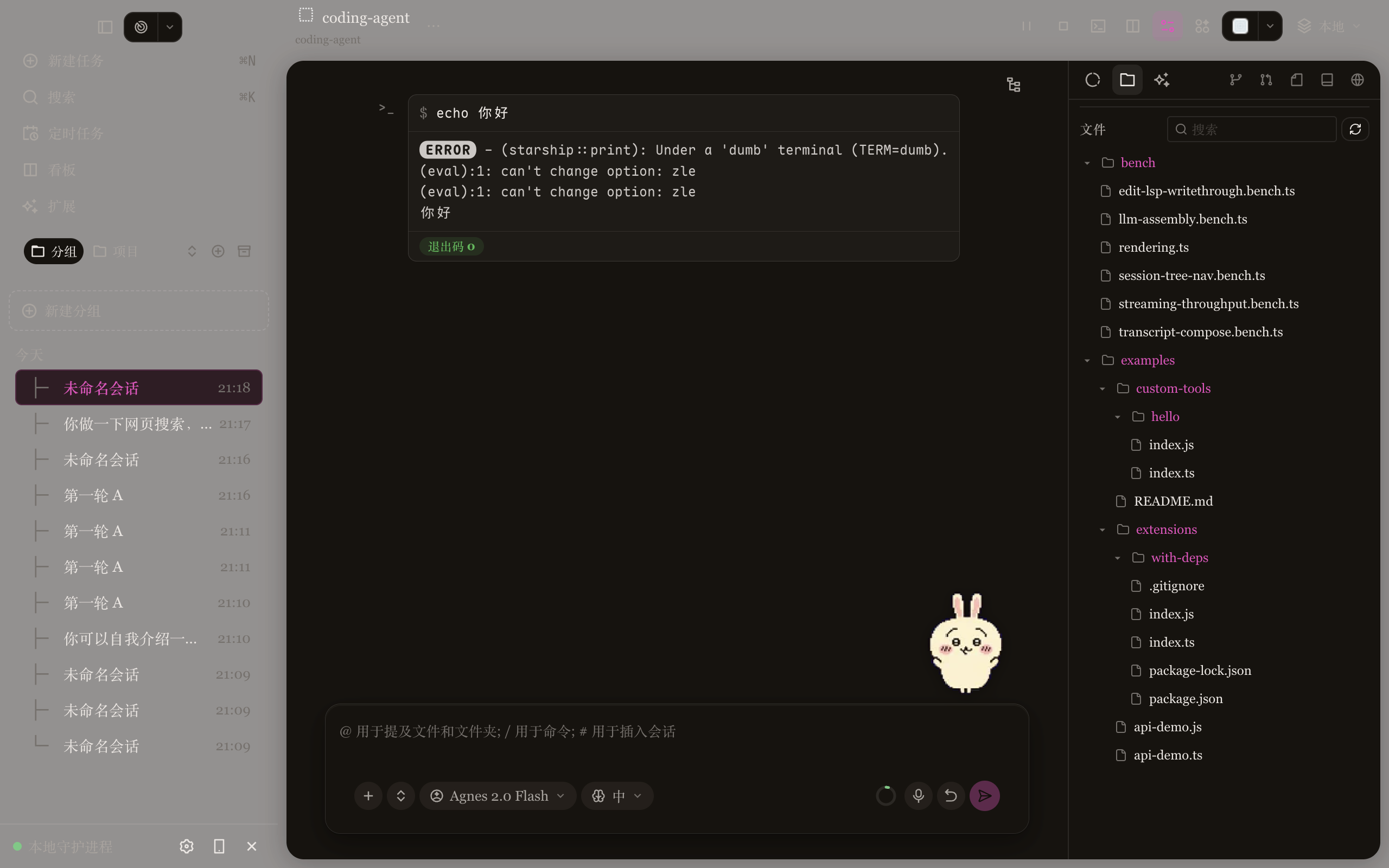 |
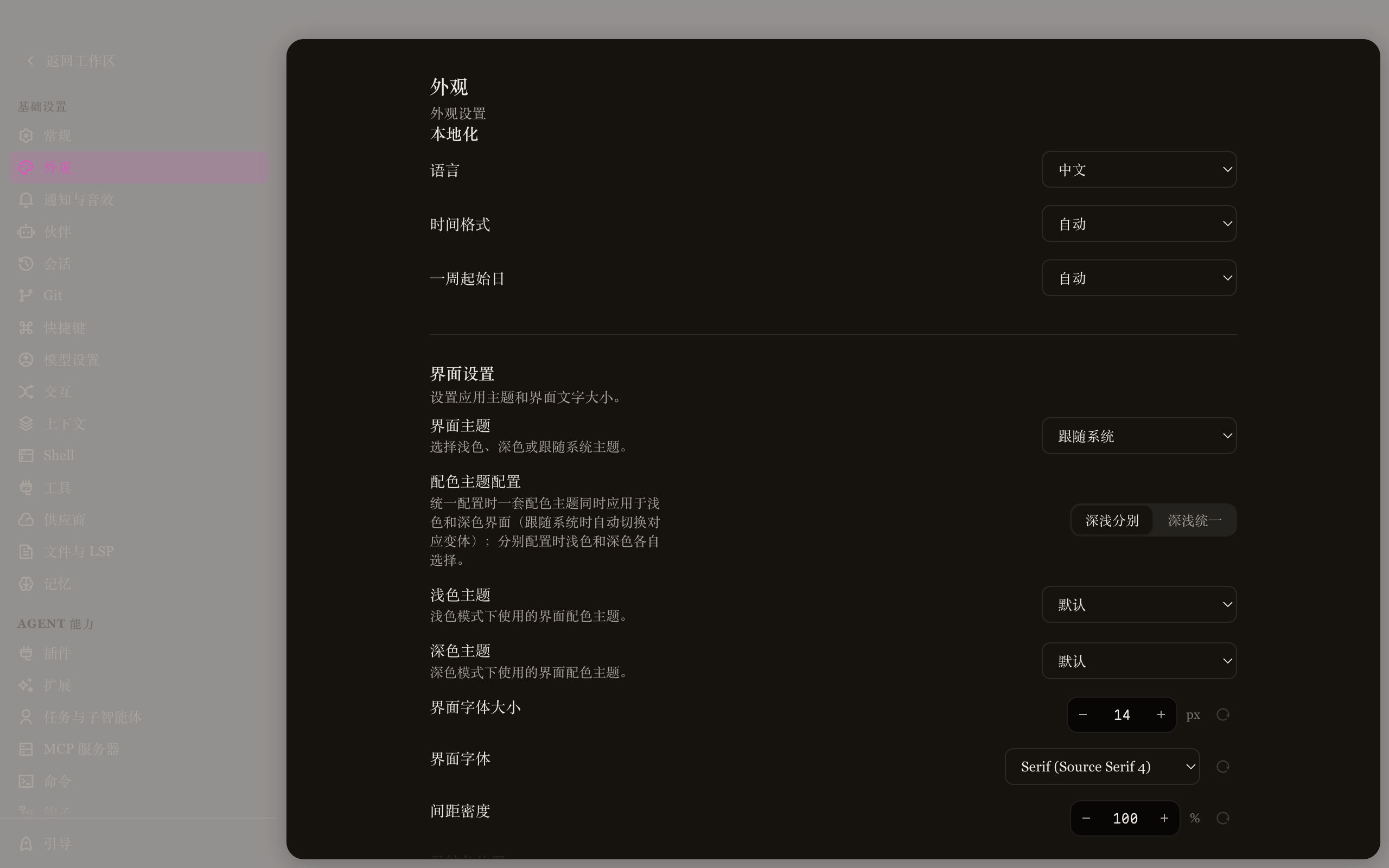 |
Features
Desktop GUI
- Electron desktop app (
packages/gui): three-pane layout (session sidebar + chat stream + context panel), Chinese-first UI, three-axis design tokens (theme / accent / density), frosted-glass vibrancy window. - Always-on desktop pet: animated companion (petdex frame-animation packs, drag positioning, click-through, hover interactions, cross-window activity bridge); task progress surfaces as pet bubbles.
- Daemon architecture: the GUI talks JSON-RPC to the daemon (
musepi serve). Sessions persist via journal + materialized view; idle 30-min sessions become history snapshots and reactivate on demand. The daemon survives GUI exit; reconnecting resumes. - Managed browser (
browser.gui): ElectronWebContentsView+ CDP bridge — drive an embedded browser page in the GUI with projected layout and pixel-sampled verification. - Integrated terminal: xterm + bun-pty with tabs (middle-click close), hardened env (strips
ELECTRON_RUN_AS_NODEetc.). - Full command surface (TUI parity):
/slash commands (headless ACP executor),!cmd/!!cmdshell,@file mentions,#session references. - Context management: context donut (
session.contextUsage),/compact-parity manual compaction, snapcompact savings estimate. - Settings panel: all 336 TUI settings merged into the desktop settings (schema-driven via
settings.schema), 10+ tabs; sidebar search matches actual setting rows. - Rich interactions: image attachments & lightbox, voice input (dictation / read-aloud /
tts.autoRead), per-session draft persistence, idle recap, reminders panel, ⌘K command palette, Board kanban (auto-scaling canvas, ChromaGrid-style group glow), widget system (custom HTML widgets with theme hot-swap). - Branching (TUI parity): 撤回 (jump back) =
branchAttree navigation — old replies stay reachable as sibling branches with an animated undo dock;/btwquestions can be promoted into a new branched session; plan approval offers an "approve and compact context" path. - Instance switcher: connect remote daemons from the top bar (bearer-token gated, openchamber parity).
- Presets (modes): named presets = extension whitelist + prompt sections + settings overrides (
~/.musepi/modes/<id>.json); managed in Settings → 智能体 → 预设. - Session lifecycle status: sidebar rows carry colored status squares (complete / interrupted / aborted / error / pending) with manual tag overrides.
- Swarm task visualizer: frosted member chip above the composer while a
tasktool runs — floating avatar/progress grid with agent trajectory drill-down. - Compaction status line: agent status line swaps to a braille spinner + stop button while context compacts.
- Model picker: provider-qualified (
provider/id) so two providers serving the same bare id never cross-light; session-scoped like the TUI/switch. - Dialogs & keyboard priority: every confirm dialog plays enter/exit animations; modals own the keyboard while open (Escape closes, Enter confirms).
- Relaunch experience: differentiated splash hold, main-window bounds restore, last-session reopen on boot.
- Right context panel: file tree (PDF/image/text previews), Git changes & commits (gitmoji, GitHub device-flow auth), PR list, embedded browser, project notes + todos + plan files.
- Subagent operations: stop / revive / chat from the AgentsPanel (
agents.kill/agents.revive/agents.chat).
Core agent engine
- 40+ LLM providers, 32 built-in tools,
xd://device extensions. - LSP wired into every write (renames, references, code actions); DAP debugger driving.
- task subagents (parallel fan-out, IRC coordination, worktree isolation), hashline content-hash edits, hindsight session memory, ACP editor-driven mode, collab sharing (self-hosted LAN/tunnel relays, plaintext guest mode).
- snapcompact compaction, magic keywords (ultrathink / orchestrate / workflowz), TTSR stream rules.
Tools
31 tools live in the same namespace as read and bash. Pin the active set with --tools read,edit,bash,…; rarely used discoverable tools stay behind xd:// devices (read xd:// lists them).
Files & search — read (files, dirs, archives, SQLite, PDFs, notebooks, URLs, ssh://, internal :// schemes) · write · edit (hashline patches) · ast_edit · ast_grep · grep · glob.
Runtime — bash (workspace shell, 46 in-process coreutils, optional PTY) · eval (persistent Python/JS cells).
Code intelligence — lsp (diagnostics, navigation, symbols, renames, code actions) · debug (DAP session) · security_scan.
Coordination — task (parallel subagent fan-out) · hub (agent messaging, job wait/cancel, process supervision) · todo · ask.
Desktop & web — browser (Puppeteer tabs over headless Chromium or your own Chrome via relay) · computer (host desktop: windows, screenshots, native input, AX tree) · web_search · github · generate_image · inspect_image · tts.
Memory & skills — checkpoint · rewind · retain · recall · reflect · memory_edit · learn · manage_skill.
Setting-gated, off by default: github, security_scan, generate_image, tts, checkpoint, rewind, and the memory tools (retain/recall/reflect/memory_edit, per memory.backend).
Prompt & session controls
Three standalone lowercase words opt a turn into specialized behavior: ultrathink (careful multi-step reasoning), orchestrate (parallel subagents, verified phases), workflowz (deterministic multi-subagent workflow). See Magic keywords.
Slash commands shift how a whole session runs (/compact, /usage, /context, /fresh, /preset, /changelog, …).
Mobile shells
- Capacitor Android app (
packages/mobile+desktop-webmobile entry): first-class phone UI sharing the collab web components — immersive edge-to-edge (customInsetsPluginfor true status/nav bar heights), QR pairing via jsQR (no GMS dependency), time-aware greeting + rotating tips, suggestion chips, 44px tap targets, Android back-key layer unwinding, rotation transitions, three-in-one send control with dot-matrix bloom, braille dot-matrix working indicator, session archiving. - HarmonyOS WebView shell (
packages/harmony): ArkTSWebcomponent loading the same bundle from rawfile — native insets (getWindowAvoidArea), badge,musepi://deep links, keyboard insets. No compat layer: immersion/camera/permissions are native. - PWA: offline connect shell via service worker (
packages/desktop-web/public/sw.js) — cached shell opens without a network; static assets cache-first. - Remote session management: guests can create / delete / rename sessions and stop a running turn (
session.abort) — dsh-mobile-remote parity. - Instance switcher: top-bar menu connects to remote daemons (
serve --remote-token <token>gates with bearer auth; hosts persist in localStorage). - Agent-initiated sharing: the
collabtool starts LAN/tunnel shares (tunnel requires explicit approval). - Pairing surface: host shares via
/collab(TUI slash: view / workspace / lan / tunnel / status / stop) orcollab.startRPC; guests join with the collab link in any browser, the Android app, ormusepi join "<link>"from the CLI. E2E-encrypted; workspace mode shares the whole session directory. - Design spec:
mobile-design.md.
Providers
60+ providers, a thousand models, one /model away. Frontier APIs, coding plans, custom OpenAI-compatible providers, and four routing knobs (priority / cost / rate / fallback). Search providers (23 backends), specialised handlers, and security databases. Full provider & routing reference in docs/.
Architecture
┌──────────────┐    JSON-RPC (collab-proto)    ┌──────────────────────┐
│  Electron GUI │ ◄────────────────────────────► │  musepi serve (daemon)│
│  packages/gui │   WS event stream (journal)   │  packages/coding-agent│
│  + desktop-web │                               │  AgentSession host    │
└──────┬───────┘                               └──────────┬───────────┘
       │                                                    │
       │  pet.html / bubble.html / pin.html                 │ agent engine
       │  (pet / bubble / pinned windows)                   ▼
       │                                         packages/agent · ai · tui
       │                                         natives (Rust N-API)
       ▼
  desktop-web: transcript / tool-render / widget / i18n (per-domain zh-CN/en-US maps)
| Package | Role |
|---|---|
gui |
Electron desktop app (main window + pet/bubble/pinned windows, xterm, pdf.js, managed-browser bridge) |
desktop-web |
GUI rendering core (transcript, tool cards, widget system, i18n) and the collab web UI (desktop + mobile entry) |
mobile |
Capacitor Android shell: InsetsPlugin (edge-to-edge), native chrome wiring, APK build |
harmony |
HarmonyOS NEXT WebView shell: ArkTS Web + harmonyNative bridge, deep links, DevEco project |
coding-agent |
CLI entry (musepi), daemon server, slash/bash commands, tool implementations |
collab-proto |
GUI ↔ daemon transport (WS frames, crypto, links) |
agent / ai / tui / catalog / wire / utils / hashline / snapcompact / mnemopi / stats |
Agent engine / provider registry / TUI / model catalog / wire types / utils |
sdk |
Client SDK (MaterializedView, session-stream event contract) |
natives |
Rust N-API bindings (Bazel/cargo builds, macOS LINKEDIT alignment post-processing) |
swarm-core / swarm-extension / tool-select / browser-relay / metaharness |
Subagent orchestration / tool selection / browser relay / harness tooling |
Key contract docs: gui-design.md · gui-implementation.md · widget-design-system.md · mobile-design.md · collab.md · UPSTREAM.md.
Entry points
- Interactive (TUI/CLI):
musepi— the agent asks when in doubt, streams output, runs tools. - SDK — embed in Node:
@musepi/pi-coding-agentfor programmatic sessions, streams, and tool hooks. - ACP / RPC: editor-driven mode and JSON-RPC daemon for hosts / GUI / collab.
Development
bun run setup            # install + natives build + link
bun run build            # workspace build (incl. GUI dist)
bun run check            # parallel check:ts (tsgo) + check:rs (cargo)
bun run test             # bun scripts/ci-test-ts.ts local
bun run lint / fmt       # biome + rustfmt
bun setup installs Bun workspaces and builds @musepi/pi-natives. Re-run bun run build:native after changing Rust crates or packages/natives. Nix users: nix develop → bun setup → bun dev.
Packaging & Releases
Desktop app (macOS)
bun --cwd=packages/gui run pack # build + electron-builder + codesign
Produces release/mac-arm64/MusePi.app. The pack scripts ad-hoc sign the bundle so it runs locally. Distribution builds need a Developer ID Application certificate + notarization — macOS 26 refuses unsigned/non-notarized apps for several entitlements. See docs/macos-signing-notarization.md.
Desktop app (Windows / Linux)
gui-release.yml builds the Electron app per platform on tag pushes: macOS arm64 (dmg + zip), Windows x64 (NSIS assisted installer, per-user no-admin default), Linux x64/arm64 (AppImage + deb). Releasing a v* tag publishes all platform artifacts plus OTA manifests (latest*.yml, beta channel when the tag contains -beta) and an update-manifest.json for the in-app update check.
Mobile (Android)
package_mobile in the same workflow builds the Capacitor app: desktop-web bundle → cap sync → Gradle assembleDebug. The debug APK lands on the release page; install with adb install -r app-debug.apk. HarmonyOS shell (packages/harmony) builds in DevEco Studio.
CLI
musepi update self-updates the installed CLI; the release pipeline is on GitHub Actions (ci.yml, gui-release.yml).
Documentation
docs/: 95+ documents (GUI, providers, tools, hooks/extensions/skills, LSP/DAP, collab, compaction, ACP, settings, i18n, …)docs/gui-design.md/docs/gui-implementation.md: GUI living docs (keep in sync with code changes)UPSTREAM.md: archived oh-my-pi sync notes (reference-absorption history)
Lineage & references
Reviews (0)
Sign in to leave a review.
Leave a reviewNo results found