retrokit
Health Pass
- License — License: Apache-2.0
- Description — Repository has a description
- Active repo — Last push 0 days ago
- Community trust — 40 GitHub stars
Code Pass
- Code scan — Scanned 12 files during light audit, no dangerous patterns found
Permissions Pass
- Permissions — No dangerous permissions requested
No AI report is available for this listing yet.
Headless-Ghidra toolkit for reverse engineering 32-bit DOS and Win32 games (1993-2010): own LE/LX loader, Watcom calling conventions, library signatures, MCP server
retro-kit – reverse engineering old games (headless Ghidra)
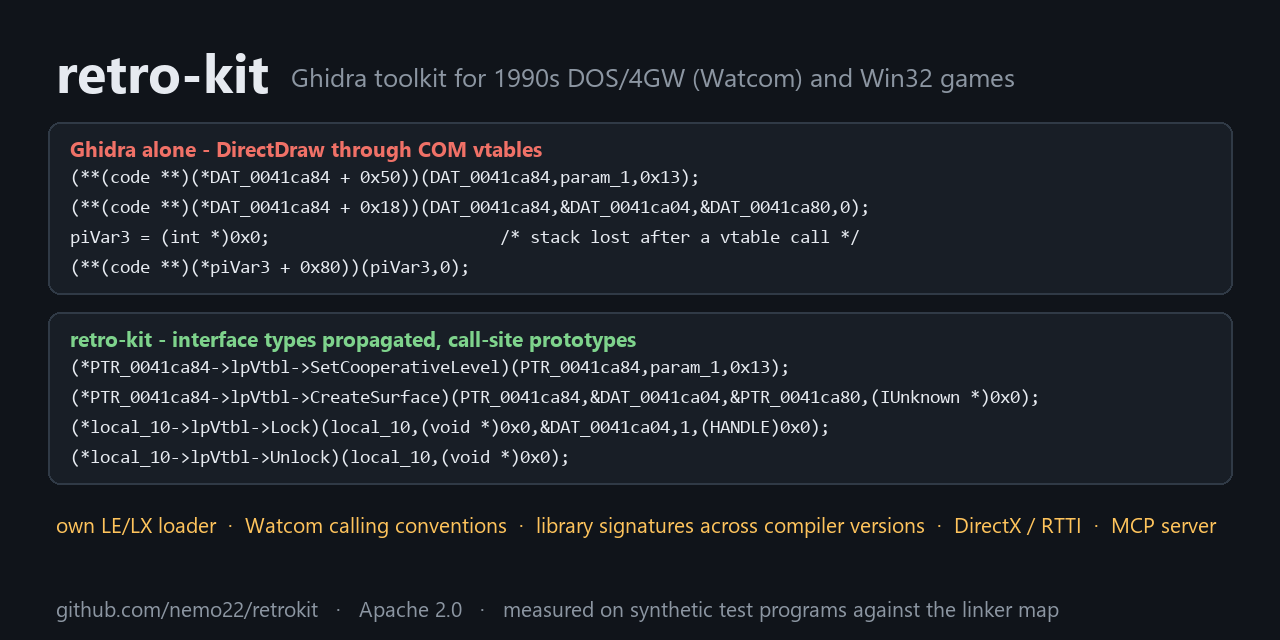
A toolkit for decompiling 32-bit games from roughly 1993–2010 with headless Ghidra:
- DOS LE/LX (DOS/4GW, DOS/32A, PMODE/W, CauseWay, DOS/4G bind; also OS/2 LX and VxD)
built with Watcom C/C++ – with its own LE/LX loader for Ghidra and Watcom compiler specs for
both calling conventions. - Win32 PE (typically MSVC): DirectX calls through COM vtables shown with their method
names, Miles/Smacker/Bink/FMOD/BASS imports typed, C++ classes from MSVC RTTI, the
compiler version from the Rich header.
The output is a workspace with one large .c file holding every function plus indexes
(functions, call graph, strings, fixups/pointer tables, imports) that you can grep and split up
between people or AI agents. Names found during the analysis go back into Ghidra and the export
is regenerated.
Install
Prerequisites: Ghidra 12.x
(unpacked), a JDK 21+ (JAVA_HOME), Python 3.10+.
pipx install git+https://github.com/nautilusbits/retrokit   # or from a checkout: pip install .  (or python -m retrokit)
retrokit doctor                                    # checks Python, Ghidra, Java, loader, cspecs
retrokit install-loader                            # once per Ghidra install (DOS LE/LX only)
Ghidra is found via --ghidra DIR, $GHIDRA_INSTALL_DIR, or a ghidra/ghidra_* directory next
to the game or the kit. install-loader compiles the loader with javac against that Ghidra
(no Gradle), installs it into Ghidra/Extensions and registers the Watcom compiler specs; run it
again after updating Ghidra (doctor tells you when).
Use
retrokit info GAME.EXE              # format, DOS extender, compiler, calling convention
retrokit analyze GAME.EXE           # full pipeline -> GAME_analysis/  (-o DIR to choose)
retrokit show GAME_analysis FUN_00012345 main
retrokit tables GAME_analysis       # function-pointer and string tables (from fixups)
retrokit names GAME_analysis        # apply notes/names_*.csv, re-export
retrokit reexport GAME_analysis     # re-run the fix-up passes + export without re-importing
analyze detects the format, the loader and – for Watcom – the calling convention
(--cspec watcom|watcomreg overrides it) and stores them in GAME_analysis/retrokit.json;
later commands only need the workspace. A workspace:
GAME_analysis/
  retrokit.json        how the binary was analysed
  decomp/              <exe>_decompiled.c, functions.csv (addr,name,size,callers,callees,cc,signature),
                       calls.txt, strings.txt, data_symbols.txt, memory_blocks.txt,
                       fixups.txt (source -> target of every pointer: the key to pointer tables
                       and to which function uses which string), imports.txt (PE)
  notes/               findings, names_<topic>.csv proposals
  ghidra_project/      the Ghidra project (open it in the Ghidra GUI too)
  logs/
AI agents: retrokit mcp GAME_analysis is an MCP server (stdio, no extra packages) over
the workspace: functions, decompiled code, call graph, cross references, strings, pointer
tables, disassembly and bytes, libraries; it records name proposals and notes and can
re-export with the names applied (on request, in the background). Claude Code:
claude mcp add retrokit -- retrokit mcp /path/to/GAME_analysis
Setup for other clients, every tool and how an agent should work: docs/MCP.md;
a short version for agents in AGENTS.md.
Names: write proposals to notes/names_<topic>.csv (addr,name,confidence,comment, confidenceV verified or G guess); retrokit names WS renames functions/labels (V wins over G,
collisions get _<addr>) and re-exports.
What the pipeline does:
- Libraries (both formats):
retrokit libs(also part ofinfoandanalyze->notes/libraries.md) recognises ~20 libraries of the period - Miles/AIL, HMI SOS, DIGPAK,
Smacker, Bink, FMOD, BASS, DirectX, zlib, libjpeg, libpng, PKWARE DCL, Lua, ... - from
strings, imports and data files, with version, notes on their formats and port hints.
Library code is found by signature (shipped: Watcom C/C++ run-time, math and C++ libraries
from Open Watcom, zlib 1.0.4-1.2.3, libjpeg 6b;retrokit sigs buildmakes them from
libraries you own,sigs learnfrom functions you identified) - exact matches first, then
similar code from other compiler versions - named, and typed fromretrokit/knowledge/*.h. - LE/LX: import with the LE loader and the Watcom cspec, functions at the targets of fixups
into code (Watcom games call much of their logic through pointer tables),switchjump tables
kept inside their functions, wrong "no return" flags undone, short strings defined and string
literals shown as"text", parameter counts from theADD ESP,ncleanups at call sites,
prototypes recovered callees-first, export. - PE: import with Ghidra's PE loader and auto-analysis, then functions at pointer-table
targets and after padding until no new ones turn up, the same string / parameter / prototype
passes, export.
Packed, encrypted or DRM-wrapped executables (UPX, SteamStub, SecuROM, SafeDisc, high-entropy
code, entry point in an appended section, ...) are detected by info and analyze: the analysis
still runs, but it warns that Ghidra mostly sees the unpacker or DRM stub, so the result may be
incomplete or wrong. Unpack such a file first (e.g. upx -d, Steamless for SteamStub).
Other commands: classes (MSVC C++ classes from RTTI), libs (libraries in use), convert (XMIDI/HMI/HMP -> MIDI, VOC -> WAV,
Smacker/Bink/FLIC -> MP4, by content), sigs match|build|learn (library signatures, seedocs/WORKFLOW.md),entries (PE: code addresses without a function), modules --rules FILE
(PE: functions → original source files via assert paths), strings EXE OUT (PE string inventory
without Ghidra), match (transfer names to a related EXE: sequel, add-on, other version),le EXE info|dump|rec|s16|s32 (read tables from an LE at Ghidra addresses), rnc (RNC ProPack),flic info|png|video (Autodesk FLI/FLC). retrokit COMMAND --help for options.
The detailed procedure, what to expect and the known pitfalls are in docs/WORKFLOW.md; the
MCP server in docs/MCP.md; task templates for AI agents in docs/AGENT_PROMPTS.md; planned
work in docs/ROADMAP.md; maintaining and releasing in docs/MAINTAINING.md.
Layout
retrokit/               Python package (CLI: retrokit/cli.py)
  ghidra_scripts/       headless Ghidra scripts used by the pipelines
  tools/                standalone Python tools behind the CLI commands
  le-loader/            LE/LX loader for Ghidra (Java) + Watcom compiler specs (data/languages/)
  sigs/                 library signatures (Open Watcom C run-time)
  knowledge/            libraries.json (library catalog), library prototypes as C headers
scripts/                build_sigs.py: rebuilds the shipped signatures
tests/                  synthetic test programs, scoring against the linker map, baseline
docs/                   WORKFLOW, AGENT_PROMPTS, ROADMAP
| Ghidra script | purpose |
|---|---|
CreateFunctionsFromFixups.java |
LE: functions at the targets of 32-bit fixups into code; switch tables in code |
CreateFunctionsAtEntries.java |
functions at given addresses (list or @file), optionally from fixups or prologues in code gaps |
FixTruncatedCallers.java |
clears a wrong "no return" that truncates callers |
FixAnalysis.java |
manual fixes: noreturn:ADDR, func:ADDR |
MarkStringsConstant.java |
defines short strings, marks strings in writable data constant (literals in the decompilation) |
ApplyLibraryPrototypes.java |
documented prototypes for named library functions (knowledge/*.h), tag LIBRARY |
ApplyStackConvention.java |
parameter counts / __cdecl / varargs from ADD ESP,n at call sites, __stdcall from RET n |
RecoverPrototypes.java |
prototypes from the decompiler, bottom-up by call-graph level |
ApplyNames.java |
names from names_*.csv |
ExportDecompiled.java |
exports .c + functions.csv, calls.txt, strings.txt, … |
DumpFixups.java |
LE fixups / PE base relocations → fixups.txt |
DumpImports.java |
PE imports and IAT slots → imports.txt |
DumpFunctions.java |
function list only (between PE entry passes) |
DumpDisasm.java |
disassembly of a function to stdout |
EnableDeepAnalysis.java |
turns on the slow analyzers (not recommended, see WORKFLOW) |
Tests
tests/ builds small synthetic programs with Open Watcom (a dev/CI dependency only: DOS/4GW,
DOS/32A, PMODE/W, DOS/4G bind, OS/2 LX, Win32; stack and register convention), checks the
loader against an independent Python model of each image, runs retrokit analyze on them and
scores the result against the linker map (function addresses, parameter counts, call arguments,
string literals, truncated functions, decompiler noise). See tests/README.md.
Contributing
Issues and pull requests are welcome on GitHub. The primary repository is maintained
elsewhere and mirrored to GitHub, so pull requests are merged there and show up on GitHub
as merged once the mirror has synchronised (docs/MAINTAINING.md). Please do not attach
game files or decompiled game code; describe the binary instead (format, extender,
compiler, what goes wrong) and, where you can, reproduce it with a small program built
with Open Watcom like the ones in tests/.
How it's made
retro-kit is developed with Claude (Anthropic) through Claude Code: most of the code and
documentation is written by Claude under the maintainer's direction, who sets the scope and
the design, tests it on Windows and Linux and decides what goes into each release. Commits list
Claude as co-author. Quality is tracked by the test corpus in tests/: synthetic programs
scored against their linker maps, with a baseline checked in CI on Windows and Linux.
License
Apache License 2.0 (LICENSE). Earlier versions of the kit used
yetmorecode/ghidra-lx-loader; the current
loader (retrokit/le-loader) is a new implementation.
retro-kit contains no game files and no decompiled game code. Use it only on software you own.
Reviews (0)
Sign in to leave a review.
Leave a reviewNo results found