ai-watermarks-reality-check
Health Warn
- License — License: AGPL-3.0
- Description — Repository has a description
- Active repo — Last push 0 days ago
- Low visibility — Only 5 GitHub stars
Code Pass
- Code scan — Scanned 12 files during light audit, no dangerous patterns found
Permissions Pass
- Permissions — No dangerous permissions requested
No AI report is available for this listing yet.
Test what AI watermark and provenance evidence exists, whether it verifies, and what survives publishing.
AI Watermarks Reality Check


Seven portable agent skills for checking what AI provenance evidence exists, whether it verifies, what a publishing pipeline destroys, and what must still be disclosed.
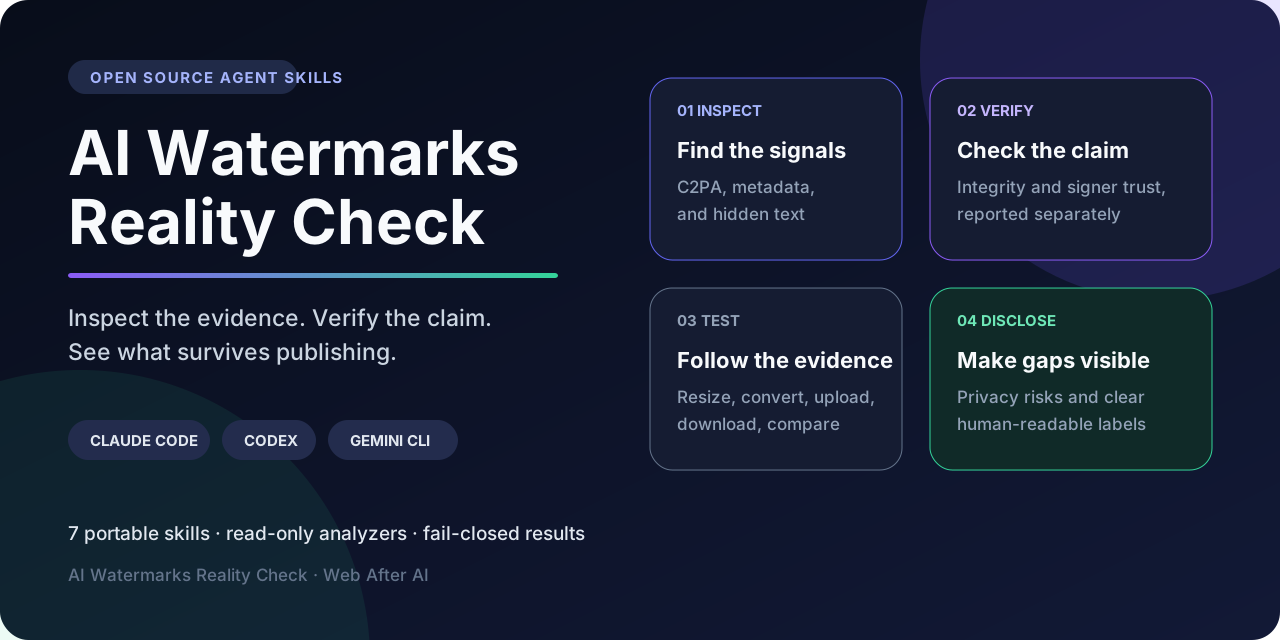
The pack deliberately does not remove watermarks or Content Credentials. It makes provenance observable without pretending that one signal can prove authorship.
Why this exists
Anthropic says newly launched Claude models are gaining imperceptible text watermarks and supported image files can carry signed C2PA metadata. Its public detector and detailed text-watermark specification are not yet available. Meanwhile, common publishing actions such as resizing, screenshots, conversion, and social uploads can remove file metadata.
This pack gives teams a reproducible workflow:
inspect → verify → transform-test → privacy-audit → disclosure-check
Agent and model compatibility
The skills work with Claude Code, Codex, Gemini CLI, and other Agent Skills-compatible tools.
Use them to audit supported evidence in files and text from Claude, ChatGPT, Gemini, open models, image generators, or any other source. Coverage follows the evidence type rather than a vendor name. C2PA, metadata, disclosure records, pipeline survival, and hidden Unicode channels can be inspected wherever they appear.
There is no universal detector for every proprietary or secret-key watermark. When an official detector, configuration, or key is unavailable, the result remains UNVERIFIABLE, UNSUPPORTED, or UNKNOWN.
The seven skills
| Skill | Use it to |
|---|---|
audit-provenance |
Start here. Answer the five questions for one asset in one pass |
inspect-content-provenance |
Locate C2PA structure and hidden text channels without overclaiming |
verify-content-credentials |
Validate a C2PA manifest and report integrity separately from signer trust |
map-provenance-survival |
Batch edited copies and create a shareable C2PA survival report |
audit-metadata-privacy |
Inventory GPS, author, device, software, and date metadata without changing the source |
check-ai-transparency |
Check whether evidence and human-readable disclosure are ready for review |
detect-text-watermark |
Run every available text-provenance detector and report what cannot be checked |
Install
npx skills add Neeeophytee/ai-watermarks-reality-check
The current skills installer requires Node.js 22.20 or newer. The installed
skills themselves require only Python 3.9 or newer.
Or copy one directory from skills/ into your agent's skill directory. Each skill folder is self-contained: the shared parsing core is vendored into every scripts/ directory, so a single folder works on its own.
As a local MCP server
For MCP-compatible clients, all seven analyzers can also be exposed as local stdio tools:
{
  "mcpServers": {
    "provenance": {
      "command": "python3",
      "args": ["/absolute/path/to/mcp/server.py"]
    }
  }
}
No hosted service is required. The MCP client starts python3 mcp/server.py on the user's machine and exchanges JSON-RPC messages with it through standard input and output. The server dispatches calls to the same read-only analyzers, reads local files, and returns structured results. Cryptographic verification uses the user's local c2patool installation. Remote-manifest access stays disabled unless the caller explicitly enables it.
The server supports two protocol eras. It implements the current stateless revision2026-07-28 and still answers the legacy initialize handshake used by2025-11-25 and earlier clients.
| Behaviour | Support |
|---|---|
server/discover (mandatory in 2026-07-28) |
Implemented |
Per-request _meta["io.modelcontextprotocol/protocolVersion"] |
Honoured |
UnsupportedProtocolVersionError (-32022) with supported/requested |
Returned |
Legacy initialize negotiation |
Retained |
Quick start
Every script uses the Python standard library and requires Python 3.9 or newer. Cryptographic C2PA verification additionally requires the official c2patool 0.20.0 or newer.
Start with the front door, which answers all five questions in one pass:
python3 skills/audit-provenance/scripts/audit_provenance.py image.png \
  --c2patool /path/to/c2patool \
  --trust-anchors /path/to/policy.pem
The individual analyzers remain directly available:
python3 skills/inspect-content-provenance/scripts/inspect_file.py image.png

python3 skills/verify-content-credentials/scripts/verify_c2pa.py image.png

python3 skills/map-provenance-survival/scripts/map_survival.py \
  --original original.png \
  --derivatives-dir transformed-copies/ \
  --derivative social-download:platform-roundtrip=downloaded.jpg \
  --c2patool /path/to/c2patool \
  --report survival-report.html

python3 skills/audit-metadata-privacy/scripts/audit_metadata.py image.png

python3 skills/check-ai-transparency/scripts/check_transparency.py \
  examples/transparency-record.json

python3 skills/detect-text-watermark/scripts/detect_text_watermark.py draft.md
Scripts emit JSON to stdout and diagnostics to stderr. Remote-manifest fetching is disabled by default and requires --allow-network. A missing verifier, an unsupported verifier version, an inaccessible remote manifest, or an unpublished detector produces an explicit unknown state rather than a pass.
Survival reports refuse to overwrite an existing file. They show only filenames
by default, while the machine-readable JSON retains the full reproducibility
record. Use --include-paths only when the report will stay private. A generated
report never claims that a proprietary watermark detector ran.
See the generated example and the
community benchmark template before
publishing a result.
What's new in v0.2.0
The provenance survival skill can now audit a directory of edited or downloaded
copies in one run and create a self-contained Markdown or HTML report. This is
useful for testing a CMS, editor, CDN, social network, or watermark-removal
workflow without changing any of the files being measured.
--derivatives-dirrecursively adds visible, non-symlink files with stable labels.--report survival-report.htmlcreates a portable, script-free report.- Local paths and the original command are redacted from reports by default.
- The JSON result remains on stdout and continues to validate against the published schema.
- Every report states its boundary: this workflow measures C2PA survival, not proprietary pixel or keyed text watermarks.
Evidence model
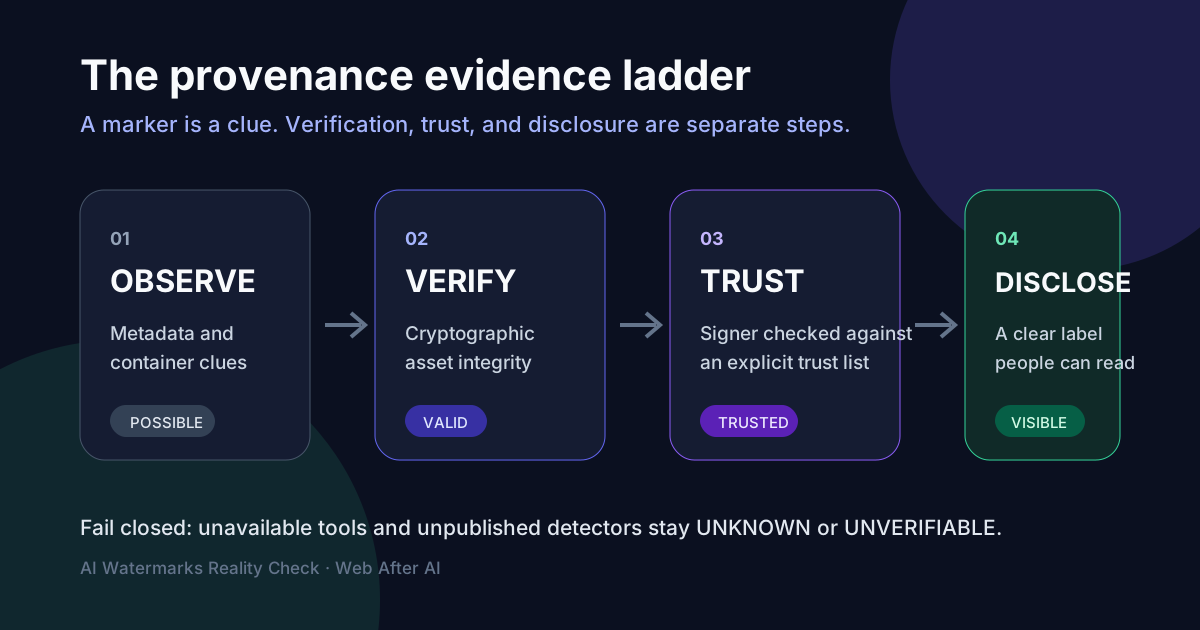
| Dimension | States | Meaning |
|---|---|---|
| Manifest presence | PRESENT, POSSIBLE, ABSENT, UNKNOWN |
Whether a C2PA manifest is observed |
| Integrity | VALID, INVALID, NOT_VERIFIED, UNKNOWN |
Whether a conforming verifier validated the claim |
| Signer trust | TRUSTED, UNTRUSTED, NOT_CHECKED, UNKNOWN |
Whether the signing chain reaches the selected trust list |
| Text watermark | UNVERIFIABLE |
Anthropic has not published its detector as of 2026-08-13 |
POSSIBLE means a structural carrier, sidecar, or format-appropriate malformed
hint was located; inspect the marker confidence before acting. OnlySTRUCTURAL means the location and carrier form match the specification.PRESENT is only ever returned by a conforming verifier. ABSENT is emitted
only for a completed bounded scan of a supported container or an explicit live
verifier "no claim" result. VALID never automatically means TRUSTED.
Absence of a mark never proves that content was human-made.
A literal mention of "C2PA" in readable text is recorded in c2pa_mentions and is never evidence.
C2PA carriers checked
Detection is structural, at the locations the C2PA 2.4 specification defines.
| Container | Carrier | ABSENT possible? |
|---|---|---|
| PNG | caBX chunk |
yes |
| JPEG | APP11 JUMBF segment | yes |
| WebP | RIFF C2PA chunk |
yes |
| TIFF/DNG | private tag 0xCD41, type 7, in the last main IFD |
yes |
| GIF | C2PA_GIF application extension |
yes |
| HTML | head <script type="application/c2pa"> containing Base64; <link rel="c2pa-manifest"> |
yes |
| Text | A.8 variation-selector wrapper; A.9 block in host comments or front matter | yes |
Associated File /AFRelationship /C2PA_Manifest |
no | |
| BMFF (MP4/HEIC/AVIF) | uuid box with the C2PA UUID, or jumb |
no |
| OOXML / ODF / ZIP | packaged manifest entry | no |
| Any | detached .c2pa sidecar |
not format-specific |
Fail closed. The right-hand column is the important one. For formats marked
no, this build inspects the carriers listed but cannot walk the container
exhaustively because of compressed PDF object streams and fragmented BMFF.
Finding nothing therefore yields UNKNOWN with a stated reason, never ABSENT.
| Confidence | Meaning |
|---|---|
STRUCTURAL |
Found at a spec-defined location |
MODERATE |
A format-appropriate key or XML namespace reference |
SIDECAR |
A detached .c2pa manifest beside the asset |
Partial scans
A bounded read can never produce a conclusive clean result. detect-text-watermark
streams the whole file where practical and always reports:
| Field | Meaning |
|---|---|
file_sha256 |
SHA-256 over every byte on disk, always |
scanned_sha256 |
SHA-256 over the region actually analysed |
file_bytes / scanned_bytes |
sizes of each |
scan_complete |
whether the two coincide |
If scan_complete is false, the status is INCONCLUSIVE with a reason and exit2, even when nothing suspicious was seen in the part that was read. A prefix
hash is never presented as the file hash.
Exit-code contract
Every entrypoint uses the same convention, so an orchestrating agent can apply one rule:
| Code | Meaning |
|---|---|
0 |
Conclusive and good: verified valid, no required gaps, no risk found |
1 |
Conclusive and bad: invalid, required gaps, HIGH privacy risk, provenance lost, covert channel found |
2 |
Inconclusive: unknown state, missing or unsupported verifier, unsupported container |
Output schemas
Machine-readable JSON Schemas for all seven tools live in schemas/. Every branch of every tool returns the same top-level field set, and CI validates real outputs against these schemas. The schemas also encode the evidence invariants: a document claiming integrity: VALID with manifest_presence: ABSENT fails validation.
Text watermark detection
detect-text-watermark runs a detector registry and reports honestly per adapter:
| Adapter | Runs? | State when it cannot run |
|---|---|---|
anthropic-official |
never | UNVERIFIABLE: no public detector or specification exists |
synthid-text |
never in this build | NOT_CONFIGURED without keys, UNSUPPORTED with them |
kgw-research |
never in this build | NOT_CONFIGURED without a key, UNSUPPORTED with one |
unicode-covert-channel |
yes | not applicable |
c2pa-text-manifest |
yes | not applicable |
The state vocabulary distinguishes five situations, so a caller can never mistake
"did not look" for "looked and found nothing":
| State | Meaning |
|---|---|
DETECTED |
The detector ran and found the signal |
NOT_DETECTED |
The detector ran and did not find it |
NOT_CONFIGURED |
Required keys or config were not supplied; nothing was analysed |
UNSUPPORTED |
Configured, but this build ships no scorer; nothing was analysed |
UNVERIFIABLE |
The scheme cannot be checked by a third party at all |
FAILED |
The detector errored |
Only DETECTED and NOT_DETECTED mean a detector ran, and only those
contribute to the top-level status. SynthID and KGW accept configuration but
this build performs no scoring for either; they are unavailable
integrations, not silent passes.
Keyed model-level watermarks bias token sampling with a secret key; detection requires that key. A third party cannot check them, and this pack says so rather than guessing.
A standards-compliant C2PA text manifest (2.4 §A.8) is itself a run of variation
selectors after a ZWNBSP. It is recognised as provenance and excluded from
covert-channel findings rather than reported as suspicious.
The covert-channel scan finds Unicode tag characters (ASCII smuggling), bidi overrides, variation selectors, zero-width characters, exotic spaces, and mixed-script homoglyphs. These are text-integrity and prompt-injection signals, not watermark evidence: they identify no model or vendor.
Deliberate non-goal: statistical or stylometric AI-text classifiers are not implemented and will not be added. Their false-positive rates make them unsafe for accusing a person of AI authorship.
Scope and safety
- No watermark removal, evasion, or provenance stripping.
- No source files are modified.
- No authorship verdicts.
- No legal-compliance claims.
- No statistical AI-text detection.
- Reports avoid printing sensitive metadata values by default.
Sources
See SOURCES.md. Product behavior is volatile; the source review date is recorded there.
License
GNU Affero General Public License v3.0 (AGPL-3.0-only)
Reviews (0)
Sign in to leave a review.
Leave a reviewNo results found