redacta
Health Warn
- License — License: MIT-0
- Description — Repository has a description
- Active repo — Last push 0 days ago
- Low visibility — Only 5 GitHub stars
Code Pass
- Code scan — Scanned 12 files during light audit, no dangerous patterns found
Permissions Pass
- Permissions — No dangerous permissions requested
No AI report is available for this listing yet.
Redacta — a Claude/Agent Skill that pseudonymises medical documents before AI processing
Redacta



Pseudonymise medical and clinical documents before they're processed by AI or
shared. Redacta replaces patient identifiers with labelled tokens —[PATIENT_NAME_1], [NHS_NUMBER_1], [DATE_OF_BIRTH_1], … — while leaving the
clinical meaning intact, and returns a redaction report alongside the cleaned
text.
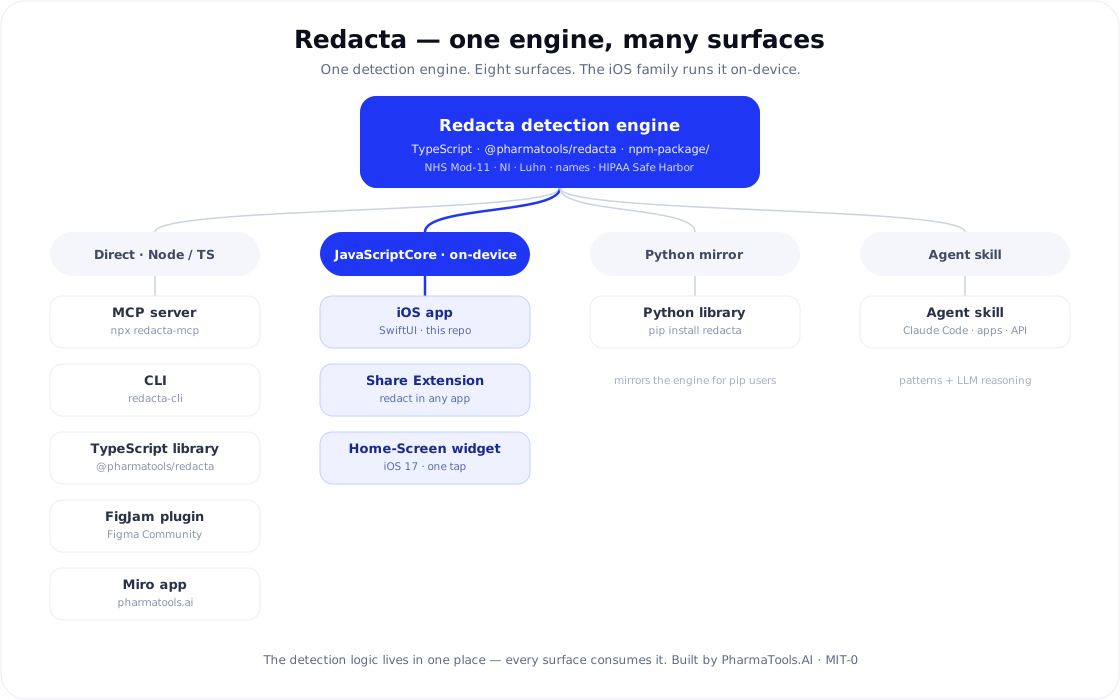
It started as an Agent Skill and is now one engine
shipped across eight surfaces — an iOS app, agent skill, MCP server, two
libraries, a CLI, and two whiteboard apps.
One engine, many surfaces
| Surface | Folder | Get it |
|---|---|---|
| iOS app — iPhone (app, Share Extension, widget) | ios-app/ |
Build with Xcode — see ios-app/README.md |
| Agent skill (Claude Code / apps / API) | SKILL.md, scripts/ |
openclaw skills install redacta (ClawHub) |
| MCP server (Claude Desktop, Cursor, …) | mcp-server/ |
npx -y redacta-mcp (npm · MCP Registry · Anthropic MCP Directory) |
| TypeScript library | npm-package/ |
npm i @pharmatools/redacta (npm) |
| Python library | python-package/ |
pip install redacta (PyPI) |
| Command-line tool | cli-package/ |
npx redacta-cli (npm) |
| Miro app | miro-app/ |
getpatiently.ai → Redacta |
| FigJam plugin | figjam-plugin/ |
Figma Community |
The detection logic lives in one place — the TypeScript engine
(@pharmatools/redacta, in npm-package/), which the MCP server and both
whiteboard apps consume, and which the iOS app runs on-device via JavaScriptCore.
The Python package mirrors it for pip users; the agent skill adds LLM reasoning
for free-text names on top of the deterministic patterns.
How it works
Two layers:
- Patterns (deterministic). A bundled script (
scripts/redact_structured.py,
Python standard library only, no network) matches fixed-format identifiers:
NHS numbers (Modulus-11 validated), UK National Insurance numbers, dates of
birth, UK postcodes, phone numbers, emails, and hospital/MRN numbers. US SSN
and ZIP codes are also handled. - Reasoning (judgement). The skill then has the agent handle what patterns
can't: patient names (told apart from the clinicians treating them), relatives
and carers, postal addresses, and identifying ages. - Self-check. A final pass re-reads the output for any identifier that slipped
through before the report is written.
It also works in reverse. Re-identification (scripts/reinstate.py) takes the
token map from an earlier redaction and restores the original values — so you can
redact a document, run it through another AI tool, and put the real details back
locally. Redact → process → re-identify is a complete round trip, and identifiers
only ever exist on your machine.
Safe Harbor mode. Ask for HIPAA Safe Harbor (or "US de-identification") and
Redacta applies a stricter pass: all dates (not just the date of birth), all
specific ages, and the remaining HIPAA identifiers — fax, certificate/licence,
device serial, VIN, and health-plan beneficiary numbers.
Install
Claude Code
git clone https://github.com/nickjlamb/redacta ~/.claude/skills/redacta
Then invoke it with /redacta, or let it trigger automatically when you ask to
redact or de-identify clinical text.
Claude apps / API
Zip the repository folder and upload it as a skill.
Contents
| Path | What it is |
|---|---|
SKILL.md |
The skill — instructions plus metadata |
reference.md |
Pattern specs, the Modulus-11 algorithm, NI prefix rules, the date-of-birth vs clinical-date rule, token vocabulary, limitations |
scripts/redact_structured.py |
The deterministic pattern layer |
scripts/reinstate.py |
The re-identification layer (restore originals from a token map) |
scripts/test_redact_structured.py |
Tests for the pattern layer |
scripts/test_reinstate.py |
Tests for the re-identification layer |
evaluations.json |
Example evaluation scenarios |
Run the tests:
python3 scripts/test_redact_structured.py
python3 scripts/test_reinstate.py
A note on limits
Redacta is a strong first line of defence, not a guarantee. It won't catch every
possible identifier and isn't a substitute for formal data-protection processes.
Always review the redaction report before sharing text.
License
MIT-0 (MIT No Attribution). Built by
PharmaTools.AI.
Reviews (0)
Sign in to leave a review.
Leave a reviewNo results found