ai-saas-starter
Health Warn
- License — License: MIT
- Description — Repository has a description
- Active repo — Last push 0 days ago
- Low visibility — Only 6 GitHub stars
Code Fail
- spawnSync — Synchronous process spawning in .claude/hooks/format-edited-file.mjs
- spawnSync — Synchronous process spawning in .claude/hooks/stop-typecheck.mjs
- rm -rf — Recursive force deletion command in .claude/settings.json
- process.env — Environment variable access in drizzle.config.ts
Permissions Pass
- Permissions — No dangerous permissions requested
No AI report is available for this listing yet.
AI SaaS boilerplate for Next.js 16 — Better Auth, Stripe subscriptions, credits system, AI image generation. AI-native: AGENTS.md, Claude Code skills & hooks.
ai-saas-starter
The free, open-source AI SaaS boilerplate and starter kit for Next.js 16.
Auth, Stripe subscriptions, an append-only credits ledger, and AI image
generation — built as an AI-native repo that Claude Code, Cursor, and
Codex can extend without breaking the money paths.


Live demo ·
Deploy guide ·
Pro version
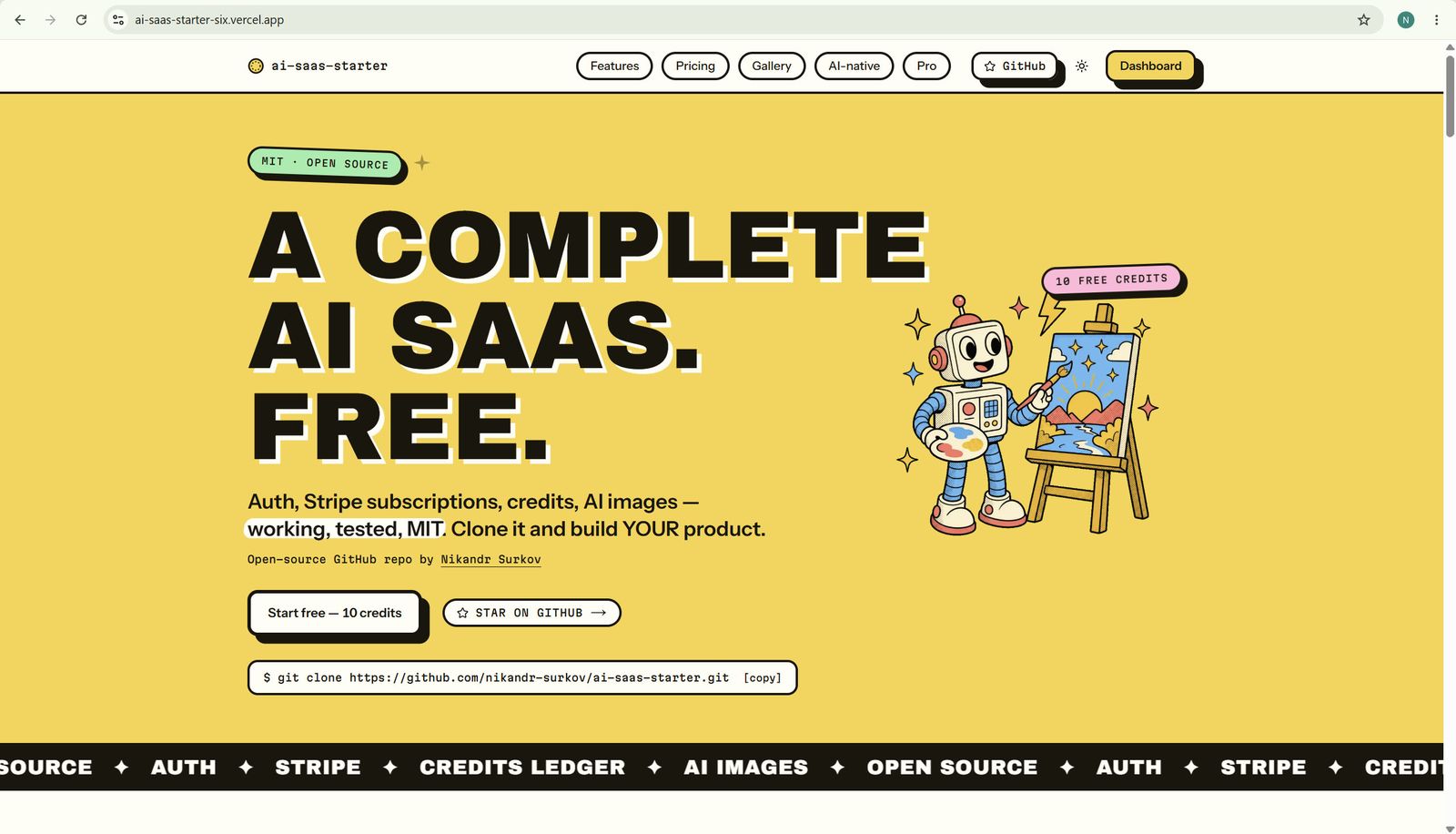
What is this?
- This website is the demo — sign up,
everything works. - The code is a free GitHub repo — MIT, clone it.
- You build YOUR product on top — auth and payments are done.
A free, open-source SaaS boilerplate / starter kit for Next.js 16 ·
React 19 · TypeScript strict · Better Auth · Drizzle + PostgreSQL ·
Stripe · AI SDK 6 · Tailwind v4 + shadcn/ui · Resend · Vitest +
Playwright.
See it
Why another SaaS boilerplate?
AI assistants are good at building product features and bad at the 20% that
loses money when improvised: webhook retries, concurrent spends, refund
paths, idempotency. This repo ships that 20% finished and tested — an
append-only credit ledger whose balance is enforced equal toSUM(amount), Stripe webhooks that verify raw-body signatures and survive
replays, a double-spend race test against real Postgres — plus the context
files (AGENTS.md, rules, skills, hooks) that keep an agent from quietly
unpicking any of it while you vibe-code the product on top.
Quickstart (60 seconds)
git clone https://github.com/nikandr-surkov/ai-saas-starter.git my-app
cd my-app
pnpm install
docker compose up -d        # Postgres 17
cp .env.example .env        # fill in BETTER_AUTH_SECRET (openssl rand -base64 32)
pnpm db:migrate
pnpm dev
That boots with graceful degradation: no Stripe keys → billing page shows a
setup card; no Resend key → emails no-op with a console warning; no OAuth
keys → those buttons hide; AI_MOCK=true → image generation is free and
offline. Every variable is documented in .env.example.
Quickstart for AI agents
Paste this into your coding agent:
Clone https://github.com/nikandr-surkov/ai-saas-starter.git and get it
running: install deps, start Postgres via docker compose, create .env
from the example (generate the secret), migrate, run dev. Then read
AGENTS.md and brief me on the rules you're operating under.
Works with Claude Code, Cursor, Codex, Copilot, and Gemini CLI. The repo
briefs the agent itself — AGENTS.md, path-scoped rules, skills, hooks.
What's inside
Auth — email/password with verification, Google, GitHub, magic links.
Sessions live in your Postgres. Settings page with password change,
account linking, and cascade-safe account deletion (cancels the Stripe
subscription first).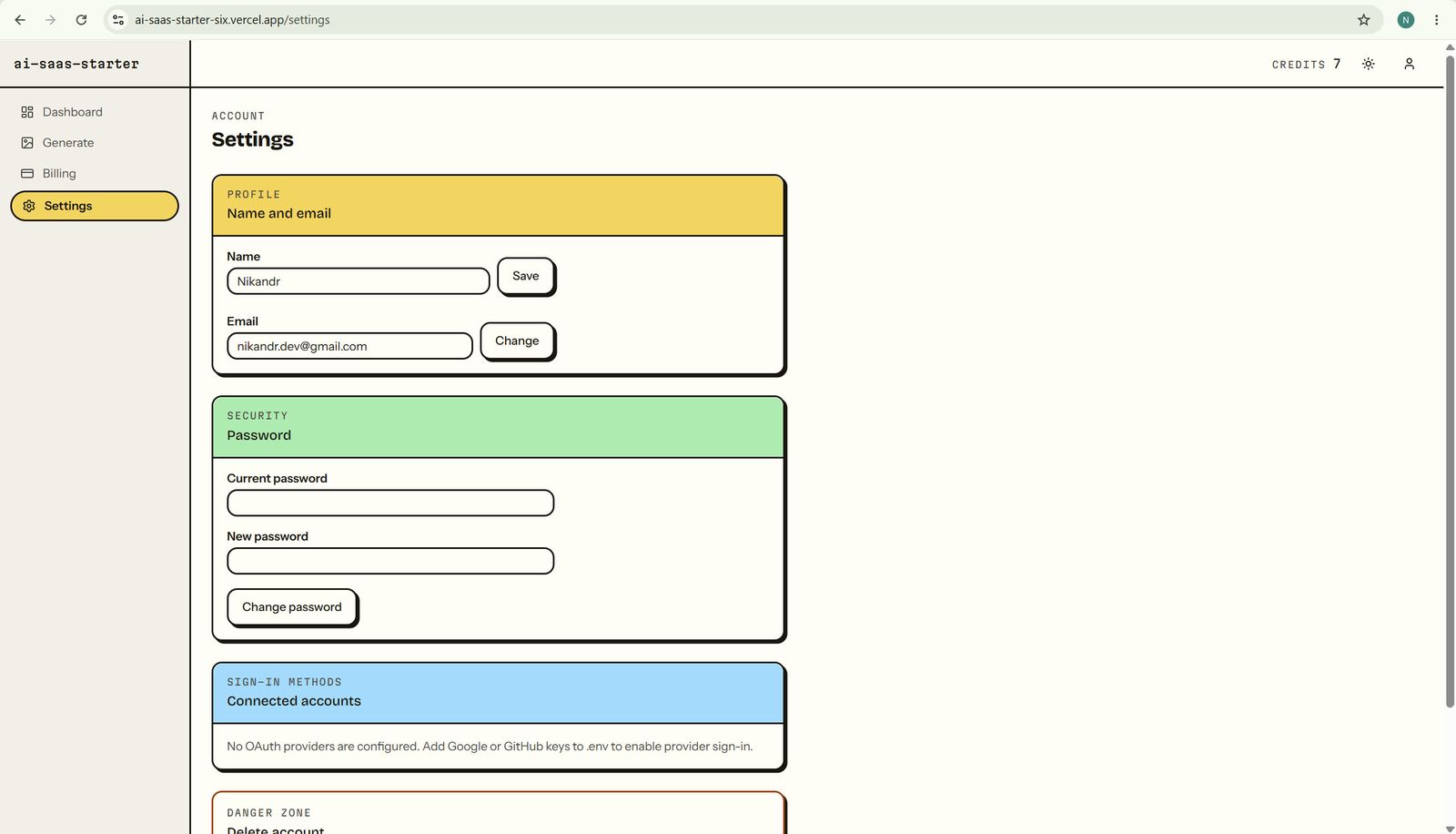
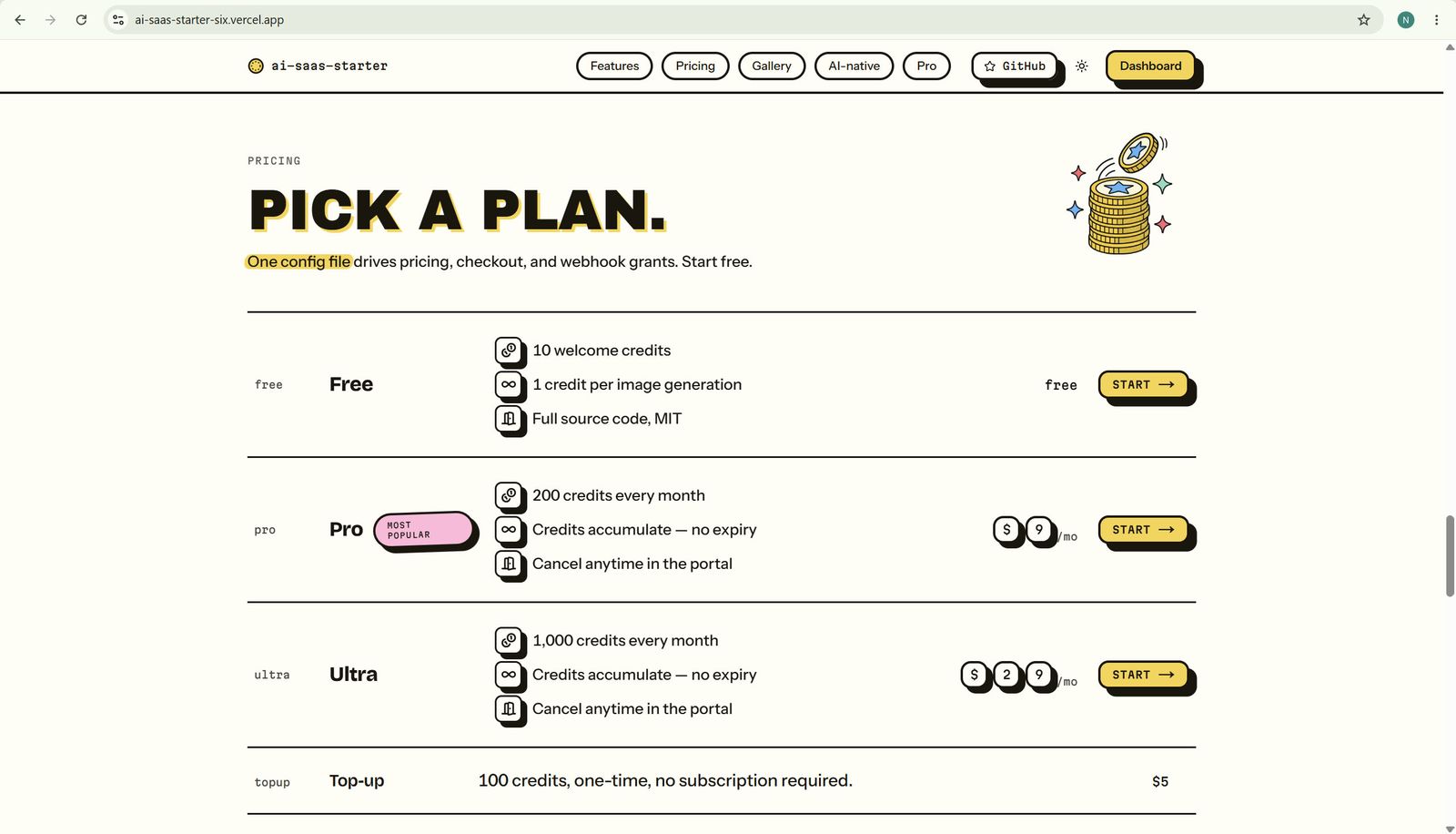
Billing — Stripe Checkout + Customer Portal as server actions, a
signature-verified webhook, and one sync function as the only writer of
subscription state. Plans, prices, and credit amounts live in
src/config/plans.ts and nowhere else.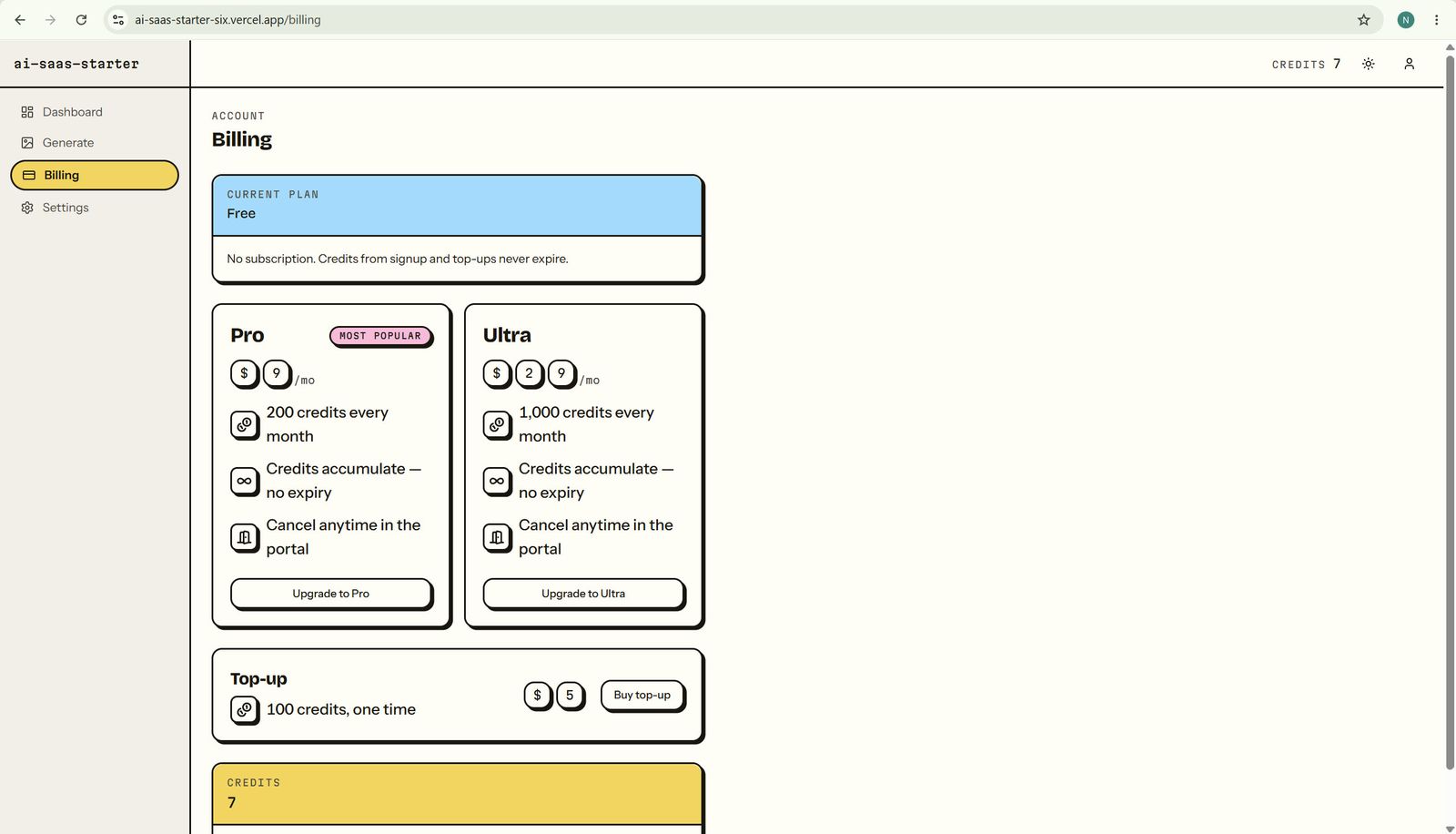
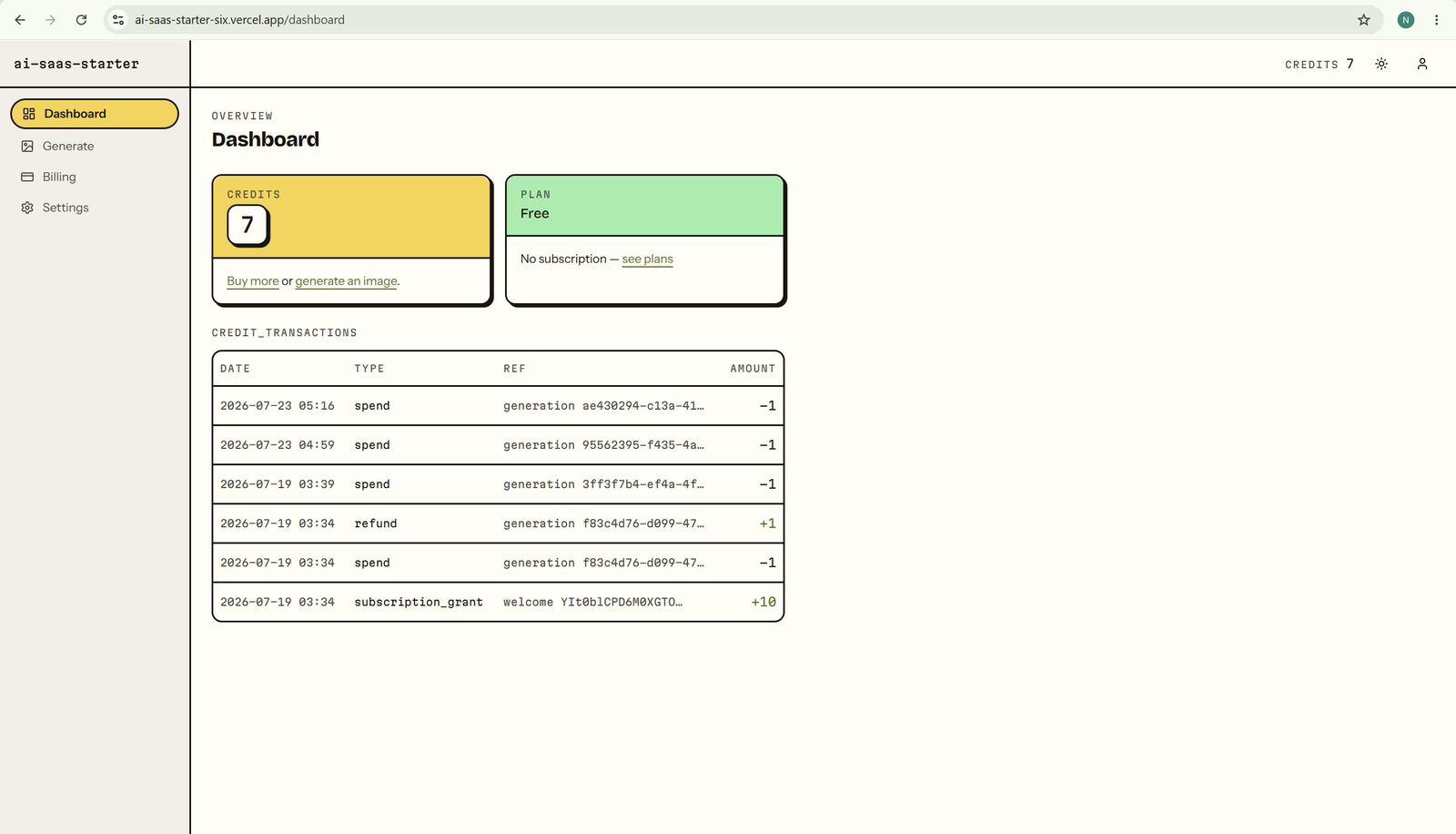
Credits ledger — append-only
credit_transactionswith UNIQUE
idempotency keys. Grants oninvoice.paid(grant_{invoiceId}), top-ups
on checkout (topup_{sessionId}), spends as one conditional UPDATE (the
race guard), refunds as compensating rows. The database itself refuses
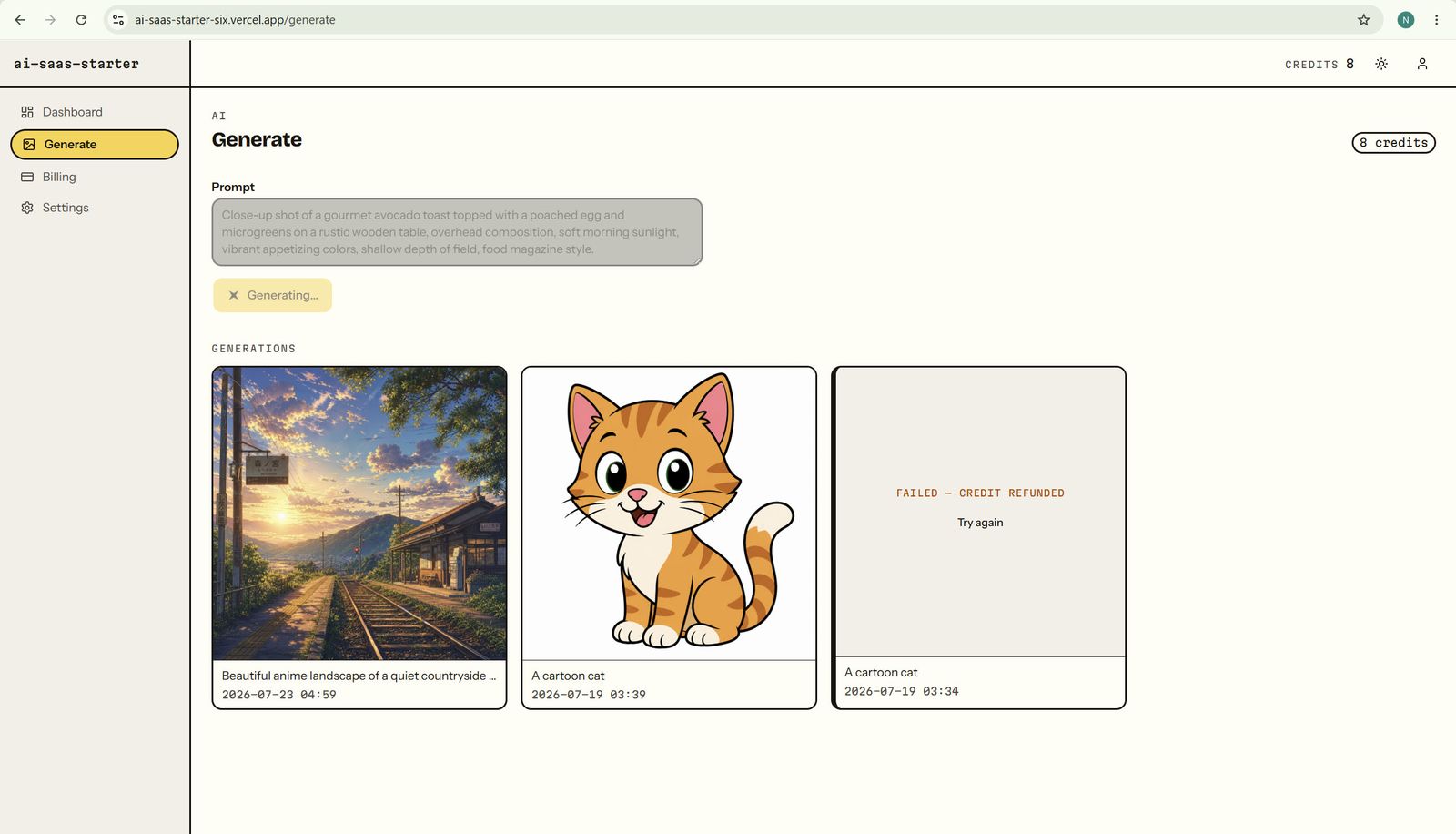
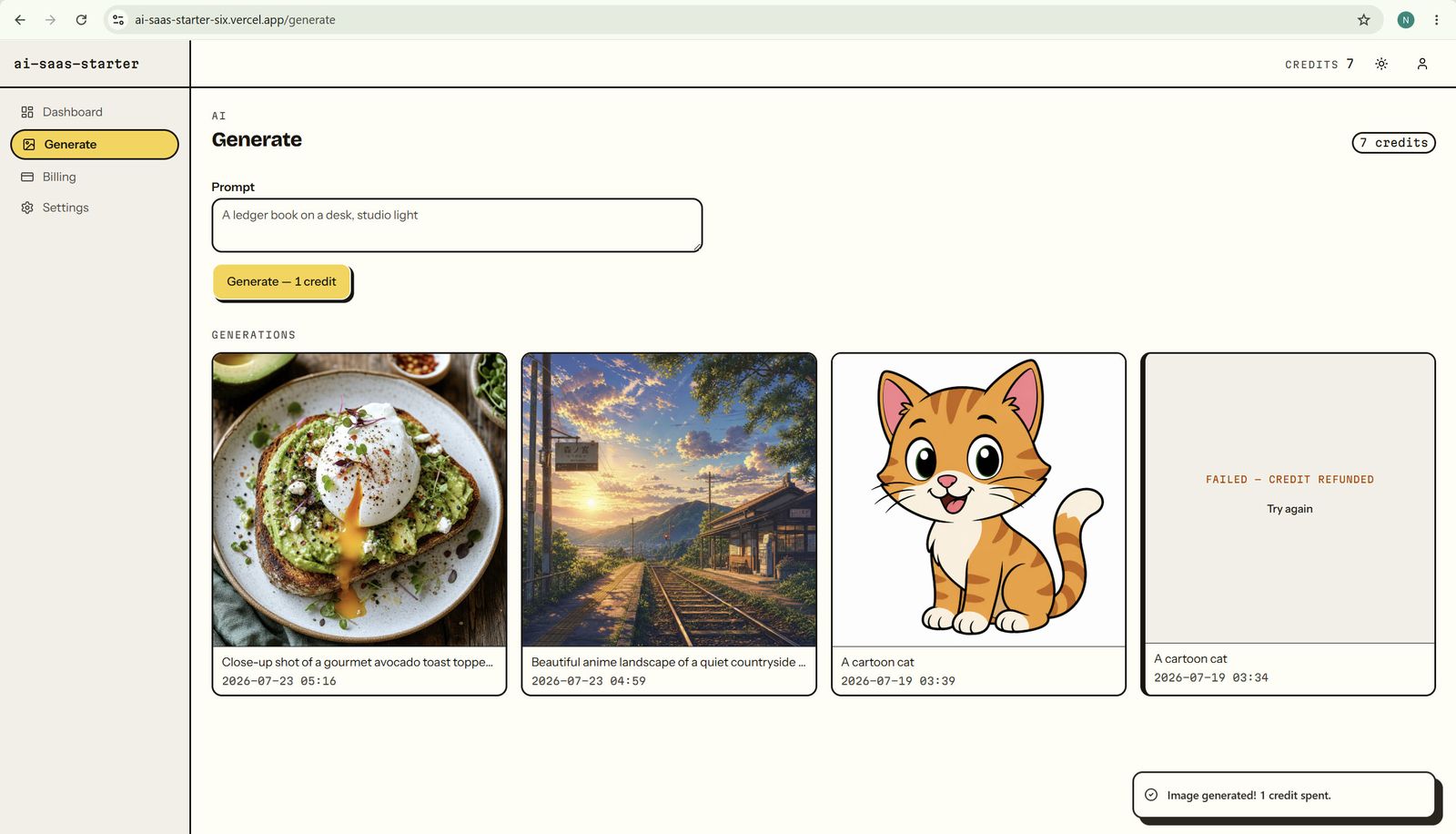
negative balances and zero-amount rows.AI generation — prompt → rate limit (10/min) → spend 1 credit →
AI SDK 6generateImage→ store (Vercel Blob, or./.generatedin dev)
→ history grid. Provider failure refunds automatically. Swap models viaAI_IMAGE_MODEL=provider/model; add providers by implementing one
interface (src/lib/ai/provider.ts).Design system — "The Ledger, LOUD MODE": tokens and hard rules in
DESIGN.md, light and dark, generated illustrations, an
interaction grammar with press physics./styleguide(dev only) shows
every primitive in both themes.
The AI-native part
This repo assumes an agent will extend it, and briefs the agent accordingly:
| File | What it does for the agent |
|---|---|
| AGENTS.md | The operating manual: commands, conventions, safety boundaries (NEVER / ASK FIRST), gotchas, definition of done. Works with Claude Code, Cursor, Codex, Copilot, Gemini CLI. |
| CLAUDE.md | Imports AGENTS.md, adds plan-mode policy for money code and skill pointers. |
| DESIGN.md | Tokens plus hard rules, so generated UI stays on-brand. |
.claude/rules/ |
Path-scoped invariants that load only when billing, database, or design files are touched. |
.claude/skills/ |
/add-feature, /add-ai-provider, /db-migration — the common jobs, scripted the repo's way. |
.claude/hooks/ |
Prettier after every edit; a Stop hook that blocks "done" until tsc --noEmit passes. |
.claude/agents/code-reviewer.md |
A read-only reviewer for auth/billing/ledger diffs. It found real money bugs during this repo's own build. |
specs/TEMPLATE.md |
Spec-first workflow — copy it, fill it, hand it to the agent. A filled example is included. |
With Claude Code: open the repo and the context loads itself; type/add-feature to scaffold the repo way. With Cursor: .cursor/rules/
mirrors the same invariants. Everything defers to AGENTS.md, so there is
one source of truth to edit. Agent-assisted contributions are welcome —
run the repo's own gates and the code-reviewer agent before opening a PR
(see CONTRIBUTING.md).
Architecture in one paragraph
Server Components by default; Server Actions for mutations; API routes only
for the Stripe webhook and the Better Auth handler. Zod validates every
boundary — forms, webhook payloads, and env
(src/lib/env.ts, the only place process.env is read).
Money is integer cents, credits are integers, and two modules own the
dangerous writes: src/lib/credits/ is the only code
that touches credit tables, and syncStripeDataToDb in
src/lib/billing/sync.ts is the only writer of
subscription state — webhooks are triggers, never sources of truth.
Testing
pnpm test        # Vitest — needs Postgres: docker compose up -d
pnpm test:e2e    # Playwright — boots its own dev server on :3100
94 unit/integration tests: the full ledger behavioral suite against real
Postgres (double-spend race, exact-boundary spends, idempotent replays,
refunds, key-collision detection, invariant checks, DB CHECK probes),
webhook signature verification with real HMAC fixtures, sync derivation,
plans-config locks, env validation, email rendering. 12 e2e tests: signup
to dashboard, mock generation, the FAIL-refund path, the 0-credit block,
open-redirect guards, image-route authorization, billing plan cards from
the plans config.
The spend→refund loop is user-visible, not just tested: a failed
generation refunds its credit automatically and says so on the tile.
e2e runs against next dev deliberately — AI_MOCK=true is refused in
production builds, so a build+start e2e would hit a real provider. The
comment in playwright.config.ts explains.
Stripe, locally
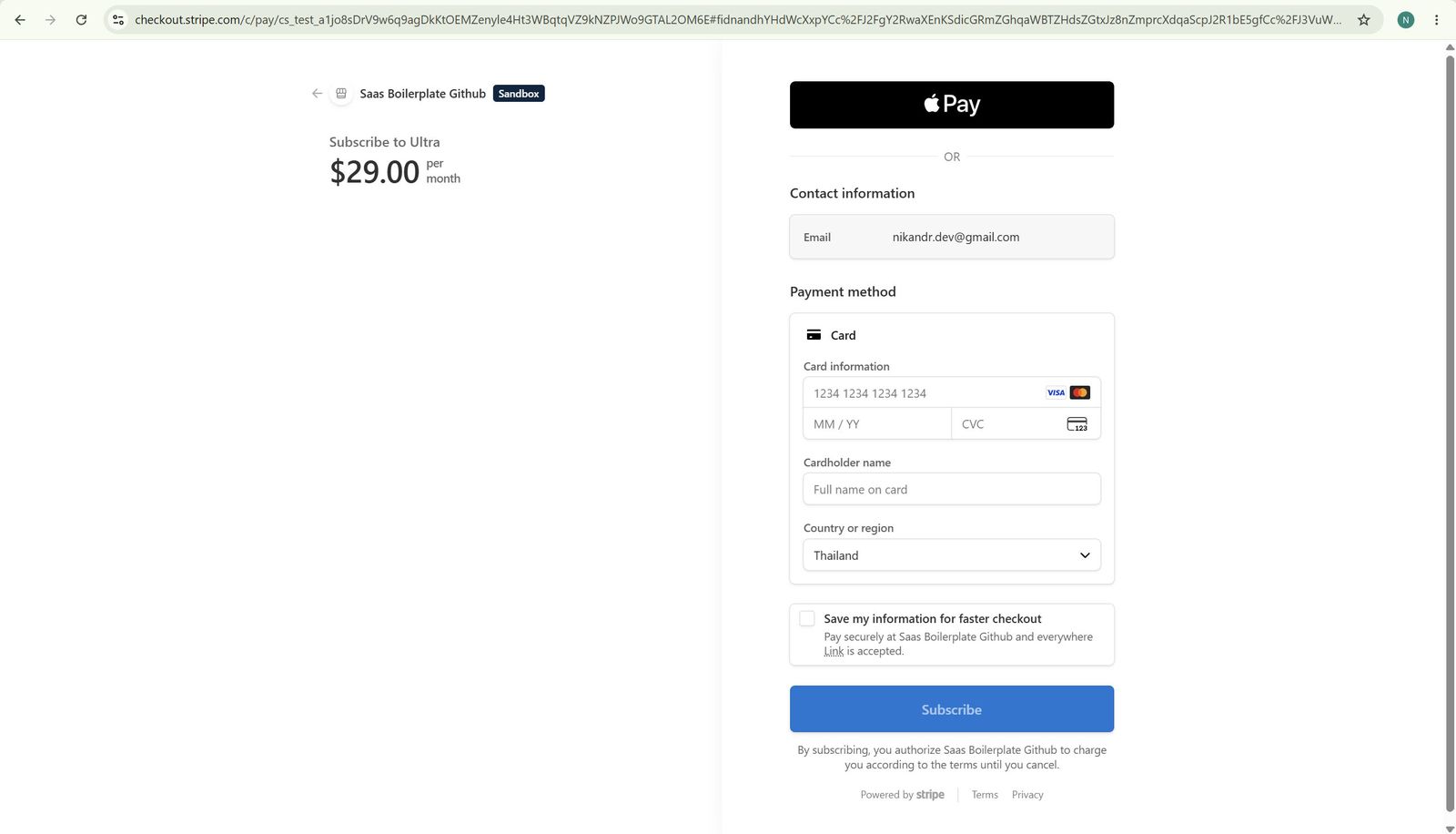
- Create three test-mode prices (Pro $9/mo, Ultra $29/mo, Top-up $5
one-time) in the Stripe dashboard
or via the API, and put theprice_...IDs in.env. pnpm stripe:listen(Stripe CLI) — copy the printedwhsec_...into.env, restartpnpm dev.- Subscribe with card
4242 4242 4242 4242→ the webhook grants the
plan's credits, keyed by invoice ID. Resend the event from the Stripe
dashboard — the ledger's unique key makes the replay a no-op. - Renewals and cancellations can't wait a month: use
test clocks to
advance time. Portal cancellations setcancel_at(not the legacy
boolean) — the sync handles both; don't "simplify" it.
Deploy to production (Vercel + Neon)
The order matters — follow it top to bottom.
Neon — create a project and copy BOTH connection strings: the
pooled one (contains-pooler, for the running app) and the
direct one (for migrations).Vercel — import the GitHub repo. Don't deploy yet.
Blob store — in the Vercel project: Storage → Create → Blob, with
Access: Public, and tick "Add a read-write token env var" — the
default flow skips it and leavesBLOB_READ_WRITE_TOKENunset, which
silently sends generated images to the (nonexistent) local fallback.Environment variables — everything from
.env.example:Variable Value DATABASE_URLthe pooled Neon URL (runtime traffic) BETTER_AUTH_SECRETopenssl rand -base64 32BETTER_AUTH_URLthe exact deployed URL — see step 9 STRIPE_SECRET_KEY+ 3 price IDsfrom your Stripe dashboard STRIPE_WEBHOOK_SECRETplaceholder for now — replaced in step 7 AI_GATEWAY_API_KEY,AI_IMAGE_MODELAI Gateway; AI_MOCKstays UNSETRESEND_API_KEY,EMAIL_FROMverified Resend domain BLOB_READ_WRITE_TOKENadded by step 3's checkbox Deploy and note the real production domain Vercel assigns — it may
suffix the project name (e.g.-six).Migrate once, locally, with the direct URL (the pooler rejects
some DDL):DATABASE_URL="<direct Neon URL>" pnpm db:migrateStripe webhook — create the endpoint for the REAL deployed domain:
https://<real-domain>/api/stripe/webhook, eventsinvoice.paid,checkout.session.completed,customer.subscription.updated,customer.subscription.deleted— then copy itswhsec_...into the
Vercel env, replacing the placeholder.Redeploy — env changes never apply to a running deployment.
Pin the domain — set
BETTER_AUTH_URL(env) andsiteConfig.url
(src/config/site.ts) to the exact production URL
from step 5, push, and redeploy if either changed.
Common deploy errors
| Error | Cause | Fix |
|---|---|---|
Invalid origin: ... on signup/login |
BETTER_AUTH_URL doesn't match the actual domain — Vercel may have suffixed the project name |
Set the exact URL in the env, redeploy |
Free tier users do not have access to this model |
The AI Gateway key has no paid credits — the key's quota is a spending cap, not a balance | Add credits to the gateway account, or bring your own provider key |
Signup 500 / relation "users" does not exist |
Migrations never ran against the production database | DATABASE_URL="<direct Neon URL>" pnpm db:migrate |
| Subscribed but no credits arrived | Webhook endpoint points at the wrong domain, stale whsec_, or the env changed without a redeploy |
Recheck step 7's domain, replace the secret, redeploy |
Every env change requires a redeploy — Vercel bakes env at build time.
FAQ
Is this production-ready? The billing and ledger core is tested to a
standard most products never reach (races, replays, invariants, adversarial
webhooks). The legal pages are placeholders and the product on top is
yours to build.
Does it work with Claude Code / Cursor? Yes — that's the point. The
repo carries its own agent context (AGENTS.md, CLAUDE.md, path-scoped
rules, skills, hooks); Cursor reads the mirrored .cursor/rules/. Open
the repo and the agent is briefed.
How does the credits system work? Every credit movement is an
append-only row in credit_transactions with a unique idempotency key,
so webhook replays can't double-grant. Spends are one conditional UPDATE
that refuses to go below zero, and the cached balance is enforced equal
to SUM(amount) by tests and a DB CHECK.
Can I swap gpt-image for another model? One env string:AI_IMAGE_MODEL=provider/model — no code changes.
Why Better Auth instead of NextAuth/Clerk? Sessions and users live in
YOUR Postgres next to the ledger, so account deletion, credit grants, and
webhooks are one transaction-safe world. No per-user vendor pricing on a
free starter.
Is this a free alternative to ShipFast or Makerkit? It overlaps where
every SaaS starter overlaps — auth, Stripe, landing page — but the focus
is different: a tested credits ledger, an AI generation loop, and agent
context files, free and MIT. The paid kits are broader (teams, i18n,
admin); the Pro version covers that ground.
Why is generation mocked by default? So a fresh clone works offline and
free. Set AI_GATEWAY_API_KEY and AI_MOCK=false for real images; in mock
mode, a prompt containing FAIL demos the refund path.
Can I swap Postgres providers? Anything with a postgres:// URL —
Neon, Supabase, RDS, the bundled Docker.
Where do I start extending? Copy specs/TEMPLATE.md, write ten lines,
and hand it to your agent with /add-feature.
Free vs Pro
| Capability | Free — this repo | Pro — nikandr.com |
|---|---|---|
| Auth, subscriptions, credits ledger | full | + rollover, meters, packs |
| AI generation | 1 image provider | image + video + audio, 7 providers |
| Async job pipeline, webhooks, auto-refund | — | Inngest, durable |
| Gallery + R2 storage, teams, admin | — | included |
| MCP server + extended agent skills | core set | full suite |
The free repo is complete — nothing above is crippled. Pro is what comes
after product-market fit.
Author
Built by Nikandr Surkov — nikandr.com. If this
repo saved you time,
star it —
stars are how other builders find it.
License
MIT — see LICENSE.
Reviews (0)
Sign in to leave a review.
Leave a reviewNo results found