claude-code-lens
Health Warn
- No license — Repository has no license file
- Description — Repository has a description
- Active repo — Last push 0 days ago
- Community trust — 17 GitHub stars
Code Fail
- process.env — Environment variable access in bin/cclens.js
- execSync — Synchronous shell command execution in src/cli/service.js
- fs.rmSync — Destructive file system operation in src/cli/service.js
- os.homedir — User home directory access in src/cli/service.js
- process.env — Environment variable access in src/cli/service.js
- os.homedir — User home directory access in src/config/target-discovery.js
- process.env — Environment variable access in src/config/target-discovery.js
- process.env — Environment variable access in src/extractor/cli.js
- os.homedir — User home directory access in src/extractor/index.js
- process.env — Environment variable access in src/extractor/index.js
- os.homedir — User home directory access in src/proxy/config.js
- process.env — Environment variable access in src/proxy/config.js
- os.homedir — User home directory access in src/proxy/logger.js
- process.env — Environment variable access in src/proxy/logger.js
Permissions Pass
- Permissions — No dangerous permissions requested
No AI report is available for this listing yet.
Local monitor for Claude Code API traffic, logs, prompts, and tools
Claude Code Lens


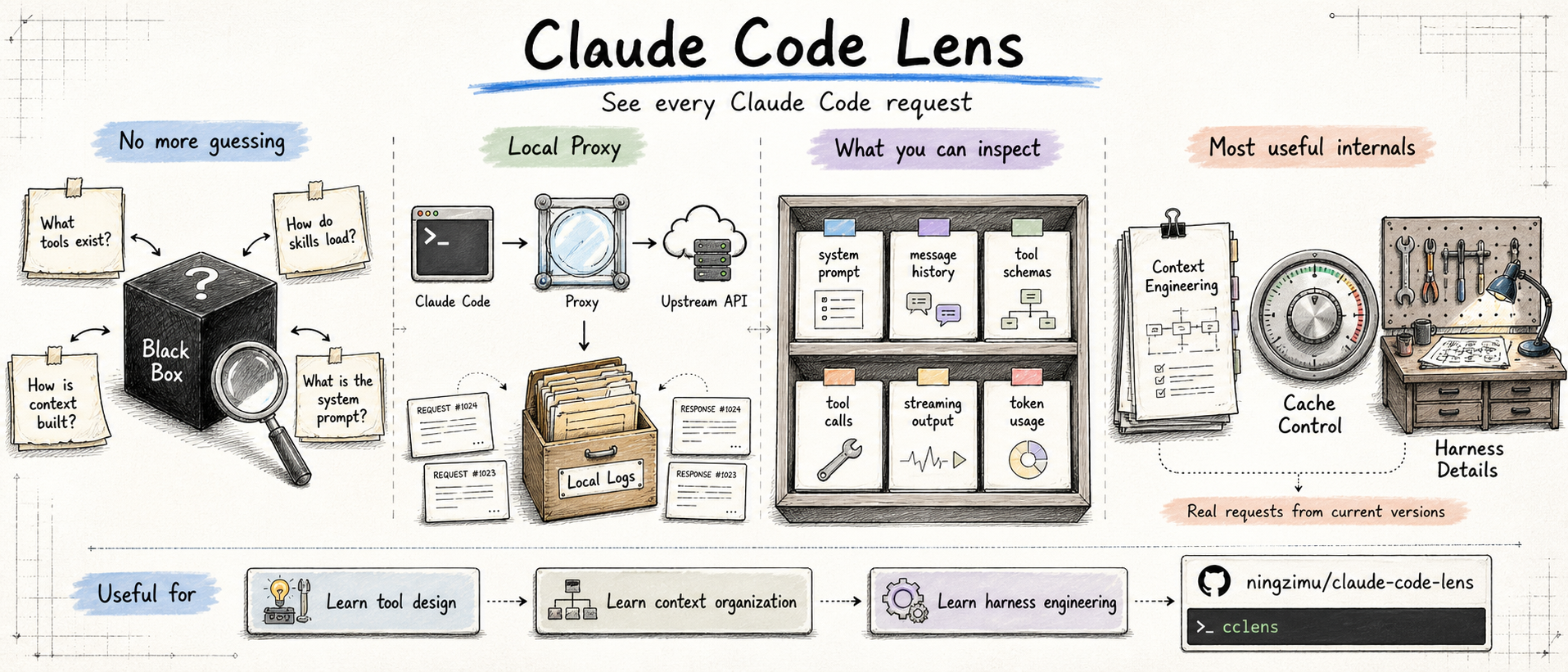
Claude Code Lens is a local observability tool for Claude Code. It runs an Anthropic-compatible proxy between Claude Code and the real upstream service, records system prompts, messages, tool definitions, tool calls, streaming responses, and token usage, then lets you inspect them in a browser.
It is designed for two workflows:
- One-off debugging: launch a monitored Claude Code session without changing your Claude Code settings. Running
cclensopens Claude Code in interactive mode while also starting the proxy and visualizer; append any Claude Code arguments when you need another mode, such ascclens -p "..."orcclens --resume, and they are passed through automatically. - Long-running monitoring: keep a local proxy running and explicitly point Claude Code at it for ongoing log capture. Use
cclens proxy, then start Claude Code with the generated settings file or an environment variable.
Why use it:
- Zero-config by default: it can discover the real base URL used by your existing Claude Code setup.
- Non-invasive: it does not patch Claude Code; one-shot mode does not write to
~/.claude/settings.jsonor project.claude/settings.json. - Full request visibility: inspect system prompts, message history, tool schemas, tool calls, streaming output, and token usage.
- Useful for tool/MCP debugging: verify the exact tool definitions and prompts Claude Code sent to the model.
- Local-first: runtime config and logs live in
~/.claude-code-lens/.
Preview
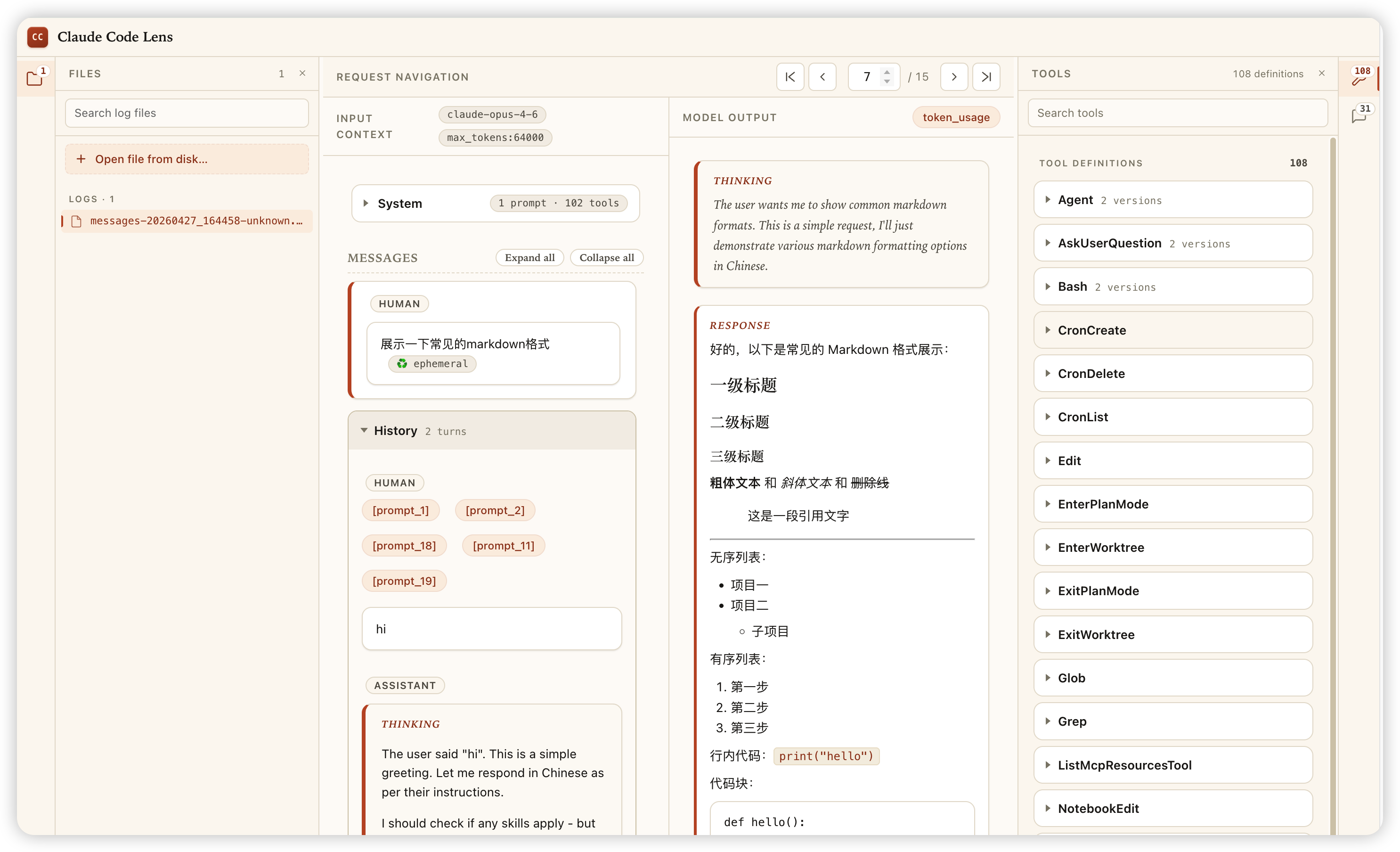
The visualizer splits each Claude Code request into input context, model output, and resources. You can inspect system prompts, messages, tool definitions, token usage, and collapse long message history when reviewing larger sessions.
Install
Install the cclens CLI:
npm install -g claude-code-lens
From a local checkout:
npm install
npm install -g .
The npm package name is claude-code-lens, and the installed command is cclens.
Optional: install the Claude Code Skill for agent-driven trace analysis:
npx skills add ningzimu/claude-code-lens --skill cclens-trace-analyzer
For a global, non-interactive install:
npx skills add ningzimu/claude-code-lens --skill cclens-trace-analyzer -g -y
The Skill install only adds the Agent Skill. It does not run npm install -g claude-code-lens, so install the CLI first if you want the agent to use cclens trace.
Usage
Use one CLI prefix for both monitor commands and Claude Code passthrough. There are two recommended modes.
Mode 1: Launch Claude Code With Monitoring
This is the simplest mode for temporary prompt, tool, MCP, or token usage debugging. Running cclens starts an interactive Claude Code session and turns monitoring on automatically.
cclens
cclens -p "hello"
cclens --resume
One-shot mode:
- Starts the local proxy, default
http://localhost:18888. - Starts the log visualizer, default
http://127.0.0.1:5500. - Opens the browser.
- Launches Claude Code in interactive mode; if you pass Claude Code arguments after
cclens, they are forwarded unchanged.
Except for monitor subcommands (proxy, stop, status, viz, extract, config, help), every argument is passed through to Claude Code automatically. Any Claude Code flag can be appended directly to cclens.
This mode does not modify your Claude Code user or project settings. It only injects the proxy environment into the launched Claude Code process and uses ~/.claude-code-lens/settings.json as a generated settings file. To stop the background proxy, run:
cclens stop
Mode 2: Long-Running Proxy Monitoring
If you want Claude Code to keep using the same local proxy over time, start the proxy manually.
cclens proxy
The command generates:
~/.claude-code-lens/settings.json
Start Claude Code with that settings file:
claude --settings ~/.claude-code-lens/settings.json
Or configure only the current shell session:
ANTHROPIC_BASE_URL=http://localhost:18888 claude
Open the monitor UI:
cclens viz
Default URL:
http://127.0.0.1:5500
Long-running mode is better for continuous monitoring. One-shot mode is better for temporary, no-config debugging.
Stop the proxy:
cclens stop
Check status:
cclens status
CLI Help
Every monitor subcommand has dedicated help:
cclens --help
cclens --version
cclens proxy --help
cclens help proxy
Command reference:
| Command | What it does | When to use it |
|---|---|---|
cclens |
Starts the proxy, visualizer, and Claude Code | One-off debugging; append Claude Code args such as -p or --resume directly |
cclens proxy |
Starts only the local API proxy | Long-running monitoring where you explicitly configure Claude Code to use the proxy |
cclens stop |
Stops monitor-managed background services | Stop the proxy without killing unrelated processes on the same port |
cclens status |
Shows proxy PID and port ownership | Check whether the proxy is running or whether another process owns the port |
cclens viz |
Starts/opens the log visualizer | Inspect existing logs without launching Claude Code |
cclens extract [log-file] |
Extracts prompts and tools from logs | Uses the newest log by default, or a specific file when provided |
cclens trace |
Lists, inspects, and exports session traces without the browser UI | Find a session by ID or time clue, inspect Lead/Subagent behavior, export Markdown for analysis |
cclens config |
Prints the resolved config | Verify ports, target base URL, visualizer settings, and env overrides |
cclens --version |
Prints the installed CLI version | Confirm which npm package version is currently installed |
Agent-Driven Trace Analysis
A Claude Code Skill is included at skills/cclens-trace-analyzer/. Install it with:
npx skills add ningzimu/claude-code-lens --skill cclens-trace-analyzer
When loaded into Claude Code, the agent can run cclens trace list → show → export → Read on its own — no browser UI needed. It locates sessions by ID fragment or time clues, inspects Lead/Subagent behavior, exports Markdown, and reports findings with evidence and recommendations.
Visualizer
The visualizer opens automatically during one-click startup. Set CLAUDE_CODE_LENS_OPEN_BROWSER=false to disable that behavior.
Startup output is intentionally brief. Set CLAUDE_CODE_LENS_VERBOSE=true to print process IDs, log paths, and startup steps.
User Directory
Runtime data is stored outside the repository:
~/.claude-code-lens/
  config.json       # user config
  settings.json     # generated Claude Code settings file
  logs/             # proxy and visualizer process logs
  raw_logs/         # captured API interactions
  prompts/          # extracted prompts and tools
config.json is optional. By default, cclens discovers the target Anthropic-compatible base URL from your existing Claude Code environment and settings.
Target discovery priority:
CLAUDE_CODE_LENS_TARGET_BASE_URL
> ~/.claude-code-lens/config.json target.baseUrl
> ANTHROPIC_BASE_URL from the current shell
> Claude Code settings env.ANTHROPIC_BASE_URL
  - custom --settings file
  - .claude/settings.local.json
  - .claude/settings.json
  - ~/.claude/settings.json
> https://api.anthropic.com
Example ~/.claude-code-lens/config.json for manual overrides:
{
  "proxy": {
    "host": "0.0.0.0",
    "port": 18888
  },
  "target": {
    "baseUrl": "https://api.anthropic.com",
    "timeout": 120000
  },
  "visualizer": {
    "host": "127.0.0.1",
    "port": 5500
  }
}
General configuration priority:
environment variables
> ~/.claude-code-lens/config.json
> Claude Code settings discovery
> built-in defaults
Supported environment overrides:
CLAUDE_CODE_LENS_HOME=~/.claude-code-lens
CLAUDE_CODE_LENS_PROXY_HOST=127.0.0.1
CLAUDE_CODE_LENS_PROXY_PORT=18888
CLAUDE_CODE_LENS_TARGET_BASE_URL=https://api.anthropic.com
CLAUDE_CODE_LENS_TARGET_TIMEOUT=120000
CLAUDE_CODE_LENS_VISUALIZER_PORT=5500
CLAUDE_CODE_LENS_LOGGING_ENABLE_CONSOLE=true
CLAUDE_CODE_LENS_OPEN_BROWSER=false
CLAUDE_CODE_LENS_VERBOSE=true
Logs
API interaction logs:
ls ~/.claude-code-lens/raw_logs/
Proxy server logs:
tail -f ~/.claude-code-lens/logs/proxy-server.log
Sensitive request headers such as authorization and x-api-key are masked in logs. Request and response bodies can still contain private project context, so review logs before sharing them.
Project Layout
bin/                  # unified cclens CLI
src/cli/              # command orchestration
src/proxy/            # local proxy and session logger
src/visualizer/       # browser UI for reading raw_logs
src/extractor/        # prompt/tool extraction implementation
skills/               # Claude Code Skills (trace analyzer)
tests/                # CLI and proxy behavior tests
Development
npm install
npm test
npm run check
Package contents can be checked with:
npm pack --dry-run
Reviews (0)
Sign in to leave a review.
Leave a reviewNo results found