session-watcher
Health Warn
- License — License: MIT
- Description — Repository has a description
- Active repo — Last push 0 days ago
- Low visibility — Only 5 GitHub stars
Code Warn
- process.env — Environment variable access in dist/hooks/session-start-entry.js
- process.env — Environment variable access in dist/hooks/session-start.js
- network request — Outbound network request in dist/hooks/session-start.js
- network request — Outbound network request in dist/public/demo-app.js
- network request — Outbound network request in dist/public/elements/bucketPanel.js
Permissions Pass
- Permissions — No dangerous permissions requested
No AI report is available for this listing yet.
Context is inventory. Know when to restock.
Session Watcher
LLM context economics, in your terminal.
Session Watcher treats your prompt cache as inventory — it uses EOQ theory to measure whether the current context is still worth carrying, tracking restart pressure so you can decide when to hand off.



Documentation · npm · Paper · llms.txt
Quick Start · Install · How It Works · Context Buckets · Handoff · MCP Tools · Agents · Cite
What it does
Session Watcher reads your Claude Code transcript in real time and answers one question: is this session still worth carrying?
Most context tools optimize how you consume tokens — Headroom compresses, /compact shrinks, RTK filters. Session Watcher tracks when the cost curve is drifting, giving you the data to decide. They compose: run any pruning strategy you like, SW measures the cost curve so you can decide when to hand off.
SW reads from the transcript, never writes to it. The dashboard and statusline are pure observers; MCP tools return data for you to act on. Metrics stay on your screen, not in the model's context window.
How it works
Your coding agent (Claude Code)
        │  writes session transcript
        ▼
┌───────────────────────────────────────────────────────┐
│  Session Watcher (in-process MCP server)              │
│  ───────────────────────────────────────────────────  │
│  harness/claude-code  — read rows, emit observations  │
│  measurement/engine   — B (context belief), epochs    │
│  session-watcher      — apply frames, run operations  │
│  rate-lamp            — bill premium (br) + gate      │
│  server.js            — Express + SSE dashboard       │
│  statusline           — one-line shell client         │
└───────────────────────────────────────────────────────┘
        │  dashboard  ·  statusline  ·  MCP
        ▼
   Your browser / terminal status bar
The harness layer is the only part that knows Claude Code: it reads transcript rows, decides the active branch, and emits normalized observations. Everything below it — measurement, dialogue history, handoff — consumes those observations and carries no transcript format, no row shape, and no tool name of any particular agent.
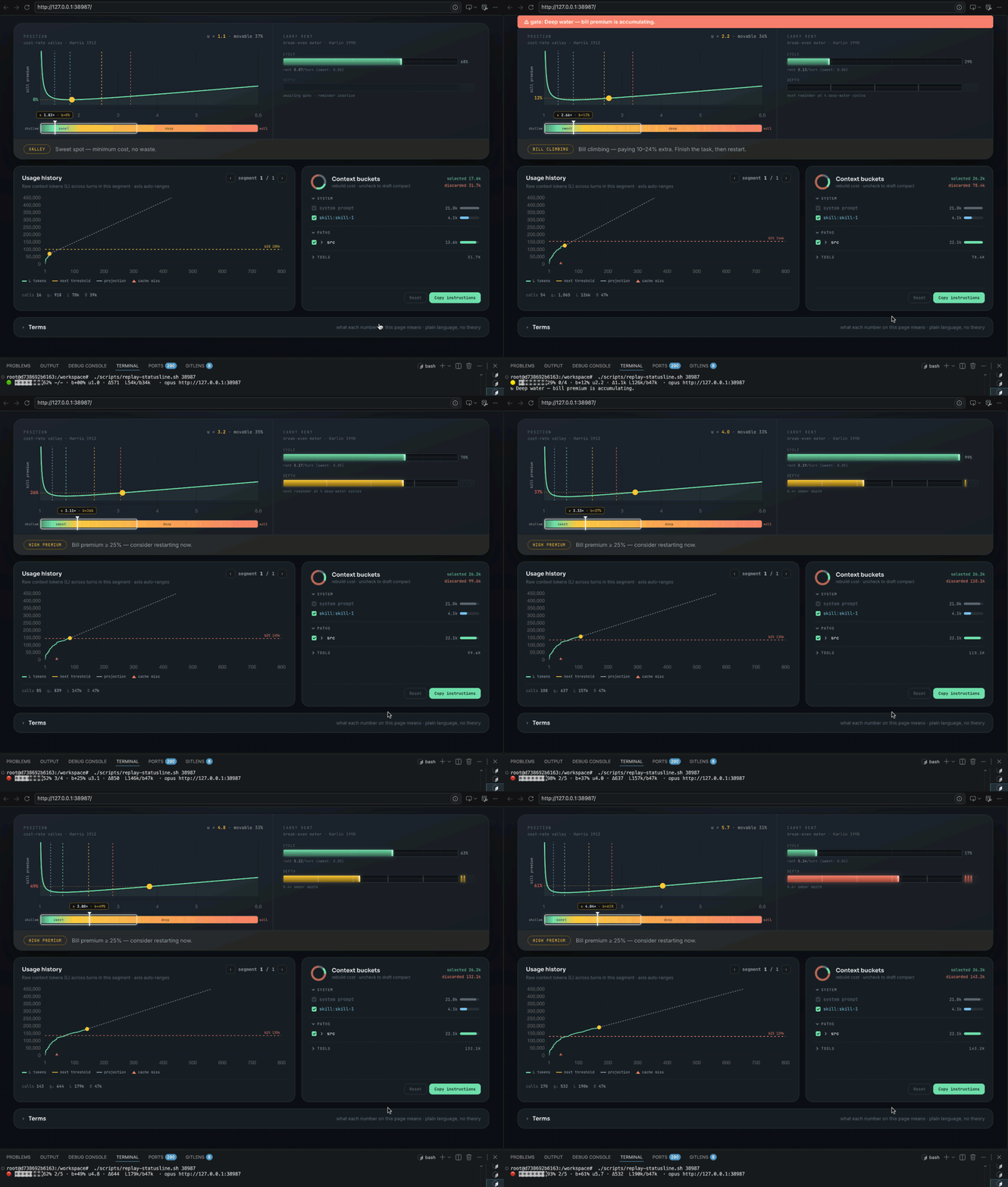
Core model: L = cache_read_input_tokens — the context stock you are renting. B is the rebuild baseline: the session's overhead floor plus the tokens of every file, skill and tool it has pulled in, which is what a restart would have to re-read. g is the growth no path accounts for, a smoothed ΔtotalStock − ΔB. x = L / B places the session on the EOQ cost curve, and br = mf × pp is the bill premium — how much you are overpaying relative to ideal restart timing.
Lamp thresholds are the named constants BR_AMBER and BR_RED in lib/bill-regret.js: below the amber one the lamp is green, between them amber, at or above the red one red. See the paper for the full derivation — EOQ inventory theory mapped to LLM prompt caching.
Quick Start
Requires Node.js ≥ 22.16.
# Try without installing — self-contained demo
npx -y @nomadop/session-watcher demo

# Replay your own transcript
npx -y @nomadop/session-watcher replay ~/.claude/projects/<project>/<session>.jsonl
Opens a browser dashboard. The demo uses a pre-built anonymized session; replay uses your real transcript. Both are read-only — nothing is modified or uploaded.
Install
Plugin (recommended)
# 1. Add the marketplace (one-time)
claude plugin marketplace add nomadop/session-watcher

# 2. Install the plugin
claude plugin install session-watcher@session-watcher
Or from within a Claude Code session:
/plugin marketplace add nomadop/session-watcher
/plugin install session-watcher@session-watcher
/reload-plugins
This registers:
- MCP tools — available in every session
- SessionStart hook — auto-launches the dashboard server on each session
If you installed or updated in an already-running session, run /reload-plugins to activate.
Statusline
The plugin system does not yet support declaring a statusline. Add to your ~/.claude/settings.json:
{
  "statusLine": {
    "type": "command",
    "command": "<plugin-install-path>/dist/statusline.js"
  }
}
Find your plugin path with:
find ~/.claude/plugins/cache -path '*/session-watcher/*/dist/statusline.js' -print
Or check via claude plugin details session-watcher@session-watcher.
Note: the plugin cache path changes on version update. After updating, re-run the command above and update your statusline path.
One compact line:

Context Buckets
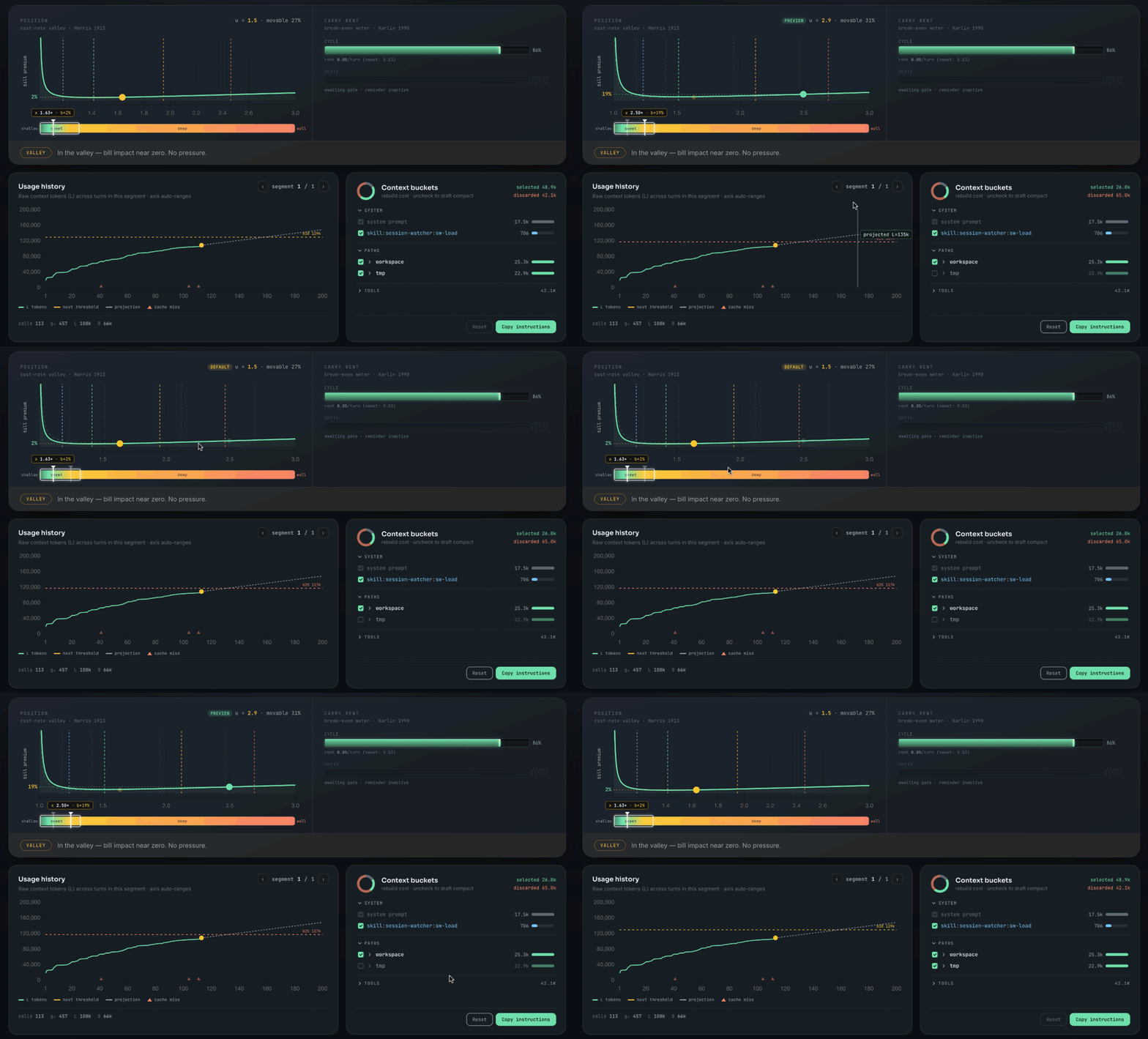
The bucket panel shows exactly which files, skills, and tools are consuming your context budget. Each path carries a token count — check or uncheck to preview how the restart cost changes. The U-curve ghost line updates in real time as you toggle.
Handoff
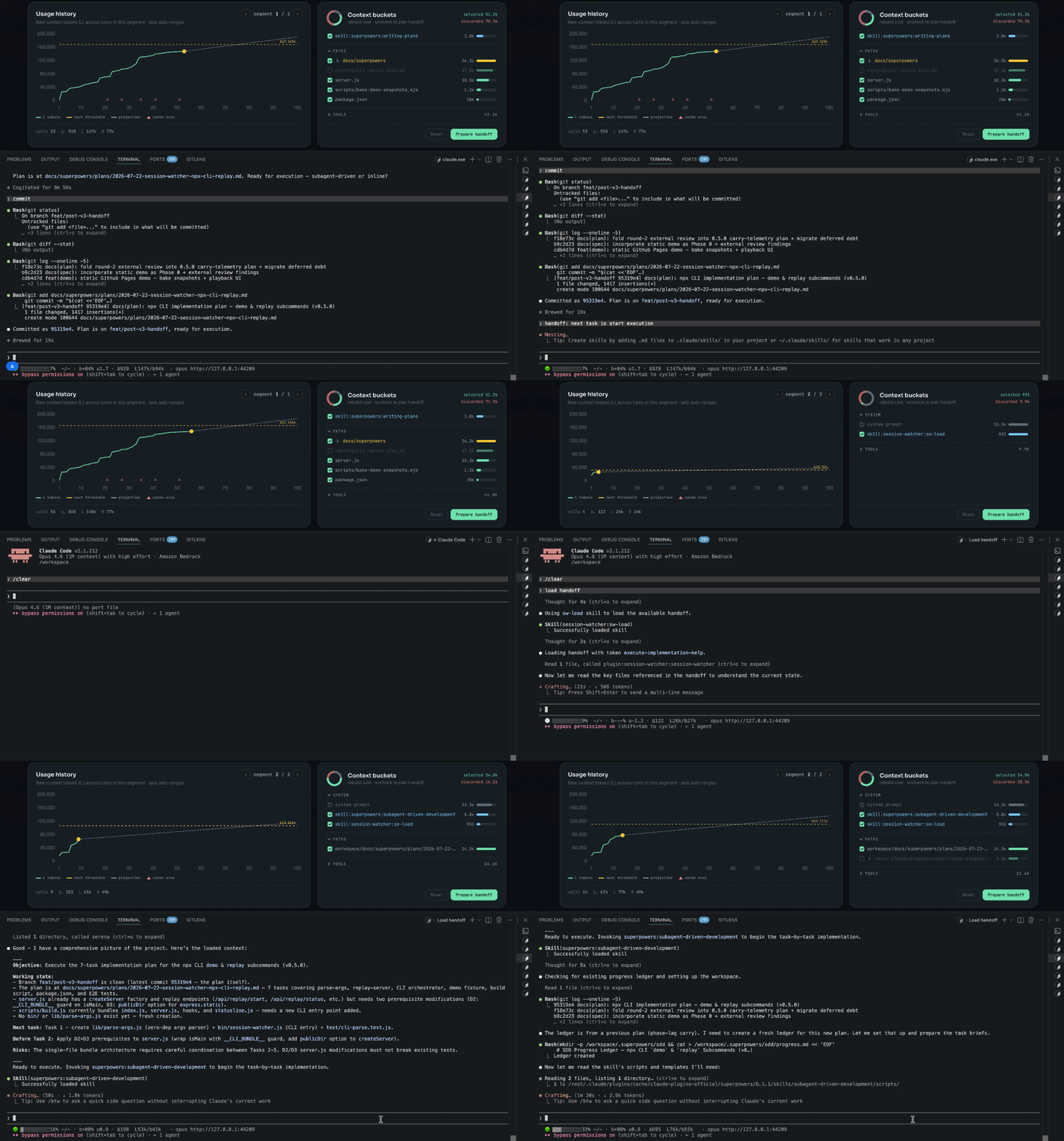
When it's time to restart, handoff preserves the state you want to keep. Run /sw-handoff to prepare a package — selected paths, working summary, next task. Then /clear, and in the fresh session run /sw-load to restore. Only what you chose is rebuilt — less ramp-up, less waste.
MCP Tools
Server lifecycle
| Tool | Description |
|---|---|
start_watcher |
Start (or reuse) the dashboard server; returns its URL |
stop_watcher |
Stop the managed server |
watcher_status |
Report whether the server is running and its URL |
rotate_session |
Rotate to a new session ID |
Handoff workflow
| Tool | Description |
|---|---|
get_bucket_summary |
Return current context bucket structure (files, skills, tools) with metrics |
get_turn_skeleton |
Render the turns of the capture epoch, one block per turn, as the slots a note can fill |
submit_turn_notes |
Return the producing session's notes through the slots the skeleton defines |
prepare_handoff |
Persist selected paths + summary as a handoff package; returns a semantic token |
load_handoff |
Load a handoff by token, free-text search, or auto-match for the current project |
Turn history
Read the history turns carried by the handoff loaded into the current session. All three resolve that lineage themselves and take no lineage identifier — without a loaded handoff there is nothing to read.
| Tool | Description |
|---|---|
turn_page |
Page deeper into the history, newest first; a returned cursor proves more history remains, while its absence does not prove none does |
turn_search |
Find a literal that occurs verbatim in the transcripts — an identifier, a path, a quoted phrase |
turn_locate |
Find which turn ranges mention a remembered term, when the original wording is unknown |
Tools return data for you to decide on — only handoff injects context back into the model, and only the paths you explicitly selected.
Agent support
Session Watcher is agent-agnostic. Everything below the harness layer consumes normalized observations, so it never learns which agent produced the session.
| Agent | Driver | Status |
|---|---|---|
| Claude Code | JSONL tail (native) | ✅ |
| OpenCode | adapter-ready | pending |
| OpenClaw | adapter-ready | pending |
| Hermes | adapter-ready | pending |
| Aider | adapter-ready | pending |
Adding a new agent means writing a harness for it: a source driver that turns that agent's own session evidence into normalized observations, and a projection that maps those observations onto measurement records. The engine, dialogue history, handoff, and every product surface are shared and need no change. See lib/harness/claude-code/ for the reference harness — source-driver.js and measurement-projection.js are the two pieces a new agent supplies. PRs welcome.
Paper
Context Is Inventory: A Rent-or-Buy Model for Prompt-Cached LLM Sessions
Longju Cheng (2026) · DOI:10.5281/zenodo.21236704
The paper derives the full theoretical specification: EOQ→LLM mapping, the 41.4% movable-cost bound, the ski-rental restart strategy, and measurements on 1,016 real session transcripts. Read it at the DOI above.
Uninstall
claude plugin uninstall session-watcher@session-watcher
# Remove state directory (optional):
rm -rf ~/.session-watcher
Test
npm test              # unit + integration (node:test)
npx playwright test   # E2E (requires running server)
Citation
@unpublished{cheng2026context,
  author = {Longju Cheng},
  title  = {Context Is Inventory: A Rent-or-Buy Model for Prompt-Cached LLM Sessions},
  year   = 2026,
  doi    = {10.5281/zenodo.21236704},
  url    = {https://doi.org/10.5281/zenodo.21236704},
  note   = {Preprint}
}
Privacy
- No remote telemetry.
- Transcripts are read locally and never uploaded.
- Local aggregate usage and handoff records are stored under
~/.session-watcher. - No transcript prose or file contents are stored in telemetry.
- Removing
~/.session-watcherdeletes all local state.
License
MIT
Reviews (0)
Sign in to leave a review.
Leave a reviewNo results found