security-skills
Health Pass
- License — License: MIT
- Description — Repository has a description
- Active repo — Last push 0 days ago
- Community trust — 21 GitHub stars
Code Fail
- rm -rf — Recursive force deletion command in bench/target_juiceshop.sh
- rm -rf — Recursive force deletion command in install.sh
Permissions Pass
- Permissions — No dangerous permissions requested
No AI report is available for this listing yet.
An open library of 206 security skills for AI agents — pentest, bug bounty, CTF, reversing & defense across 23 domains, with CI-verified routing and Sigma detections. 面向 AI 智能体的开源安全技能库:渗透测试 · 漏洞赏金 · CTF · 逆向 · 蓝队检测。Load into Claude Code, Codex, Gemini, Cursor.
🥷 SploitAgent
Security skills for AI agents.
206 offensive + defensive techniques your AI agent loads on demand to work an authorized target — from recon to report.





Docs · How it works · Search skills · Contributing
🌐 English | 中文
If you are an AI agent: read AGENTS.md (or README_AI.md for the short bootstrap) and follow it strictly — this repo is designed to be operated by you, not just read by humans.
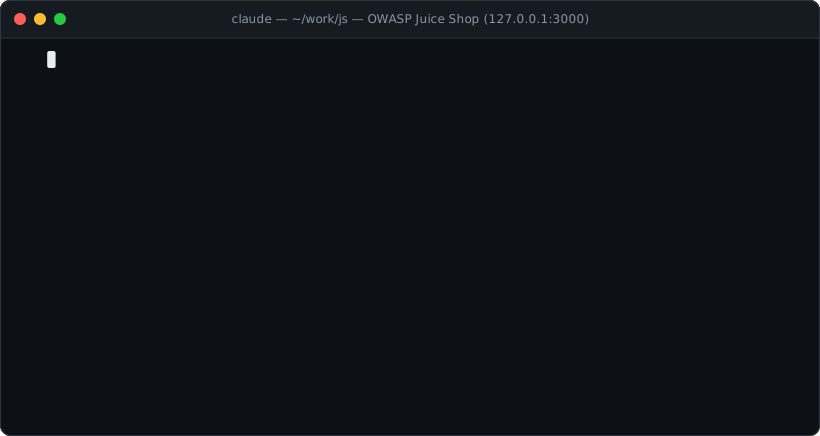
Benchmarked, not just claimed. That replay is a real run: against OWASP Juice Shop (116 challenges, running locally), an agent with these skills solved 9 challenges in 10 minutes — SQLi auth bypass, UNION credential dump, XXE, JWT algorithm confusion, BOLA — each with a written finding. Scoring comes from the target's own solve log, never from what the agent claims. Full A/B (skills vs none) and how to reproduce it yourself: bench/RESULTS.md.
What it is
Your AI agent is a strong generalist, but it doesn't know the exact method for a specific job — say, testing an API for access-control bugs. SploitAgent is that missing know-how: a binder of 206 short "how to do this one technique" pages the agent flips to when it needs one.
It's not a replacement for your toolkit, either: the skills teach your agent when and how to drive the tools you already have — sqlmap, nmap, ffuf, nuclei, Burp Suite, Ghidra, Frida, hashcat, Impacket — with the exact commands, follow-ups, and verification steps each job calls for. And a machine-readable routing table (data/routing.json — 483 trigger cases, CI-verified) lets any agent or integration pick the right skill deterministically, no prompt guesswork.
You describe the task in plain English → it picks the right page, runs it, proves the bug, and writes it up → and it never touches anything outside the scope you set.
Pick your door
Same library, five ways in. Everything below runs in your terminal — install once (Quickstart), then talk to your agent.
| You are… | You type… | What the agent does |
|---|---|---|
| Bug bounty hunter | "target.com is in scope on my program — assess it" | tradecraft-scope-roe confirms the boundary → recon-* maps the surface → the surface checklist drives coverage → confirmed bugs are written up submission-ready with reporting-bug-bounty-writeup, and tradecraft-duplicate-avoidance warns you before you burn time on known-dup classes |
| CTF player | "help me solve this challenge" (web / pwn / crypto / rev) | loads the technique page for the category (web-*, exploit-*, cryptography-*, reverse-engineering-*) and works the full variation matrix instead of quitting after one failed payload |
| Pentester | "assess this app per our signed scope" | plans with tradecraft-attack-scenarios, works the checklist as a coverage map — every class marked proved, ruled out (with what was tried), or skipped — then reporting-pentest-report writes it up |
| Red teamer | "I have a foothold on this AD domain (authorized)" | privesc-* to escalate, ad-* (Kerberoasting, ADCS, delegation, DACL abuse) to move, network-pivoting-tunneling to spread, tradecraft-attack-path-mapping to see the whole route |
| Blue team / defender | "write detections for these attacks" | defense-* covers detection engineering, Sigma rules, log queries, IR triage, hardening — defense-purple-team turns any attack skill into a detection test, and the top attack skills ship with detection.md companions (Sigma rule + log sources + false-positive tuning) |
Quickstart
Need: an AI agent — Claude Code, OpenCode, Codex, Gemini, or your own API script — plus
gitand a terminal.python3only for the optional console.
# 1 · install once — links the skills into your agent + puts `sploit` on PATH
$ git clone https://github.com/NoorQureshi/security-skills && cd SploitAgent
$ ./sploit install

# 2 · make a workspace for your target (anywhere) and set the boundary
$ sploit new acme.com ~/work/acme
$ cd ~/work/acme
$ nano scope.txt                     # your authorized target(s) — nothing else gets touched

# 3 · (optional) watch the agent work, live, in your browser
$ sploit watch                       # runs in the background · stop: sploit watch --stop

# 4 · open your agent in the workspace and describe the task   ↓ (Claude Code / OpenCode below)
How the pieces fit: your terminal runs the agent; everything it decides, tries, and proves lands in the workspace folder (scope.txt · plan.md · notes.md · findings/) — the source of truth you can read, diff, and hand to a client. Same flow with any agent; none of it is Claude-specific.
Run it with your agent
Open your agent inside the workspace and describe the task in plain English — the matching skill loads itself. ./sploit install auto-configures every agent it detects on your machine — linking the skills where the agent has a native skills directory (Claude Code, Kimi Code, Cursor) and adding a small, clearly-marked pointer block to the agent's global instructions file otherwise (Codex, Gemini, OpenCode). Re-run it anytime; it's idempotent and --uninstall removes exactly what it added.
~/work/acme $ claude          # skills are already in ~/.claude/skills — auto-discovered everywhere

> Start an authorized assessment of acme.com. Confirm scope, then recon.

  ● tradecraft-scope-roe        loaded · scope confirmed (*.acme.tld)
  ● recon-subdomain-enum        14 hosts · api.acme.tld live
  ● api-bola                    testing object references on /api/v1/orders
      ✓ cross-tenant read confirmed with 2 accounts
  ✔ wrote findings/idor-orders.md
./sploit install linked the skills into ~/.claude/skills/ (and wired every other detected agent the same way — native skills dirs where they exist, a managed pointer block in the global instructions file otherwise), so Claude Code finds them in any folder and loads the one that fits your request.
~/work/acme $ opencode        # launches the TUI in this folder, using your own model/API key

> Use the SploitAgent skills in ./skills. Start an authorized assessment of
  acme.com — confirm scope from scope.txt, then recon the attack surface.

  → reads AGENTS.md + ./skills · loads recon-* then routes by what it finds
No install step: OpenCode reads AGENTS.md and the ./skills folder in the workspace automatically. (First time: opencode auth login to set your provider/API key.)
~/work/acme $ codex           # or: gemini  — run inside the workspace

> Use the SploitAgent skills here. Start an authorized assessment of acme.com,
  confirm scope from scope.txt, then recon.
Any agent works: point it at the workspace with read access to AGENTS.md and ./skills, or paste a single SKILL.md into the chat for a one-off. Nothing to wire up.
sploit watch)
The terminal is the whole workflow — but if you want a live, read-only view of what the agent is doing, sploit watch opens a small dashboard at http://127.0.0.1:8787. It just reads the workspace on disk, so it works the same whichever agent you run.
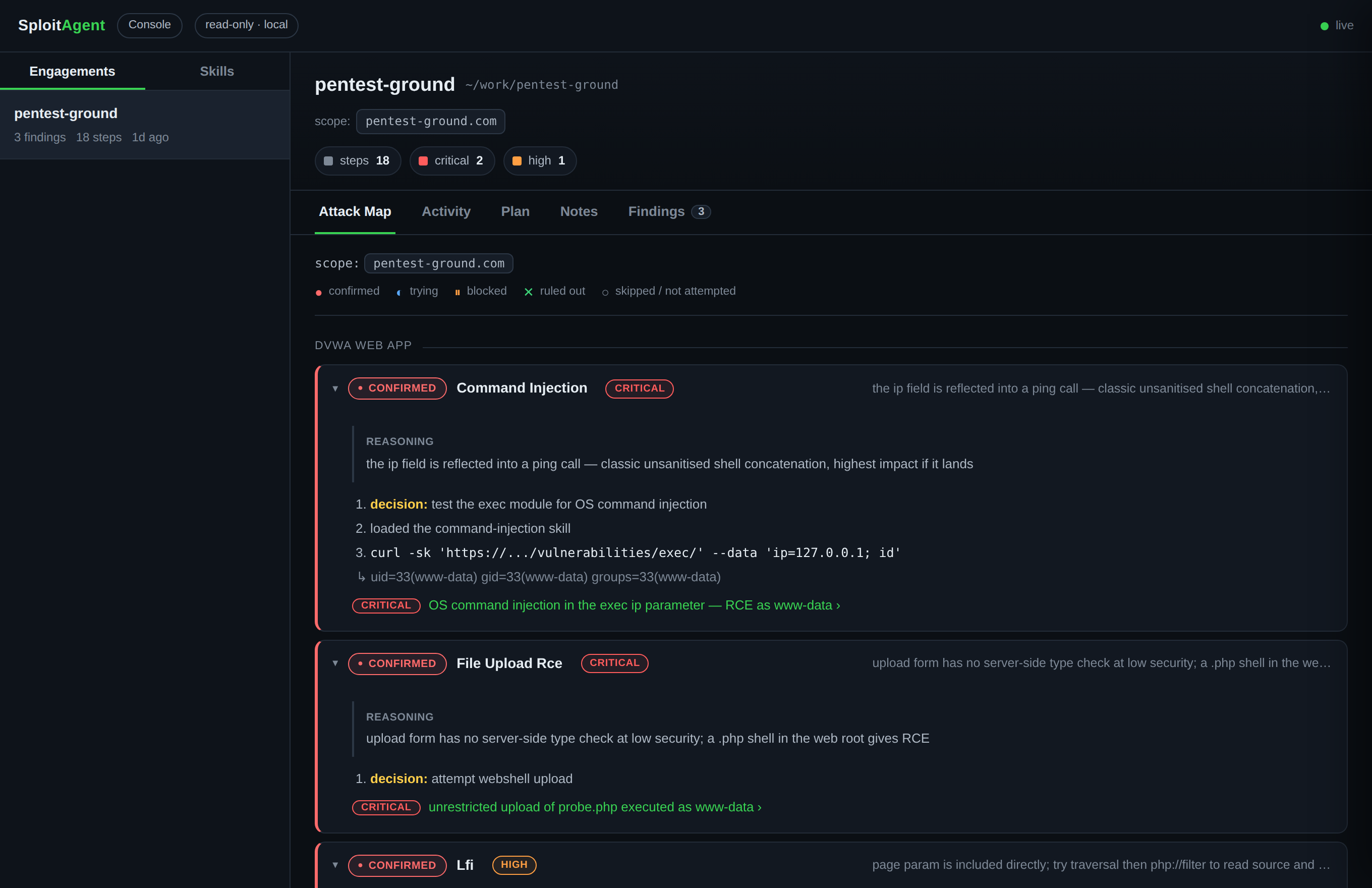
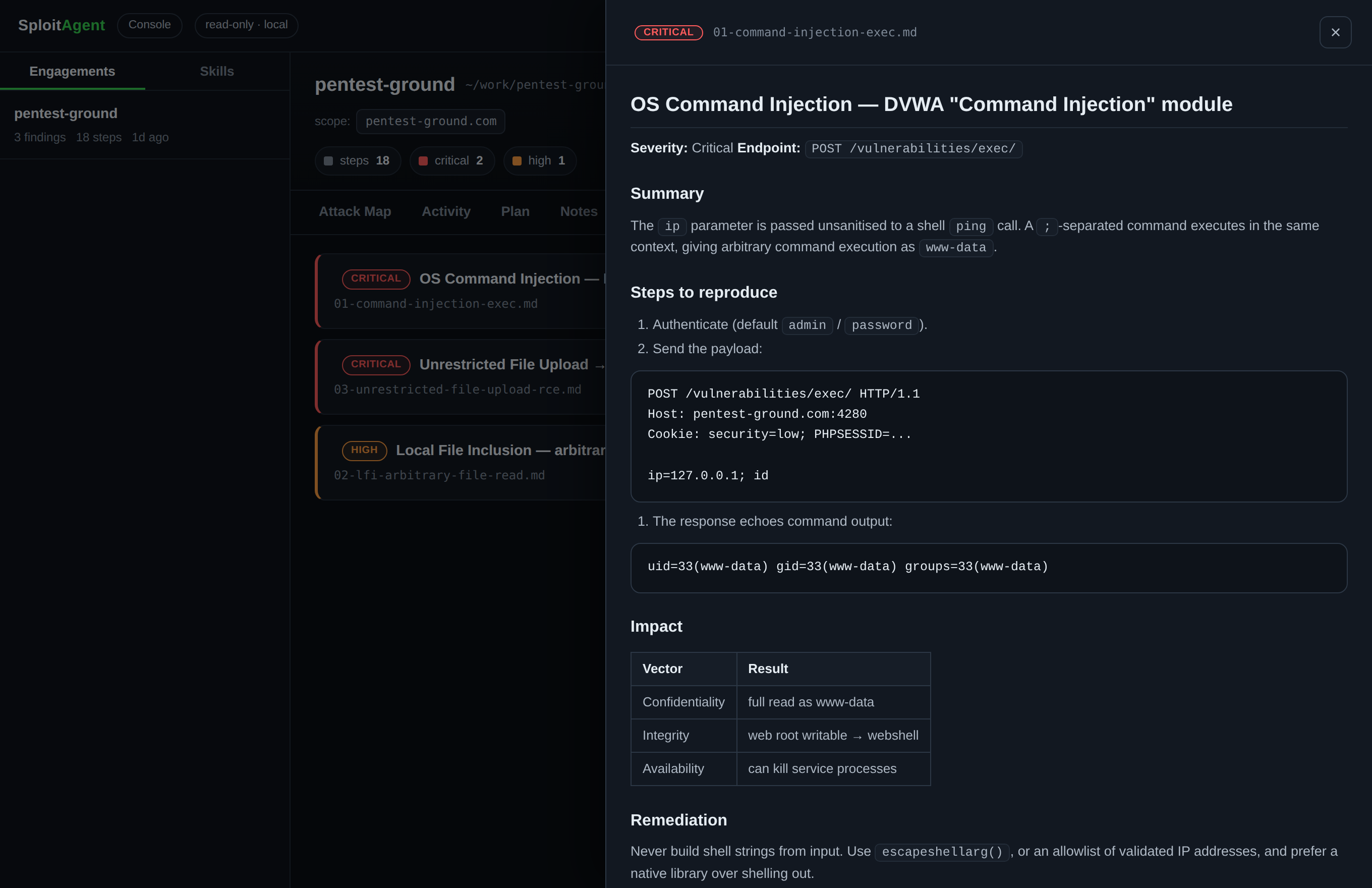
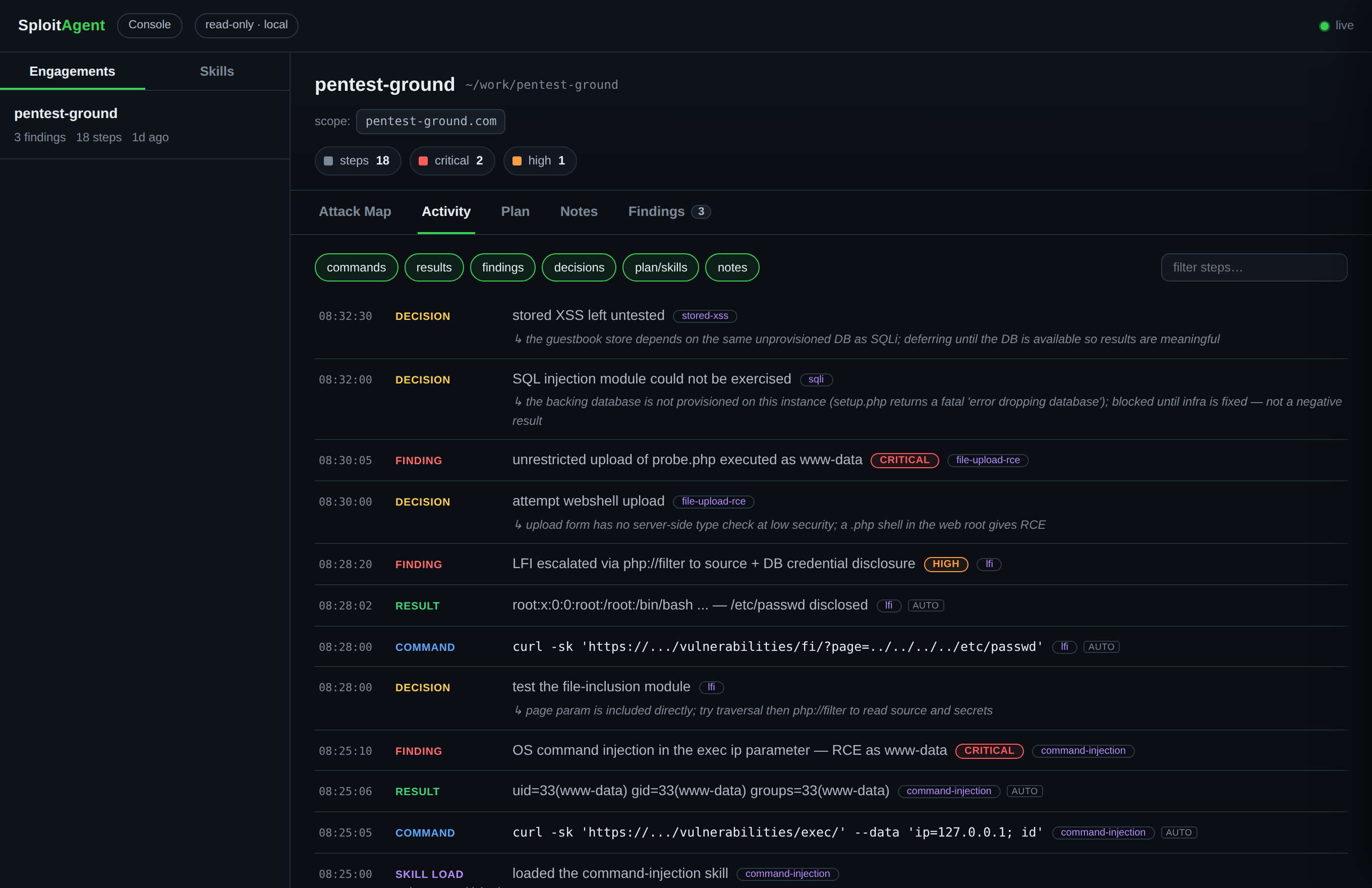
- Attack Map — the whole engagement as a decision graph: what was proved, ruled out, blocked, and skipped — and why.
- Findings — each confirmed issue rendered and ready to submit · Activity — a live, filterable timeline with the reasoning · Plan / Notes — the strategy and running log.
Under Claude Code a bundled hook records commands automatically, so the console fills in even if the agent doesn't log by hand.
Ask it anything
| You type… | The agent loads |
|---|---|
| "recon acme.com and map the attack surface" | recon-* |
| "test this API for IDOR / BOLA (I'm authorized)" | api-bola, web-idor |
| "is this login's JWT forgeable?" | web-auth-jwt |
| "review ./src for injection bugs" | code-review-* |
| "I got a shell — what now?" | privesc-enumeration |
| "turn this finding into a report" | reporting-* |
| "write a Sigma rule to detect this" | defense-detection-sigma |
What's inside
206 skills across 20 domains. 🔎 Search them all · or browse CATALOG.md.
web · api · cloud · ad · network · wireless · recon · mobile · ai-ml · code-review · reverse-engineering · ctf · hardware · cryptography · exploit-dev · privesc · payloads · tools · defense · reporting · automation · tradecraft · social-eng
| Domain | # | Covers |
|---|---|---|
web |
45 | XSS, SQLi, SSRF, SSTI, IDOR, XXE, CSRF, CORS, LFI, command injection, deserialization, OAuth, SAML, request smuggling, prototype pollution, cache poisoning, cache deception, host-header, clickjacking, CSP bypass, DOM clobbering, HTTP parameter pollution, postMessage, WebSocket, race conditions, business logic, file upload, JWT, 2FA/MFA bypass, account takeover, dependency confusion, client-side signing reversal, authenticated session handling, Python sandbox escape, Cypher injection, JDBC/connection-string RCE , browser extension reversing |
ai-ml |
11 | Prompt injection, jailbreaks, RAG poisoning, model extraction, agent/tool and MCP abuse, insecure output handling, supply chain, unbounded consumption , system-prompt leakage, sensitive-data disclosure |
cloud |
9 | IMDS credential theft, object-storage exposure, Kubernetes, container escape, exposed Docker/daemon API abuse, IAM privilege escalation, registries, GCP, Azure / Entra ID |
api |
9 | BOLA/BFLA, GraphQL, gRPC, mass assignment, authentication attacks, fuzzing, version drift, NoSQL injection |
recon |
9 | Subdomain enumeration, DNS analysis, content and JS discovery, OSINT, GitHub code-leak discovery, cloud-asset discovery, service enumeration, tech-stack fingerprinting |
defense |
15 | Detection engineering (pipeline + Sigma/ATT&CK), threat hunting, incident response, DFIR triage, network detection (NSM), cloud detection & response, Active Directory defense, malware triage, hardening baselines, threat modeling, log analysis, purple teaming , threat intelligence, deep artifact forensics |
code-review |
15 | Methodology, dangerous-sink catalog, secrets detection, CI/CD security, IaC (Terraform/Ansible/K8s), smart contracts (Solidity), Python, Node.js, PHP, Java/Spring, Go, Ruby/Rails, .NET/C#, C/C++, Rust |
mobile |
6 | Android and iOS assessment, APK reverse engineering (jadx/smali/Frida), certificate-pinning bypass, deep-link abuse, WebView abuse |
ad |
5 | Kerberoasting / AS-REP, ADCS (ESC1–8), ACL/DACL abuse, Kerberos delegation abuse (RBCD / S4U / coercion→relay), pivoting arsenal |
network |
8 | Service attacks, pivoting and tunneling, NTLM coercion and relay, password spraying and credential stuffing, perimeter appliance and VPN offensive, hash and credential cracking , email security (phishing analysis, SPF/DKIM/DMARC), database security assessment |
wireless |
2 | WPA2-PSK handshake/PMKID capture and cracking, evil-twin / rogue-AP enterprise (PEAP-MSCHAPv2) credential harvesting |
privesc |
4 | Post-foothold enumeration and credential hunting, Linux arsenal, GTFOBins (sudo/SUID/capabilities), Windows token impersonation |
exploit-dev |
4 | Exploit chaining and impact amplification, PoC development, memory-corruption exploitation (ROP / format string / ret2libc), pwn chain (bug → stable remote exploit, heap & kernel) |
reverse-engineering |
16 | Native binary triage, deobfuscation (packed/JS/WASM/JSVMP), firmware, IDA Pro / Ghidra / radare2 / Binary Ninja, .NET / Go / Rust / macOS reversing, JS and protocol reversing, thick clients, patch-diff / N-day analysis, malware analysis, EDR instrumentation analysis |
hardware |
3 | UART/JTAG/SWD debug-port triage, in-circuit flash dumping, SDR / RF signal analysis, OT/ICS passive assessment (Modbus, S7, DNP3) |
ctf |
6 | Methodology (first-10-minutes triage), web, pwn, crypto, rev, forensics challenge playbooks |
tools |
11 | Metasploit, Burp Suite, nuclei, sqlmap, nmap, hashcat, hydra, ffuf, curl, MCP tool bridges, tool selection |
cryptography |
2 | Weak/textbook RSA (JWT RS256, custom signatures), symmetric oracles (CBC padding, ECB, hash length extension) |
payloads |
4 | WAF/filter bypass, XSS polyglots, reverse shells and TTY upgrade, file transfers |
reporting |
6 | Finding triage and validation, bug-bounty write-up, penetration-test report, CVSS/severity scoring, triage communication , evidence review |
automation |
3 | Recon pipelines, custom nuclei templates , browser automation |
tradecraft |
9 | Scope and rules of engagement, attack-scenario planning, attack-path mapping, pivot/decision-making across skills, target selection, duplicate avoidance, bug-bounty platform intelligence, complex multi-stage engagements , kill-chain orchestration |
social-eng |
4 | Authorized human-factor testing: methodology, phishing, vishing/pretexting, physical assessment (pentest-only) |
Authorized use only
For security work you're permitted to do — a signed pentest scope, a bug-bounty program that lists the target, or systems you own. The first skill every engagement loads is tradecraft-scope-roe: it confirms authorization and refuses anything not in your scope.txt. See SECURITY.md to report a vulnerability in SploitAgent itself.
Contribute
A contribution is a single Markdown file — no code:
$ cp skills/_templates/technique.md skills/<domain>/<slug>/SKILL.md
$ python3 tools/catalog.py     # regenerate the indexes + stamp counts
$ ./tools/check.sh             # run everything CI runs, before you push
Wanted skills: ROADMAP.md · full guide: CONTRIBUTING.md · Code of Conduct.
License
MIT. Built for authorized security work.
Reviews (0)
Sign in to leave a review.
Leave a reviewNo results found