Nova
Health Warn
- No license — Repository has no license file
- Description — Repository has a description
- Active repo — Last push 0 days ago
- Community trust — 24 GitHub stars
Code Warn
- process.env — Environment variable access in src/lib/config.ts
Permissions Pass
- Permissions — No dangerous permissions requested
This agent acts as a yield allocation engine for the Solana blockchain. It analyzes live yield routes, estimates real net returns after subtracting hidden costs and friction, and uses an AI agent to plan conservative capital rebalancing.
Security Assessment
Overall risk: Medium. The tool does not request dangerous system permissions, execute arbitrary shell commands, or contain hardcoded secrets. However, its core purpose involves routing and potentially automating cryptocurrency transactions, which fundamentally means it has access to highly sensitive financial data and capital. The codebase accesses environment variables (likely for reading private wallet keys or RPC endpoints) in its config file. Since it is an agent designed to manage funds, users should carefully inspect the code to understand exactly what level of automated transaction control it has before providing it with capital.
Quality Assessment
The project shows positive signs of active maintenance and transparency. It is written in TypeScript, receives regular updates (last pushed today), and has clear documentation explaining its methodology. Community trust is currently low but growing, sitting at 24 GitHub stars. One notable red flag is the absence of a formal license file in the repository, despite the README claiming it uses the MIT license. Without a verified license, legal usage and contribution rights remain technically undefined.
Verdict
Use with caution: the code is actively maintained, but any tool designed to allocate cryptocurrency capital requires a thorough manual review before deployment.
Airdrop optimizer - tracks live campaigns, estimates ROI, allocates capital.
Nova
Solana yield allocation engine.
Optimizes net APR after IL drag, utilization stress, borrow carry, and rebalance friction.




Chasing headline APR is how allocators end up long emissions they cannot exit, overexposed to high-utilization lending books, or stuck inside LP routes with invisible IL drag. The job is not to farm the biggest number. The job is to route capital into the cleanest net carry after friction.
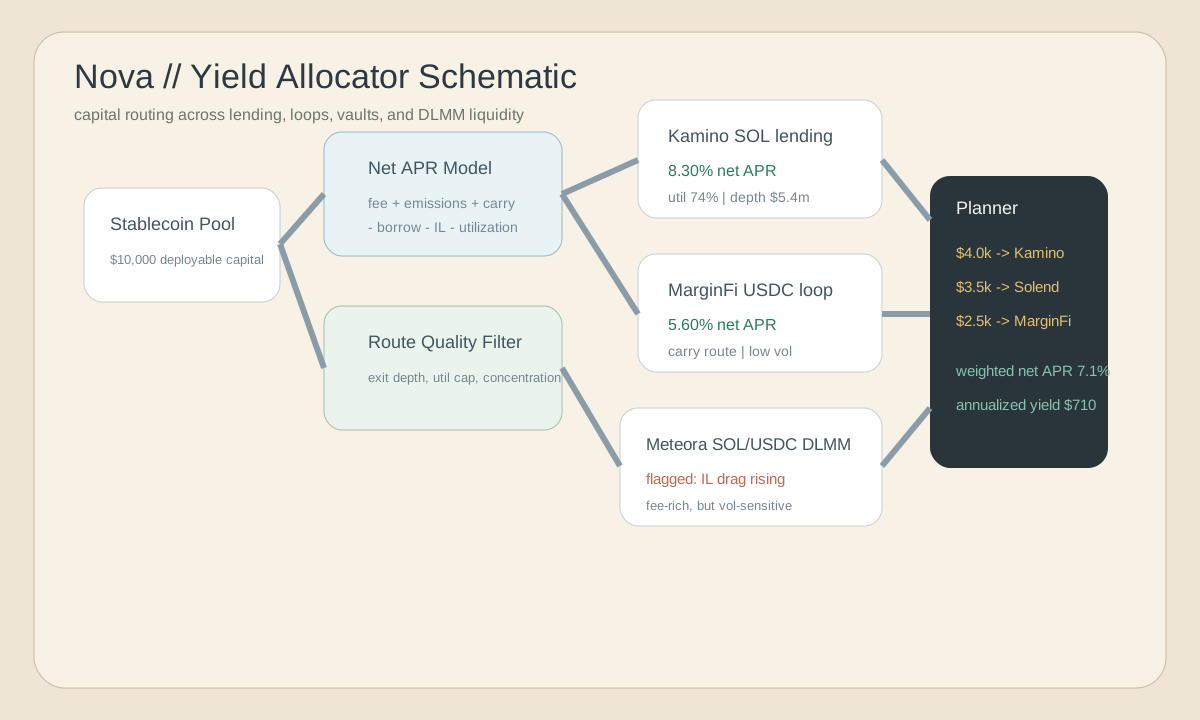
Nova maintains a registry of live Solana yield routes, decomposes gross APR into fee APR, emissions APR, lending carry, borrow cost, IL drag, and utilization penalty, then asks a Claude agent to assemble a concentration-aware rebalance plan.
The allocator is intentionally conservative around emissions that cannot be exited cleanly.
SCAN -> DECOMPOSE -> FILTER -> ALLOCATE -> REBALANCE
Allocation Schematic • Terminal Output • At a Glance • Operating Surfaces • How It Works • Example Output • Technical Spec • Risk Controls • Quick Start
At a Glance
Use case: route Solana capital into cleaner net carry instead of headline APRPrimary input: fee APR, emissions APR, lending carry, IL drag, utilization, rebalance frictionPrimary failure mode: allocating into yield that cannot actually be keptBest for: operators who care more about realized carry than advertised yield
Allocation Schematic
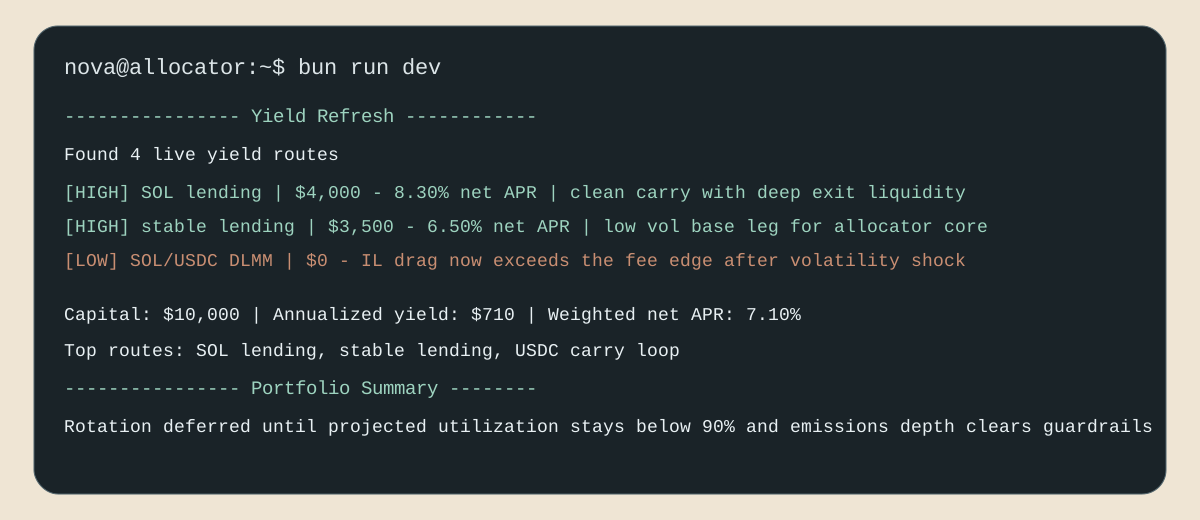
Terminal Output
Operating Surfaces
Allocation Schematic: shows how capital is being routed across the active venuesNet APR Model: exposes the components hidden behind headline yieldRebalance Planner: promotes route changes only when the edge clears frictionTerminal Output: prints the route stack the allocator would actually hold
Why Nova Exists
Most yield dashboards do not separate gross reward numbers from the frictions that make those numbers misleading. An allocator can easily end up long emissions it cannot exit, pushed into lending books that are already stressed, or carrying IL that quietly erases the headline spread.
Nova exists to force every route through a net-carry lens before it gets capital.
How It Works
Nova treats allocation as a filtration problem:
- load live Solana yield routes from the venue registry
- break each route into fee carry, emissions, borrow, IL drag, and utilization stress
- reject routes where the reward mix is too fragile or too hard to exit
- cap concentration so one venue cannot dominate the allocator
- propose a rebalance only when the net edge is strong enough to matter after friction
This is why Nova is more conservative than a simple yield board. It is optimizing for keepable yield, not optical APR.
What A Good Route Looks Like
- gross APR survives after drag and borrow costs are removed
- utilization is not already stretched
- emissions can actually be exited into real depth
- route concentration remains inside the portfolio limits
If those conditions are missing, the route should not absorb capital just because the raw number is large.
Example Output
NOVA // ALLOCATION PLAN

lead route         Kamino SOL lending
net apr            8.30%
exit depth         strong
utilization        74%
portfolio weight   40%

allocation note: carry is clean and friction stays below the rebalance threshold
Technical Spec
Nova ranks routes by net APR rather than gross APR:
NetAPR = feeAPR + emissionAPR + lendingCarryAPR - borrowAPR - ILDragAPR - utilizationPenalty
Where:
ILDragAPRis estimated fromIL = 2 * sqrt(r) / (1 + r) - 1, scaled by realized volatilityutilizationPenaltyincreases once utilization rises above 70%rebalance frictionis converted to APR-equivalent drag from the configured route size
Allocation rules:
- reject venues below
MIN_NET_APR - reject routes whose projected utilization would exceed
MAX_POST_TRADE_UTILIZATION - reject emissions-heavy routes when
rewardExitDepthUsd < MIN_EXIT_DEPTH_USD - keep capital concentration below
MAX_PROTOCOL_WEIGHT - LP routes must justify IL drag relative to carry
Risk Controls
utilization cap: blocks routes where post-trade utilization becomes too stressedexit-depth filter: blocks rewards that cannot be exited cleanlyconcentration cap: prevents one protocol from dominating the allocatorfriction-aware rebalance: rejects route changes that do not clear real costs
Nova should under-rotate rather than overtrade into noisy yield.
Architecture
venue registry
  -> net APR model
  -> claude allocation loop
  -> portfolio summary and route board
Quick Start
git clone https://github.com/NovaFarming/Nova
cd Nova && bun install
cp .env.example .env
bun run dev
Configuration
ANTHROPIC_API_KEY=sk-ant-...
TOTAL_CAPITAL_USD=10000
MIN_NET_APR=0.08
MAX_POST_TRADE_UTILIZATION=0.90
MIN_EXIT_DEPTH_USD=25000
MAX_PROTOCOL_WEIGHT=0.45
Legitimacy Notes
- Planned commit sequence:
docs/commit-sequence.md - Draft engineering issues:
docs/issue-drafts.md
Support Docs
License
MIT
allocate to carry you can actually keep.
Reviews (0)
Sign in to leave a review.
Leave a reviewNo results found