Retail-Agentic-Commerce
Health Pass
- License — License: Apache-2.0
- Description — Repository has a description
- Active repo — Last push 0 days ago
- Community trust — 15 GitHub stars
Code Pass
- Code scan — Scanned 12 files during light audit, no dangerous patterns found
Permissions Pass
- Permissions — No dangerous permissions requested
This tool is a reference implementation for NVIDIA's Agentic Commerce Protocol and Universal Commerce Protocol. It is designed to power AI-driven checkout and payment negotiations while keeping the merchant in control of the overall transaction process.
Security Assessment
Overall Risk: Low. The automated code scan checked 12 files and found no dangerous patterns, hardcoded secrets, or dangerous permission requests. However, the architecture requires making network requests, as it operates as a distributed system across multiple local ports (Merchant API, PSP service, various AI agents, and an MCP server). It handles inherently sensitive data, specifically payment delegations, vault tokens, and checkout sessions. While the base code is safe, developers must ensure they deploy this in a secure, isolated network environment and properly secure the API endpoints before handling real financial data.
Quality Assessment
Quality is high and the project is actively maintained. It is backed by a reputable organization (NVIDIA) and uses a permissive standard license (Apache-2.0). The repository is very fresh, with its last push occurring just today, and has garnered 15 GitHub stars, indicating early but positive community trust.
Verdict
Safe to use, provided developers implement proper network and API security to protect the sensitive payment data handled by the services.
Reference implementation of the Agentic Commerce Protocol (ACP) and Universal Commerce Protocol (UCP)- enabling AI-powered checkout negotiation while maintaining merchant control.
NVIDIA AI Blueprint: Retail Agentic Commerce



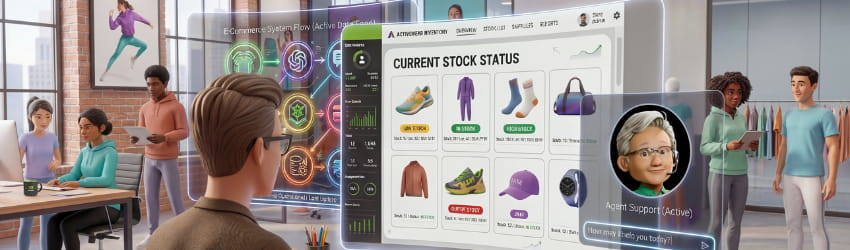
A reference implementation of the Agentic Commerce Protocol (ACP) and Universal Commerce Protocol (UCP), built for merchant-controlled checkout, payments, and agent orchestration.
Architecture
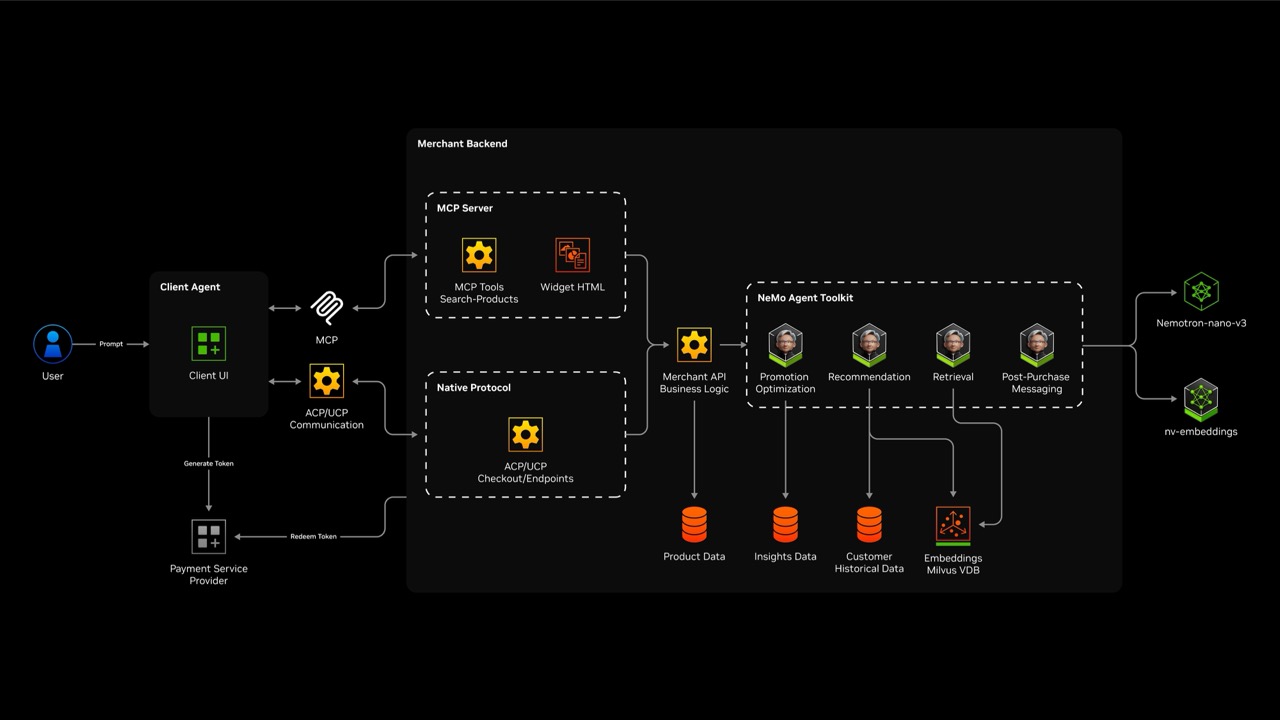
What You Get
- Merchant API (ACP + UCP discovery/A2A)
- PSP service for delegated payment flows
- Apps SDK MCP server + widget
- NAT agents for promotion, recommendations, search, and post-purchase messaging
- Demo UI with protocol and agent activity panels
Architecture (Default Deployment)
flowchart TB
    subgraph Client["Client Layer"]
        CA[🤖 Client Agent]
        subgraph Webhooks["UI Webhook Receivers"]
            WH_ACP["/api/webhooks/acp"]
            WH_UCP["/api/webhooks/ucp"]
            BRIDGE["Webhook → Agent Activity Bridge"]
        end
    end

    subgraph Integration["Integration Options"]
        direction LR
        subgraph SDK["Apps SDK Layer"]
            MCP["📦 Apps SDK MCP Server<br/>(Port 2091)"]
            subgraph tools["Entry Point"]
                T1["search-products<br/>(returns widget)"]
            end
            WIDGET["🛒 Autonomous Widget<br/>(cart, checkout, recs)"]
        end

        subgraph Native["Native Protocol Layer"]
            ACP["🔗 ACP REST Transport"]
            UCP["🔗 UCP A2A Transport"]
            subgraph endpoints["Protocol Endpoints"]
                E1["ACP: /checkout_sessions/*"]
                E2["UCP: /.well-known/ucp"]
                E3["UCP: /.well-known/agent-card.json"]
                E4["UCP: /a2a (message/send)"]
            end
        end
    end

    subgraph Backend["Backend Services"]
        MERCHANT["🏪 Merchant API<br/>(Port 8000)"]
        PSP["💳 PSP Service<br/>(Port 8001)"]

        subgraph merchant_features["Merchant Features"]
            M1[Products & Sessions]
            M2[Checkout & Promotions]
            M3[Orders & Recommendations]
        end

        subgraph psp_features["PSP Features"]
            P1[Payment Delegation]
            P2[Vault Tokens]
            P3[Idempotency]
        end
    end

    subgraph Agents["NAT Agents"]
        PROMO["🎯 Promotion Agent<br/>(Port 8002)"]
        POST["📨 Post-Purchase Agent<br/>(Port 8003)"]
        RECS["🔍 Recommendation Agent<br/>(Port 8004)"]
        SEARCH["🔎 Search Agent<br/>(Port 8005)"]
    end

    subgraph NIMs["NVIDIA NIMs"]
        LLM["🧠 Nemotron Nano LLM<br/>(Port 8010)"]
        EMBED["📐 NV-EmbedQA-E5<br/>(Port 8011)"]
    end

    subgraph Data["Data Stores"]
        SQLITE[("🗄️ SQLite<br/>Application DB")]
        MILVUS[("🧠 Milvus<br/>Vector DB")]
    end

    CA -->|MCP| MCP
    CA -->|REST| ACP
    CA -->|A2A JSON-RPC| UCP
    MCP -.->|loads| WIDGET
    WIDGET -->|MCP tools| MCP
    MCP --> MERCHANT
    ACP --> E1
    UCP --> E2
    UCP --> E3
    UCP --> E4
    E1 --> MERCHANT
    E4 --> MERCHANT
    MERCHANT --> PSP
    MERCHANT --> PROMO
    MERCHANT --> POST
    MERCHANT --> RECS
    MERCHANT --> SEARCH
    MERCHANT --> SQLITE
    MERCHANT -->|ACP post-purchase webhook| WH_ACP
    MERCHANT -->|UCP order webhook| WH_UCP
    WH_ACP --> BRIDGE
    WH_UCP --> BRIDGE
    BRIDGE --> CA
    PROMO --> LLM
    POST --> LLM
    RECS --> LLM
    RECS --> EMBED
    SEARCH --> LLM
    SEARCH --> EMBED
    EMBED --> MILVUS
    RECS --> MILVUS
    SEARCH --> MILVUS
Quick Start (Cursor, Codex, Claude Code)
This is the recommended path. It does not require local NIM containers.
Prerequisites
- Python 3.12+
- uv package manager
- Node.js 18+ and pnpm
- Docker 24+ and Docker Compose v2
- NVIDIA API key (create one)
1. Clone and Configure
git clone https://github.com/NVIDIA/Retail-Agentic-Commerce.git
cd Retail-Agentic-Commerce
cp env.example .env
Update .env:
NVIDIA_API_KEY=nvapi-xxx
On Cursor, Codex or Claude Code simply run: /setup
Manual Deployment Options
| Mode | Description | Guide |
|---|---|---|
| Docker (recommended) | Full stack in containers via Docker Compose | Docker Deployment |
| Local Development | Services on host, automated via install.sh |
Local Development |
Quick local start:
./install.sh   # install deps + start all 8 services
./stop.sh      # stop everything
Hardware Requirements (Local NIM Deployment)
Local NIM deployment requires NVIDIA GPUs to host the inference models. The following table summarizes the models and their GPU requirements:
| Model | Purpose | Minimum GPU | Recommended GPU |
|---|---|---|---|
| Nemotron-Nano-30B-A3B | LLM — prompt planning, recommendations, search, promotions | 1× A100 (80 GB) | 1× H100 (80 GB) |
| NV-EmbedQA-E5-v5 | Embedding — semantic search and product retrieval | 1× A100 (80 GB) | 1× H100 (80 GB) |
Total: 2× A100 (80 GB) minimum, 2× H100 (80 GB) recommended for best performance.
Note: These requirements apply only to self-hosted local NIM deployment. The default deployment uses public NVIDIA API endpoints and does not require any GPU hardware.
Optional: Local NIM Deployment (GPU)
Only needed for self-hosted local inference. The default deployment already works with public endpoints.
For step-by-step instructions (prerequisites, GPU setup, NIM containers, validation), see the Local NIM Deployment Notebook.
Project Structure
src/
├── merchant/      # Merchant API (FastAPI)
├── payment/       # PSP service (FastAPI)
├── apps_sdk/      # MCP server + widget
├── agents/        # NAT agents and configs
└── ui/            # Next.js demo UI

deploy/
├── docker-deployment.md
├── local-development.md
└── 1_Deploy_Agentic_Commerce.ipynb

docs/
├── architecture.md
├── features/
└── specs/
Documentation
- Docker Deployment
- Local Development
- Architecture
- Feature Breakdown
- ACP Spec
- UCP Spec
- Apps SDK Spec
- Agent Integration
License
GOVERNING TERMS: The Blueprint scripts are governed by Apache License, Version 2.0, and enables use of separate open source and proprietary software governed by their respective licenses: Nemotron-Nano-V3, (ii) MIT license for NV-EmbedQA-E5-v5. The sample data is governed by the NVIDIA Data License for Retail Agentic Commerce.
This project will download and install additional third-party open source software projects. Review the license terms of these open source projects before use, found in License-3rd-party.txt.
Reviews (0)
Sign in to leave a review.
Leave a reviewNo results found