Uni-CLI
Health Warn
- License — License: Apache-2.0
- Description — Repository has a description
- Active repo — Last push 0 days ago
- Low visibility — Only 5 GitHub stars
Code Fail
- spawnSync — Synchronous process spawning in bench/adapter-call.ts
- process.env — Environment variable access in bench/adapter-call.ts
Permissions Pass
- Permissions — No dangerous permissions requested
This tool is a universal command-line interface designed for AI agents. It translates natural language intent into executable commands, allowing agents to interact with hundreds of web APIs, desktop applications, and local operating system functions via short YAML adapters.
Security Assessment
Overall risk: Medium. The tool executes shell commands and interacts deeply with local system processes, desktop applications (like ffmpeg and Blender), and remote web APIs. While no hardcoded secrets or dangerous explicit permissions were found, the codebase does use synchronous process spawning and accesses environment variables. The ability for an AI agent to autonomously write, edit, and execute local files via YAML adapters significantly increases the risk profile if the agent is given incorrect or malicious instructions.
Quality Assessment
The project is active, having received updates very recently, and operates under the permissive Apache-2.0 license. The codebase claims an impressive test suite with over 7,000 tests. However, community trust and visibility are currently extremely low, with only 5 GitHub stars. This means the tool has not been broadly scrutinized by the open-source community for potential bugs or security vulnerabilities.
Verdict
Use with caution: the active maintenance and open license are positives, but the low community visibility and high system access capabilities require strict operational oversight.
CLI is all agents need. Universal CLI for AI agents to control internet apps and local software.

CLI is all agents need.
The execution layer for agent skills. Deterministic, editable, cross-vendor.





npm install -g @zenalexa/unicli
What
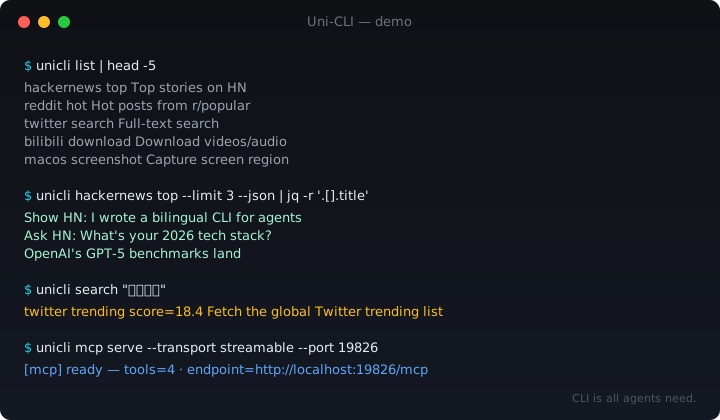
Uni-CLI is a universal interface that compiles agent intent into deterministic CLI programs. One binary reaches 200 sites, 30+ desktop apps, 35 CLI bridges, and the local OS — 968 commands in total. Every adapter is a 20-line YAML pipeline, so agents can read, edit, and re-run them without a compiler.
Coverage is cross-cutting: web APIs and browser automation, desktop subprocesses (ffmpeg, Blender, LibreOffice), macOS system calls (screenshot, clipboard, Calendar), and Computer Use Agents (Anthropic, OpenAI, Google) — all behind the same unicli <site> <command> surface. Output is a table in a terminal and JSON when piped. Errors are structured JSON on stderr with the adapter path, the failing step, and a suggestion — enough directional feedback for an agent to fix the adapter and retry.
Self-repair is a first-class capability. When a site changes its API, an agent reads the 20-line YAML, edits the selector or endpoint, saves to ~/.unicli/adapters/, and retries. Fixes survive npm update. No human in the loop.
Why
MCP tool catalogs cost 4–35× more tokens per call than an equivalent CLI invocation, and 55K tokens of cold-start tax before the agent touches a tool (Firecrawl, Scalekit, Apideck benchmarks; see docs/BENCHMARK.md). Agents perform better with executable programs than with catalogs of tool descriptions. Retrieval-over-catalog research in 2025–2026 (Semantic Tool Discovery, ITR Dynamic Tool Exposure, JSPLIT) reports 95–99% context reduction when tools are fetched on demand.
Uni-CLI is the execution half of that equation. The MCP server exposes 4 meta-tools (~200 tokens cold-start) — unicli_run, unicli_list, unicli_search, unicli_explore — and the agent pulls the exact tool it needs via BM25 bilingual search over a 50KB index. The CLI itself costs one subprocess per call.
Quick start
Five minutes, top-to-bottom:
# 1. Install
npm install -g @zenalexa/unicli

# 2. Discover
unicli list                                   # all sites + commands
unicli search "推特热门"                       # → twitter trending (bilingual)

# 3. Run
unicli reddit hot --limit 3                   # zero-config web API
unicli hackernews top --json | jq '.[].title' # pipe + transform

# 4. Wire into an agent
claude mcp add unicli -- npx @zenalexa/unicli mcp serve   # Claude Code (MCP stdio)
unicli mcp serve --transport streamable --port 19826      # Any MCP client (HTTP)
unicli acp                                                # avante.nvim / Zed (ACP)
Full walkthrough with 5 worked examples: docs/QUICKSTART.md.
Architecture
graph TB
    CMD["unicli <site> <command>"]

    CMD --> ADAPT["Adapter layer<br/>887 YAML · 72 TS · 35 bridges"]

    ADAPT --> ENGINE["Pipeline engine — <!-- STATS:pipeline_step_count -->54<!-- /STATS -->+ steps<br/>fetch · navigate · exec · extract · each · if · parallel"]

    ENGINE --> T1["HTTP<br/>(web APIs)"]
    ENGINE --> T2["CDP Browser<br/>(raw WebSocket)"]
    ENGINE --> T3["Subprocess<br/>(ffmpeg, yt-dlp, gh)"]
    ENGINE --> T4["Desktop-AX<br/>(macOS AppleScript)"]
    ENGINE --> T5["Desktop-UIA<br/>(Windows UIAutomation)"]
    ENGINE --> T6["Desktop-AT-SPI<br/>(Linux accessibility)"]
    ENGINE --> T7["CUA<br/>(Anthropic · OpenAI · Google)"]

    T1 --> OUT["Formatter<br/>table · json · yaml · csv · md"]
    T2 --> OUT
    T3 --> OUT
    T4 --> OUT
    T5 --> OUT
    T6 --> OUT
    T7 --> OUT
Seven TransportAdapters, one adapter layer, one formatter. Adapters are declarative YAML by default (Rice-decidable, no imports) and TypeScript when a site genuinely needs it. The full step reference lives in docs/ADAPTER-FORMAT.md.
Self-repair
When a command breaks:
unicli <site> <cmd> fails
  → structured JSON error on stderr
    { adapter_path, step, action, suggestion }
  → agent opens the ~20-line YAML
  → agent edits the selector / URL / auth
  → unicli <site> <cmd> works
  → fix persists in ~/.unicli/adapters/ (survives npm update)
unicli repair hackernews top      # Diagnose + suggest fix
unicli test hackernews            # Validate adapter
unicli repair --loop              # Autonomous fix loop
Exit codes follow sysexits.h: 0 ok, 66 empty, 69 unavailable, 75 temporary, 77 auth, 78 config. Agents parse those directly — no regex over human error text.
Feature matrix
| Capability | What it means |
|---|---|
| CUA backends | Anthropic computer-use, OpenAI Operator, Google CUA, and direct CDP — 4 transports behind one flag |
| MCP transports | stdio · Streamable HTTP (spec 2025-11-25) · SSE · OAuth 2.1 PKCE |
| ACP ready | unicli acp speaks JSON-RPC 2.0 for avante.nvim, Zed, Gemini CLI |
| Cross-vendor skills | Skills in skills/ work in Claude Code, OpenCode, Codex, Cursor, Cline |
| Self-repair envelope | Every error ships adapter_path + step + suggestion (Banach-convergent) |
| Bilingual search | BM25 + TF-IDF, 50KB index, <10ms queries, 200-entry ZH↔EN alias table |
| Browser daemon | Persistent Chrome via CDP, reuses your login sessions, 13-layer stealth |
Detailed benchmarks (p50/p95 token cost per category, vs GitHub MCP cold-start): docs/BENCHMARK.md.
Platform coverage
200 sites · 968 commands — the live list is auto-generated in [`AGENTS.md`](AGENTS.md) and split by domain:| Domain | Highlights |
|---|---|
| Social (25) | twitter, reddit, instagram, tiktok, xiaohongshu, bilibili, zhihu, weibo |
| Tech (19) | hackernews, stackoverflow, producthunt, github-trending, npm, pypi |
| News (11) | bbc, reuters, bloomberg, nytimes, techcrunch, 36kr |
| Finance (8) | xueqiu, yahoo-finance, eastmoney, binance, coinbase |
| AI / ML (14) | huggingface, ollama, replicate, perplexity, deepseek, doubao |
| Desktop (30+) | blender, ffmpeg, imagemagick, gimp, freecad, musescore, kdenlive |
| macOS system (58) | screenshot, clipboard, Calendar, Mail, Reminders, Shortcuts, Safari |
| CLI bridges (35) | gh, yt-dlp, jq, aws, vercel, supabase, wrangler, stripe |
Run unicli list for the live catalog, or unicli list --category=<domain> to filter.
Agent integration
Every major agent platform works out of the box:
| Platform | One-liner | Notes |
|---|---|---|
| Claude Code | claude mcp add unicli -- npx @zenalexa/unicli mcp serve |
4 meta-tools, stdio |
| Codex CLI | Add [mcp_servers.unicli] to ~/.codex/config.toml |
First-class AGENTS.md citizen |
| Cursor | MCP Settings → unicli → npx @zenalexa/unicli mcp serve |
Bilingual search works inside Cursor chat |
| avante.nvim | type = "acp", command = "unicli", args = { "acp" } |
See docs/AVANTE.md |
| OpenCode | MCP via opencode.jsonc — command: "unicli mcp serve" |
AGENTS.md auto-loaded |
| Cline | Add MCP server in settings — stdio transport | Same 4 meta-tools, 200-token cold start |
Direct shell access (any agent with Bash or exec):
unicli twitter search "AI agents"
unicli blender render scene.blend --output /tmp/frame.png
unicli macos screenshot --region 0,0,1920,1080
Authentication
Five auth strategies, auto-probed in a cascade (public → cookie → header):
| Strategy | How |
|---|---|
public |
Direct HTTP, no credentials |
cookie |
~/.unicli/cookies/<site>.json injected into headers |
header |
Cookie + auto-extracted CSRF (ct0, bili_jct, …) |
intercept |
Chrome navigates, Uni-CLI captures XHR/fetch responses |
ui |
Direct DOM interaction via CDP (click, type, submit) |
unicli auth setup twitter    # Print required cookies + target path
unicli auth check twitter    # Validate cookie file
unicli auth list             # All configured sites
The browser daemon (unicli browser start) reuses your signed-in Chrome session via CDP — no cookie export, no extension install. Auto-exits after 4h idle.
Write an adapter
Most adapters are ~20 lines of YAML. No TypeScript, no build step, no imports:
site: hackernews
name: top
type: web-api
strategy: public
pipeline:
  - fetch:
      url: "https://hacker-news.firebaseio.com/v0/topstories.json"
  - limit: { count: "${{ args.limit | default(30) }}" }
  - each:
      do:
        - fetch:
            url: "https://hacker-news.firebaseio.com/v0/item/${{ item }}.json"
  - map:
      title: "${{ item.title }}"
      score: "${{ item.score }}"
      url: "${{ item.url }}"
columns: [title, score, url]
Five adapter types: web-api, desktop, browser, bridge, service. 29 template filters (join, urlencode, truncate, slugify, default, json, …) run in a sandboxed VM.
Scaffold, dev, test:
unicli init <site> <command>     # Scaffold new adapter
unicli dev <path>                # Hot-reload during dev
unicli test <site>               # Validate
unicli record <url>              # Auto-generate adapter from traffic
Full reference: docs/ADAPTER-FORMAT.md. Migrating from OpenCLI: docs/MIGRATING-FROM-OPENCLI.md and the one-shot unicli import opencli-yaml.
Search
Agents find commands by intent, bilingual:
unicli search "推特热门"            # → twitter trending
unicli search "download video"      # → bilibili download, yt-dlp download, twitter download
unicli search "股票行情"            # → binance ticker, xueqiu quote, barchart quote
unicli search --category finance    # browse by category
BM25 + TF-IDF scoring with a 200-entry ZH↔EN alias table. The index is 50KB, queries complete in under 10ms.
Theory + benchmarks
The design rests on five principles, each tied to a citation in docs/refs.bib:
- Rice's restriction — every adapter has decidable semantics (YAML pipeline, no Turing-complete logic).
- Lehman's mandate — no adapter is permanent; self-repair is first-class.
- Shannon's compression — CLI invocations are near-optimal compression of the underlying API call.
- Agent tool trilemma (original) — coverage × accuracy × performance, pick two. We choose accuracy × performance.
- Banach convergence — structured errors must provide directional feedback (
adapter_path+step+suggestion) so repair iterations converge.
Full treatment with 42 citations: docs/THEORY.md. Reproducible benchmarks comparing Uni-CLI to GitHub MCP and Firecrawl MCP: docs/BENCHMARK.md.
Development
git clone https://github.com/olo-dot-io/Uni-CLI.git && cd Uni-CLI
npm install
npm run verify     # typecheck + lint + test + build + stats check
| Command | Purpose |
|---|---|
npm run dev |
Run from source |
npm run build |
Production build |
npm run typecheck |
TypeScript strict |
npm run lint |
Oxlint |
npm run test |
Unit tests (7083) |
npm run test:adapter |
Validate all adapters |
npm run verify |
Full pipeline (7 gates) |
Seven production dependencies: chalk, cli-table3, commander, js-yaml, turndown, undici, ws.
Release cadence
Patches ship every Friday 09:00 HKT when substantive commits have landed since the last tag. Quiet weeks are recorded and skipped — silence is success, not failure. Dependabot bumps are grouped into one PR per Monday so they ride along in the Friday cut without flooding the commit log.

Full policy — manual overrides, cancellation procedure, escalation rules: docs/RELEASE-CADENCE.md.
Contributing
The fastest path to a merged PR: write a 20-line YAML adapter for a site you use every day. Per-domain guides live in contributing/:
| Area | Guide |
|---|---|
| New adapter | contributing/adapter.md |
| New transport | contributing/transport.md |
| CUA backend | contributing/cua.md |
| MCP server | contributing/mcp.md |
| ACP integration | contributing/acp.md |
| Release process | contributing/release.md |
| Schema migration | contributing/schema.md |
License
Repo: https://github.com/olo-dot-io/Uni-CLI · npm: @zenalexa/unicli · Issues welcome.
v0.213.3 — Vostok · Gagarin TC0 Patch R2
200 sites · 968 commands · 54 pipeline steps · BM25+TF-IDF bilingual search · MCP 2025-11-25 · 7083 tests
Reviews (0)
Sign in to leave a review.
Leave a reviewNo results found