cctally
Health Uyari
- License — License: Apache-2.0
- Description — Repository has a description
- Active repo — Last push 0 days ago
- Low visibility — Only 5 GitHub stars
Code Gecti
- Code scan — Scanned 12 files during light audit, no dangerous patterns found
Permissions Gecti
- Permissions — No dangerous permissions requested
Bu listing icin henuz AI raporu yok.
Claude Code usage tracker and local dashboard for Pro/Max subscription limits - weekly cost-per-percent trend, quota forecasts, threshold alerts. ccusage-compatible.
Understand Claude Code and Codex spend: a local dashboard, conversation viewer, and CLI reports for your subscription quota.




Your Claude Code plan meters you with a percentage that creeps up all week. cctally reads your local session logs and turns that percentage into dollars: what each percent of quota costs you, whether you are on track to cap before the reset, and where the spend is going. It does the same for OpenAI's Codex CLI. Everything runs on your own machine, against your own data. No account, no API key, and nothing is uploaded.
Claude cost coverage: Claude dollar and token totals are
transcript-derived lower bounds, not exact/usagebilling totals. Claude Code can bill title-generation and
prompt-suggestion/side-query requests without retaining usable model/token
fields. cctally does not guess the missing amount. Codex accounting uses a
different retained source and is unaffected.
Latest stable: v1.95.5 (2026-08-09)
- Dashboard share-digest validation now pins the template artifact clock as well as the dashboard data clock, so two equivalent renders cannot fail Linux CI merely because their frontmatter and footer crossed a one-second wall-clock boundary.
Quick start
Requirements: Python 3.11+, macOS or Linux, Claude Code installed and run at least once.
# Homebrew (macOS / Linux)
brew install omrikais/cctally/cctally && cctally setup

# or npm
npm install -g cctally && cctally setup

# or from source
git clone https://github.com/omrikais/cctally && cd cctally && ./bin/cctally setup
The reporting commands work immediately on your existing logs, before any setup. Running cctally setup once adds the hooks that record your quota percentage continuously as you work.
cctally daily              # cost by day: your first table
cctally dashboard          # opens http://127.0.0.1:8789
cctally setup --status     # verify the install
Install details (symlinks, PATH, Python version) live in docs/installation.md. Every release ships to an opt-in beta channel first; see docs/commands/update.md.
The live dashboard
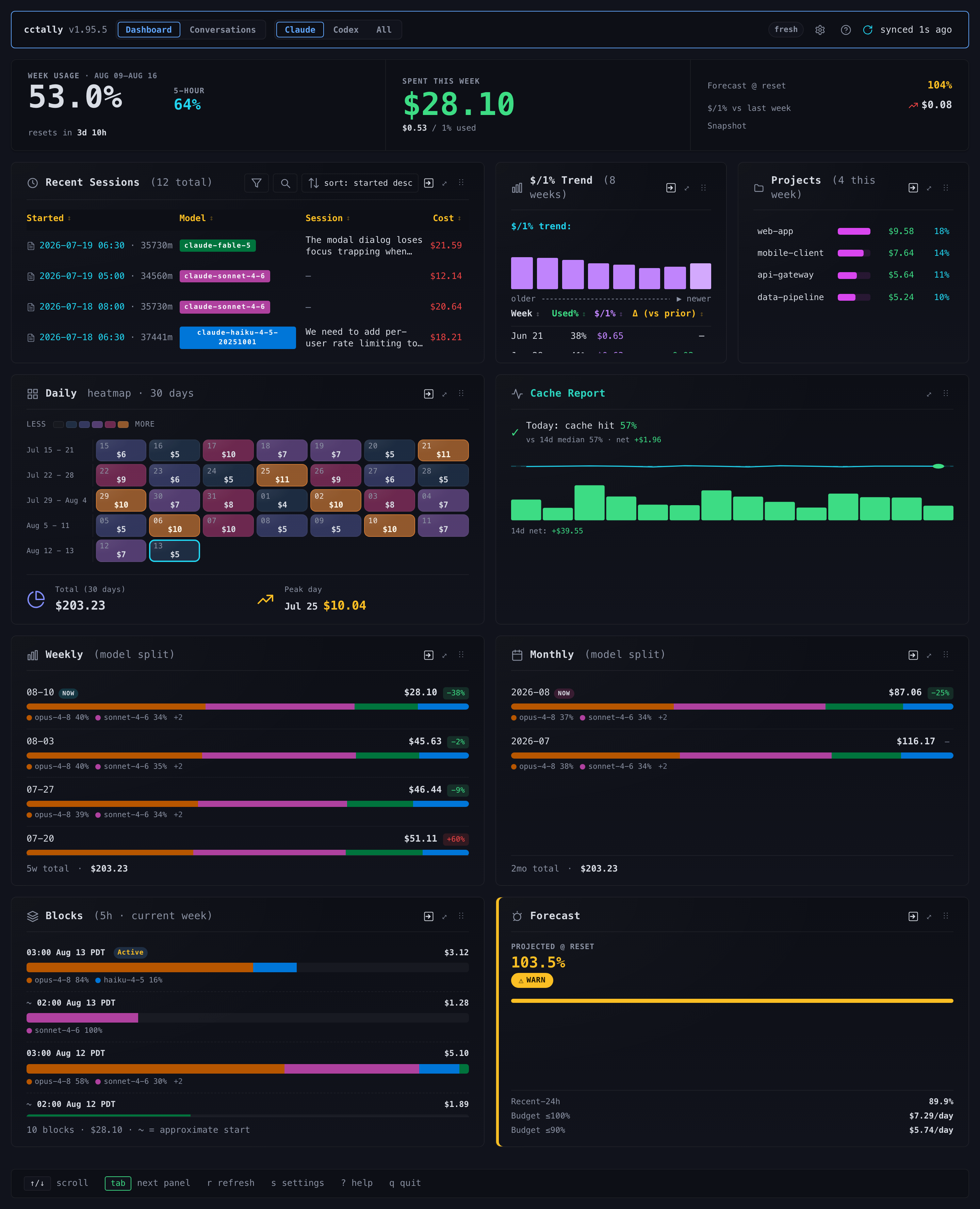
cctally dashboard serves a local web app that updates live as you work, with no refresh and no polling. Panels cover the current week, the forecast, the cost trend, sessions, 5-hour blocks, projects, and alerts. Any panel expands into a focused view, sessions are searchable, and every report can be exported as shareable Markdown, HTML, or SVG with project names anonymized by default. It stays on your machine unless you choose to open it to your network.
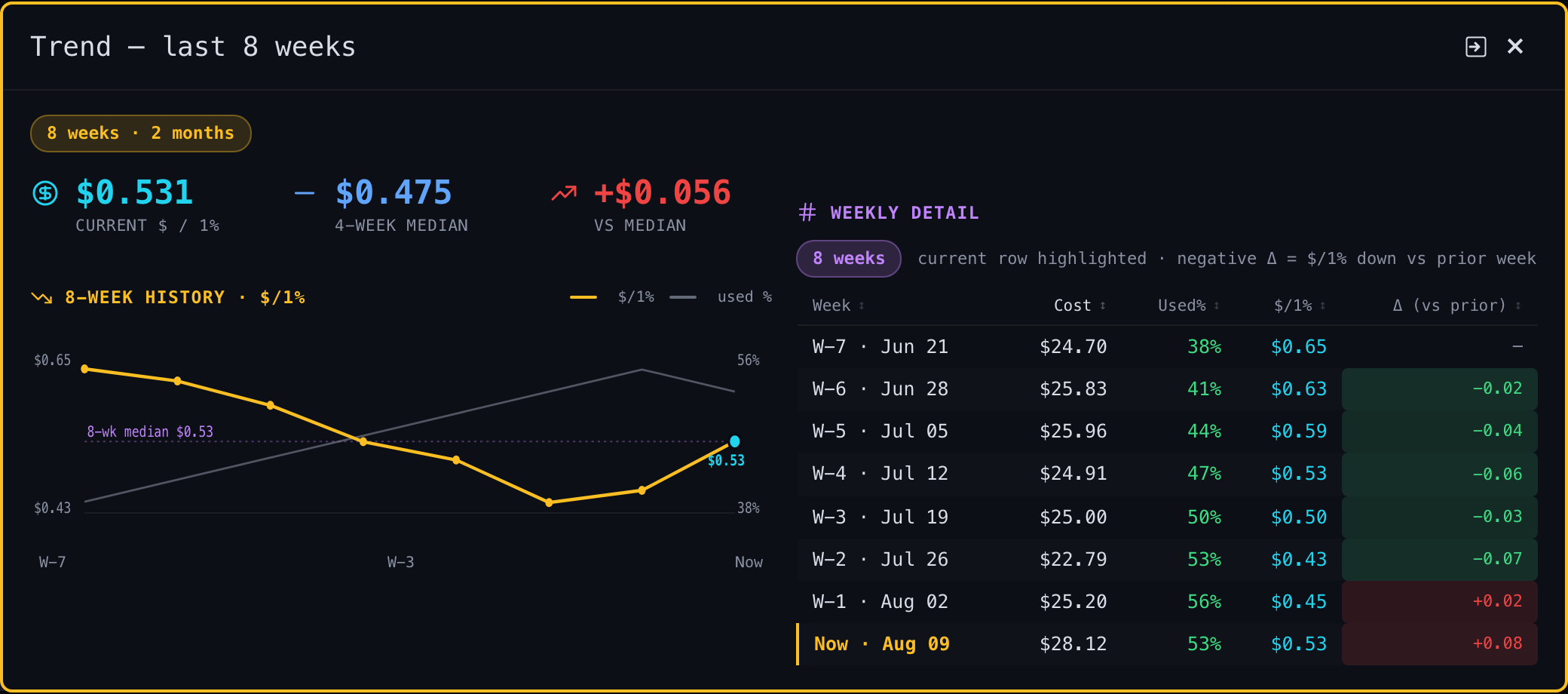
Any panel expands into a focused view: here, twelve weeks of cost per percent. |
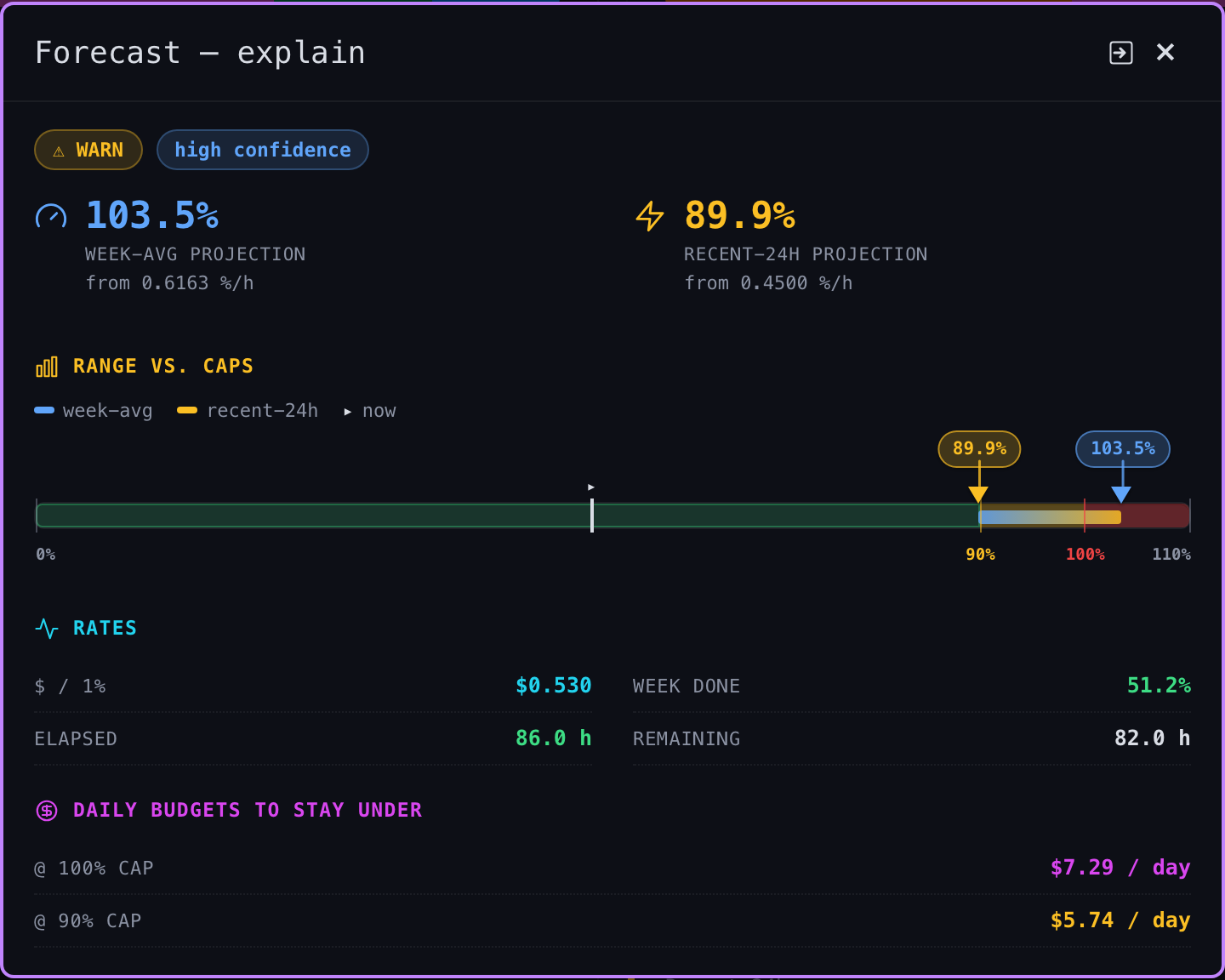
When the forecast projects a cap before the weekly reset, the modal turns amber. |
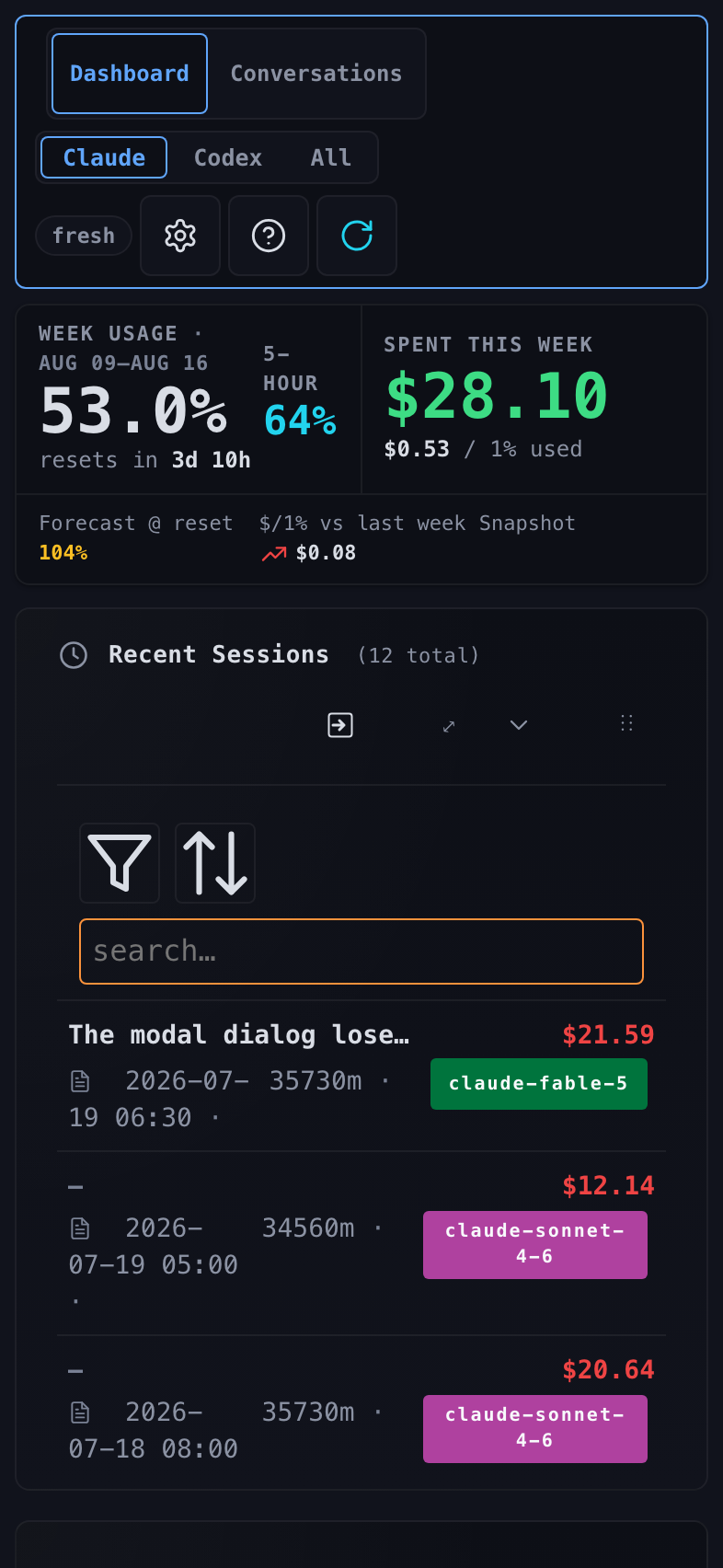
The same dashboard, reflowed for your phone. |
See docs/commands/dashboard.md.
Conversation viewer
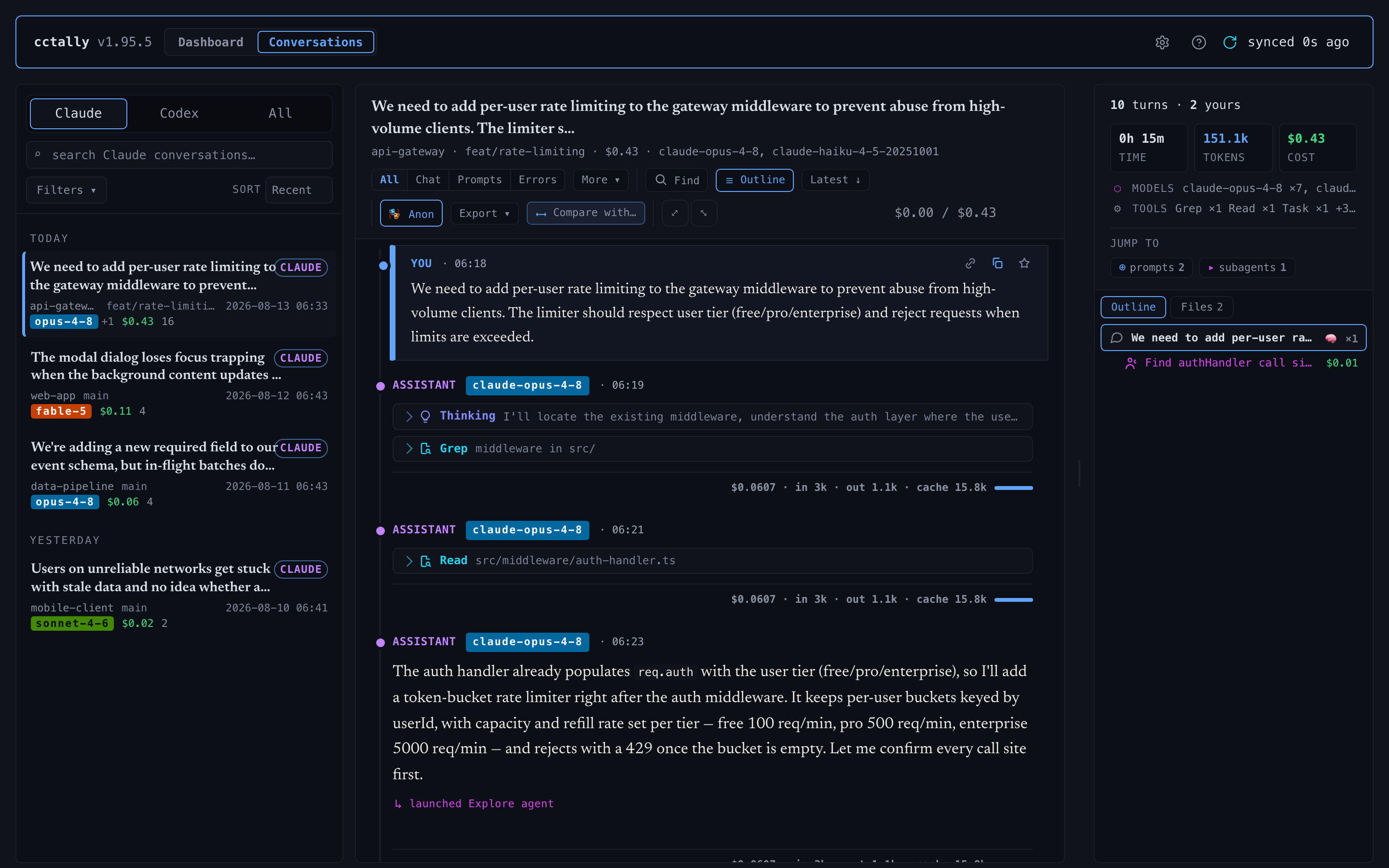
The dashboard's Conversations tab is a read-only reader for your Claude Code transcripts. A searchable rail lists every conversation with its project, branch, models, and cost; the reader shows the full turn-by-turn flow with thinking blocks, tool calls, and per-turn cost. Subagent runs render as nested threads, and the open conversation live-tails as you work. It never modifies your transcripts, and it never leaves your machine.
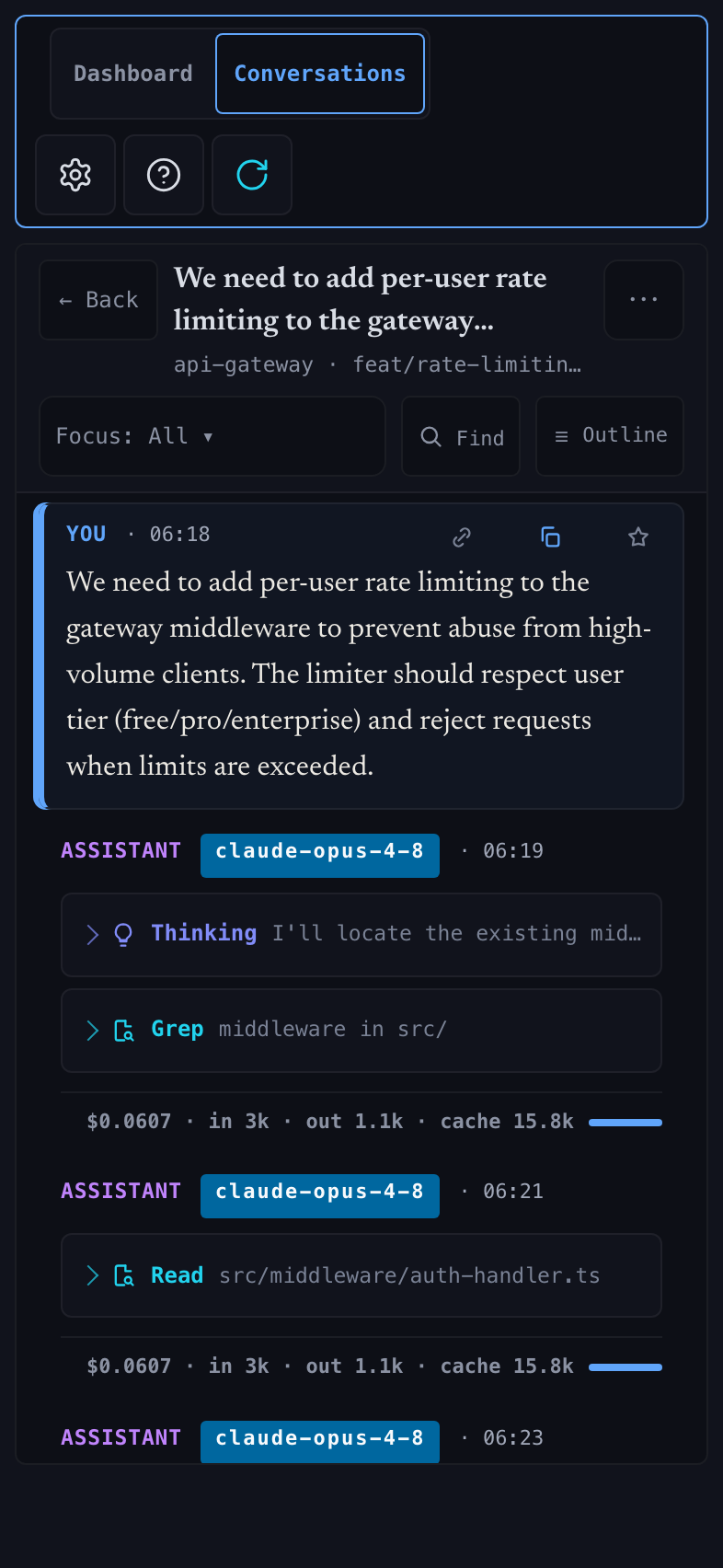
The same reader on your phone.
Cost per 1% of quota
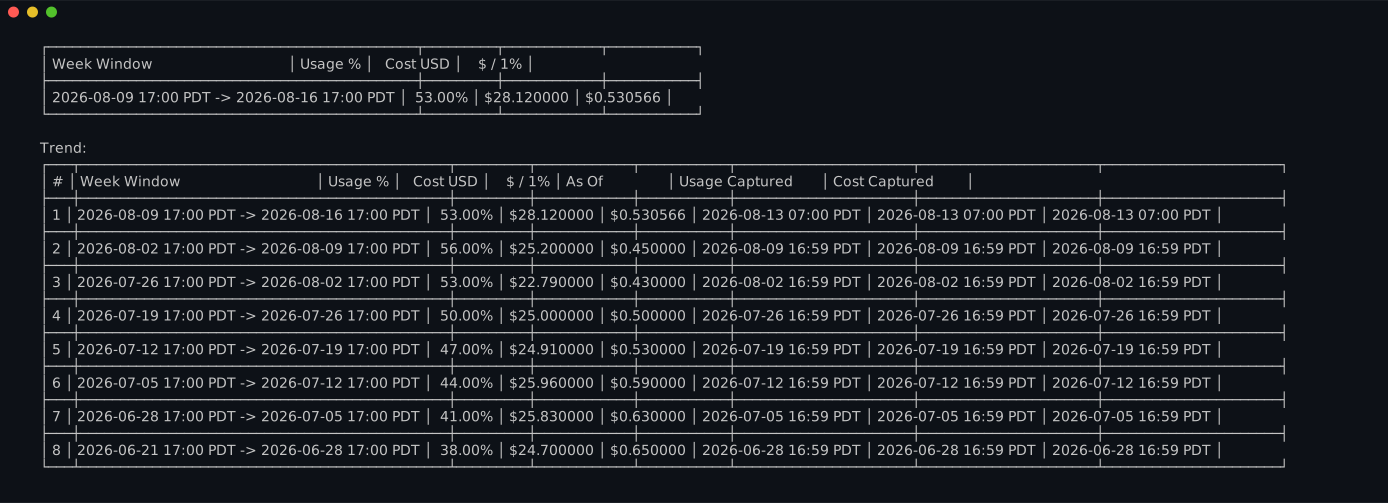
The signature view. cctally report reframes each week's spend as dollars per percent of quota used, so you can watch your spending efficiency trend week over week instead of staring at a raw percentage.
Forecast, budget, and alerts
cctally forecast projects where your weekly percentage lands at the next reset and tells you the daily budget that keeps you under the cap. cctally budget tracks a dollar target per provider over a calendar period. Native desktop notifications fire the moment you cross a percent, 5-hour, or budget threshold, so a runaway week cannot sneak up on you.
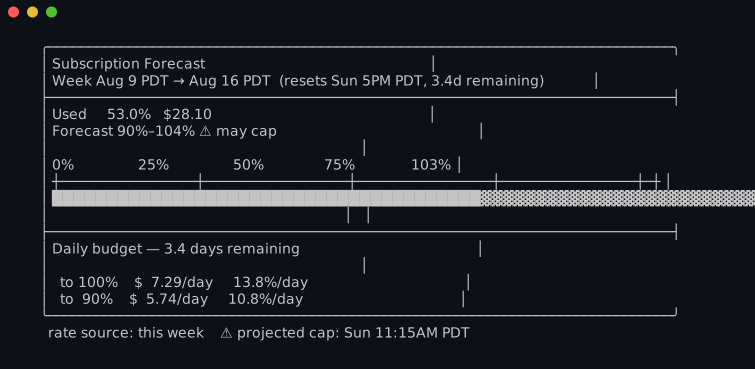
See docs/commands/forecast.md, docs/commands/budget.md, and docs/commands/alerts.md.
5-hour blocks
Claude Code's quota also runs on rolling 5-hour windows. cctally blocks and cctally five-hour-blocks break usage down per window, anchored to the real API resets, with model and project rollups.
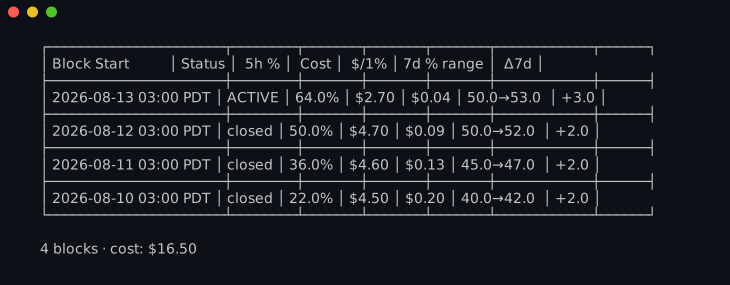
See docs/commands/blocks.md and docs/commands/five-hour-blocks.md.
Codex
If you also use OpenAI's Codex CLI, cctally tracks it with the same depth. cctally codex daily, monthly, and session are drop-in replacements for the ccusage codex commands, reading from your local ~/.codex/sessions/. cctally codex weekly adds a subscription week rollup, and cctally codex quota shows your native Codex rate limit windows.
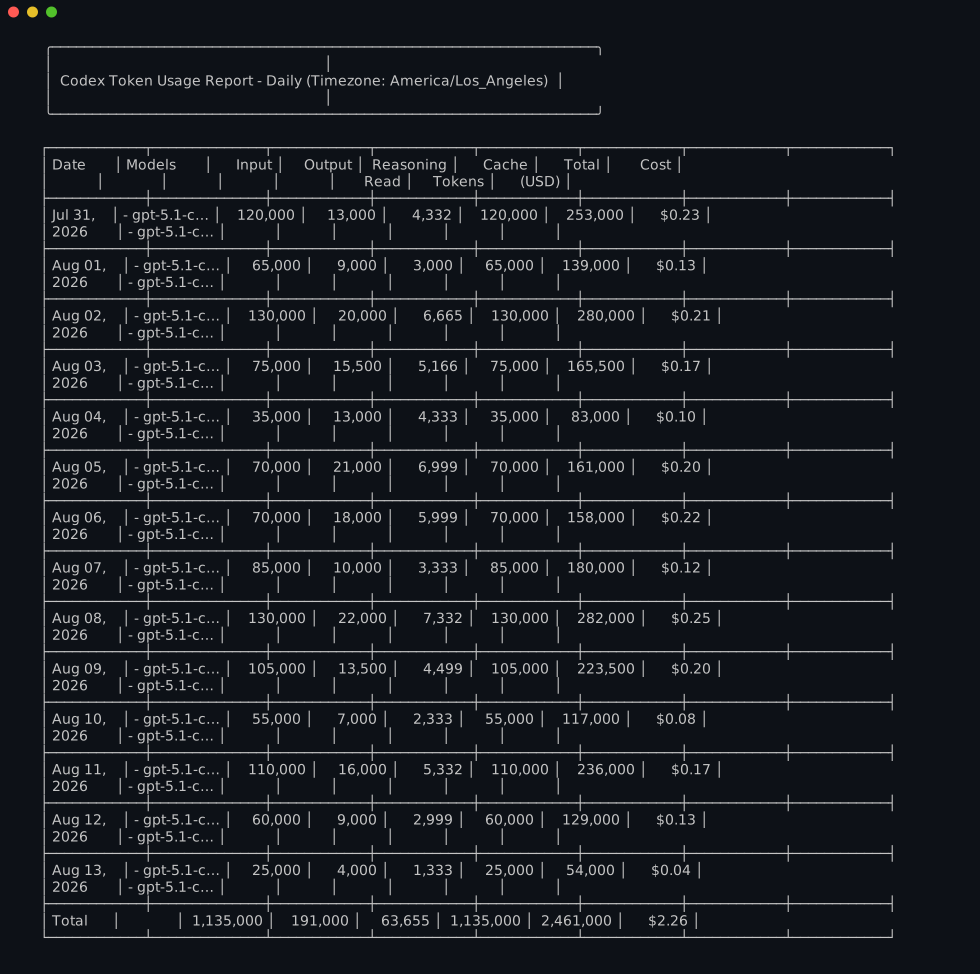
See docs/commands/codex.md and docs/commands/codex-quota.md.
Terminal UI
Prefer to stay in the terminal, or working over SSH? cctally tui shows the same live data as a refreshing terminal dashboard. It is the one feature that needs the optional rich library; everything else runs on a plain Python install.
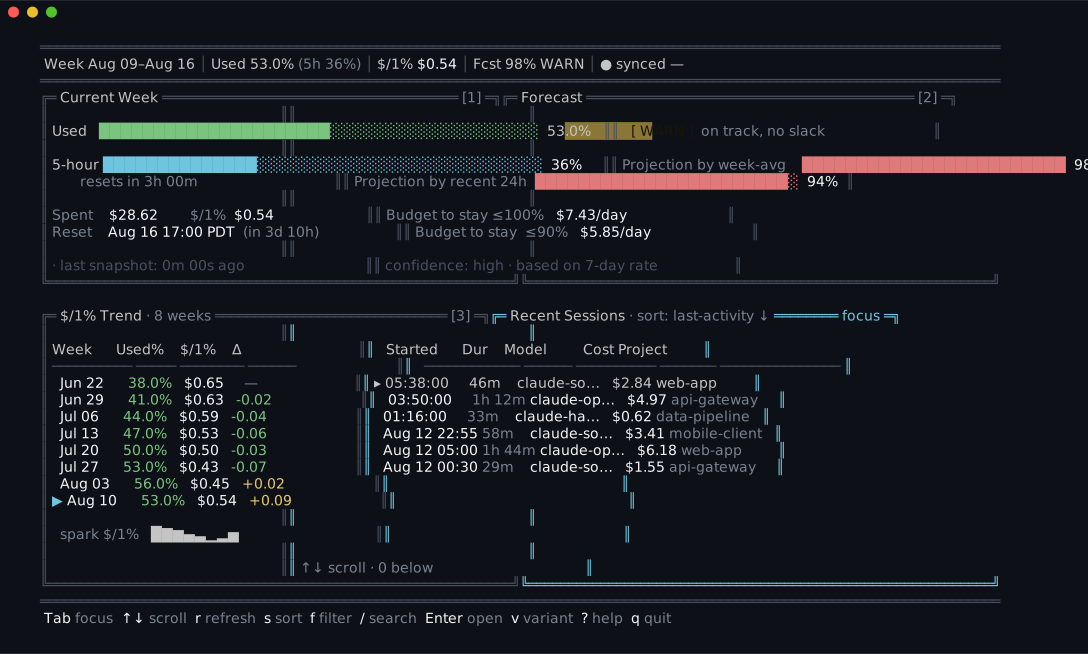
See docs/commands/tui.md.
ccusage compatibility
cctally started as a local replacement for ccusage and stays drop-in compatible: cctally claude <cmd> and cctally codex <cmd> accept your ccusage commands verbatim. It is also fast: first table on 30 days of session data took about 2.6 seconds against about 31 seconds for ccusage (about 12x, measured 2026-05-05; methodology in bench/README.md).
Privacy
Everything runs locally against your own ~/.claude and ~/.codex data; session content is never uploaded. The only telemetry is an anonymous, opt-out install-count beat (a rotating one-way token, the version, and a coarse OS family, at most once a day). Turn it off any time with cctally telemetry off. The full transparency page is docs/telemetry.md.
Documentation
- Installation: symlinks, status-line wiring, Python version.
- Configuration: config.json shape and week-start rules.
- Architecture: data flow, caches, week boundaries.
- Telemetry: the anonymous install-count beat, in full.
- Command reference: one page per subcommand.
License
Apache 2.0. See LICENSE.
Yorumlar (0)
Yorum birakmak icin giris yap.
Yorum birakSonuc bulunamadi