the-grid
Health Warn
- License — License: MIT
- Description — Repository has a description
- Active repo — Last push 0 days ago
- Low visibility — Only 5 GitHub stars
Code Fail
- rm -rf — Recursive force deletion command in _retired/issue-loop/loop/run-issues.sh
Permissions Pass
- Permissions — No dangerous permissions requested
No AI report is available for this listing yet.
Dotfiles for your AI assistant: curated skills and agent teams, wired identically onto every machine. Claude Code today, more AI tools next.
the-grid
Inspired by Tron. Dotfiles for your AI assistant: curated skills and agent teams, wired identically onto every machine and every AI tool you use.



Running in daily use on Claude Code, Codex CLI and Antigravity CLI. Gemini CLI, OpenCode, Pi and OpenClaw are wired too: see Works with. A skill is a slash command your AI tool loads, an agent is a role definition, and wired means symlinked into the tool's directory.
Quickstart
git clone https://github.com/oneafrikan/the-grid.git ~/.the-grid && bash ~/.the-grid/scripts/bootstrap.sh --with-agents
- Writes: symlinks into
~/.claude/skillsand~/.claude/agents, and one auto-handoff hook entry in~/.claude/settings.json(opt out with-hook:auto-handoff). All inside the clone: shallow submodule clones,baseline-submodules.txtandmachines/<host>.txtseeded from the.examplefiles,core.hooksPathset to.githooks,.wired.manifest,SKILLS.mdand, with--with-agents,agent-factory/.venvplusagent-factory/projects/. Rule packs and other tools' directories only with opt-in entries. Everything it writes: INSTALL.md ("What it touches"). - Undo:
bash ~/.the-grid/scripts/uninstall.shprints what it would remove; add--yesto remove it. It removes only links that resolve into the clone and keeps the clone and~/.grid. Add--purgeto delete both too (refused while the clone has uncommitted or unpushed work, unless--force). The seeded files, the venv and thecore.hooksPathsetting live inside the clone and go with it. - Needs git, bash, and python3 (with its
venvmodule) plus network access forpip, both to build the agent teams. Node >= 20.19 only for theopenspec-*skills.
To look first, try the plugins. Claude Code only, no clone and no symlinks; grid-agents@the-grid adds the dev team (docs/PLUGINS.md has the limits).
claude plugin marketplace add oneafrikan/the-grid
claude plugin install grid-core@the-grid
Or paste this into your coding agent:
Clone https://github.com/oneafrikan/the-grid.git to ~/.the-grid, run bash ~/.the-grid/scripts/bootstrap.sh --with-agents and tell me what it printed. If you are not Claude Code, read ~/.the-grid/docs/harnesses.md and tell me which harness: line to add for you.
You should now see:
bootstrap.shends with==> Bootstrap complete. Open a fresh Claude session to pick up new skills/agents.ls ~/.claude/skills | wc -lprints a number near 92 (plus the orchestrator skills; duplicate names across repos collapse to one link, so it is not exact).- In a new Claude Code session
/tronreplies with a short question about what you want to do.
Optional next steps:
- Tell the agents who you are (they say "No operator set yet." until you do):
cp ~/.the-grid/agent-factory/user.yaml.example ~/.the-grid/agent-factory/user.yaml, fill in your name and contact, re-run the bootstrap (safe to repeat). - gstack's browser skills (
/browse,/qa,/scrape) need bun and a browser download. Until you runbash ~/.the-grid/scripts/runtime-setup.sh gstack(add--dry-runto preview), bootstrap printsruntime MISSING: gstack. Detail in BOOTSTRAP.md step 8. - Fork first if you plan to customise; the clone URL above is read-only for you. Manual steps and the submodule-free install: INSTALL.md. After a
git pull, re-runbash ~/.the-grid/scripts/wire.sh(recompose agents first: BOOTSTRAP.md, "Updating an existing machine").
Works with
| Tool | What it gets | Status |
|---|---|---|
| Claude Code | skills, agents, plugins (grid-core, grid-agents), guard hooks, rule packs |
running in daily use |
| Codex CLI | skills, agents (compose --target codex), rule packs |
running in daily use |
| Antigravity CLI | skills | running in daily use |
| Gemini CLI | skills, agents (compose --target gemini-cli), rule packs |
wired, not yet smoke-tested on a real install |
| OpenCode | skills, agents (compose --target opencode), rule packs |
wired, not yet smoke-tested on a real install |
| Pi | skills, rule packs | wired, not yet smoke-tested on a real install |
| OpenClaw | skills | wired, not yet smoke-tested on a real install |
| Cursor | rule packs only (scripts/rules.py emit --harness cursor) |
generated, not yet smoke-tested |
Claude Code is on by default. The rest, Cursor aside, are opt-in with one harness:<name> line in your machine overlay, then a re-wire:
echo 'harness:codex' >> ~/.the-grid/machines/"$(hostname -s)".txt && bash ~/.the-grid/scripts/wire.sh
Codex CLI, Gemini CLI, OpenCode, Pi and OpenClaw all read ~/.agents/skills, so the skills are linked there once and reach every one of them. Agents need a compose for that tool's target first (bootstrap.sh composes Claude Code only). Rule packs reach a tool's instruction file (such as ~/.codex/AGENTS.md) only if you create that file. Paths, skip rules and what is unverified per tool: docs/harnesses.md.
The problem
- "My laptop has the skill. The server does not."
- "I installed every skill pack I liked, and now each session starts buried in descriptions it never uses."
- "Claude Code, Codex and Antigravity each want their own copy of the same skills."
Not for you if you want a supported product, a GUI or a one-click installer.
How it works
It is a dotfiles repo with one new part.
| You know it from dotfiles | In the-grid |
|---|---|
A repo you clone to ~ |
~/.the-grid |
Symlinks into $HOME |
symlinks into ~/.claude/skills, ~/.claude/agents and each opted-in tool's directories |
| A package list | the allowlist, baseline-submodules.txt |
| Per-host config | the overlay, machines/<host>.txt |
| (new) | agent roles written once and compiled per tool by agent-factory/compose.py |
flowchart LR
  S["Sources<br/>skills/, repos/* submodules, agent roles"] --> A["Allowlist<br/>baseline-submodules.txt"]
  A --> W[wire.sh]
  H["Host overlay<br/>machines/HOST.txt"] --> W
  W -->|symlinks| T["Tool dirs<br/>~/.claude, ~/.agents/skills, ..."]
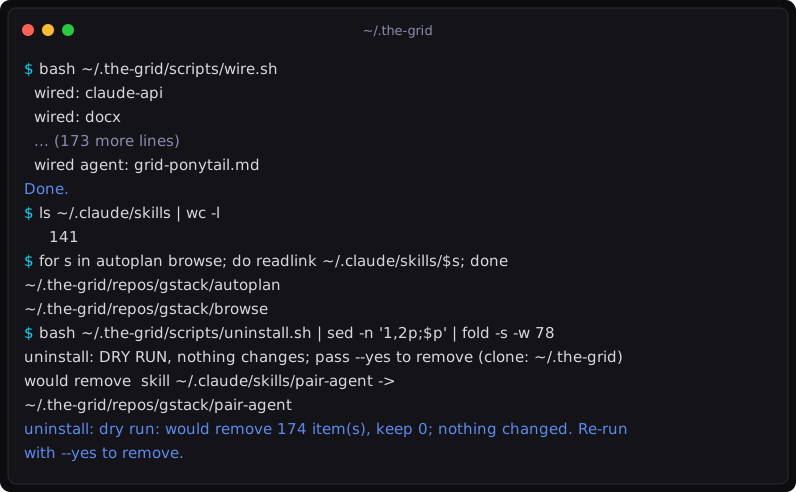
Real output captured in a throwaway home: wire.sh, a link count, then an uninstall.sh dry run. The long wire listing is trimmed.
Edit a skill once and every wired copy changes, because they are links. A skill in skills/ overrides a same-named upstream one. The full diagram, the repo layout and every step wire.sh takes are in docs/architecture.md.
Terms:
- Skill: a folder with a
SKILL.md. Your tool loads it as a slash command or an instruction set. - Agent (role): defined once as
role x stack x skills. In Claude Code an orchestrator becomes a slash command and a specialist becomes a subagent. - Wired or library: wired skills are symlinked live. Library skills are indexed in SKILLS.md, found with
/skill-scoutand not loaded. - Overlay:
machines/<host>.txt, which adds or removes allowlist entries for one machine. - Harness: an AI coding tool the-grid wires into, switched on with
harness:<name>.
What you get
- You choose what is live. The allowlist plus your machine's overlay decides which skills load; the rest stays on the shelf.
- 92 curated skills wired as slash commands (`/standup`, `/review`, `/ship`, `/skill-scout`), and 80 more indexed and switched off.
- 41 agent roles: a dev team, a finance desk, a Socratic tutor (`/morpheus`), and `/tron`, which tells you which one to use.
- One
git pullpluswire.shmakes every machine match.
The help skills are the entry points:
| Command | Answers |
|---|---|
/tron |
I have a goal: which skill or agent should I use? |
/grid-help |
Which slash command or subagent do I want? |
/openspec-help |
How do I add specs to a repo? |
/ponytail-help |
Which ponytail (minimum-diff) mode do I want? |
Layers
- Wire skills (start here; each level works without the next):
bash ~/.the-grid/scripts/bootstrap.shwithout--with-agentssyncs the submodules and links the allowlisted skills. - Agent teams:
--with-agentsalso composes the roles and links them. USAGE.md covers orchestrators and specialists. - Build your own: agent-factory composes your own roles, automation-factory cuts the issue-loop into a repo, project-factory seeds or retrofits a project, and the
openspec-*skills add spec-driven planning through OpenSpec (CONTRIBUTING.md).
Safe to run
- Audit before wiring.
wire.shrunsscripts/audit.shagainstpolicy.yamlbefore it touches a link. A high-severity finding blocks the run with nothing changed. CURATION.md records why each wired repo is trusted. - It never replaces a real directory or a foreign symlink. It only replaces links that point into the clone.
- Outside the clone, the one file it edits by default is
~/.claude/settings.json: a single auto-handoff hook entry. Opt out with-hook:auto-handoffin your overlay. SECURITY.md and INSTALL.md list every write, opt-in ones included. bash scripts/uninstall.shis a dry run until you add--yes. Submodules clone shallow, at their pinned commit.- The per-change CI (
gate, badge above) runs only the personal-data scan and shellcheck, on every push tomainand every ready pull request. The full bats suite runs nightly, on release tags and on demand, never per branch; drift checks run locally viabash scripts/gate.sh. CI runs on Linux only. The suite is written to run on macOS's Bash 3.2 too and was brought to near-green there (#301, docs/portability.md).
Why "the grid"
The Grid.
A digital frontier.
I tried to picture clusters of information as they moved through the computer.
What did they look like?
Ships? Motorcycles?
Were the circuits like freeways?
I kept dreaming of a world I thought I'd never see.
And then, one day...
I got in.
Kevin Flynn, TRON: Legacy (2010)
Same idea, smaller scale: a shared place where your skills and agents live, and one command to get in.
Get in.
git clone https://github.com/oneafrikan/the-grid.git ~/.the-grid && bash ~/.the-grid/scripts/bootstrap.sh --with-agents
Status
One person's working system, shared because the mechanics are reusable. Not a supported product, and opinionated: the wiring model, the factories and the compose format are my choices.
- Versioned from v0.1.0 (tagged 2026-11-04). v0.x may still break between tags.
- Personal config is gitignored.
baseline-submodules.txt,machines/<host>.txtandLOGS/stay untracked, and the first two ship as.examplestarting points, so a fork inherits none of my machine names or notes. - Fork rather than depend. The transferable part is the wiring model: manifest, symlinks, compose then wire.
Docs
- Start: USAGE.md (daily use), INSTALL.md (install and what it touches), BOOTSTRAP.md (full boot, update, troubleshooting), SKILLS.md (generated skill index).
- Project: CONTRIBUTING.md (skills, repos, tests, the gate, OpenSpec), SECURITY.md, CHANGELOG.md, docs/roadmap.md (what is built, what is not).
- How it fits: docs/architecture.md (full diagram, repo layout, complete docs index), docs/harnesses.md (other tools), docs/PLUGINS.md (plugin limits), docs/rules.md (rule packs), hooks/README.md (guard and auto-handoff hooks).
- Going further: docs/private-projects.md (a private desk), docs/model-selection.md (which model for which job), docs/portability.md (scripts that run on Linux and macOS).
- Factories: agent-factory, automation-factory, project-factory.
- Optional companion, a separate repo the-grid does not depend on: grid-fleet, a terminal dashboard for Claude Code sessions, tokens, subagent usage and limits across machines.
Credits and license
Wires skills from upstream projects, listed with licences in docs/SOURCES.md. Built by Gareth Knight. MIT licensed (LICENSE); submodules under repos/ keep their own licences.
Reviews (0)
Sign in to leave a review.
Leave a reviewNo results found