Cairn
Health Pass
- License — License: AGPL-3.0
- Description — Repository has a description
- Active repo — Last push 0 days ago
- Community trust — 603 GitHub stars
Code Pass
- Code scan — Scanned 12 files during light audit, no dangerous patterns found
Permissions Pass
- Permissions — No dangerous permissions requested
This project is a general-purpose state-space search engine designed to solve complex problems with clear starting points and goals. It is currently validated for autonomous penetration testing, utilizing a blackboard architecture where unstructured agent workers share facts and intents to explore unknown environments.
Security Assessment
Overall Risk: Medium. By design, the tool is built to perform autonomous penetration testing, which inherently involves executing shell commands, running network exploits, and interacting with external targets. The automated rule-based code scan confirms no dangerous hardcoded patterns or secrets were found in the core application files, and it does not request elevated system permissions. However, because the engine itself orchestrates sensitive and potentially destructive cybersecurity operations, users must ensure it is deployed in strictly controlled sandbox environments. It will access and act upon sensitive network data as part of its core functionality.
Quality Assessment
Overall Quality: High. The project appears to be an active, healthy, and well-supported initiative. It recently received updates (pushed to just days ago) and has accumulated over 600 GitHub stars, indicating strong community trust and developer interest. The repository is properly documented with a clear README, and it responsibly includes the AGPL-3.0 open-source license. A light code scan across a dozen files revealed no immediate red flags, reflecting clean and structured code.
Verdict
Use with caution: The underlying code is safe, but the tool's core function involves automating highly sensitive security operations that must only be used in isolated, legally authorized testing environments.
A general-purpose state-space search engine, validated first on autonomous penetration testing.
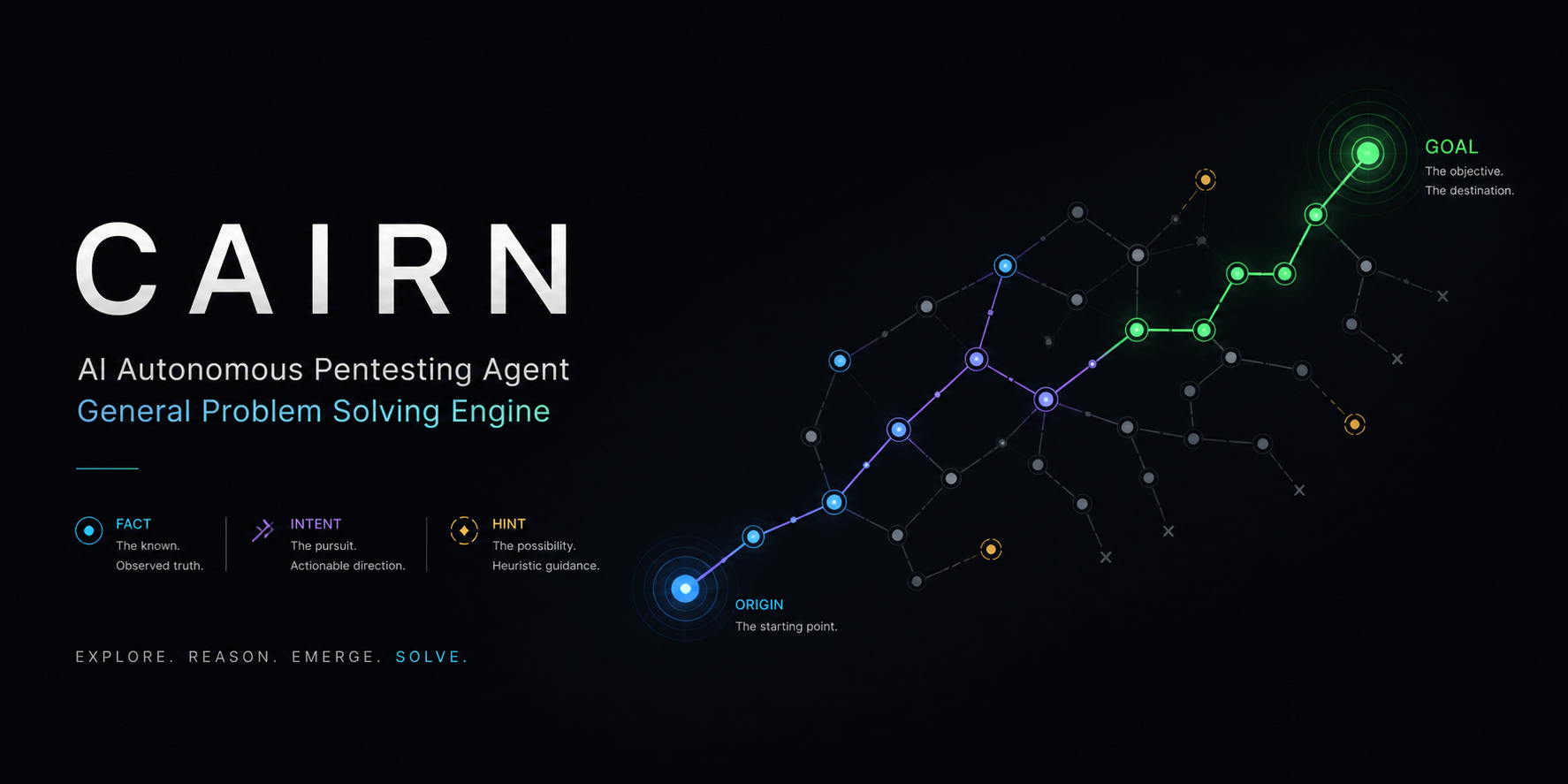
Cairn
More Than Just AI Penetration Testing — Towards General State-Space Search

Cairn is a general-purpose problem-solving engine.
It defines no roles, no workflows. Given an origin and a goal, it searches for a path through an unknown state space.
AI Penetration Testing is one such problem — and a proven one.
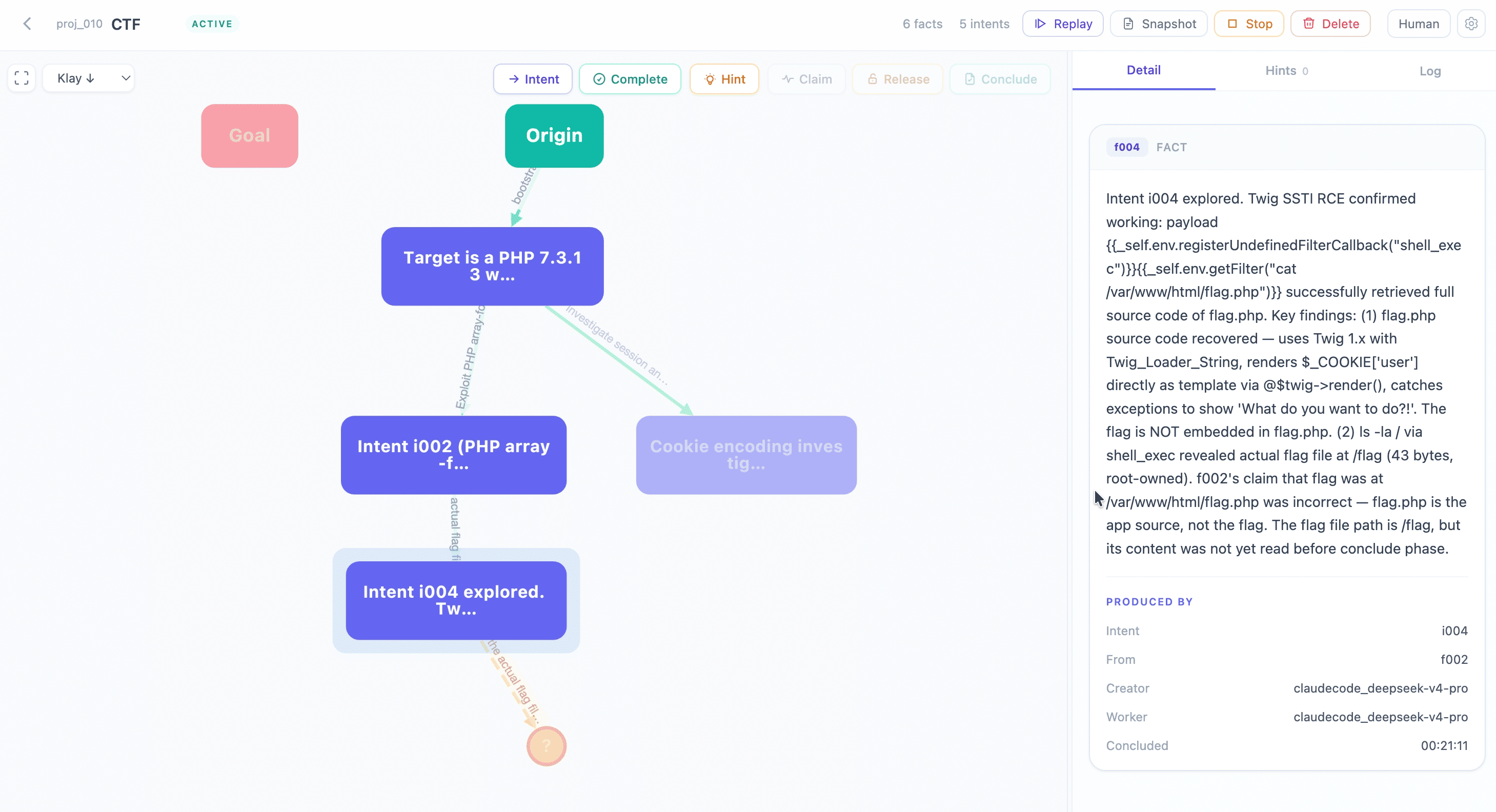
What is Cairn?
Penetration testing is fundamentally a directed search through a near-infinite state space:
- Origin: known (target IP, target system)
- Goal: defined (get a shell, capture the flag)
- Path: unknown
This structure is not unique to penetration testing. Vulnerability research, mathematical proof, CTF challenges — any problem with a clear starting point, a clear success condition, and an unknown path in between shares the same shape.
Cairn is built for this class of problems. Penetration testing is the first domain it has been validated on.
The engine is built on a Blackboard Architecture with an explicit fact-intent graph. Three primitives are all it needs:
| Concept | Meaning |
|---|---|
| Fact | A confirmed, objective finding written to the board |
| Intent | A declared direction of exploration, not yet executed |
| Hint | Human judgment injected at any time; absorbed by agents on the next read |
The graph grows from origin toward goal. Every new Fact is a stepping stone; every Intent is a step into the unknown.
Agent Workers run an OODA loop — Observe the full graph, Orient to the current state, Decide on next intents, Act to explore — and write their findings back as new Facts. Workers have no fixed roles. Tasks are generated at runtime from the graph's current state, not from predefined job descriptions.
Agents coordinate exclusively through the shared board (Stigmergy). No direct communication. No information silos.
Cairn in Action
https://github.com/user-attachments/assets/e557b1ac-dda4-41cb-87dd-9d56dbf05133
How It Works
Three task types, all executed by the same Worker:
| Task | What it does | Output |
|---|---|---|
| Bootstrap | At project start, attempts to solve the problem directly | Fact + possible Complete |
| Reason | Reads the full graph: is the goal met? What should be explored next? | Complete / new Intents / no-op |
| Explore | Claims one Intent, executes the exploration, reports findings | One Fact |
System architecture:
          ┌──────────────────────────────────┐
          │           Cairn Server           │
          │    Facts + Intents + Hints       │
          └─────────────────┬────────────────┘
                            │
                     Read / Write API
                            │
          ┌─────────────────┴────────────────┐
          │             Dispatcher           │
          │   Schedules tasks, manages       │
          │   containers, writes protocol    │
          └──────────┬───────────────┬───────┘
                     │               │
     ┌───────────────┴──┐     ┌──────┴──────────────┐
     │  Worker Container│     │  Worker Container   │
     │   (Project A)    │     │   (Project B)       │
     │  ┌────┐  ┌────┐  │     │  ┌────┐  ┌────┐     │
     │  │ W. │  │ W. │  │     │  │ W. │  │ W. │     │
     │  └────┘  └────┘  │     │  └────┘  └────┘     │
     └──────────────────┘     └─────────────────────┘
Cairn Server maintains graph consistency only.
Cairn Dispatcher reads the graph, schedules tasks, spins up and tears down worker containers, and is the sole writer to the protocol. Each project gets its own Worker Container; multiple Agent Workers run concurrently inside it. Agent Workers only receive a prompt and return structured output.
Results
Tencent Cloud Hackathon · AI Penetration Testing Challenge · 2nd Edition
610 teams · 1,345 participants · top universities and security firms across China
| Metric | Value |
|---|---|
| Problems solved | 54 / 54 — only team to AK |
| Final ranking | 3rd |
The system had never been tested before the competition. The full pipeline came online for the first time at 4 AM on race day. No training, no tuning, no domain-specific tooling. Zero MCP tools, zero RAG, zero predefined agent roles.
Getting Started
Prerequisites
- macOS or Linux
- Python ≥ 3.12
- Docker
Pull required images
Both setup methods require the worker container image:
docker pull --platform=linux/amd64 ghcr.io/oritera/cairn-worker-container:latest
Docker Compose (recommended)
Pull the base image used to build Cairn:
docker pull ghcr.io/astral-sh/uv:python3.13-trixie
Edit dispatch.yaml and fill in your LLM endpoints and API keys, then start both services:
docker compose up --build
This starts cairn-server on port 8000 and cairn-dispatcher once the server passes its health check. The dispatcher mounts dispatch.yaml from the project root and connects to Docker via the host socket. Data is persisted to ./datas/cairn/.
Manual
Edit dispatch.yaml and fill in your LLM endpoints and API keys, then:
# Start the server
uv run --project cairn cairn serve

# Run the dispatcher
uv run --project cairn cairn dispatch --config dispatch.yaml

# Run startup health checks only
uv run --project cairn cairn dispatch --config dispatch.yaml --startup-healthcheck-only
⚖️ License
This project is licensed under GNU AGPLv3 for personal and educational use.
Commercial Use: If you wish to use this project in a commercial or proprietary environment without the AGPL-3.0 open-source obligations, please contact me to obtain a commercial license.
Contributions: By submitting a Pull Request, you agree that your contributions may be used under both the AGPL-3.0 and the project's commercial license.
Reviews (0)
Sign in to leave a review.
Leave a reviewNo results found