cc-audit
Health Warn
- License — License: MIT
- Description — Repository has a description
- Active repo — Last push 0 days ago
- Low visibility — Only 6 GitHub stars
Code Fail
- spawnSync — Synchronous process spawning in scripts/build-npm.mjs
- spawnSync — Synchronous process spawning in scripts/bundle.mjs
- os.homedir — User home directory access in src/__tests__/conditionalContext.test.ts
- process.env — Environment variable access in src/__tests__/conditionalContext.test.ts
Permissions Pass
- Permissions — No dangerous permissions requested
No AI report is available for this listing yet.
Local-first CLI that audits Claude Code transcripts for spend by model, avoidable context-carry waste, always-on config cost, and AI-fluency signals. Runs fully offline by default; opt-in tiers gate any egress.
cc-audit
Point it at your Claude Code transcripts and see where the money — and the bad habits — are.
Spend attribution · model right-sizing · context-hygiene waste · AI-fluency signals. 100% local by default.




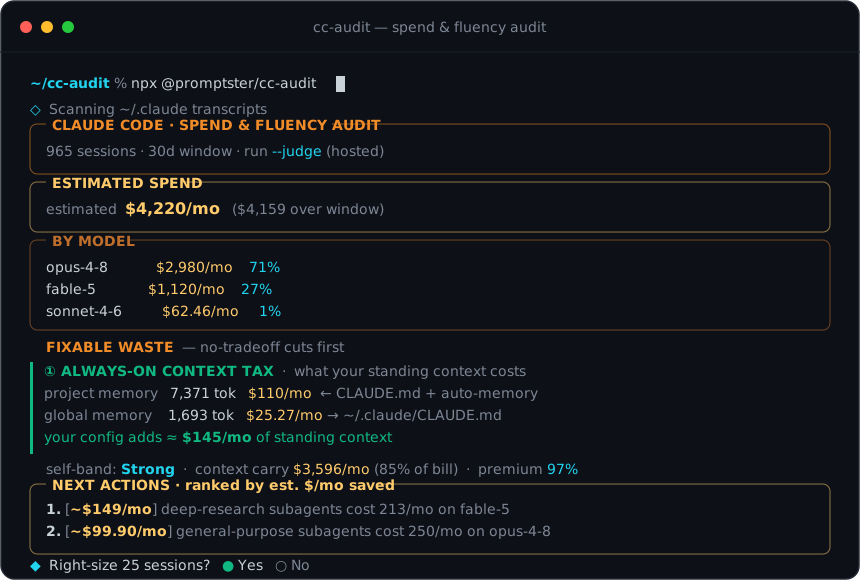
npx @promptster/cc-audit
That's it. No install, no API key, no signup. It reads your local Claude Code history
(~/.claude/projects) and shows you spend by model, the fixable waste (context you paid to
carry that a /compact or /clear would have shed), what your always-on config costs every
turn, and AI-fluency signals like plan-mode rate.
Built by Promptster — we measure and level up AI-engineering
fluency across whole teams.cc-auditis the local, open-source slice of that, for your own
machine. More below ↓
Quick start
# one-off — nothing to install
npx @promptster/cc-audit

# use it regularly? install it
npm i -g @promptster/cc-audit && cc-audit
Prefer a single self-contained executable (no Node)? Grab a pre-built binary for macOS
(arm64 / x64) or Linux (x64) from the
latest release — or build your own withnpm run bundle (via bun).
What it finds
- 💸 Spend, attributed —
$/moby model, your most expensive sessions, and cost broken
down per prompt when a session actually did two different things. - ⓪ Fixable waste, first — the avoidable carry: context held past the
~160K/compact
line, and task-switches a/clearwould have reset. Real dollars, billed only above a
conservative line — never a fabricated "all carry is waste" number. - ① Always-on context tax — what your
CLAUDE.md, memory, skills, plugins, and MCP
servers cost you every turn. Useful ≠ free. - 🧭 AI-fluency signals — plan-mode rate, prompts-per-session, command/skill leak, subagent
spend, and a skill/MCP ROI ledger (what's earning its keep vs. dead weight). - 🎚️ Model right-sizing (opt-in
--judge) — which premium-model tasks a cheaper tier
would have nailed. The frontier-vs-cheap call stays your policy; this just prices it.
Usage
npx @promptster/cc-audit                 # local audit (default)
npx @promptster/cc-audit --judge         # + hosted right-sizing analysis
npx @promptster/cc-audit --open          # + shareable public web report
npx @promptster/cc-audit --json          # machine-readable, local-only unless a flag is given
| Flag | What it does |
|---|---|
--since-days N |
Only look at the last N days. |
--root DIR |
Point at a transcript root other than ~/.claude/projects. |
--rows N |
How many rows to show in the leaderboards. |
--aggressiveness conservative|balanced|aggressive |
How eagerly to flag over-modeled tasks as cuts (default balanced). |
--judge |
Hosted right-sizing — sends task gists + metadata, never code. |
--open |
Upload the privacy-safe aggregate and open a shareable web report. |
--json |
Print the aggregate record as JSON (always local-only, pure stdout). |
cc-audit label   [--n 50]  # judge real sessions → a sheet you hand-label
cc-audit score   <file>    # score your labels vs. the judge (precision/recall)
cc-audit fix               # turn recommendations into reviewable patches (never auto-applied)
What leaves your machine
By default: nothing. The audit runs fully local — no network, no key. Two optional steps
upload data, and each asks first, gated proportional to what leaves:
| Tier | Trigger | What's sent |
|---|---|---|
| 0 — local read | first run | Sticky one-time ack. Reads ~/.claude/projects. Nothing leaves. |
| 1 — right-sizing | --judge |
Each task's gist + metadata (model, token counts, turn shape) to the hosted model. Never your code, prompts, file paths, or repo names. |
| 2 — shareable report | --open |
The privacy-safe aggregate (shares and counts — never raw $ or code) to a public link. Defaults to No, re-confirmed each run. |
--json and any non-TTY run are strictly non-interactive: only an explicit --judge/--open
sends anything, so CI stays local. A random anonymous machine ID (a hash, not your hostname) is
minted for dedup only if you share a report.
How it works
The deterministic half — parse → attribute → report — runs entirely on your machine. Egress is
a separate, opt-in tier that only fires on an explicit flag:
                    ┌──────────── LOCAL · deterministic · no network, no key ─────────────┐
  ~/.claude/        │                                                                     │
   projects   ───▶  │   adapter ─▶ model ─▶ attribute ─▶ ┬─ fluency ────────┐             │
  (your             │  (claudeCode)  (Session/  (spend    ├─ alwaysOn ───────┼─▶ report    │
   transcripts)     │                 Span)     by model) └─ contextHygiene ─┘   (TUI)     │
                    └─────────────────────────────────────┬───────────────────────────────┘
                                                          │
                                       opt-in · consent-gated ▼
                            --judge ─▶ right-sizing     task gists + metadata ─▶ hosted model
                            --open  ─▶ shareable report privacy-safe aggregate ─▶ public link
| Stage | Modules |
|---|---|
| Ingest | adapters/claudeCode.ts → model.ts (Session/Span). Tool-agnostic, so Codex/Cursor adapters can drop in later. |
| Analyze (local) | attribute.ts, pricing.ts + vendor/ (cost tables), fluency.ts / alwaysOn.ts / contextHygiene.ts, tied together by audit.ts into an AuditResult; aggregate.ts is the privacy-safe record. |
| Render | report.ts + theme.ts (the only module that knows ANSI). |
| Egress (opt-in) | judgeClient.ts (--judge), open.ts (--open), fixClient.ts / fix.ts (cc-audit fix). All behind consent.ts. |
The core principle, preserved by design: no code path phones home on a bare or
non-interactive run.
Not the assessment CLI
This is not @promptster/cli (bin:promptster), which candidates use to run Promptster hiring assessments. cc-audit audits your
own Claude Code spend and fluency. Different command, different job — you can have both
installed without conflict.
Contributing
npm install
npm run build      # tsc → dist/
npm test           # vitest
npm run lint       # oxlint
node dist/cli.js   # run it locally
Pricing tables live in src/vendor/ (a hand-copied mirror — seeMAINTAINING.md). Issues and PRs welcome.
💼 Built by Promptster
cc-audit is the open-source, local slice of what Promptster does
for engineering organizations: measure how fluently a team actually wields AI — spend, waste,
and skill — and turn that into a level-up plan. If the numbers this tool surfaces for you are
interesting, they're a lot more interesting across a whole team.
License
Reviews (0)
Sign in to leave a review.
Leave a reviewNo results found