ultracode-skill
Health Pass
- License — License: MIT
- Description — Repository has a description
- Active repo — Last push 0 days ago
- Community trust — 108 GitHub stars
Code Pass
- Code scan — Scanned 1 files during light audit, no dangerous patterns found
Permissions Pass
- Permissions — No dangerous permissions requested
No AI report is available for this listing yet.
Codex-first Ultracode skill for dynamic coding workflows
Ultracode Skill





Ultracode Skill gives Codex a dynamic workflow layer for serious coding tasks: planning, native agents, integration, and final verification without turning the repo into a separate runner.
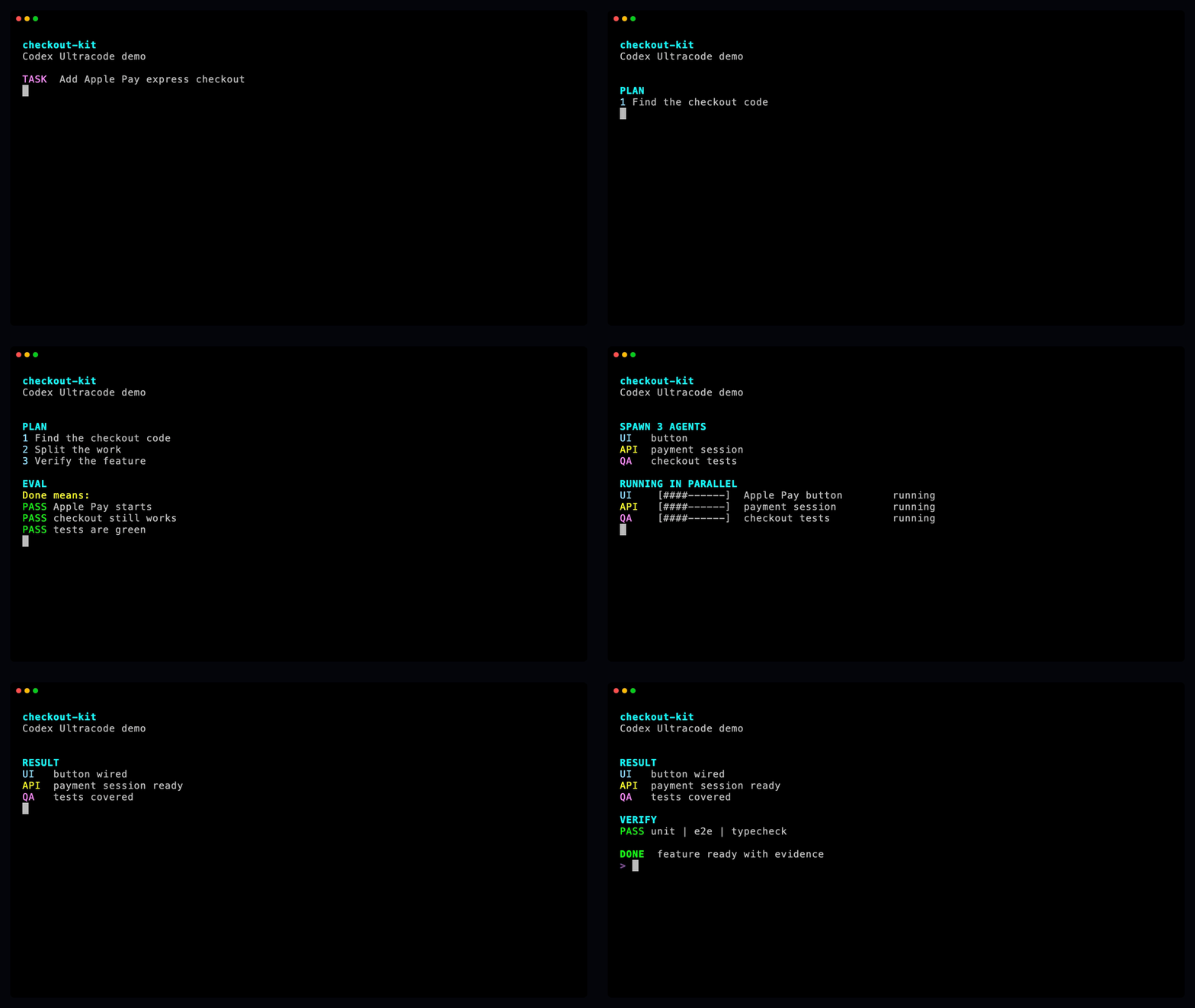
Use it when a task needs more than one pass: discovery, implementation, review, tests, and a final integration step. The skill tells the agent how to decide between a direct edit, a packetized workflow, or native agent delegation.
Codex is the main target. Claude Code already has first-class workflow concepts; Codex has native multi-agent tools, but users still need a clean operating pattern around them. Ultracode fills that gap with one small SKILL.md folder.
What it does
Ultracode asks the agent to:
- Define the goal and success criteria.
- Decide whether the task needs direct, workflow, or delegated mode.
- Create workflow artifacts for non-trivial work.
- Use native agents when they are useful and allowed by the host.
- Keep integration in the parent session.
- Use lightweight eval contracts for risky shared surfaces.
- Verify the result before answering, with a final audit for high-risk runs.
For Codex, that means the skill can use native spawn_agent for independent packets, then integrate the results in the parent session.
Install
The installable skill folder is ultracode/.
Codex
mkdir -p "${CODEX_HOME:-$HOME/.codex}/skills"
cp -R ultracode "${CODEX_HOME:-$HOME/.codex}/skills/"
Restart Codex after installing.
Claude Code
mkdir -p "$HOME/.claude/skills"
cp -R ultracode "$HOME/.claude/skills/"
Antigravity
Workspace install:
mkdir -p .agents/skills
cp -R /path/to/ultracode .agents/skills/
User install:
mkdir -p "$HOME/.gemini/antigravity/skills"
cp -R ultracode "$HOME/.gemini/antigravity/skills/"
Usage
Start with the short form:
Use $ultracode to build this feature end to end.
You do not have to manually design the workflow or ask for subagents. Ultracode decides whether the task needs a direct edit, a workflow, or native agents.
For non-trivial Codex tasks, $ultracode is delegated-workflow intent: when useful native agents are available, Ultracode should prefer a small bounded fan-out instead of doing every independent packet in one session.
If you want to force a delegated run, you can still say it directly:
Use $ultracode. Split this across agents where it is safe, keep integration in the parent session, and verify the final patch.
Modes
| Mode | Use it for | Behavior |
|---|---|---|
| Direct | Small, clear edits | No workflow files unless needed. Run the narrowest useful check. |
| Workflow | Multi-step work without useful delegation | Write plan, packet, result, integration, and final report files. |
| Delegated | Independent packets where native agents are available | Spawn bounded agents, keep the critical path local, integrate results, verify. |
Workflow files
For non-trivial tasks, Ultracode writes plain Markdown and JSON:
.workflow/ultracode/<run-slug>/
  plan.md
  orchestration.md
  state.json
  packets/
  results/
  integration.md
  final-report.md
High-risk or cross-surface runs may also include eval-contract.md, contracts/, handoffs/, or final-audit.md.
These files make the run inspectable. You can see what was delegated, what changed, what passed, and what risk remains.
Codex behavior
When Codex exposes native agent tools, Ultracode prefers real delegation over fake packet simulation.
The parent session should:
- keep the critical path local
- spawn
exploreragents for read-only discovery - spawn
workeragents only with clear file ownership - prefer 2-4 sidecar agents for useful independent packets
- stay under 5 total sidecar agents unless the user approves more
- avoid combining
agent_typewith a full-history fork - wait only when a result blocks the next parent step
- close agents after collecting their results
If native agents are unavailable, blocked by policy, or not useful for the task, Ultracode falls back to workflow mode and records the concrete reason.
Live test
This skill was tested in Codex with a fresh demo repository.
Result:
$ultracodeloaded the skill.workflow/ultracode/...artifacts were created- Codex used native
spawn_agent - tests passed
- the parent session integrated the agent results
What it is not
Ultracode Skill does not ship a background service, hidden runner, or required scripts. It is a small skill folder that teaches the agent how to run high-effort coding workflows with the tools already available in the current host.
Repository name
The repo is ultracode-skill.
The skill name is ultracode, so users can invoke it with:
$ultracode
Star history
License
MIT.
Reviews (0)
Sign in to leave a review.
Leave a reviewNo results found