pardesline
Health Pass
- License — License: Apache-2.0
- Description — Repository has a description
- Active repo — Last push 0 days ago
- Community trust — 10 GitHub stars
Code Pass
- Code scan — Scanned 12 files during light audit, no dangerous patterns found
Permissions Pass
- Permissions — No dangerous permissions requested
No AI report is available for this listing yet.
3D vision and medical imaging in one Python package: 73 algorithms, 43 datasets in one line, Open3D / SimpleITK / PyVista, MCP server for AI agents

pardesline: 3D computer vision and medical imaging datasets, algorithms and models for Python
Load 43 public 3D and medical datasets in one line, run 73 algorithms on point clouds, meshes and CT/MRI volumes with defaults that hold on real scans, hand the result to Open3D, PyVista or SimpleITK, or to an AI agent through MCP.









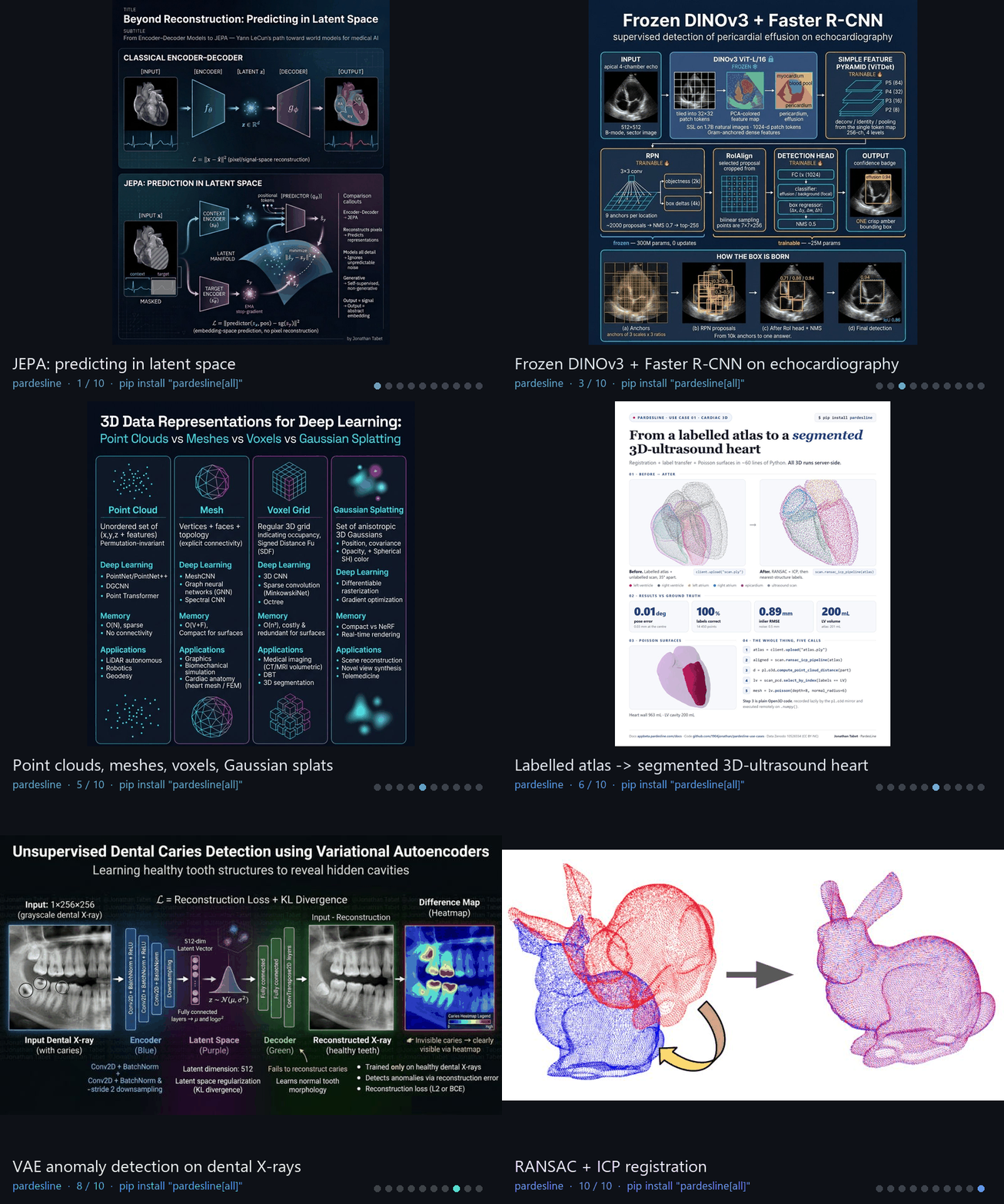
Ten pipelines, one package: the showcase has the snippet, the expert skill and the MCP tool for each.
30-second demo: dataset in, registration out
pip install "pardesline[all]"
import pardesline as pl
import pyvista as pv

s = pl.load("rire_brain")[0]  # CT + MR T1 of one head (19 MB); the licence line is printed, never guessed
moved = s.ct.align(s.mr_t1)  # rigid registration: SimpleITK, Mattes mutual information, catalog defaults
print(moved.transform["sub_transforms"][0]["rotation_deg"])  # [0.34, -0.35, -4.38] degrees

ct, mr = s.ct.to_pyvista(), moved.to_pyvista()  # the libraries you already use, one call away
p = pv.Plotter(shape=(1, 2))
p.subplot(0, 0)
p.add_mesh(ct.slice("z"), cmap="gray")
p.add_text("CT (fixed)")
p.subplot(0, 1)
p.add_mesh(ct.slice("z"), cmap="gray")
p.add_mesh(mr.slice("z"), cmap="magma", opacity=0.55)
p.add_text("MR T1 registered onto the CT")
p.show()
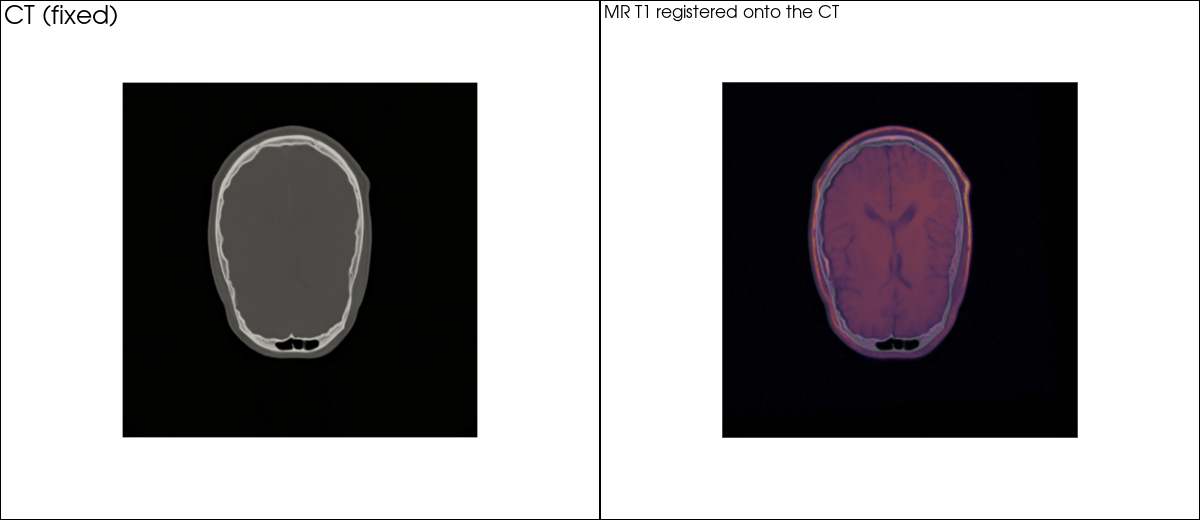
Measured cold on a laptop: 7.6 s download, 8.8 s registration, 21.5 s total. The script is examples/register_ct_mr_rire/run.py.
Why this exists
- Datasets are scattered and incompatible. The Decathlon is a tar on S3, TCIA is a REST API that returns zips of DICOM, KiTS is on Hugging Face, KITTI is a zip of headerless binaries. pardesline describes each one in a manifest (files, roles, labels, frame, units, licence, citation) and fetches lazily, by HTTP Range inside archives when it can, so one sample costs one sample.
- Nothing carries its meaning. A
.binis numbers until someone says(N, 4) float32, x y z reflectance, metres. A NIfTI label map is integers until someone says1 = anterior. Manifests carry that; your own folders get it throughpl.scan, which asks what it cannot know instead of guessing. - Open3D, PyVista and SimpleITK do not talk to each other. One typed object (
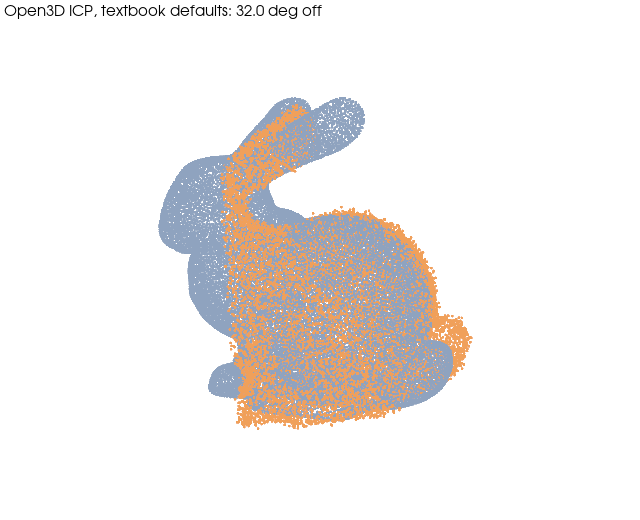
PointCloud,Mesh,Volume,LabelMap) converts between them, keeps frame, units, labels, licence and provenance, and exposesto_open3d(),to_pyvista(),to_sitk()when you want the library itself. - Textbook defaults break on real scans. The ICP that converges on the tutorial fragments ends 32 degrees off on a noisy partial scan while reporting a 0.98 fitness. Every algorithm here runs behind one call with defaults tied to the data (voxel size from the bounding box, correspondence distances as multiples of it) and the sidecar records what was used. See Defaults that work on real data.
- Models do not plug into datasets. The expert skills and reference scripts (PointNet, DINOv3 features, JEPA, VAE, nnU-Net preparation) read any pardesline dataset. One-line access to pretrained models through the same manifest pattern is the next step on the roadmap.
Install
pip install pardesline                 # core: catalog, object model, datasets, CLI (no native libraries)
pip install "pardesline[local]"        # + Open3D, PyVista, SciPy, scikit-image: point clouds, meshes, LiDAR, SDF
pip install "pardesline[medical]"      # + SimpleITK: volumes, DICOM series, registration, segmentation
pip install "pardesline[hf]"           # + huggingface_hub: datasets on the Hub
pip install "pardesline[mcp]"          # + mcp: the local server for AI agents
pip install "pardesline[all]"          # everything above
| Linux | macOS | Windows | |
|---|---|---|---|
Core (pardesline) |
3.10 – 3.13 | 3.10 – 3.13 | 3.10 – 3.13 |
[local] / [all] |
3.10 – 3.13 | 3.10 – 3.13 (arm64) | 3.10 – 3.13 |
[local] needs Open3D wheels: 0.20 covers Python 3.10 – 3.13, 0.19 covers 3.10 – 3.12. pardesline 0.2.0 on PyPI pins Open3D below 0.20, so on Python 3.13 use 3.12 or install from main until 0.3.0 ships. Conda users: conda create -n pl python=3.12 && pip install "pardesline[all]" (Open3D and SimpleITK come from PyPI). Troubleshooting: docs/running-modes.md.
📦 Datasets
One loader for every source. Files are fetched on access and verified; the licence and the citation travel with the data; ds.describe() says what each role is, in which frame and units, and what the labels mean.
ds = pl.load("totalsegmentator_ct")  # 1 228 CTs, 117 structures, 23 GB zip on Zenodo: indexed with 14 MB
ct = ds.take(1)[0].ct  # one 50 MB volume fetched by HTTP Range, nothing else
ds = pl.load(
    "hf://neheller/KiTS-Challenge-Imaging"
)  # any Hugging Face repo: a manifest is drafted and confirmed
ds = pl.load("tcia://Pancreas-CT")  # any public TCIA collection: DICOM series as folders
ds = pl.scan("/data/my_study")  # your folder: drafts a manifest, asks for units / labels / licence
Medical (35)
| Dataset | Modality / type | Size | Licence | Source | One-line loader |
|---|---|---|---|---|---|
| AMOS 22: abdominal multi-organ segmentation, 600 CT and MRI with 15 organ labels | CT / MRI / NIfTI (labels, volume) | 23.7 GB | CC-BY-SA-4.0 | zenodo.org | pl.load("amos22") |
| C3VD colonoscopy scenes as Gaussian splats and point clouds (EndoGSLAM fits from PR-ENDO) | endoscopy / Gaussian splats / points (points, splat) | 7.7 GB | CC-BY-4.0 | zenodo.org | pl.load("c3vd_endoscopy_splats") |
| CHAOS: abdominal CT and MR (T1 in/out-phase, T2 SPIR) as DICOM series, 40 patients | CT / MRI / DICOM (volume) | 891 MB | CC-BY-NC-SA-4.0 | zenodo.org | pl.load("chaos_abdomen") |
| AbdomenAtlas 1.0 Mini: abdominal CTs with nine organ masks (first 100 of 5 195 cases) | CT / NIfTI (labels, volume) | 7.8 GB | CC-BY-NC-SA-4.0 (gated) | Hugging Face AbdomenAtlas/AbdomenAtlas1.0Mini |
pl.load("hf_abdomenatlas_mini") |
| CVPR 2025 BiomedSegFM, 3-D validation set: 2 144 CT / MRI / PET / 3-D ultrasound / microscopy volumes as npz | CT / MRI / PET (labels, volume) | 19.5 GB | CC-BY-NC-SA-4.0 | Hugging Face junma/CVPR-BiomedSegFM |
pl.load("hf_biomedsegfm_3d_val") |
| CT-RATE: non-contrast chest CTs paired with radiology reports (first 20 validation cases) | CT / NIfTI (volume) | 6.8 GB | CC-BY-NC-SA-4.0 (gated) | Hugging Face ibrahimhamamci/CT-RATE |
pl.load("hf_ct_rate_valid") |
| KiTS23: 489 kidney-tumour CTs with kidney, tumour and cyst labels | CT / NIfTI (labels, volume) | 87.9 GB | CC-BY-NC-SA-4.0 | Hugging Face neheller/KiTS-Challenge-Imaging |
pl.load("hf_kits23") |
| NSCLC-Radiomics (TCIA) as NIfTI: 422 lung-cancer CTs with organ and tumour segmentations | CT / NIfTI (labels, volume) | 11.7 GB | CC-BY-3.0 | Hugging Face farrell236/NSCLC-Radiomics-NIFTI |
pl.load("hf_nsclc_radiomics") |
| OpenMind: head-and-neck 3D MRI pooled from OpenNeuro, one study at a time | MRI / NIfTI (labels, volume) | CC-BY-4.0 | Hugging Face MIC-DKFZ/OpenMind |
pl.load("hf_openmind") |
|
| IXI: ~600 healthy-subject brain MRIs (T1, T2, PD, MRA) from three London hospitals | MRI / NIfTI (volume) | 24.6 GB | CC-BY-SA-3.0 | biomedic.doc.ic.ac.uk | pl.load("ixi_brain_mri") |
| Liver tumour CT with three radiologists segmentations | CT (labels, volume) | 2 MB | see source | https | pl.load("liver_tumor_patient01") |
| LUNA16: 888 thoracic CTs (LIDC-IDRI subset) for lung nodule detection | CT / MetaImage (volume) | 64.8 GB | CC-BY-4.0 | zenodo.org | pl.load("luna16") |
| MedShapeNet: 106 101 anatomical and surgical-instrument shapes as STL meshes | mesh / STL (mesh) | 1953.1 GB | CC-BY-4.0 | mml.ikim.nrw | pl.load("medshapenet") |
| Medical Segmentation Decathlon, Task01 BrainTumour | MRI / NIfTI (labels, volume) | 7.4 GB | CC-BY-SA-4.0 | msd-for-monai.s3-us-west-2.amazonaws.com | pl.load("msd_task01_braintumour") |
| Medical Segmentation Decathlon, Task02 Heart: left-atrium segmentation on 30 cardiac MRIs | MRI / NIfTI (labels, volume) | 456 MB | CC-BY-SA-4.0 | msd-for-monai.s3-us-west-2.amazonaws.com | pl.load("msd_task02_heart") |
| Medical Segmentation Decathlon, Task03 Liver | CT / NIfTI (labels, volume) | 28.2 GB | CC-BY-SA-4.0 | msd-for-monai.s3-us-west-2.amazonaws.com | pl.load("msd_task03_liver") |
| Medical Segmentation Decathlon, Task04 Hippocampus | MRI / NIfTI (labels, volume) | 28 MB | CC-BY-SA-4.0 | msd-for-monai.s3-us-west-2.amazonaws.com | pl.load("msd_task04_hippocampus") |
| Medical Segmentation Decathlon, Task05 Prostate | MRI / NIfTI (labels, volume) | 240 MB | CC-BY-SA-4.0 | msd-for-monai.s3-us-west-2.amazonaws.com | pl.load("msd_task05_prostate") |
| Medical Segmentation Decathlon, Task06 Lung | CT / NIfTI (labels, volume) | 8.9 GB | CC-BY-SA-4.0 | msd-for-monai.s3-us-west-2.amazonaws.com | pl.load("msd_task06_lung") |
| Medical Segmentation Decathlon, Task07 Pancreas | CT / NIfTI (labels, volume) | 12.0 GB | CC-BY-SA-4.0 | msd-for-monai.s3-us-west-2.amazonaws.com | pl.load("msd_task07_pancreas") |
| Medical Segmentation Decathlon, Task08 HepaticVessel | CT / NIfTI (labels, volume) | 9.1 GB | CC-BY-SA-4.0 | msd-for-monai.s3-us-west-2.amazonaws.com | pl.load("msd_task08_hepaticvessel") |
| Medical Segmentation Decathlon, Task09 Spleen | CT / NIfTI (labels, volume) | 1.6 GB | CC-BY-SA-4.0 | msd-for-monai.s3-us-west-2.amazonaws.com | pl.load("msd_task09_spleen") |
| Medical Segmentation Decathlon, Task10 Colon | CT / NIfTI (labels, volume) | 6.1 GB | CC-BY-SA-4.0 | msd-for-monai.s3-us-west-2.amazonaws.com | pl.load("msd_task10_colon") |
| OpenNeuro ds000228: T1-weighted MRI of 155 children and adults (Richardson et al.) | MRI / NIfTI (volume) | 2.4 GB | PDDL-1.0 | S3 openneuro.org |
pl.load("openneuro_ds000228") |
| POPI-model: 4D-CT of one thorax, six breathing phases | CT / 4D (labels, volume) | 500 MB | see source | creatis.insa-lyon.fr | pl.load("popi_lung_4dct") |
| RIRE training_001: CT and MR-T1 of one brain | CT / MRI (volume) | 19 MB | see source | rire.insight-journal.org | pl.load("rire_brain") |
| SPIDER: lumbar spine MRI (T1, T2, T2 SPACE) of 218 patients with vertebra, disc and canal masks | MRI / MetaImage (labels, volume) | 3.7 GB | CC-BY-4.0 | zenodo.org | pl.load("spider_lumbar_mri") |
| TCIA LIDC-IDRI: 1 018 thoracic CTs for lung nodule analysis (DICOM) | DICOM / CT (volume) | 122.1 GB | CC-BY-3.0 | TCIA LIDC-IDRI |
pl.load("tcia_lidc_idri") |
| TCIA NSCLC-Radiomics: 422 lung-cancer CTs with RTSTRUCT and SEG contours (DICOM) | DICOM / CT (volume) | 32.2 GB | CC-BY-3.0 | TCIA NSCLC-Radiomics |
pl.load("tcia_nsclc_radiomics_dicom") |
| TCIA Pancreas-CT: 82 abdominal contrast-enhanced CTs (NIH) | DICOM / CT (volume) | 8.8 GB | CC-BY-3.0 | TCIA Pancreas-CT |
pl.load("tcia_pancreas_ct") |
| TCIA Prostate-3T: 64 T2-weighted prostate MRIs (DICOM) | DICOM / MRI (volume) | 200 MB | CC-BY-3.0 | TCIA Prostate-3T |
pl.load("tcia_prostate_3t") |
| TotalSegmentator CT dataset v2.0.1: 1 228 CT volumes with 117 anatomical structures | CT / NIfTI (labels, volume) | 23.0 GB | CC-BY-4.0 | zenodo.org | pl.load("totalsegmentator_ct") |
| TotalSegmentator MRI dataset v1.0.0: 298 MRI volumes with 56 anatomical structures | MRI / NIfTI (labels, volume) | 2.3 GB | CC-BY-NC-SA-2.0 | zenodo.org | pl.load("totalsegmentator_mri") |
| VerSe 2019: 160 spine CTs with vertebra-level label maps and centroids | CT / NIfTI (labels, volume) | 12.0 GB | CC-BY-SA-4.0 | s3.bonescreen.de | pl.load("verse19_spine") |
| Visible Human Project: MRI of the head | MRI (volume) | 2 MB | see source | nlm.nih.gov | pl.load("visible_human_head_mri") |
General 3D (8)
| Dataset | Modality / type | Size | Licence | Source | One-line loader |
|---|---|---|---|---|---|
| 3D Arena: image-to-3D outputs of 29 generators on 100 shared input images | mesh / Gaussian splats (image, mesh, splat) | 19.5 GB | MIT | Hugging Face 3d-arena/3d-arena |
pl.load("hf_3d_arena") |
| KITTI-360 street chunks as point clouds and Gaussian splats (GaussianWorld subset, 16 chunks) | LiDAR / points / Gaussian splats (points) | 2.4 GB | CC-BY-NC-SA-3.0 | Hugging Face GaussianWorld/kitti_360_subset_chunk_gs_preprocessed |
pl.load("hf_kitti360_gs_subset") |
| Objaverse 1.0, one shard of glTF meshes (5 000 objects) | mesh (mesh) | 14.6 GB | ODC-By-1.0 | Hugging Face allenai/objaverse |
pl.load("hf_objaverse_glb_shard") |
| UniOcc, CARLA 10 Hz mini split: LiDAR sweeps, camera views and semantic occupancy grids | LiDAR / points (image, labels, points) | 4.9 GB | MIT | Hugging Face tasl-lab/uniocc |
pl.load("hf_uniocc_carla_mini") |
| KITTI raw, drive 2011_09_26_0001: 108 Velodyne sweeps with the four camera streams | LiDAR / points / stereo (image, points) | 459 MB | CC-BY-NC-SA-3.0 | s3.eu-central-1.amazonaws.com | pl.load("kitti_raw_2011_09_26_drive_0001") |
| Stanford armadillo (Open3D demo mesh) | mesh (mesh) | 7 MB | see source | Open3D data | pl.load("open3d_armadillo") |
| Stanford bunny (Open3D demo mesh) | mesh (mesh) | 3 MB | see source | Open3D data | pl.load("open3d_bunny") |
| Open3D ICP demo: three indoor point-cloud fragments | points (points) | 6 MB | see source | Open3D data | pl.load("open3d_icp_demo") |
"Size" is the whole source; one sample costs its own size. "See source" means the data owner states terms outside a standard licence; ds.describe() prints them and the loader warns. Not bundled, and why: BraTS (Synapse data-use agreement), ModelNet, ShapeNet and ScanNet (registration-gated downloads); they are on the Datasets wanted list.
What standardization and the manifest give you: every role is typed (volume, labels, mesh, points, splat, image, transform), with frame (LPS, sensor, Y-up), units (mm, m), label names, raw-array layouts, licence, citation and provenance; label maps become exact surfaces in world coordinates, DICOM series become one volume, .npy/.bin become point clouds; ds.export(folder) writes standard PLY / MetaImage files with sidecars; ds.split(by="patient") never leaks a patient across splits. Add a dataset: CONTRIBUTING.md and docs/datasets.md.
🧠 Algorithms & models
Every row is a public capability of the package today. "Works on" names the object types from the table above. "Validated on" names the bundled data an example or test exercised; a blank cell means the method is covered by generated-data tests only.
Classical algorithms (73 methods in 19 catalog modules; pl.describe("module.method") prints every parameter with its range)
| Task | High-level call | Underlying method | Works on | Validated on | Docs |
|---|---|---|---|---|---|
| Rigid registration of point clouds | target.align(moving) |
RANSAC on FPFH features, then point-to-plane ICP (Open3D) | points, mesh | Stanford bunny, 35° / 70 % overlap / 0.5 % noise: 0.14° residual (example) | registration |
| Rigid / affine / B-spline / demons registration of volumes | fixed.align(moving) |
SimpleITK ImageRegistrationMethod, Mattes MI, geometry initialisation |
volume | RIRE CT/MR (example) | simpleitk_registration |
| Non-rigid registration of point clouds | pl.run("deformable_registration.cpd_deformable", ...) |
Coherent Point Drift (pycpd), Gaussian deformation | points | deformable_registration | |
| Surface reconstruction | points.to_mesh() |
Poisson (density-trimmed), ball pivoting, alpha shape, convex hull | points | Stanford bunny (example) | point_cloud_reconstruction |
| Label map to mesh | mask.to_mesh(label=k) |
marching cubes in world coordinates (VTK) | labels, volume | MSD hippocampus (example) | object model |
| Threshold segmentation of volumes | volume.segment(lower, upper) |
Otsu / manual threshold, connected components, watershed (SimpleITK) | volume | MSD spleen (example) | simpleitk_segmentation |
| Point cloud cleaning and downsampling | points.clean(), points.downsample(voxel_size) |
statistical / radius outlier removal, voxel grid (Open3D) | points | Stanford bunny (example) | point_cloud_processing |
| Point cloud segmentation | points.segment(eps, min_points) |
DBSCAN, RANSAC plane | points | point_cloud_segmentation | |
| LiDAR scenes | sweep.run("lidar_scene_detection.object_clustering") |
ground plane RANSAC, DBSCAN objects, height colouring; LiDAR-camera fusion | points | KITTI drive (example) | lidar_scene_detection |
| Mesh processing | mesh.decimate(), mesh.smooth(), mesh.clean() |
quadric decimation, subdivision, Laplacian / Taubin smoothing, hole filling, normals (Open3D, PyVista) | mesh | MSD hippocampus (example) | mesh_processing, pyvista_mesh_processing |
| Mesh to points, voxels, SDF | mesh.to_points(), voxel_to_mesh, sdf.compute_sdf |
Poisson-disk sampling, voxelisation, signed distance fields, occupancy | mesh, points | Stanford bunny (example) | sdf |
| Volume processing | volume.run("pyvista_volume_processing.pv_slice_orthogonal") |
contour, slices, threshold, geometry extraction (PyVista) | volume | pyvista_volume_processing | |
| Geometry analysis | pl.run("pyvista_analysis.pv_distance", ...) |
curvature, mesh-to-mesh distance, feature edges, scalar statistics | mesh, points | pyvista_analysis | |
| Features | points.normals(), features_extraction.fpfh_features |
normals, FPFH, curvature | points | features_extraction | |
| Collision | collision_detection.sdf_collision, penetration_depth |
SDF-based collision and penetration depth | mesh | collision_detection | |
| Stereo | stereo_3d_reconstruction.depth_colorization, depth_filter |
depth maps to coloured clouds | image | stereo_3d_reconstruction |
Deep-learning models (reference implementations and expert guides; no weights are shipped and there is no inference API yet. The direction: one-line pretrained model access through the same manifest and loader pattern as datasets, see the model registry tracking issue.)
| Task | What ships today | Model | Works on | Validated on | Docs |
|---|---|---|---|---|---|
| Point cloud semantic segmentation | make_point_dataset.py + pointnet_seg.py (train / eval / infer) |
PointNet (Qi et al. 2017), PointNet++ notes | points from any label map | MSD hippocampus (example) | pointnet-segmentation |
| Dense visual features | dinov3_features.py, dinov3_faster_rcnn.py |
DINOv3 / DINOv2 frozen backbones (transformers), Faster R-CNN head | image | KITTI camera frame (example) | dinov3-dense-features |
| Self-supervised pretraining on volumes | jepa3d_pretrain.py |
3D JEPA (context encoder, predictor, EMA target) | volume | MSD hippocampus (example) | jepa-pretraining |
| Anomaly detection by reconstruction | vae_anomaly.py (train / score, AUROC) |
convolutional VAE | image | MSD hippocampus slices (example) | vae-anomaly-detection |
| Supervised 3D medical segmentation | prepare_nnunet_dataset.py (any dataset to nnU-Net v2 raw layout) |
nnU-Net and the model families that win MSD / AMOS / KiTS | volume + labels | MSD spleen (skill script) | medical-segmentation-models |
| Gaussian splats from points | points_to_gaussians.py |
3DGS initialisation (means, log-scales, SH colour) | points, mesh | Stanford bunny (example) | gaussian-splatting |
Metrics & evaluation
| Task | Call | Metrics | Validated on | Docs |
|---|---|---|---|---|
| Segmentation and surface quality | metrics3d.py (dice, iou, hd95, assd, surface_dice, volume_error) |
label-map metrics with spacing, in mm | liver tumour, three radiologists (example) | evaluation-metrics-3d |
| Registration and point sets | chamfer, f_score, pose_error; registration_eval.py |
fitness, inlier RMSE, rotation / translation error, Chamfer, HD95 | Stanford bunny (example) | point-cloud-registration |
Defaults that work on real data
Same task, same two clouds: the Stanford bunny sampled to 20 000 points, and a second "scan" rotated by 35°, trimmed to 70 % overlap and jittered with 0.5 % noise of the bounding-box diagonal. Left, Open3D's registration_icp the way the tutorial calls it; right, target.align(moving).
| Open3D ICP, textbook call | pardesline, one call |
|---|---|
|
|
 |
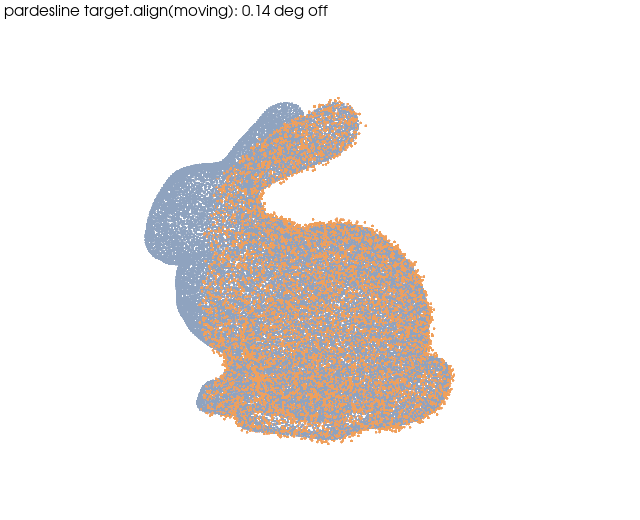 |
| rotation error 32.0°, fitness 0.98 (misleading: it counts pairs within 0.02, which the identity start already satisfies for the overlap), nearest-neighbour RMSE 7.1 mm | rotation error 0.14°, inlier RMSE 0.9 mm, nearest-neighbour RMSE 1.4 mm (the noise floor) |
What the one call sets, and why:
voxel_size = 0→ 1.3 % of the bounding-box diagonal: the feature scale follows the object, not a hard-coded 0.05 m that is wrong for a 15 cm bunny and for a 15 m facade alike.distance_threshold_factor = 1.5 × voxel: RANSAC accepts a correspondence within one and a half cells; tighter rejects true matches on noisy scans, looser lets outliers in.- RANSAC on FPFH first, ICP second: ICP alone is a local optimiser and needs a start within a few degrees; a 35° offset is outside its basin, which is why the textbook call stops where it started.
icp_estimation_method = point_to_plane,icp_threshold_factor = 1.5 × voxelthenrefine_threshold_factor = 0.4 × voxel: coarse to fine, so the last iterations are not pulled by the 30 % of points that have no counterpart.- Every value is in the sidecar
aligned.provenance[-1]["params"], andpl.describe("registration.ransac_icp_pipeline")prints the ranges to override them.
Numbers come from examples/icp_registration_bunny/run.py (result.json is committed next to the images). The written proof for every algorithm family, failure mode by failure mode, is the docs page Why our defaults work.
Validated on real cases
| Use case | Domain | Data characteristics | Algorithm | What the defaults handle | Example |
|---|---|---|---|---|---|
| Multimodal head registration | medical imaging | CT 0.65 mm × 4 mm slices vs MR 1.25 mm × 4 mm, different fields of view | simpleitk_registration.rigid |
anisotropic spacing, intensity ranges that do not match (mutual information), initial offset of 40 mm | register_ct_mr_rire |
| Second scan of a part | industrial 3D scanning (public stand-in) | partial overlap 70 %, 0.5 % noise, unknown pose | registration.ransac_icp_pipeline |
scale-free feature radius, global init, coarse-to-fine ICP | icp_registration_bunny |
| Organ surface from a label map | medical imaging | 1 mm isotropic MRI label map, two labels | LabelMap.to_mesh + Taubin smoothing |
exact label boundary in LPS mm, voxel staircase removed without shrinking | hippocampus_mask_to_mesh |
| Street scene from a LiDAR sweep | automotive LiDAR | 120 000 points, headerless (N, 4) binary, ground plane tilted |
lidar_scene_detection.object_clustering |
layout from the manifest, RANSAC ground at 0.3 m, DBSCAN 0.5 m | kitti_lidar_ground_and_objects |
These run on public data that stands in for the industrial and medical scans the defaults were tuned on. Real cases from users are collected in examples/real_cases/: a template and a tracking issue, so that every claim on this page stays reproducible.
How it compares
pardesline is the dataset layer and the domain-level API on top of these libraries, not a replacement: it calls Open3D, PyVista, VTK and SimpleITK and hands you their objects. Each cell is checked against the project's own documentation; corrections are welcome as issues.
| pardesline | Open3D | PyVista | SimpleITK | trimesh | MONAI | TorchIO | HF datasets | |
|---|---|---|---|---|---|---|---|---|
| One-line access to public 3D / medical datasets | 43 manifests: MSD, TCIA, Zenodo, S3, Hugging Face, OpenNeuro, KITTI | demo meshes and fragments (open3d.data) |
example meshes and volumes (pyvista.examples) |
notebook data fetcher | no | DecathlonDataset, TciaDataset, MedNISTDataset |
IXI, EPISURG and other medical sets | any Hub repo, files untyped |
| Point clouds, meshes and volumes in one object | yes, plus splats and raw arrays | points, meshes, voxel grids | meshes, grids, volumes | volumes | meshes | volumes (tensors) | volumes | no |
| Standardization (frame, units, labels, spacing) | manifest + sidecar, never guessed | no | no | header-aware | no | transforms (Spacingd, Orientationd) |
transforms (Resample, ToCanonical) |
no |
| Licence and provenance attached to the data | yes | no | no | no | no | no | no | licence field on the card |
| High-level, domain-vocabulary API | align, segment, to_mesh, clean, scan |
algorithm names | VTK filter names | ITK filter names | geometry names | transforms and bundles | transforms | no |
| Defaults tied to the data scale | voxel from bounding box, thresholds as multiples | fixed numbers in calls | filter defaults | filter defaults | n/a | per bundle | per transform | n/a |
| Validated on real industrial / medical data | public stand-ins + examples/real_cases/ mechanism |
tutorials | gallery | notebooks | tests | model zoo benchmarks | papers | n/a |
| Classical 3D algorithms | 73 (through the libraries) | yes | yes | yes | yes | some (via ITK/MONAI transforms) | no | no |
| One-line pretrained model access | roadmap (model registry) | Open3D-ML weights | no | no | no | Model Zoo bundles | no | via transformers |
| Local MCP server for AI agents | 14 tools, 20 skills | no | no | no | no | no | no | no |
| Licence | Apache-2.0 | MIT | MIT | Apache-2.0 | MIT | Apache-2.0 | Apache-2.0 | Apache-2.0 |
Full page with the sources of each cell: docs comparison.
Examples gallery
Each folder is one self-contained script that downloads what it needs, runs, and writes its images next to itself. Titles follow <algorithm or model> on <dataset>. Run any of them with python examples/<folder>/run.py.
SimpleITK rigid registration on RIRE CT fixed, MR T1 moving, 21 s cold |
RANSAC + ICP on the Stanford bunny textbook ICP vs one call, with numbers |
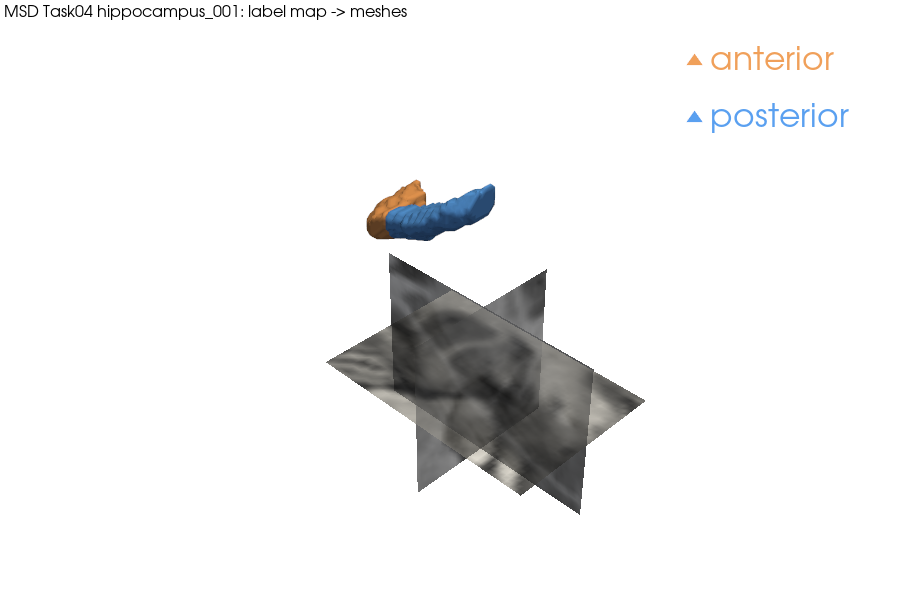 Label map to mesh on MSD hippocampus exact boundaries, Taubin smoothing, STL + sidecar |
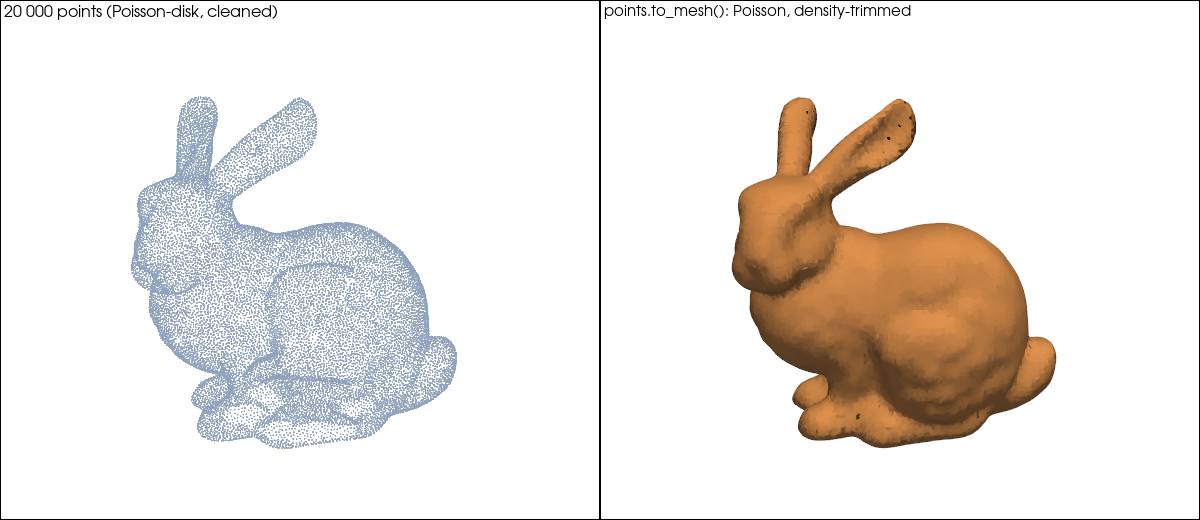 Poisson reconstruction on the Stanford bunny sample, clean, rebuild a surface |
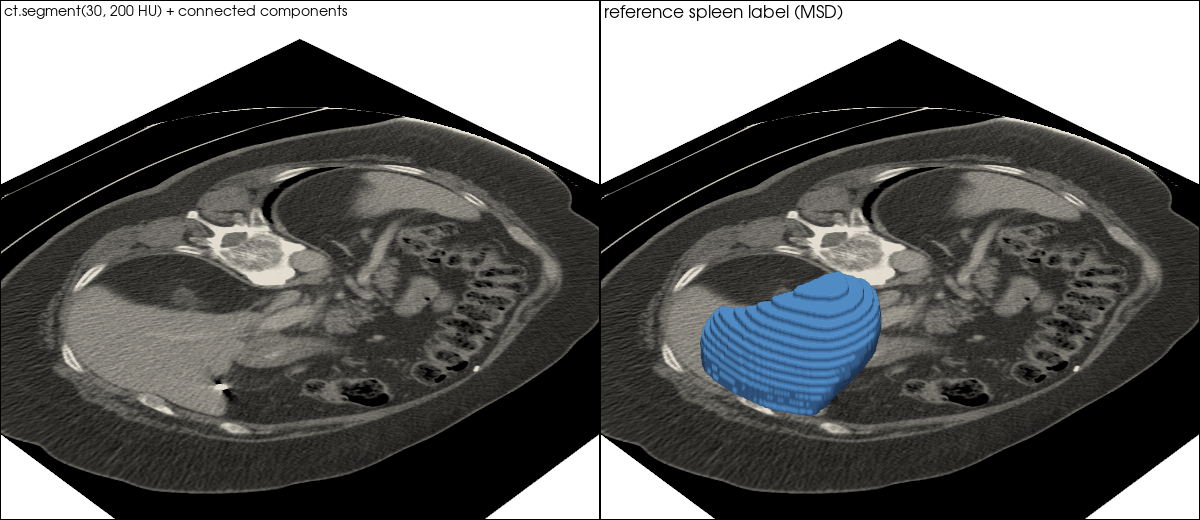 Threshold segmentation on MSD spleen the honest baseline a model has to beat |
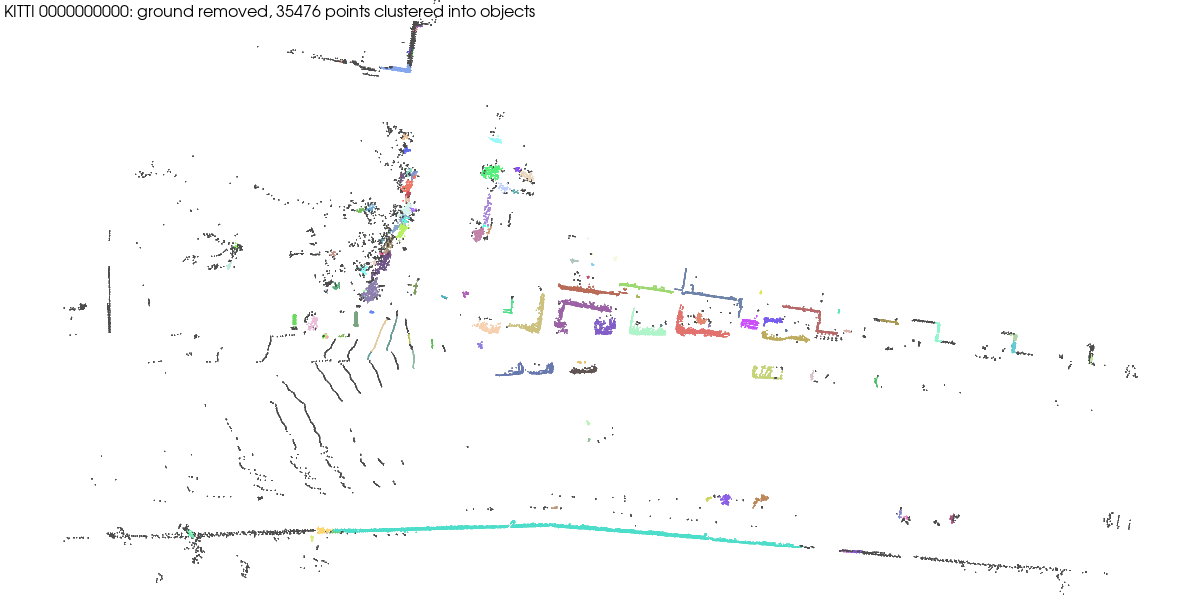 Ground removal + clustering on KITTI one 2 MB sweep out of a 459 MB zip |
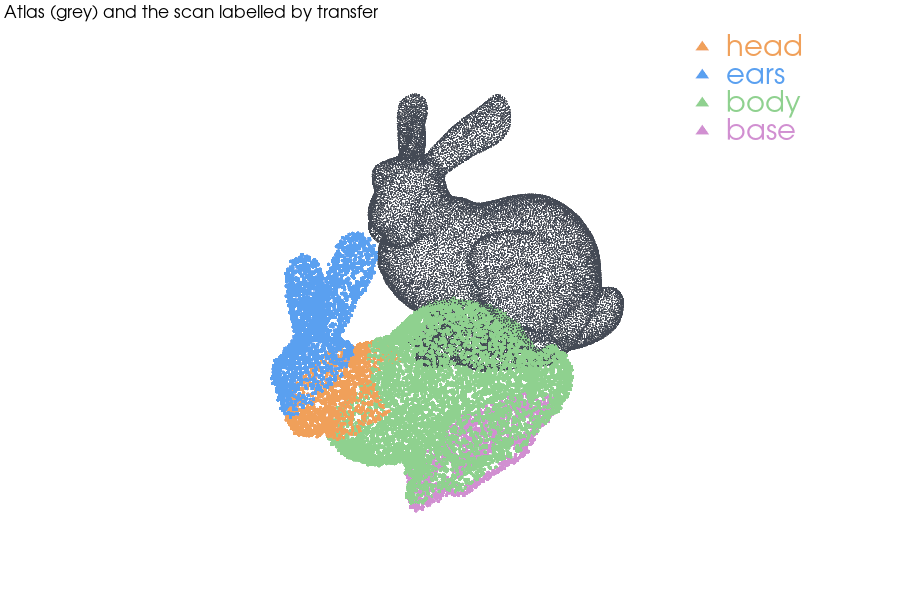 Atlas label transfer on the Stanford bunny register a labelled atlas, transfer labels: 99.4 % agreement |
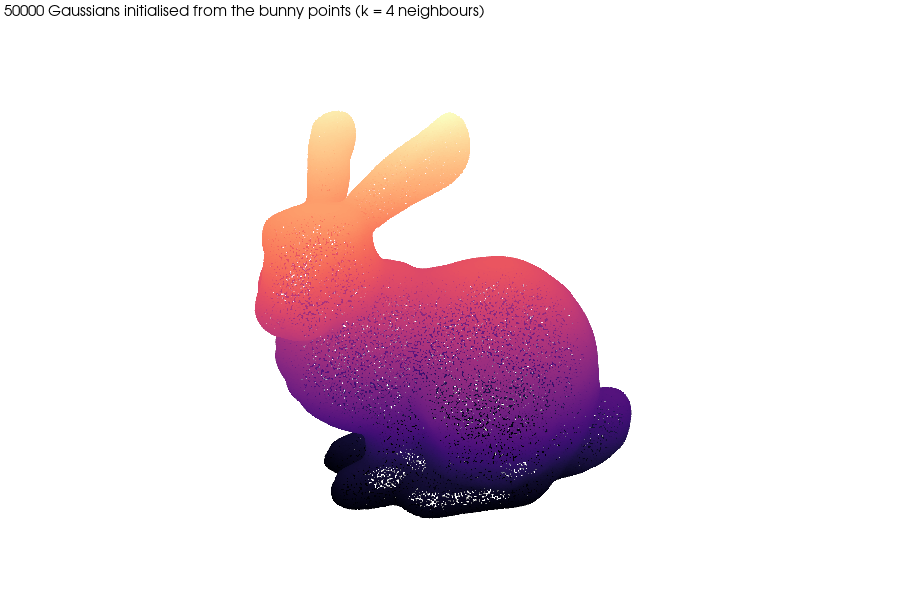 Gaussian splats on the Stanford bunny 50 000 points to a 3DGS PLY that opens in gsplat |
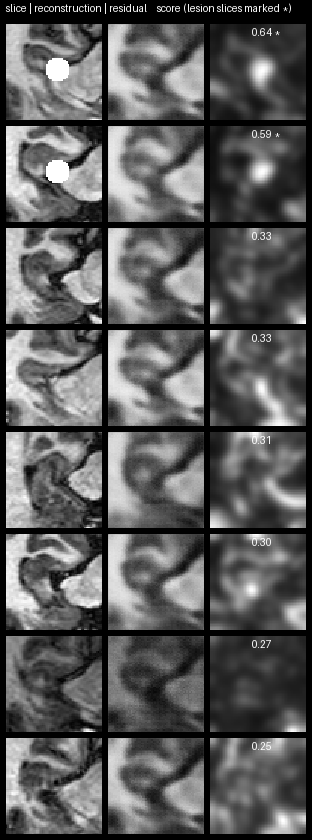 VAE anomaly detection on MSD hippocampus slices lesion slices score 0.59 and 0.64, normals at most 0.33 |
| PointNet on MSD hippocampus 40 cases, 40 epochs on CPU: 0.97 mIoU anterior / posterior |
3D JEPA on MSD hippocampus self-supervised pretraining, laptop-sized |
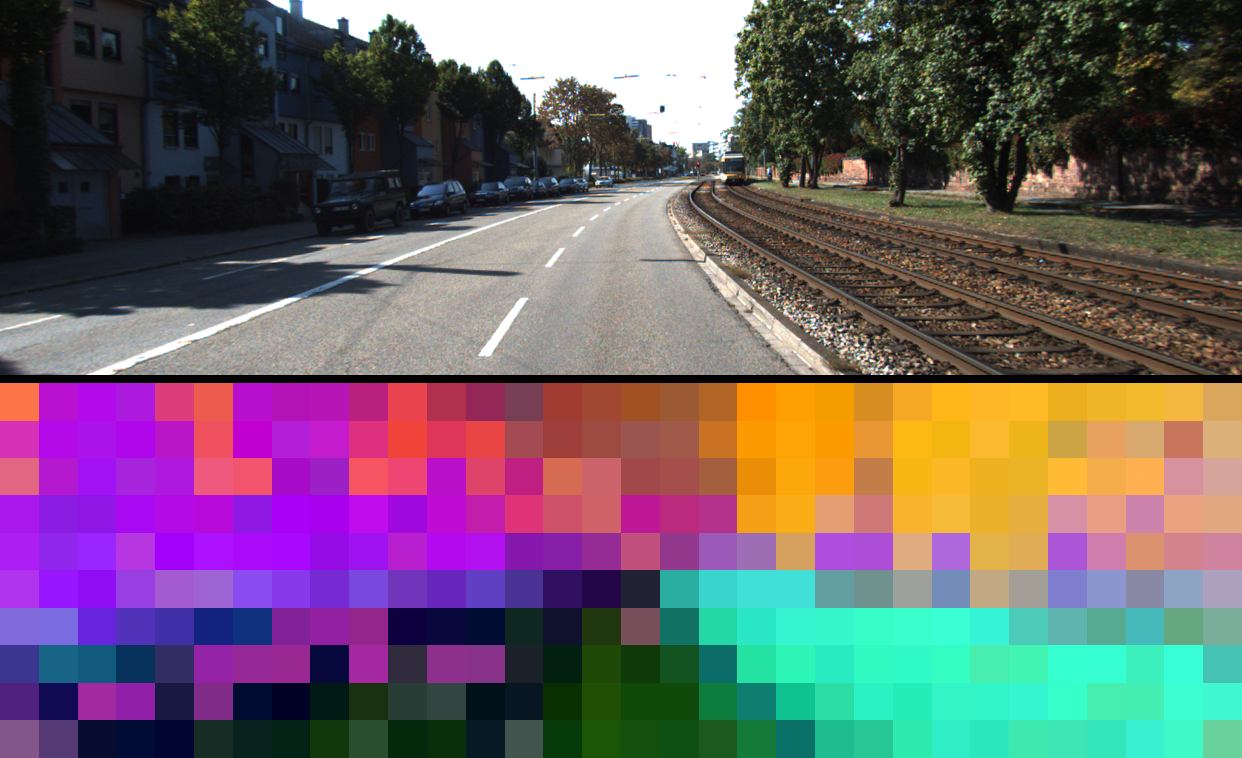 DINOv2 / DINOv3 features on KITTI frozen backbone, PCA-coloured patch features |
Also: Dice / HD95 between three radiologists on the liver tumour CT (0.82 to 0.85 Dice, 2.5 mm HD95: the inter-observer ceiling). The PyTorch examples need pip install torch (CPU is enough); DINOv3 weights need the licence accepted on the Hub, DINOv2 does not. Index and expected runtimes: examples/README.md.
🤖 MCP: give it to an AI agent
pip install "pardesline[mcp]"
claude mcp add pardesline -- pardesline mcp        # Claude Code; Claude Desktop, Cursor, Gemini CLI, Codex: {"command": "pardesline", "args": ["mcp"]}
The server exposes the datasets, the algorithms, the object model and the twenty skills as tools: list_datasets, describe_dataset, list_samples, load_sample, scan_dataset, confirm_dataset, export_dataset, list_methods, describe_method, run_method, describe_object, to_mesh, list_skills, get_skill. An agent can browse the catalog, fetch one sample, run a pipeline, read the expert guide for the method it is about to use, and export standard files. Questions the package will not guess (licence, units, array layout) come back as JSON for the agent to relay to the human. No account, nothing leaves the machine. Client configurations and the full contract: docs/mcp.md.
Roadmap
Vote with 👍 on the tracking issue; comment with your dataset, model or use case.
- Model registry: one-line access to pretrained 3D and medical models (DINOv3, SAM-3D-style segmenters, JEPA encoders, PointNet, segmentation nets) through a model manifest (source, weights URI, licence, input type, task, memory needs, provenance) and
pl.load_model(...)/pl.run(model, dataset), the same pattern as datasets. Tracking issue - Gaussian splats as a first-class kind (
Splat: load, render, convert to points, metrics). Tracking issue - More datasets: BraTS (behind the user's Synapse credentials), VerSe 2020, the remaining public TCIA collections, ModelNet / ShapeNet / ScanNet once their gating can be honoured. Datasets wanted
- Models wanted: model manifests contributors can write before the runner exists. Models wanted
- Benchmarks: package defaults vs upstream defaults on the bundled data, numbers regenerated by CI. Tracking issue
- A pardesline organisation on Hugging Face mirroring the permissive datasets with
pip install pardeslineas the documented loader. Tracking issue - Deformable registration and TotalSegmentator-class segmentation behind the same calls (
align(mode="deformable"),segment(model=...)). Tracking issue
Community and contributing
- Questions and show-and-tell: GitHub Discussions.
- Bugs and requests: issues, with templates for bugs, features, dataset requests and algorithm or model requests.
- First contribution: good first issues, most of them "add dataset X" or "add algorithm Y" with a template to copy.
- How to set up, test, add a dataset, an algorithm or a model: CONTRIBUTING.md. Code of conduct: CODE_OF_CONDUCT.md. Security: SECURITY.md.
Citation
If pardesline helps your research, cite it (CITATION.cff, also behind the "Cite this repository" button):
@software{tabet_pardesline_2026,
  author  = {Tabet, Jonathan},
  title   = {pardesline: 3D vision and medical imaging in one Python package},
  year    = {2026},
  version = {0.2.0},
  url     = {https://github.com/pardesline/pardesline},
  license = {Apache-2.0}
}
Cite the datasets you use as well: ds.citation returns the reference the data owner asks for.
Acknowledgements and licence
pardesline stands on Open3D, PyVista and VTK, SimpleITK, NumPy, SciPy, scikit-image, pycpd, httpx, pydantic, loguru, huggingface_hub and the MCP Python SDK. The datasets belong to their authors and institutions; every manifest carries the citation they ask for and the licence they state.
Apache License 2.0 for the package; see LICENSE and NOTICE. Datasets keep their own licences: ds.describe() prints them.
Reviews (0)
Sign in to leave a review.
Leave a reviewNo results found