ariadne
Health Pass
- License — License: MIT
- Description — Repository has a description
- Active repo — Last push 0 days ago
- Community trust — 11 GitHub stars
Code Fail
- os.homedir — User home directory access in skills/obsidian-agentic-vault/scripts/register_vault.js
- fs module — File system access in skills/obsidian-agentic-vault/scripts/register_vault.js
- child_process — Shell command execution capability in skills/obsidian-agentic-vault/test/test_register_vault.js
- spawnSync — Synchronous process spawning in skills/obsidian-agentic-vault/test/test_register_vault.js
- fs module — File system access in skills/obsidian-agentic-vault/test/test_register_vault.js
Permissions Pass
- Permissions — No dangerous permissions requested
No AI report is available for this listing yet.
Agent skill package for building Obsidian vaults that AI agents can navigate, maintain, and operate reliably
Ariadne
In Greek myth, Ariadne gives Theseus the thread that lets him navigate the labyrinth.
Ariadne gives AI agents a thread through a complex knowledge labyrinth.
An agent skill package for building Obsidian vaults that AI agents can navigate, maintain, and operate reliably. Works with Claude Code, Codex CLI, and any agent runtime that supports the skills protocol.
The core pattern: humans choose what enters, agents compile raw material into a linked wiki, Obsidian is the readable frontend, and Bases are live query views over the Markdown source of truth.
flowchart TD
  Human(["👤 Human\nRaw · Inbox · Brain dumps"])
  Agent(["🤖 AI Agent\nClaude Code · Codex CLI"])

  subgraph Vault["Vault"]

    subgraph OG["Operating Graph"]
      OP["AGENTS.md · Agent Navigation\nTask Routing Matrix · Workflows"]
    end

    subgraph Scopes["Recursive Scope Tree"]
      ROOT["Root — global policy"]
      D1["Domain A\n└ local AGENTS.md (delta only)"]
      D2["Domain B\n└ local AGENTS.md (delta only)"]
      ROOT --> D1 & D2
    end

    subgraph KG["Knowledge Graph (per scope)"]
      K["Research · Concepts · Entities\nRelationships · Decisions · Questions"]
    end

    subgraph VL["View Layer"]
      B["Bases — live .base queries"]
      V["Validator — 11 structural checks"]
    end

  end

  Human -->|"obsidian-research-ingest\nobsidian-ingest-compile\nobsidian-research-synthesis"| KG
  Agent -->|enters via| OG
  OG -->|"routes to smallest\nrelevant context"| Scopes
  Scopes --> KG
  KG --> B
  V -.->|structural guarantee| Vault
  B -.->|surfaces gaps| Human
In Practice
This is Satyam's vault after several months of active use — research threads, five active project scopes, a published essay scope, and the agent operating graph all wired together.
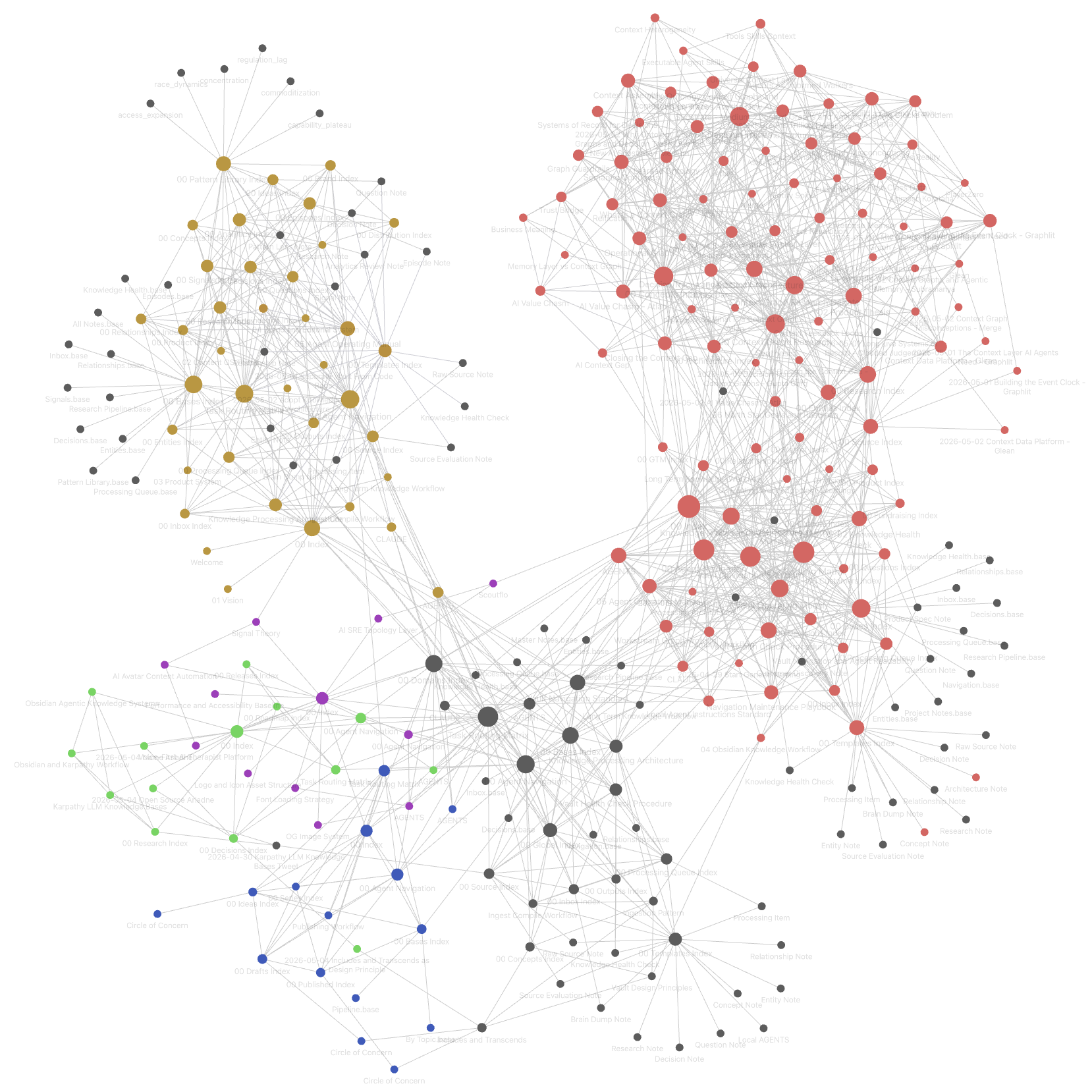
Each color cluster is a scope. The large hub nodes with many edges are the agent navigation files (00 Index.md, Agent/00 Agent Navigation, routing matrices). The graph shows what the scope model looks like when it's actually running: dense within boundaries, connected across them through deliberate navigation links.
Requirements
- Obsidian installed, with filesystem access to the target vault.
- Obsidian Bases enabled in the vault (Settings -> Core plugins -> Bases) if you want the
.baseview files to render inside Obsidian. - Node.js with
npm/npxavailable for installing skills and running the bundled validator and vault-registration scripts. - A skills-capable agent runtime, such as Claude Code, Codex CLI, or another runtime that supports the skills protocol.
- Recommended companion pack: kepano/obsidian-skills, which provides Obsidian mechanics skills such as Markdown, Bases, JSON Canvas, clean Markdown extraction, and Obsidian CLI interaction.
Install the companion Obsidian skills first when your agent does not already have equivalent Obsidian mechanics skills:
npx skills add https://github.com/kepano/obsidian-skills \
  --global \
  --agent '*' \
  --copy \
  --yes
Ariadne itself has no package install step and no external npm dependencies. Its scripts use only built-in Node.js modules.
Install
Install for all supported agents (Claude Code, Codex CLI, and others):
npx skills add https://github.com/pariyar07/ariadne \
  --global \
  --agent '*' \
  --copy \
  --yes
Install for a specific agent:
# Claude Code
npx skills add https://github.com/pariyar07/ariadne \
  --global \
  --agent claude-code \
  --copy \
  --yes

# Codex CLI
npx skills add https://github.com/pariyar07/ariadne \
  --global \
  --agent openai \
  --copy \
  --yes
List available skills:
npx skills add https://github.com/pariyar07/ariadne --list
Skills
Start with obsidian-agentic-vault to bootstrap a new vault. All other skills operate on an existing vault.
| Skill | Purpose |
|---|---|
obsidian-agentic-vault |
Start here — Bootstrap a new agent-ready vault with folders, navigation, templates, and Bases |
obsidian-vault-discovery |
Register existing Obsidian vaults so cold agents can find them from any workspace |
obsidian-scope-manager |
Create, promote, import, and nest durable knowledge scopes |
obsidian-navigation-architect |
Design hubs, routing, workstream graphs, templates, and view layers |
obsidian-ingest-compile |
Turn links, documents, and brain dumps into durable wiki notes |
obsidian-research-ingest |
Cold-start research source ingest into the right scope |
obsidian-research-synthesis |
Synthesize multi-source research threads and debate hubs |
obsidian-research-pipeline |
Add research intake and synthesis infrastructure inside an existing scope |
obsidian-vault-maintainer |
Run health checks and repair navigability drift |
obsidian-vault-validator |
Deterministic structural validation — 11 checks, zero-warnings target |
What's Coming
Ariadne's next direction is cross-domain synthesis and feedback loops.
Today, Ariadne helps agents enter a vault, find the right scope, ingest research, maintain hubs, and validate structure. The next layer is helping agents notice when knowledge in one domain should affect another domain, then returning those connections to the user as useful output.
Planned areas of exploration:
- cross-domain synthesis across scope-level research hubs
- explicit relationship notes for connections between domains
- recurring daily or weekly vault briefs
- stale question resurfacing
- contradiction review across old decisions, beliefs, and newer synthesis
The design constraint stays the same: agents should not need to read the whole vault to be useful. They should follow explicit routes, compare durable syntheses, write back meaningful connections, and keep the Markdown vault as the source of truth.
How It Works
Three Layers
Every vault created with Ariadne has three layers:
- Knowledge Graph — research, concepts, entities, relationships, decisions, and domain workstreams
- Operating Graph — agent instructions (
AGENTS.md), routing matrices, workflows, intake queues, and templates - View Layer — Bases (
.basefiles), canvases, and dashboards as live queries over the Markdown source of truth
Recursive Scope Model
The vault is a tree of scopes, not a flat folder. The root scope owns global policy. Each child scope inherits parent rules and adds only local deltas.
Vault root (global policy)
├── Agent/            ← global routing and workflows
├── Bases/            ← global view layer
├── Domains/
│   ├── Alpha/        ← child scope (inherits root)
│   │   ├── AGENTS.md ← local deltas only
│   │   ├── Agent/    ← local routing
│   │   └── Bases/    ← scoped views
│   └── Beta/         ← another child scope
Navigation Layers
Agents navigate through a layered structure — no cold reading of raw notes:
00 Index.md               → strategic map
Agent/00 Agent Navigation → routing map
Agent/Task Routing Matrix → task entry selector
Folder hubs               → detailed local maps
Thread hubs               → deep synthesis notes
Bases                     → dynamic inspection layer
Wikilink Resolution
Navigation files (AGENTS.md, 00 Index.md, Agent/) always use path-qualified wikilinks so agents arriving cold have zero ambiguity. Content notes may use bare links because agents always arrive via a qualified navigation file, never cold.
The validator resolves wikilinks to real vault files, including Markdown notes, Base files, Canvas files, and attachments. Orphan checks remain Markdown-only.
Validation
Run the validator from a vault root:
node /path/to/skills/obsidian-vault-validator/scripts/validate_vault.js "/path/to/vault"
A healthy vault reports all zeros:
yaml-ok
broken-wikilinks: 0
true-orphans-md: 0
unlinked-base-files: 0
bloat-warnings: 0
local-base-scope-warnings: 0
local-agents-inheritance-warnings: 0
ambiguous-wikilink-warnings: 0
scope-navigation-warnings: 0
routing-matrix-warnings: 0
base-scope-formula-warnings: 0
See docs/guides/validator.md for the full counter reference.
Guides
| Guide | Contents |
|---|---|
docs/guides/quickstart.md |
Full usage guide — every skill, every scenario, cold-start phrases, skill chains, and common mistakes |
docs/guides/global-discovery.md |
Optional machine-level vault registration so cold agents can find local vaults from any folder |
docs/guides/validator.md |
Validator counter reference |
Global Discovery
After bootstrapping a vault, Ariadne can optionally register the vault on the user's machine. For existing vaults, use obsidian-vault-discovery.
node skills/obsidian-agentic-vault/scripts/register_vault.js \
  --vault "/path/to/vault" \
  --name "My Knowledge Vault" \
  --purpose "Long-term project and research knowledge." \
  --agents codex,claude,gemini \
  --primary
This creates ~/.ariadne/vaults.json and ~/.ariadne/vaults.md, then adds a small marker-managed discovery block to selected global agent instruction files. The block points agents to the registry; it does not copy the whole vault context.
Use this when you want future cold agent sessions, launched from any folder, to find the vault quickly for vague questions about prior projects, meetings, research, decisions, or "what was I working on?"
References
All reference docs live under skills/obsidian-agentic-vault/references/:
| Reference | Contents |
|---|---|
vault-operating-model.md |
How the three layers interact |
vault-modes.md |
Single-scope vs multi-scope vault patterns |
vault-structure.md |
Folder conventions and filing rules |
maintenance.md |
Health check and repair procedures |
knowledge-processing-architecture.md |
Intake → compile → link → index pipeline |
recursive-scopes.md |
Scope inheritance, wikilink resolution, child scope patterns |
bases-scope-patterns.md |
Base filter patterns and scope formula conventions |
Contributing
See CONTRIBUTING.md. Issues and PRs welcome — please read the contributing guide before opening either.
License
MIT
Reviews (0)
Sign in to leave a review.
Leave a reviewNo results found