local-code-tutor
Health Pass
- License — License: MIT
- Description — Repository has a description
- Active repo — Last push 0 days ago
- Community trust — 23 GitHub stars
Code Fail
- eval() — Dynamic code execution via eval() in ds/eval_set.py
Permissions Pass
- Permissions — No dangerous permissions requested
No AI report is available for this listing yet.
Fine-tune Qwen2.5-Coder-7B for free (QLoRA on Kaggle T4) and run a local coding agent that runs your code instead of guessing — 8 GB Mac, llama.cpp, LoRA weight analysis with charts
Local Code Tutor
Fine-tune Qwen2.5-Coder-7B for free and run a coding agent that runs your code instead of guessing — on an 8 GB MacBook






Execution-verified training data · QLoRA on a free GPU · GGUF on Apple Silicon · agent with measured fixes for 7B failure modes · LoRA/weight analysis with charts
Goal · At a glance · Results · Quick start · How it works · Lessons learned · Roadmap · Русская версия
Goal
Give every student a private, free code tutor that runs on their own laptop — and never states
something about code that it hasn't checked.
A 2nd-year student shouldn't need a paid cloud subscription to get a patient explanation of why
their code behaves the way it does. This project aims to show that a 7B model on an 8 GB laptop
can be that tutor — if the system around it is built so the model doesn't have to guess:
- Explain, don't paraphrase — name the language mechanism, show why step by step, point out the
trap, give the fix. In the student's own language. - Verify, don't guess — outputs, errors and "is it done?" come from running code, never from the
model's memory. - Go beyond toy snippets — whole programs ("how does this system work?"), data analysis
(pandas, SQL, dashboards) and looking inside neural networks with charts. - Reproducible for $0 — a recipe anyone can repeat: free GPU for training, local inference, every
decision and measurement documented.
Definition of done for v1.0 — each item is measurable with the tools in this repo:
| Goal | Target | Now |
|---|---|---|
| Key facts on held-out questions | ≥ 15 / 18 | 13 / 18 |
| Agent asks instead of guessing on vague requests | 4 / 4 | ✅ 4 / 4 |
| "What will this print?" answered from a real run | 100 % | ✅ 2 / 2 |
| Multi-file tasks finished by the plan, not by luck | 4 / 4 hard tasks | measuring |
| Verified examples, incl. Java, SQL analytics, PyTorch | ≥ 2,000 | 954 |
| Runs fully offline on a MacBook Air M2 8 GB | yes | yes |
Non-goals: competing with frontier cloud models on large refactors or deep reasoning; being a
general-purpose chatbot. The target is narrow on purpose — understanding code you're learning from.
At a glance
|
Release
|
Tested with
|


| Metric | Value |
|---|---|
| Verified training examples | 900+ and growing (target ≈ 2,600) across 20+ categories |
| Held-out key facts, base → v2 → v3 | 8 / 18 → 9 / 15 → 13 / 18 (details) |
| Agent failure mode #8 "guesses instead of asking" | 1 / 4 → 4 / 4 on real Qwen2.5-Coder-7B |
| Agent failure mode #4 "can't run code in its head" | 0 / 1 → 2 / 2 on real Qwen2.5-Coder-7B |
| Cost | $0 — free Kaggle GPU, local inference |
Small local models are great at sounding right. Ask a 7B model "what does this print?" and it will
confidently invent the output. This project is built around one rule:
The model never guesses what code does. Something always runs it.
| Where | How the rule is enforced |
|---|---|
| Training data | Every example is executed (Python, JS, C/C++, Java, SQLite). If the answer disagrees with the real output, the example is dropped. Near-duplicates are caught by comparing code skeletons (identifiers → ID, literals → S/N). |
| Agent | When you ask "what will this print / why does it crash", the loca agent shows the model the source and runs it before the model answers. Unsafe code (deletes files, network, input()) is never auto-run. |
| Evaluation | 18 held-out questions that never appear in training, scored automatically on key facts. |
Everything below runs on a MacBook Air M2 with 8 GB RAM; training uses the free Kaggle T4.
flowchart LR
  A[LLM writes candidate<br/>examples] --> B[run every snippet<br/>compare real output<br/>skeleton dedup]
  B --> C[verified dataset]
  C --> D[QLoRA on free<br/>Kaggle T4 · Unsloth]
  D --> E[GGUF Q4_K_M<br/>4.4 GB]
  E --> F[llama.cpp / Ollama<br/>8 GB Mac]
  F --> G[loca agent]
  H[weights tools<br/>stats · diff · LoRA · quant] -- MCP --> G
Results
All numbers are measured, including the ones that didn't go my way.
1. Fixing 7B failure modes inside the agent
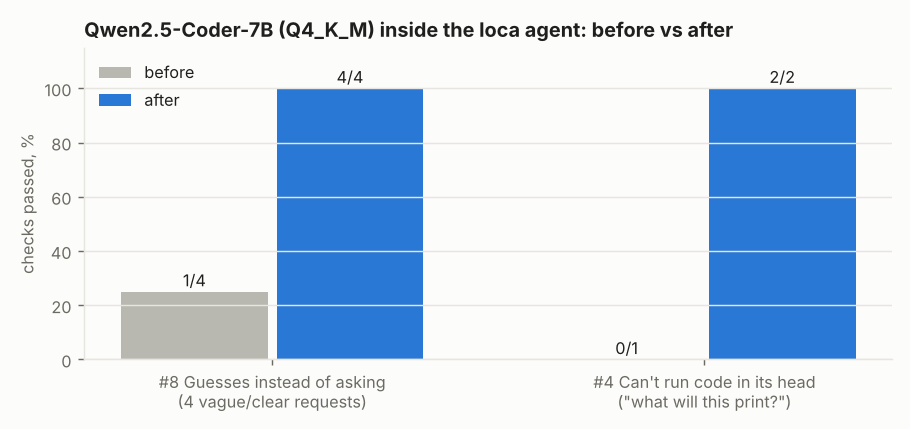
Measured on the real thing: Qwen2.5-Coder-7B-Instruct Q4_K_M in llama-server, with a probe
harness that runs the same requests before and after each fix (bench/probe.py in loca).
- #8 "Guesses instead of asking" — 1/4 → 4/4. On vague requests ("add promo codes") the model
invented a goal and even marked existing files as "(new)". Fix: a task spec step (goal, files,
constraints, a runnable done-check, assumptions, questions) plus deterministic post-checks that don't
trust the model — paths are verified against the disk, and a vague request with no questions gets one.
Now the model itself asks: which promo codes, where are they stored, how do they affect the total? - #4 "Can't execute code in its head" — 0/1 → 2/2. A "run it first" reminder was simply ignored:
asked abouttricky.py, the model replied "that file doesn't exist" without calling a single tool.
Fix: the agent runs the code itself and puts the source + real output in context before the model speaks.
2. Fine-tuning: v2 learned the form, v3 started getting the facts
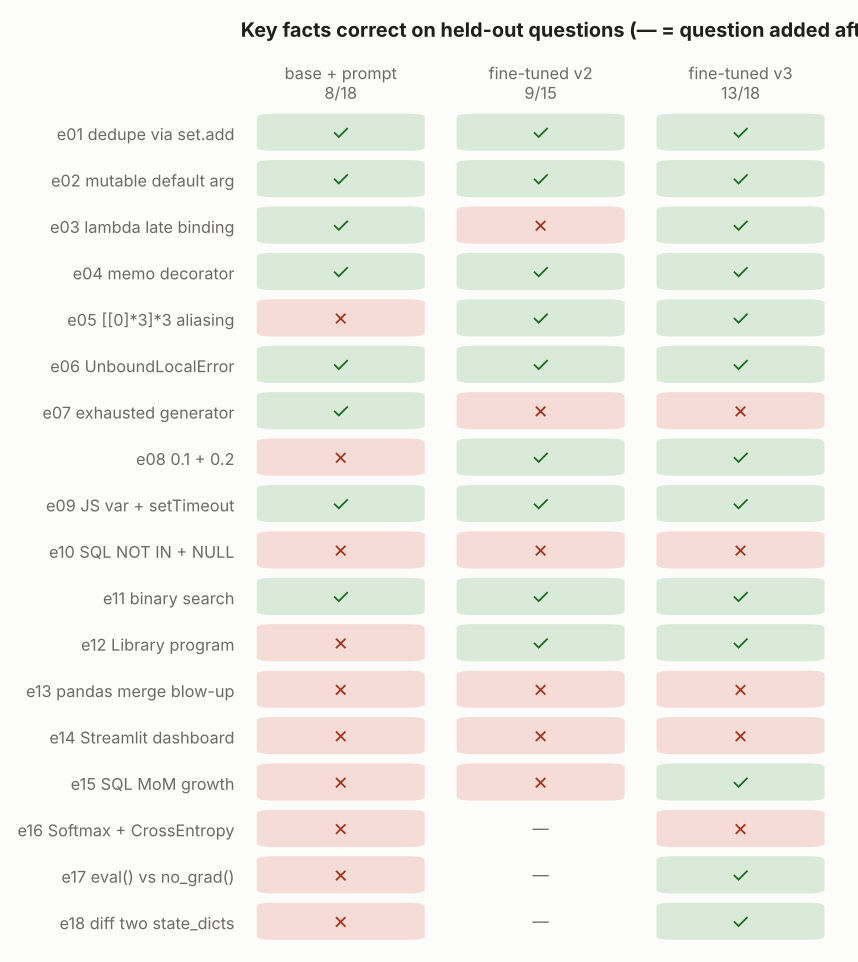
| base + prompt | v2 (762 examples) | v3 (954 examples) | |
|---|---|---|---|
| Key facts, 18 held-out questions | 8 / 18 | 9 / 15* | 13 / 18 |
* v2 was evaluated before PyTorch questions e16–e18 were added.
v2 answered exactly in the target style (verdict first, precise mechanism, fixed code) — but
confidently invented outputs: [3, 3, 3] instead of [2, 2, 2], "6" instead of 14. v3 added
pandas, SQLite analytics, PyTorch and weight-analysis examples: late binding is now right, the SQL
answer uses SQLite's STRFTIME + LAG, the PyTorch questions pass. It still can't do arithmetic in
its head (e07, e13) — which is exactly why the agent runs code instead of trusting the model.
Details: docs/RESULTS.md.
3. Look inside the network — with charts
wtools/weights.py (CLI + MCP server, so the agent can call it):
| Command | What you learn |
|---|---|
inspect |
tensors, shapes, dtypes, memory at fp32 / fp16 / int8 / int4, biggest blocks |
stats |
per-layer scale, >6σ outliers, dead neurons, sparsity, weight histogram |
diff |
what fine-tuning changed: ‖ΔW‖/‖W‖ and cosine per layer and per module type |
lora |
ΔW = B·A·α/r per module, effective rank, energy in the top direction, spectrum — via QR on r×r, fast even for 7B |
quant |
int8/int4 error per layer: per-tensor vs per-row vs 32-block scales (the GGUF idea) |
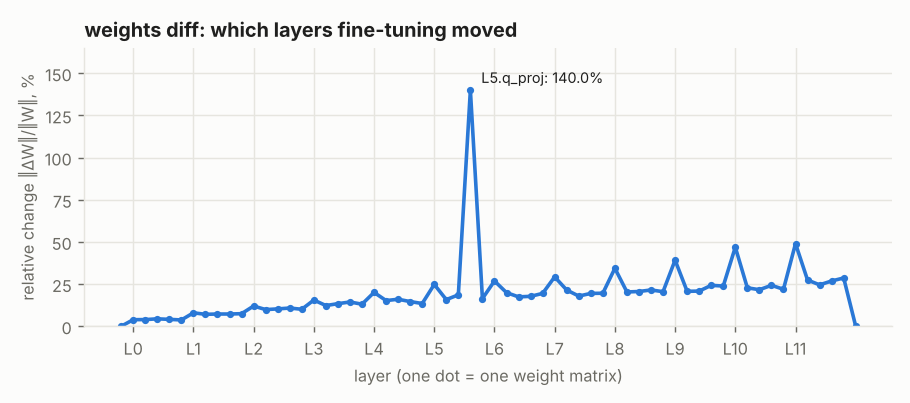
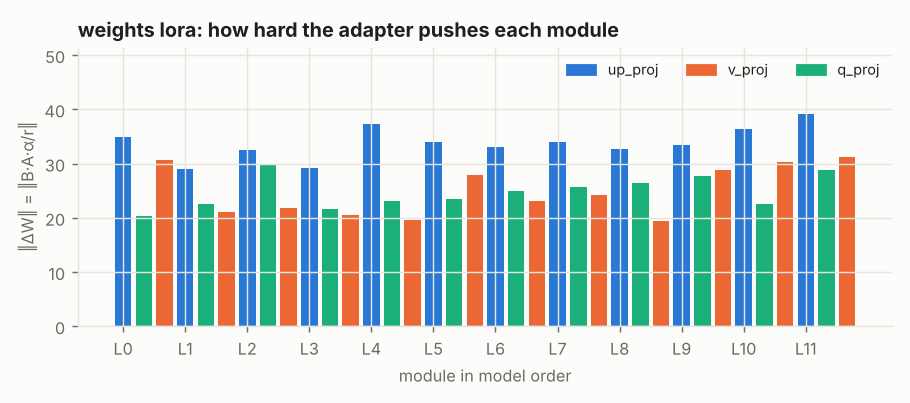
Toy model from the test suite. The agent can't see images, so every number on a chart is also
printed as text — the model explains the chart from the numbers.
Quick start
Analyze a LoRA adapter or a checkpoint (any PEFT adapter / safetensors / .pt):
pip install torch safetensors matplotlib
python3 wtools/weights.py lora   path/to/lora_adapter        # what did fine-tuning actually do?
python3 wtools/weights.py diff   base.safetensors tuned.safetensors
python3 wtools/weights.py quant  model.safetensors --bits 4
Fine-tune your own tutor on a free GPU: open kaggle_qwen_coder_finetune_v2.ipynb on Kaggle
(GPU T4 × 1), upload your explain_*.jsonl, Run All. You get a LoRA adapter, a held-out evaluation
and a Q4_K_M GGUF ready for llama.cpp / Ollama.
Build a verified dataset:
cd ds && ./ds.sh            # pick a topic → prompt goes to clipboard → paste the LLM's answer back
./ds.sh status              # coverage per category vs targets
./ds.sh build               # re-run everything, dedup, write the training file
Run it locally with the agent:
llama-server -m my-coder-v2-Q4_K_M.gguf --jinja -c 8192 -fa on -ctk q8_0 -ctv q8_0
loca --backend llamacpp                     # https://github.com/pnnnx/loca
python3 wtools/install_loca.py              # give the agent the weight-analysis tools
How it works
The dataset pipeline (ds/)
- A prompt with the category, topics, what is already covered and strict format rules goes to an
LLM (ChatGPT or Claude) via the clipboard. - The answer is parsed and every snippet is executed in a sandboxed temp dir (
runner.py). build.pyrejects an example if: the stated output doesn't match the real one, it crashes without
naming the exception, the "write code" answer doesn't contain the code, it's a skeleton-duplicate of
anything already accepted, it's too close to a held-out question, or it's too short / long / watery.- Rejections are turned into a "fix these" message for the same chat; accepted examples are committed
to git automatically with the rejection reasons in the commit message.
Training (kaggle_qwen_coder_finetune_v2.ipynb) — Unsloth QLoRA on Qwen2.5-Coder-7B-Instruct,
fp16 on T4, adamw_8bit, loss on responses only, half of the examples with a system prompt so the model
behaves the same with and without it; then automatic held-out eval and GGUF export.
The agent (loca) — a stdlib-only terminal coding agent
for small local models: repo map with signatures and tests per file, read-by-symbol, fuzzy edits, a
plan graph with executable acceptance checks and rollbacks, sub-agents, undo snapshots, hooks, MCP,
Ollama and llama.cpp backends. 98 tests.
Lessons learned
- A 7B model ignores polite reminders. "Run the code first" in the prompt changed nothing; doing it
deterministically in the harness fixed it. Prefer code paths over prompt paths for anything critical. - Fine-tuning teaches style long before facts. 762 examples were enough to change how the model
answers, not enough to make it right more often. Put the verdict after a short trace, not before. - Verify with execution, not with another LLM. A judge model says "looks correct"; a Python
process prints the truth. - Measure on the real model. Every fix that "obviously worked" in unit tests failed at least once on
the actual 7B before it was adjusted.
Roadmap
| Milestone | What | Status |
|---|---|---|
v0.1 |
verified dataset pipeline, held-out eval, model v1 | ✅ done |
v0.2 |
model v2, auto-scoring, agent fixes measured on 7B, wtools | ✅ done |
v0.3 |
model v3 (954 verified examples): 13/18 key facts, SQLite & PyTorch questions fixed | ✅ done |
v0.4 |
dataset ≈ 2,000+ (Java practice tasks, SQL analytics, PyTorch bugs), trace-then-verdict, persona mode | 🚧 in progress |
v0.3 |
agent plan reliability (#2): root cause found on 7B and fixed | ✅ done · end-to-end GPU run 🚧 |
v0.4 |
wtools: activations & attention via hooks, GGUF reader | 📋 planned |
v0.4 |
one-command local setup for Apple Silicon | 📋 planned |
See docs/PLAN.md for the full plan and CHANGELOG.md for what changed.
Contributing
Issues and PRs are welcome — especially new verified example categories, eval questions and
agent failure modes you've seen with small models. Start with CONTRIBUTING.md.
Security issues: see SECURITY.md.
Citation
If you use this in a write-up, there is a CITATION.cff (GitHub shows "Cite this repository").
Repository map
| Path | What |
|---|---|
ds/ |
dataset pipeline: ds.sh, tools/runner.py, build.py, dedup.py, score_eval.py, prompts |
ds/eval_set.py |
18 held-out questions + key-fact checks |
kaggle_qwen_coder_finetune_v2.ipynb |
QLoRA training → adapter + eval + GGUF |
loca_bench_kaggle_v2.ipynb |
agent benchmark + failure-mode probe on a GPU |
wtools/ |
weight analysis CLI, MCP server, tests |
docs/ |
plan, decisions, failure modes, results, a journal of every step |
results/ |
raw model answers on the held-out set |
The training data itself is not published: examples were generated with ChatGPT and Claude, whose
terms restrict using outputs to train models. The pipeline, checks and results are all here — point it
at your own generator.
FAQ
Does a 7B model really run on 8 GB? Yes: Q4_K_M is ~4.7 GB of RAM; use 4–8k context with a q8_0 KV cache.
Why does the model explain in Russian? That's the author's target audience. Nothing in the pipeline
is language-specific — change the prompts in ds/tools/gpt_data.json and the style checks in build.py.
How was this built? By a 2nd-year applied-math student, together with an AI assistant (Claude) —
you'll see it in the commit trailers. Decisions, measurements and dead ends are documented in docs/.
Acknowledgements
Qwen2.5-Coder (Apache 2.0) ·
Unsloth · llama.cpp ·
Ollama · free GPUs from Kaggle
License
MIT — see LICENSE. If this saved you some GPU hours, a ⭐ helps others find it.
Reviews (0)
Sign in to leave a review.
Leave a reviewNo results found