google-play-cli
Health Warn
- License — License: MIT
- Description — Repository has a description
- Active repo — Last push 0 days ago
- Low visibility — Only 5 GitHub stars
Code Fail
- rm -rf — Recursive force deletion command in .github/workflows/ci.yml
Permissions Pass
- Permissions — No dangerous permissions requested
No AI report is available for this listing yet.
gplay: publish to Google Play from CI or a coding agent. One static binary, JSON output that mirrors the Play Developer API verbatim, semantic exit codes. Replaces Fastlane supply.
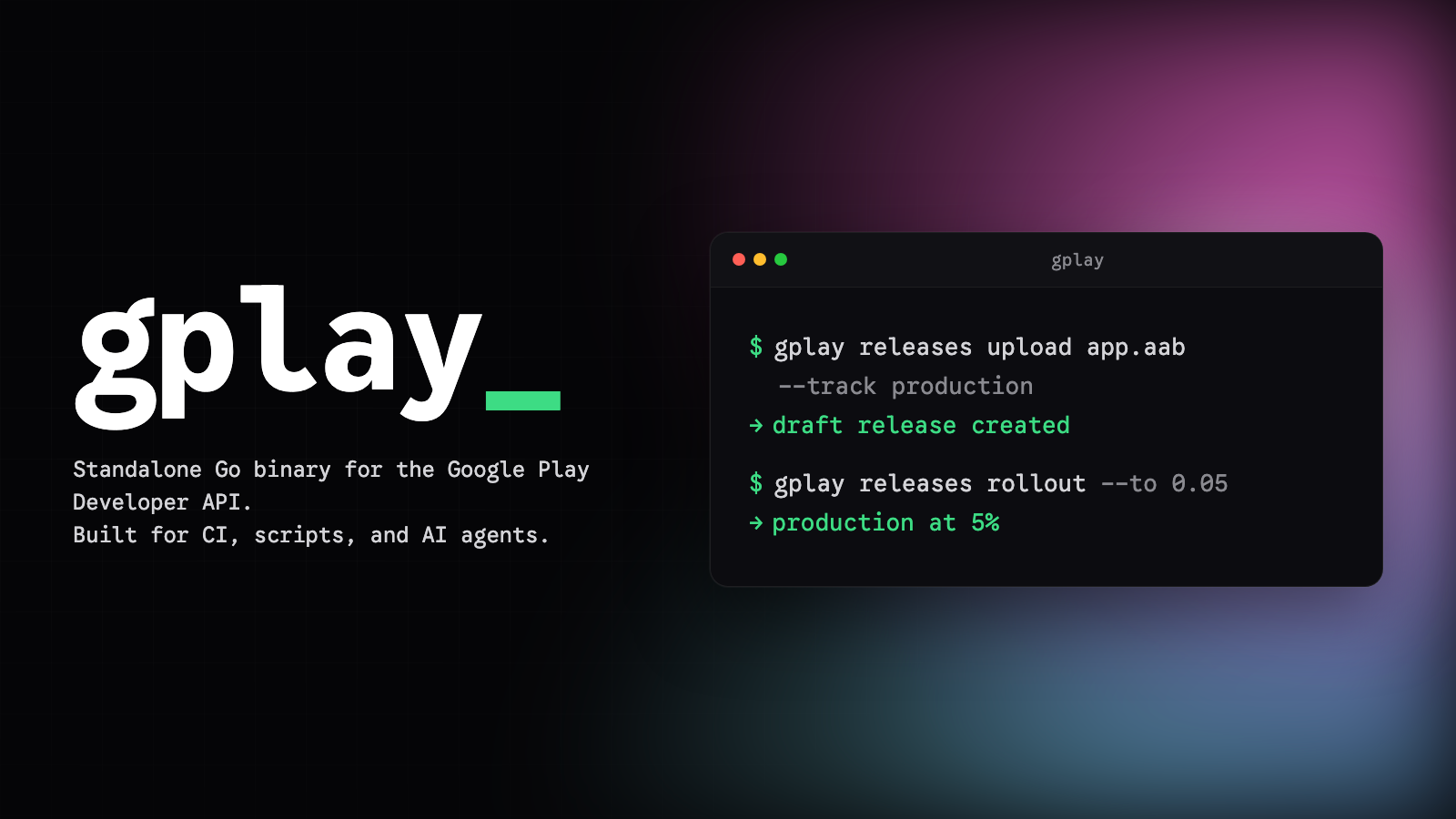






gplay
Publish to Google Play from a CI pipeline or a coding agent (Claude Code,
Codex, Cursor), without Fastlane. Shipping supply means shipping a Ruby
runtime in your image, output meant for humans, and generic exit codes that
turn retry logic into guesswork. gplay replaces it with one static binary,
nothing to install alongside it, and exit codes you can branch on.
Two properties do the heavy lifting for a non-human caller. --output json
returns the Google Play Developer API response verbatim: an agent that knows
Google's API already knows gplay's output, field for field, including the
zero values a typed re-marshal would drop. And every command declares its
contract: unmarked means frozen under the Public contract, [experimental]
means free to evolve. --help tells you which, per command.
Two ways to drive it: the raw CLI (flags, scripts, CI) or
agent skills that run it from natural-language prompts.
Generally available. The Public contract is in force: for every command
not marked[experimental], names, flags, semantics and exit codes will not
change without a major bump. That covers auth, apps, the core release loop,
tracks, testers, team, edits, metadata, compliance, vitals, andreviews list/view/reply. Newer or less-exercised commands ship[experimental]and stay free to evolve: monetization,games,recovery,orders,reviews history, and the side namespaces underreleases.--helpis the source of truth: the label is on the command itself.
See Stability and the Public contract,
Migrating to 1.0, and
docs/BACKLOG.md for what's out of scope.
Why
- Standalone Go binary. No Ruby, no Node, no Python: one file in your CI
image. - Built for CI and agents. TTY-aware output (
tableby default,json
in pipes), explicit flags, semantic exit codes for retry decisions. - API-faithful.
--output jsonreturns the raw Google Play Developer
API response shape, with no custom envelope to learn. The Google docs are
the schema docs. - Safe by default on production. Uploading or promoting to the
productiontrack creates adraftrelease unless you explicitly--completeor--staged <fraction>.
See ADR-0002.
Install
Pick go install, Homebrew, or the install script. Pre-built binaries for
Linux, macOS, and Windows are on the
releases page.
# go install
go install github.com/PollyGlot/google-play-cli/cmd/gplay@latest

# Homebrew
brew install PollyGlot/tap/gplay

# Install script
curl -fsSL https://gplay.sh/install | sh
The install script verifies the archive's SHA-256 against the releasechecksums.txt and fails closed: a missing, incomplete, or mismatched
checksum aborts the install. Set GPLAY_INSTALL_NO_VERIFY=1 to bypass (prints
a warning, greppable in CI). To add cosign and provenance checks on top, see
Verify a release.
Agent skills
gplay is shaped for a non-human caller: explicit flags, no interactive
prompts, machine-readable output. A skill turns a natural-language prompt into
the matching invocation, safe defaults included:
"Promote the latest internal build of com.example.myapp to beta."
→ thegplay-release-flowskill runsgplay releases promote --from internal --to betafor you.
Install them in one step. This is the one gplay command that needs Node/npx:
gplay install-skills
That wraps the skills CLI (npx skills add PollyGlot/google-play-cli-skills --global --agent '*' --yes), installing every skill for every detected agent.
No Node? Run that npx line yourself, or browse the skills by hand. (Driving
the Play API stays Node-free: install-skills is a workstation convenience,
never on the CI path.)
Skills live in a companion repo,
PollyGlot/google-play-cli-skills.
Each is a folder with a SKILL.md documenting its intent, the commands it
runs, and the limits it enforces.
ADR-0021 fixes the roster: one skill
per shipped namespace, plus a gplay-cli-usage foundation.
| Skill | Drives |
|---|---|
gplay-cli-usage |
Cross-cutting conventions (foundation) |
gplay-setup |
Auth onboarding |
gplay-apps |
Apps registry + details |
gplay-release-flow |
upload / promote / rollout |
gplay-tracks |
Tracks + testers |
gplay-reviews |
reviews list / reply |
gplay-metadata-sync |
Listings + images |
gplay-compliance |
Data Safety |
gplay-team |
users / grants / permissions |
gplay-vitals |
Crash / ANR rates, error reports, anomalies (read-only) |
gplay-monetization |
Subscriptions and one-time products as declarative files |
gplay-orders |
Order lookup and refunds |
gplay-recovery |
App recovery actions for a bad release |
gplay-games |
Play Games Services achievements and leaderboards |
gplay-device-tiers |
Device tier configs for tiered delivery |
gplay-customapps |
Managed Google Play private apps |
gplay-appstore |
Alternative app store catalog and update feed |
Quick start
# Point gplay at a Google Cloud service account JSON.
gplay auth login --service-account ./service_account.json

# List configured accounts and see which one is active.
gplay auth list
gplay auth status

# Verify the SA actually has access to your app.
gplay auth doctor --package com.example.myapp

# Bootstrap a project-local config (cascading: project → user → defaults).
gplay init
Full command reference: gplay --help (or gplay <subcommand> --help).
Replacing Fastlane
The commands the skills above drive. All shipped, all in the frozen contract:
# Upload an AAB to the internal track, with localized release notes.
gplay releases upload app.aab \
  --package com.example.myapp \
  --track internal \
  --release-notes-dir ./whatsnew

# Promote the latest internal build to beta.
gplay releases promote --package com.example.myapp --from internal --to beta

# Stage a production rollout, then advance it.
gplay releases rollout --package com.example.myapp --track production --to 0.10

# Read the most recent reviews (API exposes the last 7 days only) and reply.
gplay reviews list --package com.example.myapp --stars 1-2
gplay reviews reply --review-id REVIEW_ID --reply "Thanks for the feedback!"
How it's set up
Every decision lands in a document before it lands in code, so contributors
and agents start from the same page.
- CLAUDE.md: project context and agent working
instructions (read order, conventions, build/test, PR gate). - CONTEXT.md: glossary of canonical terms (Edit,
Account, Project, ...). Use them verbatim. - docs/DESIGN.md: CLI conventions across commands
(auth precedence, exit codes, output format, verbosity, edit lifecycle). - docs/BACKLOG.md: explicitly out-of-scope features.
- docs/CI_CD.md: how to wire
gplayinto a CI
pipeline (GitHub Actions example). - docs/adr/: Architecture Decision Records.
Verify a release
Confirm an artifact came from this repo's release pipeline (cosign + provenance).Every release publishes a cosign signature over checksums.txt and a GitHub
build-provenance attestation over each archive. Two independent checks, and
either one confirms the archive came from this repo's release pipeline before
you trust it in CI.
# 1. Build-provenance attestation (needs the GitHub CLI; no extra download).
#    Proves the archive was built by this repo's release workflow.
gh attestation verify gplay_<version>_<os>_<arch>.tar.gz \
  -R PollyGlot/google-play-cli

# 2. cosign signature over checksums.txt (needs cosign). The checksum file
#    transitively covers every archive it lists, so verify it, then check
#    your archive against it.
cosign verify-blob checksums.txt \
  --bundle checksums.txt.sigstore.json \
  --certificate-identity-regexp '^https://github.com/PollyGlot/google-play-cli/\.github/workflows/release\.yml@' \
  --certificate-oidc-issuer https://token.actions.githubusercontent.com
shasum -a 256 -c <(grep " gplay_<version>_<os>_<arch>.tar.gz$" checksums.txt)
Download checksums.txt and checksums.txt.sigstore.json from the same
release as the
archive. The install script already checks the SHA-256 against checksums.txt
and fails closed; these commands add provenance and signature
verification on top.
Contributing
See CONTRIBUTING.md. TL;DR: open an issue first for
anything bigger than a typo, branch from main, open a PR.
License
MIT. © 2026 Pavlo Trinko.
Not affiliated with Google
gplay is an independent open-source project. It calls the public Google
Play Developer API. Google LLC does not endorse, sponsor, or maintain it. "Google Play" is a trademark of Google LLC.
Reviews (0)
Sign in to leave a review.
Leave a reviewNo results found