siftwise
Health Warn
- License — License: Apache-2.0
- Description — Repository has a description
- Active repo — Last push 0 days ago
- Low visibility — Only 5 GitHub stars
Code Fail
- process.env — Environment variable access in .github/workflows/action-e2e.yml
- fs module — File system access in .github/workflows/action-e2e.yml
- rm -rf — Recursive force deletion command in .github/workflows/dogfood.yml
Permissions Pass
- Permissions — No dangerous permissions requested
No AI report is available for this listing yet.
Open-source test impact analysis for agent-driven CI

Run only the tests your change needs, safely.
Self-hosted test selection and failure triage for agent-driven CI.
Quickstart · Architecture · Eval results · Eval methodology · Changelog · Contributing


2,049 / 2,050 real failures caught replaying rdflib's CI (the miss: a flaky test) · /select in ~0.4 s on 18,000 tests · self-hosted, Apache-2.0
siftwise is a self-hosted service for teams whose CI is flooded with pull requests, many of
them now written by coding agents. It records every CI test result, picks the tests a change
can affect (running the full suite whenever it isn't sure), and tells people and agents
whether each failure is a new regression, already broken on main, or flaky. What sets it
apart: it runs on your own Postgres with no test instrumentation; it fails open, so a
siftwise outage never blocks CI; it ships an MCP server, so coding agents ask which tests
to run and why a test failed; and its shadow mode measures, on your own CI, how often a
selection would have missed a real failure before you rely on it. Why now: Anthropic reports
a 25x increase in CI jobs over six months as agents sped up writing code
(Agentic coding is straining CI),
and Linear found that as development accelerates, CI becomes a bottleneck, because every PR
still has to pass through it
(AI coding has made CI a bottleneck).
Status: alpha (
0.2.0). Evaluated on four real repos' CI history. APIs and the
database schema may change before 1.0.
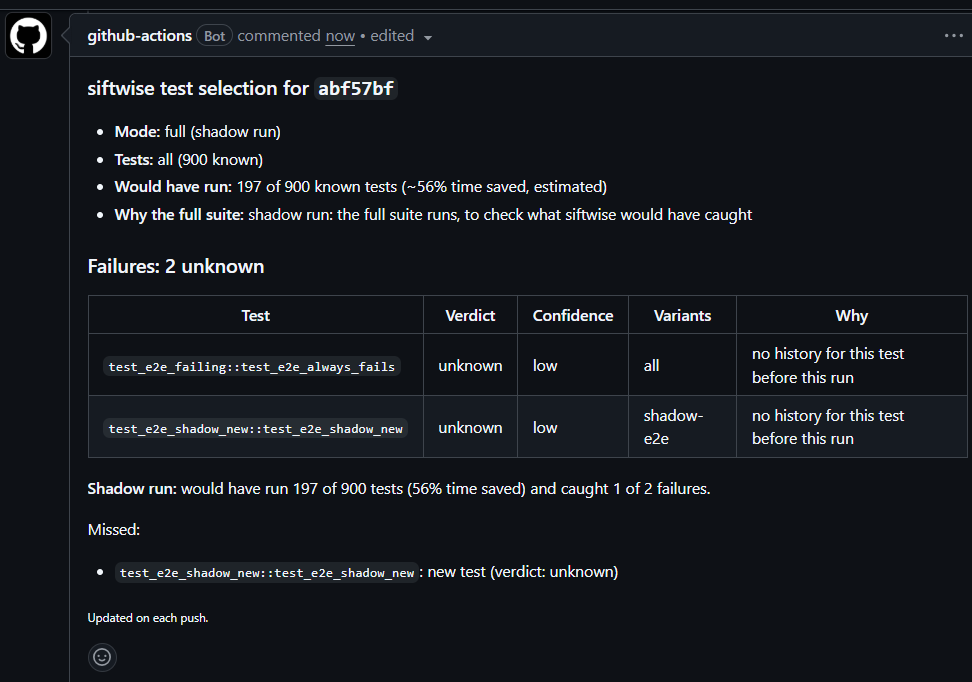
The sticky PR comment on a shadow run: what siftwise would have run, each
failure with its verdict, and the failure the selection would have missed, with its cause.
How it works
flowchart LR
    A["CI run, PR or<br/>agent branch"] --> B["siftwise select<br/>(git diff + import graph)"]
    B --> C[("siftwise server<br/>Postgres per-test history")]
    C --> D["test command<br/>+ reasons"]
    D --> E["run tests"]
    E --> F["record JUnit"]
    F --> C
    F --> G["rollup: triage verdicts<br/>+ shadow compare"]
    G --> H["PR comment"]
Full details: ARCHITECTURE.md.
- Record. CI uploads JUnit XML with the commit, branch, changed files and what the change
links to. The server keeps every result and rolls up per-test history. - Select. The CLI diffs your branch and builds Go or Python import graphs locally; the
server returns the tests the change can affect, each with a reason, or the full suite when
the diff, a build file or the history leaves any doubt. - Triage. Each failure gets a verdict (new regression, pre-existing on main, flaky,
unknown) with a confidence and its evidence, using only history from before the run. - Measure. Shadow runs run the full suite and report what the selection would have
caught or missed, and why.
Quickstart
From zero to a first selection in about 5 minutes, on a small example project. You need
Docker, git and uv. The commands are bash: on Windows, use Git
Bash or WSL. CI runs the blocks below on every change
(quickstart.yml), with the server image and the CLI built
from the checkout.
git clone https://github.com/PramodBasavarajMenasi/siftwise.git
cd siftwise
1. Start the server with Postgres, from the published image
(ghcr.io/pramodbasavarajmenasi/siftwise:0.2.0). The API token is a shared secret you choose;
it goes in .env, which docker compose reads:
[ -f .env ] || echo "SIFTWISE_API_TOKEN=$(openssl rand -hex 32)" > .env
docker compose up -d --wait             # pulls the image, waits until both services are healthy
curl -fsS http://localhost:8000/healthz # {"status":"ok"}
To run the server from your checkout instead (when you change it), add --build.
2. Install the CLI (the light install, without the server's dependencies) and give it the
token:
uv tool install siftwise                # or: pip install siftwise
export SIFTWISE_API_TOKEN=$(sed -n 's/^SIFTWISE_API_TOKEN=//p' .env)
If siftwise isn't found afterwards, run uv tool update-shell once and open a new shell.
3. Record a first run. Copy the example project into a git repo of
its own, run its tests with a JUnit report, and upload the report:
demo="$(mktemp -d)/shop" && cp -r examples/quickstart "$demo" && cd "$demo"
git init -q && git add -A && git commit -qm "A shop"
uv run pytest -q --junitxml=junit.xml
siftwise record junit.xml --repo demo/shop --branch main --main
4. Change a file and ask what to run. shop/cart.py changes; only the cart's tests import
it:
echo "# reviewed the bulk discount" >> shop/cart.py && git commit -qam "Touch the cart"
siftwise select --repo demo/shop --base HEAD~1 > selected.sh
cat selected.sh                         # pytest tests/test_cart.py
uv run sh selected.sh
The command goes to stdout (so eval "$(siftwise select ...)" works, or a file as here) and a
summary to stderr:
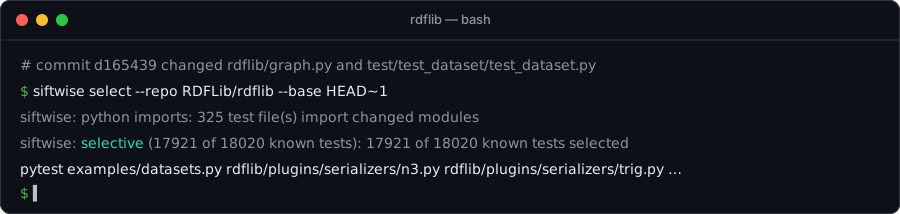
siftwise: python imports: 1 test file(s) import changed modules
siftwise: selective (2 of 4 known tests): 2 of 4 known tests selected
A change to shop/prices.py selects both test files instead (the cart imports prices).--json prints the full response with a reason per test. Exit codes: 0 ok, 1 API error, 2
usage error, 3 full suite needed but no command known. docker compose down stops the server
(down -v also deletes its data).
On your own project: record each CI run's JUnit report (the GitHub Action
does it for you, or siftwise record below), then call siftwise select (or the Action's
select step) on a change. In CI, check out with fetch-depth: 0 so the base...head diff works;
if it fails, the full suite runs.
Install
| Install | What you get | Size |
|---|---|---|
pip install siftwise |
the CLI: select, record, triage, report, rollup, and the GitHub Action's steps |
9 MB |
pip install 'siftwise[server]' |
plus the API server: siftwise server start and migrate (FastAPI, SQLAlchemy, Postgres driver) |
50 MB |
pip install 'siftwise[mcp]' |
plus siftwise mcp, for coding agents |
49 MB |
For a command-line tool, uv tool install siftwise (or pipx install siftwise) gives it its
own environment; add the extras the same way (uv tool install 'siftwise[mcp]'). From a
checkout: uv tool install . (or ".[server]", ".[mcp]"). A command whose extra is missing
exits 2 and prints the install command. siftwise --version prints the version.
Run the server
With Docker, from the published image:
docker run -d -p 8000:8000 -e SIFTWISE_API_TOKEN=... \
    -e SIFTWISE_DATABASE_URL=postgresql+psycopg://user:password@db-host:5432/siftwise \
    ghcr.io/pramodbasavarajmenasi/siftwise:0.2.0
To build the image from a checkout instead: docker build -t siftwise ., then run siftwise
in place of the image name.
- The image (about 80 MB to pull, 350 MB unpacked) runs
siftwise server startas a
non-root user: it applies the database migrations, then serves on port 8000. Migrations take
a Postgres lock, so several replicas can start at once. A Docker health check calls/healthz. - Without Docker:
pip install 'siftwise[server]', thensiftwise server start --host 0.0.0.0(siftwise server migrateapplies the migrations alone). - Reaching it from CI: the quickstart's
docker-compose.ymlpublishes the API on127.0.0.1only (portSIFTWISE_PORT, default 8000) and keeps Postgres inside Docker. Put
the server behind a reverse proxy with TLS: the token travels in a request header. - Upgrading: change the image tag to the new version (the quickstart's
docker-compose.ymlnames it; a newer checkout already has it), thendocker compose up -d:
the new image migrates the database when it starts. Never go back to an older image: once
the database has a migration that image doesn't know, itssiftwise server startfails withCan't locate revision ...and the container restarts in a loop. If you build from a
checkout (--build), rebuild after every pull for the same reason. A few migrations need a
step after them: see the migration notes.
Seed history from past CI runs
Backfill a repo's past GitHub Actions runs (here rdflib, which uploads one JUnit artifact per
matrix leg) instead of waiting for new ones. GITHUB_TOKEN needs actions:read andcontents:read:
export GITHUB_TOKEN=...
uv run python scripts/backfill.py --repo RDFLib/rdflib --workflow validate.yaml \
    --artifact-pattern '*-pytest-junit-xml' --max-runs 20 --batch
Record results from other CI systems
On GitHub, use the GitHub Action; on GitLab, the CI template.
Elsewhere, upload JUnit XML after each test run:
siftwise record junit.xml --repo acme/shop --branch feature-x --ci-run-id 1234 \
    --base origin/main --started-at "$(date -u +%Y-%m-%dT%H:%M:%SZ)"
Uploads are idempotent per (repo, ci_run_id, run_attempt, variant): a re-upload stores
nothing new. For a matrix, give each leg a --variant (e.g. ubuntu-py3.12) and--defer-rollup, then run siftwise rollup --repo acme/shop once after all legs. With--base, record also stores what the change links to, which triage needs to tell whether a
later failure was related to this run's change.
Triage from the CLI
siftwise triage reads a run's JUnit reports and its diff, and gives each failing test a
verdict:
siftwise triage junit.xml --repo acme/shop --base origin/main --variant ubuntu-py3.12 \
    --ci-run-id 1234 --fail-on new_regression
new_regression  high   tests.test_cart::test_total
    tests/test_cart.py tests changed src/cart.py
pre_existing    high   tests.test_db::test_query
    failing on main on ubuntu-py3.12 since 4f2a9c1 (3 main runs)
flaky           medium tests.test_net::test_fetch
    flaky 1 time in 90 days (1 unrelated fail-then-pass)
siftwise: 3 failing test(s): 1 new regression, 1 pre existing, 1 flaky, 0 unknown
The rules, in order, are in the architecture doc.
Only runs before the triaged one count, so triaging an old run gives the answer it would have
got live. --json prints the verdicts with their evidence. Exit codes: 0 ok, 1 API error, 2
usage error, 4 a failure got a --fail-on verdict (off by default). 500 failures on rdflib
take about 0.25 s.
GitHub Action
Three composite actions in this repo. They install the light CLI from the action's own
checkout and never block CI: if the server is unreachable, times out or returns an error,select outputs mode: full and record/rollup log a warning. The only exception isfail-on, which you opt into.
| Action | When | What |
|---|---|---|
actions/select |
before tests | picks tests; outputs mode, command, selected, total, reason, junit-dir (and the shadow outputs); posts one sticky PR comment and a job summary |
actions/record |
after tests, if: always() |
uploads JUnit with the run ID and attempt, the PR head commit (not the merge commit), branch, variant, start time, changed files and known_flaky; optionally re-runs unknown failures; in a single job, then triages the failures and reports a shadow run |
actions/rollup |
once after a matrix | triages the failures of every leg and reports a shadow run, then updates test stats once for all legs |
Setup:
- Secrets:
SIFTWISE_URL(your server) andSIFTWISE_TOKEN(itsSIFTWISE_API_TOKEN). - Permissions:
contents: read,actions: read(the run's start time) andpull-requests: write(the comment). - Full history: check out with
fetch-depth: 0.selectfails with a clear message on a
shallow clone, the only way it fails. - Version: the examples use
@main; pin a release tag (@v0.2.0) or a commit SHA for
reproducible CI. The actions install the CLI from their own checkout, so the CLI's version
always matches the tag.
Never use these actions with pull_request_target. That event runs with secrets on code
from the PR, so a fork could read your siftwise token. Use pull_request: on fork PRs, secrets
are empty, so select runs the full suite and skips the comment, record skips the upload,
and there are no failure verdicts.
Single job
name: CI
on:
  push:
    branches: [main]
  pull_request:
permissions:
  contents: read
  actions: read
  pull-requests: write
jobs:
  test:
    runs-on: ubuntu-latest
    steps:
      - uses: actions/checkout@v7
        with:
          fetch-depth: 0
      - uses: actions/setup-python@v7
        with:
          python-version: "3.12"
      - run: pip install -r requirements.txt   # your install step

      - id: siftwise
        uses: PramodBasavarajMenasi/siftwise/actions/select@main
        with:
          server-url: ${{ secrets.SIFTWISE_URL }}
          token: ${{ secrets.SIFTWISE_TOKEN }}

      - name: Tests
        env:
          MODE: ${{ steps.siftwise.outputs.mode }}
          COMMAND: ${{ steps.siftwise.outputs.command }}
          JUNIT_DIR: ${{ steps.siftwise.outputs.junit-dir }}
        run: |
          if [ "$MODE" = selective ]; then
            # Shell-quoted by siftwise; each pytest command writes its own report to JUNIT_DIR.
            if [ -n "$COMMAND" ]; then eval "$COMMAND"; else echo "No tests affected."; fi
          else
            pytest --junitxml="$JUNIT_DIR/full.xml"   # your normal full suite
          fi

      - if: always()
        uses: PramodBasavarajMenasi/siftwise/actions/record@main
        with:
          server-url: ${{ secrets.SIFTWISE_URL }}
          token: ${{ secrets.SIFTWISE_TOKEN }}
Pass the command through env: as above, never as ${{ }} inside run:, so the shell sees
it once, quoted. record uploads **/junit*.xml plus everything in the select step'sjunit-dir (its junit input takes other globs). For Go, write JUnit withgotestsum --junitfile or go-junit-report.
Matrix
Each leg records its own variant and skips the per-upload stats rollup; one rollup job runs
after every leg:
jobs:
  test:
    strategy:
      matrix:
        os: [ubuntu-latest, macos-latest]
        python: ["3.11", "3.12"]
    runs-on: ${{ matrix.os }}
    steps:
      - uses: actions/checkout@v7
        with:
          fetch-depth: 0
      # ... set up Python and install, as above ...
      - id: siftwise
        uses: PramodBasavarajMenasi/siftwise/actions/select@main
        with:
          server-url: ${{ secrets.SIFTWISE_URL }}
          token: ${{ secrets.SIFTWISE_TOKEN }}
          comment: ${{ strategy.job-index == 0 }}   # one leg comments, or they race
      # ... the Tests step, as above ...
      - if: always()
        uses: PramodBasavarajMenasi/siftwise/actions/record@main
        with:
          server-url: ${{ secrets.SIFTWISE_URL }}
          token: ${{ secrets.SIFTWISE_TOKEN }}
          variant: ${{ matrix.os }}-py${{ matrix.python }}

  siftwise-rollup:
    needs: test
    if: always()
    runs-on: ubuntu-latest
    steps:
      - uses: PramodBasavarajMenasi/siftwise/actions/rollup@main
        with:
          server-url: ${{ secrets.SIFTWISE_URL }}
          token: ${{ secrets.SIFTWISE_TOKEN }}
The rollup job needs no checkout: the server already has what each leg recorded.
Failure verdicts
After the run's last upload (rollup after a matrix, record in a single job: its triage
input, auto, true or false), siftwise triages the failing tests from what the uploads
stored, including the change links record computed. The sticky PR comment gets a
Failures section under the selection:
- a summary line, e.g. "2 new regressions, 1 unknown, 1 flaky, 1 pre-existing", counting each
test once, under its worst verdict over the legs; - a table of test, verdict, confidence, legs and one reason: new regressions first, then
unknown; flaky and pre-existing collapsed below.allmeans every recorded leg got that
verdict; - at most 20 rows per table, then "+N more"; the job summary has the full list (up to 500).
The comment is left alone if the PR got new commits since the run started, and a new push's
selection drops the old commit's failures. Raw failure messages are never shown (the comment
is public). Outputs: verdicts-available, counts (JSON, per verdict) and report (the
summary's Markdown, as a file). How each verdict is decided:
triage verdicts.
fail-on
fail-on (on rollup, or record in a single job) fails the step when a failure gets one of
the listed verdicts, on any leg:
      - uses: PramodBasavarajMenasi/siftwise/actions/rollup@main
        with:
          server-url: ${{ secrets.SIFTWISE_URL }}
          token: ${{ secrets.SIFTWISE_TOKEN }}
          fail-on: new_regression,unknown
- It can only add a failure. A leg whose tests failed is already red. To let siftwise
decide, give the test stepscontinue-on-error: trueand make the rollup job the required
check. - Gate on
new_regression,unknown.new_regressionalone letsunknownthrough, andunknownis common (a new test, an unknown diff, an unrelated failure with no flaky history). - With
fail-onset, unavailable verdicts fail the step too (fail closed): a server
that's down or erroring, a timeout, or nothing recorded for the attempt. A real failure
can't pass while siftwise is unreachable. - Except without a siftwise token: fork PRs get no secrets, so the step warns
fail-on skipped: no siftwise token (fork PR?); this run is not gatedand passes. Keep
another required check on fork PRs. A missingSIFTWISE_TOKENsecret on your own repo looks
the same: watch for that warning. - A PR can't excuse its own failures with
known_flaky:recordapplies the PR base
commit's list (Flaky tests).
Without fail-on (the default), siftwise never fails anything.
Flaky tests
Two ways to keep known flakes from reading as regressions, both in record:
      - if: always()
        uses: PramodBasavarajMenasi/siftwise/actions/record@main
        with:
          server-url: ${{ secrets.SIFTWISE_URL }}
          token: ${{ secrets.SIFTWISE_TOKEN }}
          rerun-unknown: 2         # re-run unknown failures up to twice
          rerun-prefix: uv run     # how pytest or Jest runs in your job (poetry run, npx)
known_flakyin.siftwise.toml: a failing listed test not linked to
the change is flaky (medium); linked, it's unknown ("re-run to tell"). For a pull request,recordapplies the base commit's list (known-flaky-source: base, the default), so a PR
can't mark its own failures flaky; when the PR changes the list, the comment says
"known_flaky changes in this PR apply after merge".known-flaky-source: headapplies the
PR's own list instead. A push always applies its own.rerun-unknown: N(0 to 3, default 0): after uploading,recordtriages its own leg,
re-runs failures whose verdict is inrerun-verdicts(unknown, orunknown,new_regression) with the test's own runner, and records each re-run (all of a
round's reports in one upload). A test that passes on one is flaky, high; one that fails
again keeps its verdict, with a note.Runners, chosen per failing test from its ID and file and the checkout:
Runner When Re-run command Report pytest a test ID that maps to a file in the checkout [prefix] pytest -p no:cacheprovider <node IDs>--junitxmlin the runner's temp dirGo an import path in the root go.mod's moduleper package: gotestsum ... -- -count=1 -run '^(TestA|TestB)$' <package>, orgo test -jsonwith the same flags when gotestsum isn't on PATHgotestsum's JUnit, or go test -jsonconverted by siftwiseJest a JS/TS test file (the JUnit must name it: jest-junit's addFileAttribute) under apackage.jsonorjest.config.*with Jestper file, from that package: [prefix] jest --ci --runTestsByPath <file> -t '^(<full name>|...)$'jest-junit (it must be installed, as for the CI run) Maven a Java class and method, pom.xmlat the rootmvn -B -Dtest=Class#m1+m2,Other#m3 test(./mvnwwhen present)the target/surefire-reportsfiles the re-run wrote, copied out (then put back as they were)Gradle a Java class and method, build.gradle[.kts]orsettings.gradle[.kts]at the rootgradle test --continue --tests Class.method ...(./gradlewwhen present)the build/test-resultsfiles the re-run wrote, copied out (then put back as they were)Go subtests re-run through their top-level test; Java parameter lists and
[n]indexes are
dropped (all of a method's cases run). Names that reach a regex are escaped; Java class and
method names must be plain identifiers, else the test isn't re-run. A test whose runner can't
be told isn't re-run, with a warning.rerun-prefixgoes in front of the pytest and Jest commands, split like a shell would,
e.g.uv run,poetry run,npx,yarn. Go, Maven and Gradle never get it (a prefix for
one language would break another in a mixed repo): siftwise uses gotestsum if it's on PATH
(go install gotest.tools/gotestsum@latestbeforerecord), elsego test -json, and the
repo's./mvnwor./gradlewif present, elsemvnorgradle.Limits: at most
rerun-max-teststests (20) withinrerun-timeout-minutes(10) for all
rounds and runners. Tests whose file isn't in the checkout aren't re-run. Every command runs
without a shell. A re-run's report must name the test as the CI run did: with custom
jest-junit name templates (or settings only the test step had), the re-run may not match,
and the test keeps its verdict.Maven and Gradle reports: both write a re-run's reports where the CI run's are (Surefire
can't be pointed elsewhere from the command line, and Gradle empties its results directory,
leaving only the re-run classes'). Sorecordbacks up everyTEST-*.xmlundertarget/surefire-reportsandbuild/test-resultsbefore a re-run, copies the re-run's out,
and puts the CI run's back afterwards, also when the re-run fails or times out (a file it
can't put back is a warning). Other output isn't restored: Surefire's.txtsummaries,
Gradle's HTML report (build/reports/tests) and binary results, compiled classes. A Gradle
daemon can keep writing after a timeout. A build that puts its reports elsewhere (its ownreportsDirectory) gets no re-runs: no report is found, and the re-runs stop with a warning.Fail open: any problem is a warning and the verdicts stay what they were. Re-runs never
turn a red job green; the PR comment andfail-onuse the verdicts after them. Outputs:rerun-tests,rerun-passed.
Shadow mode
How often would siftwise's selection have missed a real failure? On a sampled run the full
suite runs while siftwise stores what it would have selected; after the run is recorded, the
server checks every failure against that selection:
      - id: siftwise
        uses: PramodBasavarajMenasi/siftwise/actions/select@main
        with:
          server-url: ${{ secrets.SIFTWISE_URL }}
          token: ${{ secrets.SIFTWISE_TOKEN }}
          shadow: 10%          # or always; off by default
- Sampling:
off(default),always, or a percentage of CI runs, by a hash of the run ID,
so every matrix leg and re-run attempt agrees. Matrix legs can setvariantonselect(the
same value asrecord's) to store a selection per leg. - A shadow run always runs the full suite and records its results as usual; shadow mode
never fails or shortens a run. - The report: where verdicts are computed, the PR comment and job summary get a line like
"Shadow run: would have run 197 of 900 tests (56% time saved) and caught 1 of 2
failures", then each missed test with its cause (see the screenshot above). Time saved is
measured on the run's own durations. Failures triage calls flaky are counted apart, never as
misses. - Not counted, with a warning: a selection the server couldn't store, siftwise unreachable
at select time, or a comparison that failed.
Recall over time comes from GET /repos/{repo}/recall?days=30, or siftwise report
(example output):
siftwise report --repo acme/shop --days 30
# Recall 98.7% (148 of 150) over 40 shadow runs; selective runs only: 96.0% (48 of 50) over 25
The first figure counts every shadow run, including those where siftwise would have run the
full suite anyway, so the report always shows the selective-only figure next to it. Below come
the misses by verdict and cause, the measured time saved, the runs not counted, and each miss.--by week prints the same per week:
Week of     Runs  Recall (all)        Selective  Recall (selective)  Caught  Missed  Time saved
2026-09-28    11  100.0% (41 of 41)           7  100.0% (13 of 13)       41       0         38%
2026-10-05    12  98.0% (49 of 50)            8  95.0% (19 of 20)        49       1         41%
Each miss gets a cause, from evidence the server already has:
| Cause | Evidence |
|---|---|
new_test |
no result for the test before the run |
flaky_history |
flaky before, but not called flaky this time |
config_gap |
a non-code file (data, fixture, golden file) changed in the test's own directory, which no import graph follows; the report suggests a [[depends]] rule for you to review |
no_link |
the change is known and nothing in it links to the test (the report lists what changed) |
unknown |
the run's change links weren't recorded, or the test was linked but not selected (the report warns: possibly a selector bug) |
action-e2e.yml runs all three actions against a real server
on every push and PR of this repo: verdicts, fail-on, a shadow run with a miss,known_flaky and rerun-unknown.
GitLab CI
A CI template, gitlab/siftwise.gitlab-ci.yml,
with three hidden jobs around siftwise gitlab select|record|rollup. They run the same steps
as the GitHub Action, with the same rules: they fail open, use the merge request's base forknown_flaky, support shadow mode and rerun-unknown, and fail only through fail-on.
| Your job | extends: |
What it does |
|---|---|---|
siftwise-select |
.siftwise-select (stage .pre) |
picks the tests; passes SIFTWISE_MODE, SIFTWISE_COMMAND_FILE, SIFTWISE_SELECTED, SIFTWISE_TOTAL, SIFTWISE_REASON and SIFTWISE_JUNIT_DIR (plus the shadow outputs) to later jobs as a dotenv report; writes the selection into one sticky merge request note |
| your test jobs | .siftwise-record |
its after_script uploads the job's JUnit (**/junit*.xml and .siftwise-ci/junit/) with the pipeline ID, the merge request's source commit (never a merged results commit), the branch, the variant, the changed files and the base commit's known_flaky; optionally re-runs unknown failures |
siftwise-rollup |
.siftwise-rollup (stage .post, when: always) |
triages every test job's failures into the note, applies fail-on, reports a shadow run, then updates the test stats once |
Each job writes its reports under .siftwise-ci/ (artifacts, kept 1 week): select.md,failures.md, and the dotenv files. GitLab has no job summary, so these files are where to
look.
Setup:
- Include the template by a release tag and its hash, never a branch. The tag fixes what
runs in your pipelines with your tokens; GitLab rejects the file if it changes
(include:integrity, GitLab 17.9+). Get the hash
withcurl -sL <url> | openssl dgst -sha256 -binary | openssl base64 -A. Each template
installs its own release (pip install siftwise==<version>). Or copy the file into your
repository andinclude: local:it. - CI/CD variables (Settings > CI/CD > Variables):
SIFTWISE_SERVER(your server, https),SIFTWISE_TOKEN(itsSIFTWISE_API_TOKEN; Masked and hidden) and, for the note,SIFTWISE_GITLAB_TOKEN(Masked and hidden). Choosing between protected and not:
protected or unprotected. - Full history: the select and test jobs set
GIT_DEPTH: "0"; new GitLab projects clone
20 commits. On a shallow clone,selectfails with that fix and the pipeline runs the full
suite (the select job hasallow_failure: true). - Images: the select job uses
python:3.12-bookworm, which has git. For Go import graphs,
give it an image with Go and Python 3.11+. The record step runs in your test job's image,
which needs Python 3.11+ (python3 -m venv).
include:
  - remote: https://raw.githubusercontent.com/PramodBasavarajMenasi/siftwise/v0.2.0/gitlab/siftwise.gitlab-ci.yml
    integrity: sha256-<base64 SHA-256 of that file>

workflow:  # merge request pipelines for open MRs, branch pipelines otherwise
  rules:
    - if: $CI_PIPELINE_SOURCE == "merge_request_event"
    - if: $CI_COMMIT_BRANCH && $CI_OPEN_MERGE_REQUESTS
      when: never
    - if: $CI_COMMIT_BRANCH

siftwise-select:
  extends: .siftwise-select

test:
  extends: .siftwise-record
  image: python:3.12
  script:
    - pip install -r requirements.txt
    - |
      if [ "$SIFTWISE_MODE" = selective ]; then
        # Shell-quoted by siftwise; each pytest command writes its report to .siftwise-ci/junit.
        if [ -s "$SIFTWISE_COMMAND_FILE" ]; then sh "$SIFTWISE_COMMAND_FILE"; else echo "No tests affected."; fi
      else
        pytest --junitxml=.siftwise-ci/junit/full.xml   # your full suite
      fi
  artifacts:
    reports:
      junit: .siftwise-ci/junit/*.xml

siftwise-rollup:
  extends: .siftwise-rollup
  variables:
    SIFTWISE_FAIL_ON: new_regression,unknown   # optional: see fail-on
If siftwise-select failed or didn't run, SIFTWISE_MODE is empty and the test job runs the
full suite. Test jobs that use needs: must list siftwise-select to get its variables. If
your test job has its own after_script or artifact paths, add!reference [.siftwise-record, after_script] and .siftwise-ci/ to them.
Matrix: give each leg a SIFTWISE_VARIANT. The template's record step defers the stats
and the verdicts to siftwise-rollup, which runs once after every leg:
test:
  extends: .siftwise-record
  image: python:$PY
  parallel:
    matrix:
      - PY: ["3.11", "3.12"]
  variables:
    SIFTWISE_VARIANT: py$PY
  script:
    - ...   # as above
Inputs are the GitHub Action's, as variables: SIFTWISE_REPO, SIFTWISE_BASE_REF,SIFTWISE_SHADOW, SIFTWISE_COMMENT, SIFTWISE_VARIANT, SIFTWISE_JUNIT_GLOB,SIFTWISE_FAIL_ON, SIFTWISE_KNOWN_FLAKY_SOURCE, the SIFTWISE_RERUN_* ones. The rollup's
outputs are SIFTWISE_VERDICTS_AVAILABLE, SIFTWISE_COUNT_<VERDICT>, SIFTWISE_REPORT and
the shadow ones.
Try it on gitlab.com with examples/gitlab: a small project whose
pipeline runs its own siftwise server and Postgres inside each job, with a random token, so
the only variable it needs is SIFTWISE_GITLAB_TOKEN. With no server between pipelines, it
keeps history only within a pipeline: a merge request pipeline first runs the full suite at
the MR's base commit and records it as a main run. A real setup runs one persistent server
and needs neither.
The GitLab token
The note goes through the Notes API. Give it the least
that works:
- Premium or Ultimate, or Self-Managed: a project access token
with the Reporter role, theapiscope (read_apican't write notes) and an expiry
date. Its bot user writes the note. Planner is the lowest role that can comment, but not when
merge requests are set to "Only Project Members" (permissions). - GitLab.com Free (no project access tokens): a dedicated user (a bot account, a project
member with the Reporter role) with a fine-grained personal access token
limited to this project: Work Item create, read and update (merge request notes are part
of it), Merge Request read, and User read (siftwise looks up its own user so it only
edits its own note). Set an expiry date. A classic token with theapiscope also works, but
it can do anything its user can, everywhere. CI_JOB_TOKENcan't do it: its allowlist has onlyGETendpoints for merge requests
and notes (job token), so it can read notes
but not write them.
The role should stay below Maintainer: Maintainers can edit other users' comments. A token
without access just warns (merge request comment failed: HTTP 403), and the pipeline goes on.
Protected or unprotected variables
- Protected variables reach only pipelines on protected branches and tags. A merge request
from an unprotected branch (most of them) gets no token: siftwise runs the full suite, posts
no note and records nothing. Withfail-onset,siftwise-rollupthen fails closed: only
forks skip the gate, so don't combine protected variables andfail-on. GitLab 18.1+ can pass
protected variables to merge request pipelines, but only when both the source and target
branches are protected
(details). - Unprotected (masked and hidden) variables reach every branch pipeline. Anyone who can
push a branch (the Developer role) can change.gitlab-ci.ymlon it and read both tokens.
Masking hides a value in logs, not from the job's code. - Recommended: unprotected, masked and hidden, when everyone with the Developer role may read
and write siftwise history. The siftwise token reads and writes every repo on its server:
run a separate siftwise server per trust boundary, so that a leaked token exposes only one
team's repos. Otherwise use protected variables: siftwise then helps only protected branches.
Forks
By default a fork's merge request pipeline runs in the fork, without this project's
variables: the full suite, no note, no upload, and fail-on skipped with a warning (as for
fork PRs on GitHub). Keep another required check on them. Never run untrusted forks'
pipelines in the parent project (Run pipeline on the merge request's Pipelines tab): that
runs the fork's code with this project's variables, so it could read both tokens. siftwise
warns when it sees one. Like GitHub's pull_request_target, only do it for code you've read.
GitLab security
- Tokens come from the environment only. No
--tokenoption exists, and siftwise redacts
every value ofSIFTWISE_TOKEN,SIFTWISE_API_TOKEN,SIFTWISE_GITLAB_TOKENandCI_JOB_TOKENfrom its log lines, dotenv files, reports and the note, even when an error
message echoes one. Never addset -xorCI_DEBUG_TRACEto these jobs. - Untrusted text is inert in the note. Test IDs, file paths, reasons and variant names come
from the merge request's code, so siftwise writes them as code spans, which GitLab shows
literally: no links, images, HTML,@mentions, references or placeholders. No line can
start with/, so none can run a quick action. Raw failure messages are never shown. - A merge request can't excuse its own failures:
recordapplies theknown_flakylist
of the MR's base commit. - Plain http warns:
SIFTWISE_SERVERwithhttp://and a host other thanlocalhostor a
one-word service name (the token travels in a header) gives a warning. - Protect
.gitlab-ci.yml: a merge request that edits it can change any gate. Protect the
default branch and, with Premium or Ultimate, require code owner approval for the file
(CODEOWNERS).
Limits:
- Retried jobs: a retried job keeps its pipeline ID, so only the pipeline's first upload of
each leg is stored (recordwarns). Run a new pipeline to record again. - No diff base: merge trains, scheduled, manual (web), API and trigger pipelines run the
full suite. after_scriptlimits: it runs with a 5-minute limit by default (RUNNER_AFTER_SCRIPT_TIMEOUT),
which capsrerun-unknown, and, depending on the executor, without software thescript
section installed. Re-runs need the test dependencies inside the project directory (a
virtualenv there,node_modules), or callsiftwise gitlab recordat the end ofscript.- Tested mostly with mocks: the GitLab support is tested against GitLab's documented
variables and API, with mocks, plus the example project
on gitlab.com (Free tier). Self-Managed instances and Premium features are untested.
Coding agents (MCP)
siftwise mcp is an MCP server (stdio) that gives a coding agent three tools. It keeps no
state: each call computes the change in the agent's checkout, with the same code assiftwise select, and asks the siftwise server. It never records runs.
| Tool | The agent calls it | Returns |
|---|---|---|
select_tests |
before running tests after a change | mode, the command to run, the selected tests with a reason each |
triage_failure |
when tests fail, before trying to fix them | a verdict per failure (from JUnit paths or test IDs), with reasons and evidence |
explain |
when a selection or verdict surprises it | one test's recent results, flaky evidence, broken-on-main status, and why it would (not) be selected |
- Uncommitted work counts. The diff runs from the merge base of the base branch and HEAD
to the working tree, untracked files included. When the tree is dirty, triage sends no
commit, so "passed on this commit before" can't apply. - Fails open. If the server is down, errors or no token is set,
select_testssays to run
the full suite andtriage_failuresays verdicts are unavailable. - Compact output. Each result stays under 8,000 characters. The API token never appears
in a result.
Install the CLI with the mcp extra (Install):
uv tool install 'siftwise[mcp]'  # siftwise lands in ~/.local/bin (Windows: %USERPROFILE%\.local\bin)
uv tool update-shell             # once, if that directory isn't on your PATH; then restart the agent
uv tool dir --bin                # prints the directory, for a full path in the configs below
The server reads SIFTWISE_SERVER and SIFTWISE_API_TOKEN, and optionally SIFTWISE_REPO
(default: owner/name from the origin remote), SIFTWISE_BASE_REF (default: the branchorigin/HEAD points to, else main) and SIFTWISE_REPO_PATH. Keep the token out of files
you commit: use your user-level config, or environment-variable expansion where the client has
it.
Which repository: the first that applies of the tool's repo_path argument (an absolute
path the agent can pass), SIFTWISE_REPO_PATH, CLAUDE_PROJECT_DIR (set by Claude Code), the
client's workspace folders if it supports MCP roots, and the server's working directory.
A folder the client sets (CLAUDE_PROJECT_DIR, a root) that isn't a repository but holds
exactly one directly inside means that one, and the result says so. Outside a git repository,
every tool says so and how to fix it, listing the repositories one level down.
Tested on Windows with Claude Code, GitHub Copilot in VS Code, Cursor, Codex CLI and Gemini
CLI. Windsurf and Cline configs follow their docs but are untested. Setup for each, with
snippets: MCP clients.
| Client | Config | How it finds the repository |
|---|---|---|
| Claude Code (tested) | claude mcp add, or .mcp.json |
CLAUDE_PROJECT_DIR, which Claude Code sets |
| GitHub Copilot in VS Code (tested) | .vscode/mcp.json |
MCP roots, else the workspace folder it starts in |
| Cursor (tested) | .cursor/mcp.json or ~/.cursor/mcp.json |
MCP roots: no path to configure |
| Codex CLI (tested) | ~/.codex/config.toml |
the working directory: set cwd |
| Gemini CLI (tested) | .gemini/settings.json |
the working directory: set cwd |
| Windsurf (untested) | mcp_config.json |
SIFTWISE_REPO_PATH, or the repo_path argument |
| Cline (untested) | cline_mcp_settings.json |
SIFTWISE_REPO_PATH, or the repo_path argument |
Claude Code:
claude mcp add siftwise --env SIFTWISE_SERVER=https://siftwise.example.com \
    --env SIFTWISE_API_TOKEN=your-token -- siftwise mcp
or a project .mcp.json, which expands ${VAR} from your environment:
{
  "mcpServers": {
    "siftwise": {
      "command": "siftwise",
      "args": ["mcp"],
      "env": {
        "SIFTWISE_SERVER": "https://siftwise.example.com",
        "SIFTWISE_API_TOKEN": "${SIFTWISE_API_TOKEN}"
      }
    }
  }
}
Codex CLI (~/.codex/config.toml):
[mcp_servers.siftwise]
command = "siftwise"
args = ["mcp"]
cwd = '/path/to/your/repo'   # the repository: Codex starts the server there
env = { SIFTWISE_SERVER = "https://siftwise.example.com", SIFTWISE_API_TOKEN = "your-token" }
If Codex says the model isn't supported with a ChatGPT account, pick another model with/model.
Cursor (~/.cursor/mcp.json for every project, or .cursor/mcp.json in one): the same
JSON as .mcp.json above, with the token value written in. No repository path: Cursor sends
its workspace folders as MCP roots.
Gemini CLI (.gemini/settings.json): the same JSON with "cwd": "/path/to/your/repo"
added. Put the token in the server's env block (as above): Gemini CLI strips inherited
variables whose names contain TOKEN, so one set only in your shell never reaches siftwise.
GitHub Copilot in VS Code (.vscode/mcp.json): servers go under "servers" with"type": "stdio"; see MCP clients
for a config that prompts for the token.
If the agent can't find siftwise (it doesn't see your shell's PATH, common on Windows),
give the full path from uv tool dir --bin as the command. In JSON, double the backslashes
("C:\\Users\\you\\.local\\bin\\siftwise.exe"); in TOML, use a single-quoted string.
Then tell the agent when to use it, e.g. in AGENTS.md or CLAUDE.md:
Before running tests, call the siftwise `select_tests` tool and run the command it returns.
When tests fail, call `triage_failure` before fixing anything: fix `new_regression` failures,
re-run `flaky` ones, and leave `pre_existing` ones (already failing on main).
Configuration
.siftwise.toml at the root of the repo being tested, read by the CLI, the Action and the
MCP server:
always_run = ["tests/smoke/**", "tests.test_health::*"]  # test file paths or test IDs
generated = ["build/reports/**"]          # more files your test runs write (see below)
known_flaky = ["tests/test_net.py"]       # triage: unlinked failures are flaky

[[depends]]                               # dependencies no import graph can see
tests = "test/cli/**"                     # test file paths, or <Go package dir>/<TestName>
on = ["**/*.go", "!**/*_test.go"]         # ! excludes
- Globs:
**spans directories, while*and?stay within one path segment
(tests/*matchestests/test_a.py, nottests/unit/test_b.py). Go test IDs contain their
package's import path, so match them with**::TestNameor<import path>::*. - Generated files never count as changed code, even untracked or committed by mistake:
junit*.xml,coverage.xml,.coverage,.coverage.*,htmlcov/,*.log,.pytest_cache/and__pycache__/, plus editor and coding-agent settings:.vscode/,.cursor/,.idea/,.mcp.json,.codex/and.gemini/, all at any depth.generated
adds to that list. known_flakyis for triage only (selection still runs listed tests); CI applies a pull
request's base list (Flaky tests).
| Variable | Used by | Default |
|---|---|---|
SIFTWISE_API_TOKEN |
server (required: if unset, every endpoint but /healthz returns 503) and clients |
none |
SIFTWISE_SERVER |
clients: the CLI's --server, MCP, the Action's steps |
http://localhost:8000 |
SIFTWISE_REPO_PATH |
MCP: the repository, when the client starts the server elsewhere (which repository) | none |
SIFTWISE_DATABASE_URL |
server | postgresql+psycopg://siftwise:siftwise@localhost:5432/siftwise |
SIFTWISE_STATS_WINDOW_DAYS |
server: per-test stats window (0 = all history) | 90 |
SIFTWISE_MAX_UPLOAD_BYTES |
server: request body limit | 50 MB |
GITHUB_TOKEN |
scripts/backfill.py |
none |
Supported languages:
| Language | Selection | Commands |
|---|---|---|
| Python (pytest) | foo.py → test_foo.py; test files importing a changed module (static graph incl. parent packages, conftests, plugin strings); changed test files |
pytest node IDs, whole test files, pytest --doctest-modules for doctests |
| Go | changed package and every package whose tests import it (go list -deps -test) |
go test ./pkg (whole) or -run '^(TestA|TestB)$' |
| JS/TS (Jest) | foo.ts → foo.test.*, foo.spec.*, __tests__/foo.* (needs file paths in the JUnit) |
jest <files> |
| Java (Maven/Gradle) | recorded with full history; selection falls back to the full suite | — |
Results on real repos
Replays of real CI history with no peeking at the future, with the current code except where
noted. How they measure, and what they don't prove: eval methodology;
full numbers: eval results.
| Repo | Failures caught | Test time skipped |
|---|---|---|
| ipfs/kubo (Go, ~4,100 tests), measured with the week-2 code | 19 of 19 in failing PRs | 30.7% over 20 main commits replayed as PRs; 0% on recent PRs (all dependency/CI bumps) |
| RDFLib/rdflib (Python, ~18,000 tests) | 2,049 of 2,050 in 39 failing PRs; 140 of 141 in selective runs. The miss is a flaky remote-service test | 10.4% on the 10 most recent PRs; 0.6% over 19 main commits |
| quantumlib/Cirq (Python monorepo, 9 packages, ~40,000 tests) | not measurable: JUnit only from main, which never failed | 37.9% over 132 merged PRs; 79.8% for cirq-google-only PRs, 20.2% for cirq-core |
| agent-substrate/substrate (Go, ~9,000 tests, 8 days of history) | 2,043 of 2,044 in 72 failing PRs; 38 of 39 in selective runs, with declared rules for its e2e and functional suites (26 of 38 without them, week-3 code) | 5.1% on PR runs and 13.9% over 40 main commits, with both rules (19.5% / 31.7% without rules, week-3 code) |
- Savings follow package boundaries. In the Cirq monorepo, a change to one integration
package skips most of the suite; a change to the core package everything imports skips
little. rdflib's__init__.pyand plugin registry connect nearly every module to nearly
every test, so safe file-level selection still runs ~99% of its suite (its 10.4% comes from
lint-only PRs). Bigger savings need codebases with independent parts, or per-test coverage. - The misses: substrate's are end-to-end suites that drive a deployed system (no import
edge reaches them; a declared dependency catches them at the cost of most of the savings)
and flaky tests. rdflib's one miss,test_service_with_bound_solutions, calls a remote
SPARQL service and had failed in unrelated runs before: it's flaky, which is whatrerun-unknownis for.
Triage (a verdict per failure, scored against what happened next;
details):
- The worst error, a regression called flaky: 0 on rdflib. On substrate, 5 of 406
labelled regressions, all on tests with earlier same-commit flakes; 4 are likely label noise
from merge diffs. - The prediction tests held up:
new_regression319 of 319 labelled substrate failures
(and 10 of 11 rdflib fix episodes with a known diff), and medium-confidencepre_existing
759 of 759, each called after a single failing main run. - Flaky precision is mostly by construction: almost every
flakyverdict is a pass of the
same commit seen before the failure, which is also the flaky label's evidence.
Performance (rdflib history; results identical before and after;
details): triage of a 22-variant CI run 1,032 → 220 ms
(180 → 12 queries, no longer growing with variants); the selection inside /select 605 → 237
ms; ingesting a 9,891-result upload about 2.2 → 1.25 s.
How it compares
From each project's public docs as of October 2026; corrections welcome.
| Open source | Self-hosted | Languages | How it selects | Agent/MCP support | |
|---|---|---|---|---|---|
| siftwise | Yes (Apache-2.0) | Yes | Python, Go, JS/TS | file mapping, Go/Python import graphs, failure history | MCP server (select, triage, explain) |
| CloudBees Smart Tests | No | Not stated | Many (runner integrations incl. Python, Go, Java, JS) | LLM analysis of changes + test history | Not documented |
| Datadog Test Impact Analysis | No | No (Datadog SaaS) | JS/TS, Java, Python, Go, Swift and more | per-test code coverage | Not documented |
| Develocity Predictive Test Selection | No | Yes (Develocity server) | Gradle and Maven builds | predictive model from past builds | Not documented |
| pytest-testmon | Yes (MIT) | Local plugin, no server | Python (pytest) | per-test code coverage | No |
Coverage-based tools see dynamic dependencies that static graphs miss, but they need
instrumented runs. siftwise uses no instrumentation; when its graphs can't see a dependency,
the fallbacks and .siftwise.toml cover it.
Security and limits
Found a vulnerability? Report it privately, as SECURITY.md describes, not in a
public issue.
- One token per server, with full access.
SIFTWISE_API_TOKENis a single shared secret:
every client (CI, the CLI, the MCP server) uses it, and it can read and write the history of
every repo on the server. There are no per-repo, read-only or per-user tokens. Run a
separate server for repos whose owners shouldn't see each other's history, and rotate the
token by changing it on the server and in each secret. - Keep the token out of fork PRs. Use
pull_request, neverpull_request_target: a
fork's code must never run with the token. On GitLab, never run untrusted forks' merge
request pipelines in the parent project (Forks). - Protect your workflows. The base-branch
known_flakyrule assumes the workflow itself
is protected. A PR that edits.github/workflows/(or.gitlab-ci.yml) can change any gate,
so protect workflows with CODEOWNERS or a ruleset (on GitLab: protected branches, and code
owner approval with Premium or Ultimate). GitLab's token choices:
protected or unprotected variables. - What the server stores: test IDs, outcomes, durations, failure messages (truncated to 4
KB), changed file paths, branch names and commit SHAs. Failure messages can contain whatever
your tests print, so treat the database as you treat CI logs. Public PR comments show test
IDs, verdicts and siftwise's own reasons, never raw failure messages. - Stats cover the window only. Per-test stats use the last
SIFTWISE_STATS_WINDOW_DAYS
(90) days before the repo's newest run; older raw results stay, but no longer feed stats. - Limits to know: merge-queue (
merge_group), scheduled and manual runs always run the
full suite (no diff base); the Action is tested on Linux runners only, and the GitLab
template with mocks and one example project on gitlab.com (Free); Java tests are
recorded but always run in full (rerun-unknownre-runs pytest, Go, Jest, Maven and Gradle
tests).
Roadmap
- Done (v0.1): recording and history, test selection with import graphs and safe
fallbacks, the GitHub Action, failure triage with verdicts in the PR comment andfail-on,
the MCP server, the triage eval, shadow mode withsiftwise report, miss
causes, flaky handling (known_flaky,rerun-unknown), performance
(batched triage, faster select and ingest), packaging (a light CLI, a server image, the
quickstart) and thev0.1.0release on PyPI and GHCR. - Done (v0.2): MCP support for more clients (tested with Claude Code, GitHub Copilot in
VS Code, Cursor, Codex CLI and Gemini CLI),rerun-unknownfor Go, Jest, Maven and Gradle,
and GitLab CI support (changelog). - Next: a demo and the launch write-up; an arm64 server image.
- v0.3: live dogfooding: every siftwise PR and push to main runs as a shadow run, with a
server inside the CI job (dogfood.yml).
Running since 2026-10-26; recall and time-saved numbers with v0.3.
Contributing
Issues and pull requests are welcome: see CONTRIBUTING.md for the dev
setup, the checks and the PR checklist, and ARCHITECTURE.md for
how the pieces fit. Everyone taking part follows the Code of Conduct.
License
Apache-2.0
Reviews (0)
Sign in to leave a review.
Leave a reviewNo results found