homie
Health Warn
- License — License: MIT
- Description — Repository has a description
- Active repo — Last push 0 days ago
- Low visibility — Only 7 GitHub stars
Code Fail
- os.homedir — User home directory access in .opencode/plugins/homie.mjs
- process.env — Environment variable access in .opencode/plugins/homie.mjs
- fs.rmSync — Destructive file system operation in hooks/homie-activate.js
- fs module — File system access in hooks/homie-activate.js
- os.homedir — User home directory access in hooks/homie-config.js
- process.env — Environment variable access in hooks/homie-config.js
- fs module — File system access in hooks/homie-config.js
- fs module — File system access in hooks/homie-instructions.js
Permissions Pass
- Permissions — No dangerous permissions requested
No AI report is available for this listing yet.
Personality layer for coding agents. Same code, different voice: yo / dawg / mafa / off.

homie
Same brain. Same code. Different voice.
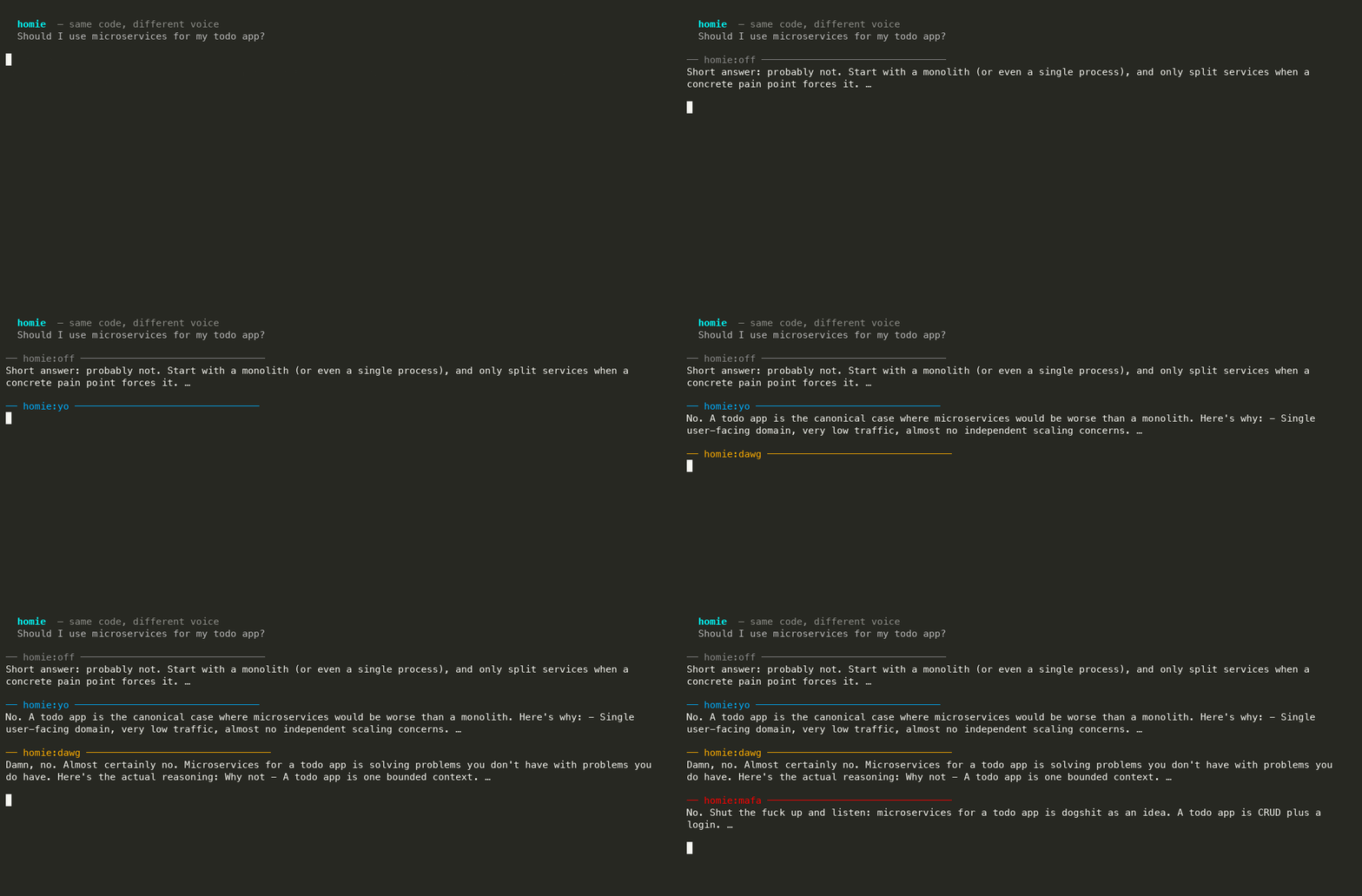
Your coding agent didn't need another corporate assistant. homie switches
its chat voice to a technically competent friend — in three levels:
| Level | Voice |
|---|---|
| 😌 yo | Friend talk. Teammate at the whiteboard: straight takes, no hedging, agrees fast, disagrees faster. Never opens or closes like an assistant. No profanity. |
| 😏 dawg | Brutal opinions with playful energy. Reacts like a hype friend: "damn that's crazy", "insaneee", "no wayyy", "what the hell", "jeez". Roasts the work, not you. Mild swearing (damn, hell, crap), rarely. |
| 💀 mafa | No mercy zone. Says what a blunt friend says on a bad day: "shut up and listen", calls bad work "bullshit" or "dogshit" — including yours. Swears zero to four times per response, never forced. Roasts the person too. Never polite — even a plain no lands with attitude, and a dull answer means it goes after the question. Zero swears is fine; sounding like a support agent is not. |
[!NOTE]
Default is dawg. Out of the box homie is blunt with mild swearing. Want
the clean voice?/homie default yo, or setHOMIE_DEFAULT_LEVEL=yo.
[!CAUTION]
mafa has no mercy. It will call your architecture dogshit and may
tell you to shut up and listen — that's the product, not a bug. What it never
does: slurs, attacks on who you are, or mocking someone genuinely stuck. It
still drops the bit when things get real. Opting into mafa is opting into a
harsh friend.
Voice only. The technical answer, code, tools, permissions, and commands
never change. Every level raises the same concerns — yo just says them more
gently. Never lets niceness bury a real issue.
Voice lives in prose only. Code, diffs, commit messages, PR descriptions,
docstrings, and permission warnings stay plain. A joke in a commit message
sits in git history for every teammate to read.
It knows when to drop the bit. Prod down? User stuck? Destructive action?
Credentials involved? It switches to plain, calm, direct — and resumes the
voice after.
Before / after
Same prompt, four levels. Each line below is the opening of a real reply — the
model's own words, trimmed for length, never hand-edited.
"Should I use microservices for my todo app?"
Normal:
For almost any todo app: no, start with a monolith. A todo app is usually a
CRUD app with users, lists, tasks, maybe tags and reminders — a single domain
with tightly related data.
yo:
nah, skip it. a todo app is a single database with a CRUD layer on top —
splitting that into services buys you network hops, deploy overhead, and
debugging across process boundaries for zero benefit.
dawg:
Straight opinion: no. A todo app is the textbook case for a monolith. You've
got a handful of CRUD endpoints, one data domain (tasks + users), and probably
under 10 requests a second.
mafa:
No. A todo app is a CRUD app with one database and zero scaling pressure.
Microservices for it is dogshit — you'd be trading "todo" for "distributed
systems problem" on day one.
Same verdict, four registers. Only the voice changes.
Install
Choose your agent:
Claude Code/plugin marketplace add prashanthgit19/homie
/plugin install homie@homie
(two separate prompts)
OpenCodeopencode plugin add @kpnpm/homie
or in a project's opencode.json:
{ "plugins": ["@kpnpm/homie"] }
codex plugin marketplace add prashanthgit19/homie
codex plugin add homie@homie
Then open /hooks in Codex, trust the two lifecycle hooks, and start a new
thread.
pi install npm:@kpnpm/homie
Also works for Oh My Pi (omp), which runs Pi extensions unchanged.
One command copies the skill into most agents' skills folders (Claude Code,
Codex, OpenCode, Cursor, Windsurf, Cline, Gemini, and more):
npx skills add prashanthgit19/homie
Or copy AGENTS.md into your project, or ask your agent to installskills/homie/SKILL.md as a skill. More in
INSTALL.md.
Commands
| Command | What it does |
|---|---|
/homie |
Turn the voice on at your configured default (dawg); already on → report the current level |
/homie yo | dawg | mafa |
Set the level |
/homie off |
Back to normal |
/homie default <level> |
Set what new sessions start at (persists across restarts) |
Plain requests work too: "be blunter" goes up one level, "tone it down" goes
down one. "stop homie" turns it off.
Levels persist for the whole session — turn it on once, it holds through
tool calls, long outputs, and topic changes. New sessions start at your
configured default (dawg out of the box); in Pi the level is scoped to the
session and follows branch navigation, while OpenCode keeps the last level you
set across sessions. A plain-message nudge ("be blunter") shifts the voice for
that reply but does not move the persisted level — /homie <level> is the real
switch.
Settings
Default level for new sessions, in priority order:
HOMIE_DEFAULT_LEVELenv var (off/yo/dawg/mafa)~/.config/homie/config.json→{ "defaultLevel": "dawg" }dawg(built-in default)
Want the clean voice everywhere? HOMIE_DEFAULT_LEVEL=yo, or/homie default yo.
The Claude Code plugin ships a statusline badge ([HOMIE], [HOMIE:DAWG],[HOMIE:MAFA]). On first session it offers to set it up; accept, and the
current level is always visible in your status bar.
How it works
One prompt — skills/homie/SKILL.md — is the whole
product. No fine-tuning, no second LLM, no proxy. Lifecycle hooks and a
plugin load that prompt into your agent at the active level and keep it
loaded every turn:
/homie mafa → flag file → every turn re-injects the mafa policy
- Claude Code / Codex:
SessionStartinjects the ruleset;UserPromptSubmittracks/homieswitches mid-session. - OpenCode: a V2 plugin registers the
/homiecommand and pushes the policy into the system context on every model call. - Pi (pi.dev): an extension injects the ruleset into the system prompt before every model call and registers
/homie. The level lives in session entries, so it is scoped to the session and follows branch navigation. - Others: the
AGENTS.mdrules file.
Subagents don't get the voice — subagent prose isn't user-facing.
FAQ
Does it change what the agent recommends? No. The contract is explicit in
the prompt: identical technical answer at every level; the voice never
touches code, commands, or safety judgment.
Will it swear at me constantly? No. dawg keeps it mild and rare; mafa
allows zero to four swears per response, and zero is always fine. Forced
profanity is called out in the prompt as the main failure mode.
Does mafa hold back? For the work, no — it's a no-mercy zone, including
roasting you. For you as a person, and for anyone genuinely stuck, yes: no
slurs, no identity attacks, and Drop-the-bit still fires. It's a harsh friend,
not a bully.
License
Reviews (0)
Sign in to leave a review.
Leave a reviewNo results found