quantum-lens
Health Pass
- License — License: MIT
- Description — Repository has a description
- Active repo — Last push 0 days ago
- Community trust — 13 GitHub stars
Code Pass
- Code scan — Scanned 2 files during light audit, no dangerous patterns found
Permissions Pass
- Permissions — No dangerous permissions requested
No AI report is available for this listing yet.
Analysis that sees what you don't. 7 cognitive lenses + solution engineering for Claude Code.
Quantum Lens



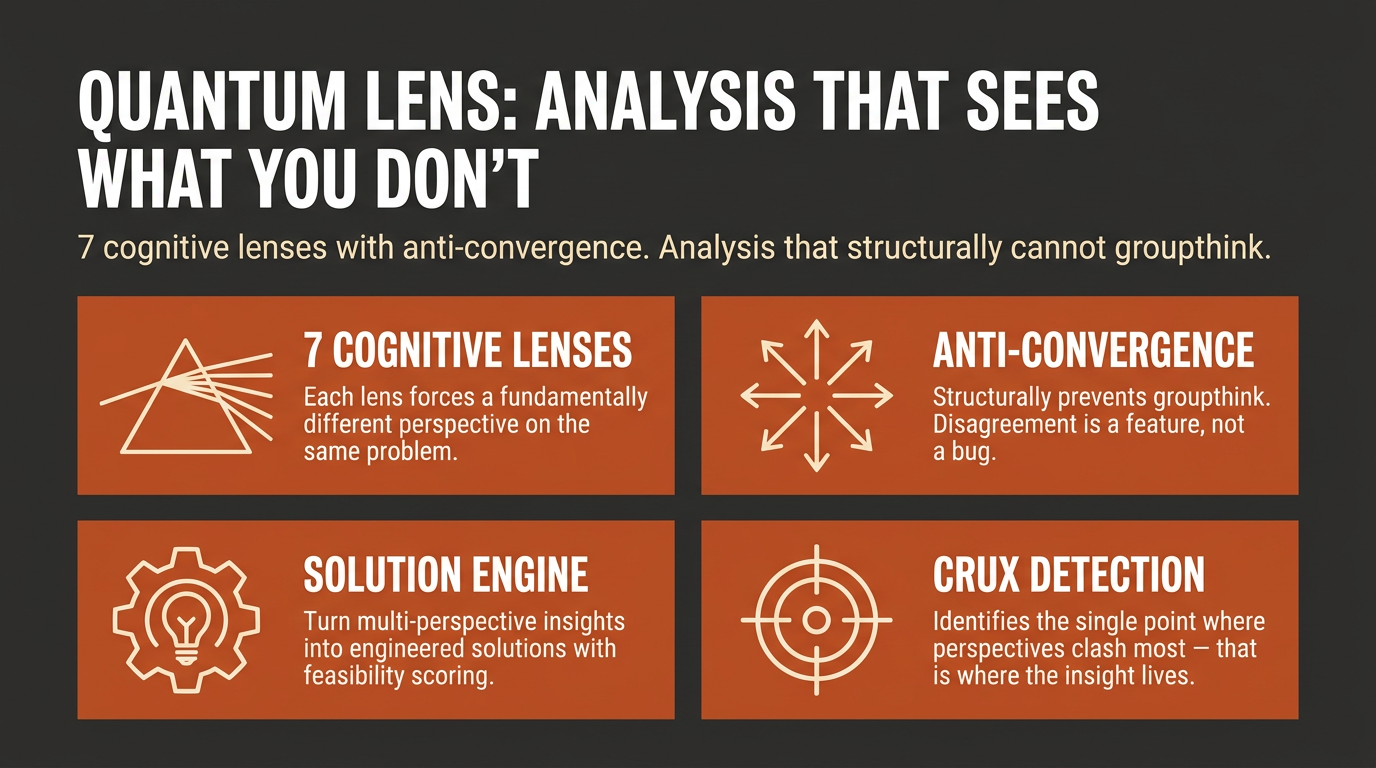
Analysis that sees what you don't. 7 cognitive lenses run in parallel, each with a structurally distinct way of perceiving your input. Where they agree - high confidence. Where they clash - breakthrough candidates. Where conventional tools give you one perspective, Quantum Lens gives you seven that can't converge even if they tried.
"Ran /quantum-lens on our pricing strategy doc. The Void Reader found we never
mentioned churn. The Failure Romantic found our 'competitive advantage' is actually
a dependency. The Killer Question collapsed 3 weeks of debate into one testable claim."
Quick Install
git clone https://github.com/primeline-ai/quantum-lens
cp -R quantum-lens/.claude/scenarios/quantum-lens your-project/.claude/scenarios/quantum-lens
Then in your project:
claude
# /quantum-lens "AI will replace knowledge workers by 2030"
# /quantum-solve https://github.com/primeline-ai/evolving-lite
# /quantum-full concept: the attention economy --depth deep
What Makes This Different
Two engines, not one. Perception Engine deconstructs. Solution Engine rebuilds. /quantum-full chains both - wild perception filtered through hard engineering constraints. The space between observation and action is where breakthroughs happen.
Structural anti-convergence. LLM agents prompted to "disagree" converge anyway (NeurIPS 2024). Quantum Lens enforces divergence through architecture: each lens has a computationally distinct cognitive mode, unique required output sections, and hard voice constraints. Convergence = suspicion, not confidence.
DSV-gated scoring. Every score passes through Decompose-Suspend-Validate. No point estimates - confidence bands with stated weakest assumptions. Score says 80%? You see exactly which assumption could make it 40%.
Barrier taxonomy with teeth. Every limitation gets classified: assumed (nobody questioned it), mutable (real but changeable), temporal (immutable today, not tomorrow), immutable (hard proof). Default is "assumed" - reverse the burden of proof.
3 tiers, zero lock-in. Works with just Claude Code. Add Firecrawl for URL scraping. Add Kairn for persistent memory. Each tier adds capabilities but nothing breaks without it.
5-Minute Quick Start
1. Analyze something
/quantum-lens "The attention economy is a myth"
/quantum-lens https://arxiv.org/abs/2502.12018 --depth deep
7 lenses decompose the input into atoms, each lens perceives it through a structurally different cognitive mode, interference patterns are detected, cruxes identified, and a Killer Question formulated.
2. Solve something
/quantum-solve "Context window fills too fast during multi-agent tasks"
/quantum-solve https://github.com/primeline-ai/universal-planning-framework --mode repo
/quantum-solve "contra: you need a CS degree to build production AI" --cascade
Three modes: evaluate a repo (repo), break through a limitation (problem), challenge accepted status quo (contra). Contra-mode with --cascade finds who already broke the limit, then runs full analysis on their approach.
3. Full pipeline
/quantum-full "AI agents will replace 80% of knowledge workers" --depth deep --solve-mode contra
Perception (all 7 lenses) -> Smart Filter -> Solution Engine -> Combined Report. One input, two engines, one actionable output.
The 7 Cognitive Lenses
| Lens | What It Sees | Cognitive Mode |
|---|---|---|
| Void Reader | What's absent - missing concepts, unstated premises | Negative space cognition |
| Paradox Hunter | Self-contradictions that are features, not bugs | Dialectical synthesis |
| Boundary Dissolver | Artificial category boundaries | Holistic integration |
| Temporal Archaeologist | Frozen processes, arrested trajectories | Dynamic systems thinking |
| Scale Shifter | Same pattern at radically different scales | Fractal/spatial reasoning |
| Failure Romantic | Information density in dead ends | Inversion reasoning |
| Interference Reader | Patterns between patterns (meta) | Cross-domain structural mapping |
Not personas. Not "different expert opinions." Computationally distinct cognitive strategies modeled on neurodiverse processing styles (autistic systemizing, ADHD divergent linking, dyslexic spatial reasoning).
Commands
| Command | What It Does |
|---|---|
/quantum-lens <input> |
Multi-perspective perception analysis (8-section report) |
/quantum-solve <input> |
Solution engineering (7-section report) |
/quantum-full <input> |
Complete pipeline: perception + solution |
/quantum-review |
Review past analyses, track lens effectiveness, surface recurring cruxes |
/lens-calibrate |
Customize lenses, adjust depth defaults, add custom lenses |
Depth Modes (Perception)
| Mode | Lenses | Best For |
|---|---|---|
quick |
2 (Void Reader + Failure Romantic) | Tweets, quick takes, time pressure |
standard |
4 (+ Paradox Hunter + Boundary Dissolver) | Articles, frameworks (default) |
deep |
6 (all workers) | Complex papers, paradigm-level ideas |
Solution Modes
| Mode | Trigger | Question |
|---|---|---|
repo |
URL present | "Can we use this? How do we adapt it?" |
problem |
Problem description | "How do we break through this limitation?" |
contra |
"contra:" prefix | "Why do we accept this limit? Who already broke it?" |
3 Tiers
| Tier | What You Need | What You Get |
|---|---|---|
| Core | Claude Code only | Full perception engine, solution engine in general analysis mode |
| Web-enhanced | + Firecrawl MCP | URL scraping, repo analysis, web search for counter-examples |
| Full | + Kairn MCP | Persistent insight storage, cross-analysis patterns, effectiveness tracking |
All tiers work out of the box. See SETUP.md for installation details per tier.
System Context (Optional)
For the Solution Engine to map insights against YOUR system, fill in the template files in system-context/:
SYSTEM-MAP.md- Your component inventoryarchitecture.md- How components connectproject-goals.md- Current goals and blockers
Without these: perception works fully, solution engine operates in general analysis mode.
With these: system-specific adaptation roadmaps with file paths.
How It Works
Perception Pipeline
INPUT -> Intake (AoT decomposition) -> Parallel Lenses -> Interference Detection -> Synthesis
Solution Pipeline
INPUT -> Mode Detection -> System Scan -> Engineering (reverse-engineer + adapt) -> DSV Synthesis
Combined (/quantum-full)
INPUT -> Perception (all phases) -> Smart Filter -> Solution Engine -> Combined Report
Scoring
Breakthrough Score (Perception)
- 1-3: Conventional reframing
- 4-6: Non-obvious connection
- 7-8: Genuine breakthrough (auto-saved)
- 9-10: Paradigm-level (extended analysis saved)
Solution Scoring
- Confidence bands, not point estimates (e.g., "60-85%, medium confidence")
- Every score passes a DSV gate (Decompose-Suspend-Validate)
- Action Gate: >= 70% triggers implementation plan draft
Research Foundations
Built on peer-reviewed research, not vibes:
| Source | What We Took |
|---|---|
| PRISM Framework (Diamond 2025) | Cognitive modes grounded in neuroscience |
| Multi-LLM Debate (NeurIPS 2024) | Anti-convergence rules (same-model debate converges to shared misconceptions) |
| Quantum Abduction (Pareschi 2025) | Synthesis before pruning - let contradictions interfere |
| Atoms of Thought (Teng 2025) | AoT decomposition with Markov property |
| Structure-Mapping (Gentner 1986+) | Cross-lens isomorphism detection |
| Adversarial Collaboration (FRI 2024) | CRUX identification from structured disagreement |
| Superpositional Belief (2026) | Deferred commitment - ambiguity as structured output |
Full source registry: .claude/scenarios/quantum-lens/knowledge/inspirations/index.md
The Ecosystem
Quantum Lens is part of a progression. Each tier works independently - no hard dependencies.
You're here          You want this            Install this
-----------          -------------            ------------
Raw Claude Code  ->  Session memory       ->  Starter System (free)
                 ->  Workflow skills      ->  + Skills Bundle (free)
                 ->  Deep planning        ->  + UPF (free)
                 ->  Deep analysis        ->  + Quantum Lens (free) <- you are here
                 ->  AI-powered system    ->  + Course (paid)
| Component | What It Does | Link |
|---|---|---|
| Starter System | Session memory, handoffs, context awareness | GitHub |
| Skills Bundle | 5 workflow skills: debugging, delegation, planning, code review, config architecture | GitHub |
| UPF | Universal Planning Framework with deep multi-stage planning | GitHub |
| Quantum Lens | Multi-perspective analysis + solution engineering | You're reading it |
| Course | Kairn + Synapse: AI-powered memory and knowledge graphs | primeline.cc |
How They Work Together
Quantum Lens references ecosystem components with "if available" language:
- DSV scoring gates use the methodology from UPF (included as
knowledge/dsv-reference.md) - Kairn persistence provides cross-analysis patterns via
/quantum-review(falls back to local files) - Solution Engine action gate can trigger plan creation (works with any planning tool, enhanced with UPF)
If nothing else is installed, Quantum Lens works perfectly on its own.
License
MIT - see LICENSE.
Part of the PrimeLine Ecosystem
| Tool | What It Does | Deep Dive |
|---|---|---|
| Evolving Lite | Self-improving Claude Code plugin — memory, delegation, self-correction | Blog |
| Kairn | Persistent knowledge graph with context routing for AI | Blog |
| tmux Orchestration | Parallel Claude Code sessions with heartbeat monitoring | Blog |
| UPF | 3-stage planning with adversarial hardening | Blog |
| Quantum Lens | 7 cognitive lenses for multi-perspective analysis | Blog |
| PrimeLine Skills | 5 production-grade workflow skills for Claude Code | Blog |
| Starter System | Lightweight session memory and handoffs | Blog |
Reviews (0)
Sign in to leave a review.
Leave a reviewNo results found