universal-planning-framework
Health Pass
- License — License: MIT
- Description — Repository has a description
- Active repo — Last push 0 days ago
- Community trust — 36 GitHub stars
Code Warn
- Code scan incomplete — No supported source files were scanned during light audit
Permissions Pass
- Permissions — No dangerous permissions requested
No AI report is available for this listing yet.
A thinking process, not a template. 3-stage planning framework for Claude Code that catches the gaps plans always miss.
Universal Planning Framework



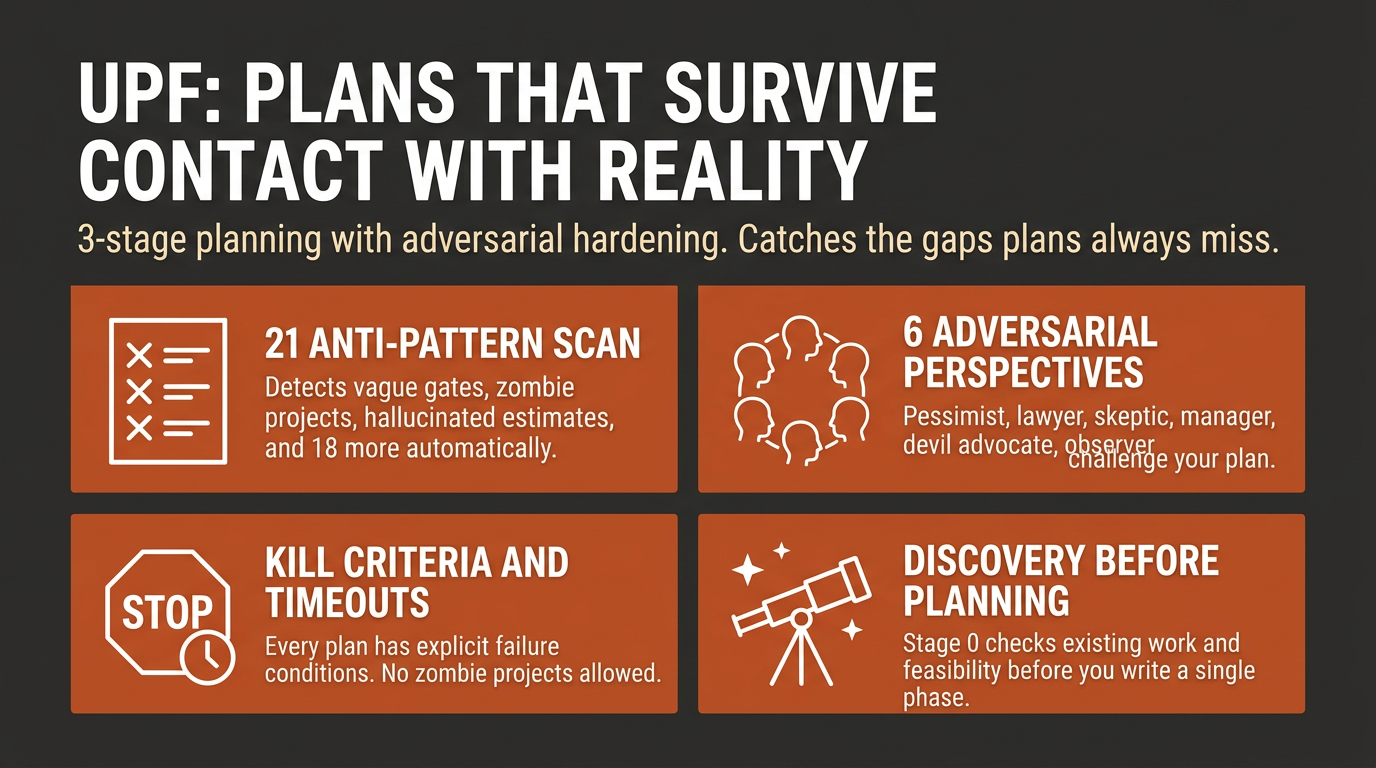
Plans fail because discovery happens too late. This framework catches gaps that only surface during execution - evolved from 117 real plans + 195 handoffs.
"Initial idea was a custom booking system (8 weeks). Stage 0 discovered Calendly + Stripe does 90% of it. Shipped in 3 weeks, saved 5 weeks of engineering."
Quick Install
Full install (recommended - gives you commands, agent, and rule):
git clone https://github.com/primeline-ai/universal-planning-framework
cp -r universal-planning-framework/.claude/* your-project/.claude/
Minimal install (rule file only):
mkdir -p .claude/rules
curl -o .claude/rules/universal-planning.md \
  https://raw.githubusercontent.com/primeline-ai/universal-planning-framework/main/.claude/rules/universal-planning.md
What Makes This Different
Formal reasoning foundation (DSV). Most plans fail not because validation is missing, but because the wrong question gets validated. The framework is built on Decompose-Suspend-Validate - a principle that forces you to challenge your interpretation before committing to it. See Theoretical Foundation below.
FAILED conditions are mandatory. Every plan must define when to kill the project - not just when it succeeds. No FAILED condition = zombie project (anti-pattern #11).
21 anti-patterns with detection rules. Not guidelines - specific detection rules that catch vague gates ("looks good"), hallucinated estimates, assumed facts, discovery amnesia, and 17 more. Categorized as 12 Core + 5 AI-Specific + 4 Quality.
Autonomous hardening (Stage 1.5). Run /plan-refine and 6 adversarial perspectives stress-test your plan without asking you a single question. The Pedantic Lawyer catches vague gates. The Devil's Advocate challenges your core assumption. You get back a hardened plan with a change log.
Quality rubric with teeth. Grade C/B/A based on objective criteria. Numbers need sources. Gates must be observable. Delegated work needs input/output specs. FAILED conditions must be measurable.
Behavior specs + acceptance criteria. Optional Behavior Description (tech-agnostic, what the feature does) and Given/When/Then acceptance criteria give plans testable behavior coverage without forcing a separate spec document.
Reference Library. For coding domains, plans must link the official docs they consulted - so the person maintaining the output has the same sources.
8 domain detection. Software, AI/Agent, Business, Content, Infrastructure, Data & Analytics, Research, Multi-Domain. Each domain auto-includes relevant sections.
5-Minute Quick Start
1. Create a plan
/plan-new "Add OAuth login to Next.js app"
Claude runs through 3 stages:
- Stage 0: Discovers existing work, checks feasibility, challenges your approach (AHA Effect)
- Stage 1: Builds the plan with 5 CORE sections, domain-specific CONDITIONAL sections, and a confidence level
- Stage 1.5: Autonomously hardens the plan from 6 adversarial perspectives
- Stage 2: Meta-checks including Cold Start Test and Discovery Consolidation
2. Interview an existing plan
/interview-plan path/to/plan.md
Framework-aware questions across 3 tiers: critical gaps, domain-specific probes, quality strengthening. Includes DSV checks for premature commitment and assumption mutation. References anti-patterns by number.
3. Review plan quality
/plan-review path/to/plan.md
Objective assessment against the rubric. Returns grade, anti-patterns found, and top 3 improvements.
4. Harden a plan autonomously
/plan-refine path/to/plan.md
6 perspectives stress-test the plan. Fixes structural issues, flags strategic decisions for you.
Theoretical Foundation: DSV
The framework is built on Decompose-Suspend-Validate (DSV) - a reasoning principle that prevents premature commitment at every stage of planning.
Most planning failures share a root cause: the planner validates an assumption without first questioning whether it's the right assumption. You check "Can we build X in 4 weeks?" when the real question is "Should we build X at all?" DSV prevents this by structuring thought into three phases:
| Phase | What it does | Framework mapping |
|---|---|---|
| Decompose | Break the problem into discrete, testable claims | Stage 0 checks 0.1-0.6 (Existing Work, Facts, Docs, Updates, Practices, Research) |
| Suspend | Challenge each claim - explore alternative interpretations before committing | Stage 0 checks 0.7-0.12 (Feasibility, ROI, AHA Effect, Competitive, Constraints, People Risk) |
| Validate | Test each claim independently with explicit methods and failure impacts | Stage 1 Assumptions section (VALIDATE BY + IMPACT IF WRONG) |
The key insight is Suspend. Decomposing is natural. Validating is expected. But actively suspending your first interpretation - asking "what if this means something entirely different?" - is what most planners skip. That's why Stage 0's sparring checks (0.7-0.12) exist.
Quick DSV (3 questions, 30 seconds)
For time-pressured situations, DSV compresses to three questions:
- "What are the 2-3 key claims?" (Decompose)
- "What alternative interpretation haven't I considered?" (Suspend)
- "Which claim am I least sure about?" (Validate that one first)
This works standalone - even without the full framework. Use it before any decision where you catch yourself feeling "obvious."
The Framework
Stage 0: Discovery (Before Planning)
12 checks in 3 priority tiers. The agent decides which to run based on context. Maps directly to the DSV phases above: checks 0.1-0.6 decompose, 0.7-0.12 suspend, Stage 1 Assumptions validates.
| Tier | Checks |
|---|---|
| Always | Existing Work, Feasibility, Better Alternatives (AHA Effect) |
| Usually | Factual Verification, Official Docs, ROI |
| Context-dependent | Updates, Best Practices, Deep Research, Competitive, Constraints, People Risk |
The AHA Effect (Check 0.9) is the single most valuable check:
- Custom CMS planned? "Strapi does 90% of it."
- 50 blog posts? "5 pillar posts + derivatives might outperform."
- Building from scratch? "This open-source project does 80%."
Stage 1: The Plan
5 CORE sections (always required): Context & Why (+ optional Behavior Description), Success Criteria (with FAILED conditions + optional GWT acceptance criteria), Assumptions (with VALIDATE BY + IMPACT IF WRONG), Phases (with binary gates + review checkpoints), Verification (Automated + Manual + Ongoing Observability).
Optional structured formats: Behavior Description captures what a feature DOES in tech-agnostic language (3-5 sentences). Given/When/Then acceptance criteria complement FAILED conditions — FAILED covers what must NOT happen, GWT covers what MUST happen.
18 CONDITIONAL sections (domain-detected): Rollback, Risk, Post-Completion, Budget, User Validation, Legal, Security, Resume Protocol, Incremental Delivery, Delegation, Dependencies, Related Work, Timeline, Stakeholders, Reference Library, Learning & Knowledge Capture, Feedback Architecture, Completion Gate.
Coding domains size phases by scope (files, features, tests), not hours. Non-coding domains use time estimates as rough guides.
Plan Confidence Level: High / Medium / Low - assigned at plan header. Low confidence = Phase 1 must be a validation sprint.
Stage 1.5: Autonomous Hardening (Optional)
6 adversarial perspectives stress-test the plan:
- Outside Observer - Goal clarity, End State, ambiguous metrics
- Pessimistic Risk Assessor - Single failure points, FAILED condition timeouts
- Pedantic Lawyer - Vague gates, delegation contracts, deployment completeness
- Skeptical Implementer - First blocker, unverified facts, cold start readiness
- The Manager - Resume Protocol, scope realism, deadline acknowledgment
- Devil's Advocate - Core assumption validity, 80/20 path, obsolescence risk
Structural fixes applied in place. Strategic decisions flagged as [Stage 1.5 Note:] for user review. Hardening Log appended as audit trail.
Stage 2: Meta (7 Checks)
Delegation Strategy, Research Needs, Review Gates, Anti-Pattern Check (21), Cold Start Test, Plan Hygiene Protocol, Discovery Consolidation.
Domain Detection
| Domain | Key Sections | Phase Sizing | Review Frequency |
|---|---|---|---|
| Software Development | Rollback, Risk, Delegation, Reference Library | Scope-based | Every 2 phases |
| Multi-Agent / AI | Risk, Delegation, Security, Reference Library | Scope-based | Every 2 phases |
| Business / Strategy | Timeline, Budget, Stakeholders, Validation | Time-based | Per milestone |
| Content / Marketing | Timeline, Validation, Legal, Feedback Architecture | Time-based | Per draft |
| Infrastructure / DevOps | Rollback, Risk, Dependencies, Reference Library | Mixed | Every phase |
| Data & Analytics | Risk, Rollback, Legal, Security, Reference Library | Mixed | Every phase |
| Research / Exploration | Incremental, Budget, Related Work, Learning | Time-based | Per finding |
| Multi-Domain | Union of matched domains | Most conservative | Most conservative |
Quality Rubric
| Grade | Criteria |
|---|---|
| C (Viable) | All 5 CORE + 1 CONDITIONAL. No critical anti-patterns (#3, #9, #11, #20, #21). |
| B (Solid) | C + Stage 0 + FAILED conditions + Confidence Level + Cold Start Test. Zero anti-patterns. |
| A (Excellent) | B + sparring (0.7-0.9) + Review Checkpoints + Reference Library (coding) + Replanning triggers. |
| Red Flags | Vague criteria, no FAILED conditions, assumptions untested, numbers without sources, delegated work without specs. Fix before implementing. |
When to Activate
Use for: New features, architecture changes (3+ files), multi-phase projects, anything with external dependencies.
Skip when ALL true: Single file, no external dependencies, <50 lines, no schema change, no user-facing change, rollback = git revert.
Philosophy
Traditional planning: Goal - Approach - Steps - Execute - "Oh crap, we didn't consider X."
This framework inverts it: Discovery - Constraints - Assumptions - THEN plan.
Stage 0 is where you find out your "simple feature" touches 6 systems, the existing code does 70% of what you need, your timeline was off by 3x, and there's a legal requirement you didn't know about.
The DSV principle explains why this works: most "overlooked" requirements weren't missing from the problem space - they were missing from the planner's interpretation of it. By forcing decomposition and suspension before validation, the framework catches gaps at the cheapest possible moment: before a single line of the plan is written.
The framework is domain-agnostic. Use it for software features, business launches, content creation, data pipelines, research projects - anything that needs a plan.
Examples
| Example | Domain | Grade | Key Features |
|---|---|---|---|
| Business Launch | Business / Strategy | A | AHA Effect saved 6 weeks, 8 sub-phases, full CONDITIONAL suite |
| Content Creation | Content / Marketing | B | 11 sub-phases, code examples, Resume Protocol |
| Software Feature | Software Development | B | OAuth implementation, Security section, Reference Library |
| Infrastructure CI/CD | Infrastructure / DevOps | A | Resume Protocol, Rollback, Reference Library, Review Checkpoints |
Contributing
See CONTRIBUTING.md for guidelines. Key requirements:
- Example plans must pass their own anti-pattern self-audit honestly
- Use grades C/B/A only (no B+, A-, etc.)
- Coding examples must include a Reference Library
Found a gap the framework doesn't catch? Open an issue.
The Ecosystem
UPF is one piece of a progression. Each tier works independently - no hard dependencies.
You're here          You want this            Install this
-----------          -------------            ------------
Raw Claude Code  ->  Session memory       ->  Starter System (free)
                 ->  Workflow skills      ->  + Skills Bundle (free)
                 ->  Deep planning        ->  + UPF (free) <- you are here
                 ->  Deep analysis        ->  + Quantum Lens (free)
                 ->  AI-powered system    ->  + Course (paid)
| Component | What It Does | Link |
|---|---|---|
| Starter System | Session memory, handoffs, context awareness | GitHub |
| Skills Bundle | 5 workflow skills: debugging, delegation, planning, code review, config architecture | GitHub |
| UPF | Universal Planning Framework with deep multi-stage planning | You're reading it |
| Quantum Lens | Multi-perspective analysis + solution engineering (7 cognitive lenses) | GitHub |
| Course | Kairn + Synapse: AI-powered memory and knowledge graphs | primeline.cc |
The Skills Bundle includes a lightweight plan-and-execute skill for everyday planning. UPF is the deep version - use it when the stakes are high enough to justify Stage 0 discovery.
License
MIT License - see LICENSE file.
Part of the PrimeLine Ecosystem
| Tool | What It Does | Deep Dive |
|---|---|---|
| Evolving Lite | Self-improving Claude Code plugin — memory, delegation, self-correction | Blog |
| Kairn | Persistent knowledge graph with context routing for AI | Blog |
| tmux Orchestration | Parallel Claude Code sessions with heartbeat monitoring | Blog |
| UPF | 3-stage planning with adversarial hardening | Blog |
| Quantum Lens | 7 cognitive lenses for multi-perspective analysis | Blog |
| PrimeLine Skills | 5 production-grade workflow skills for Claude Code | Blog |
| Starter System | Lightweight session memory and handoffs | Blog |
Reviews (0)
Sign in to leave a review.
Leave a reviewNo results found