cc-equity-research
Health Warn
- License — License: Apache-2.0
- Description — Repository has a description
- Active repo — Last push 0 days ago
- Low visibility — Only 6 GitHub stars
Code Pass
- Code scan — Scanned 1 files during light audit, no dangerous patterns found
Permissions Pass
- Permissions — No dangerous permissions requested
No AI report is available for this listing yet.
Turn Claude Code into an equity-research agent: 24 analysis skills (Anthropic's open-source bundle + community), a single data MCP, and a personalization layer for investors at any level.
CC Equity Research Toolkits
A self-contained repo that turns your Claude Code into an equity-research agent. Unlocks Anthropic's official equity-research skills for every investor — a single data MCP that replaces a $150K-per-year institutional data stack, and a personalization layer that caters to sell-side analysts, portfolio managers, retail investors, and academic economists alike.
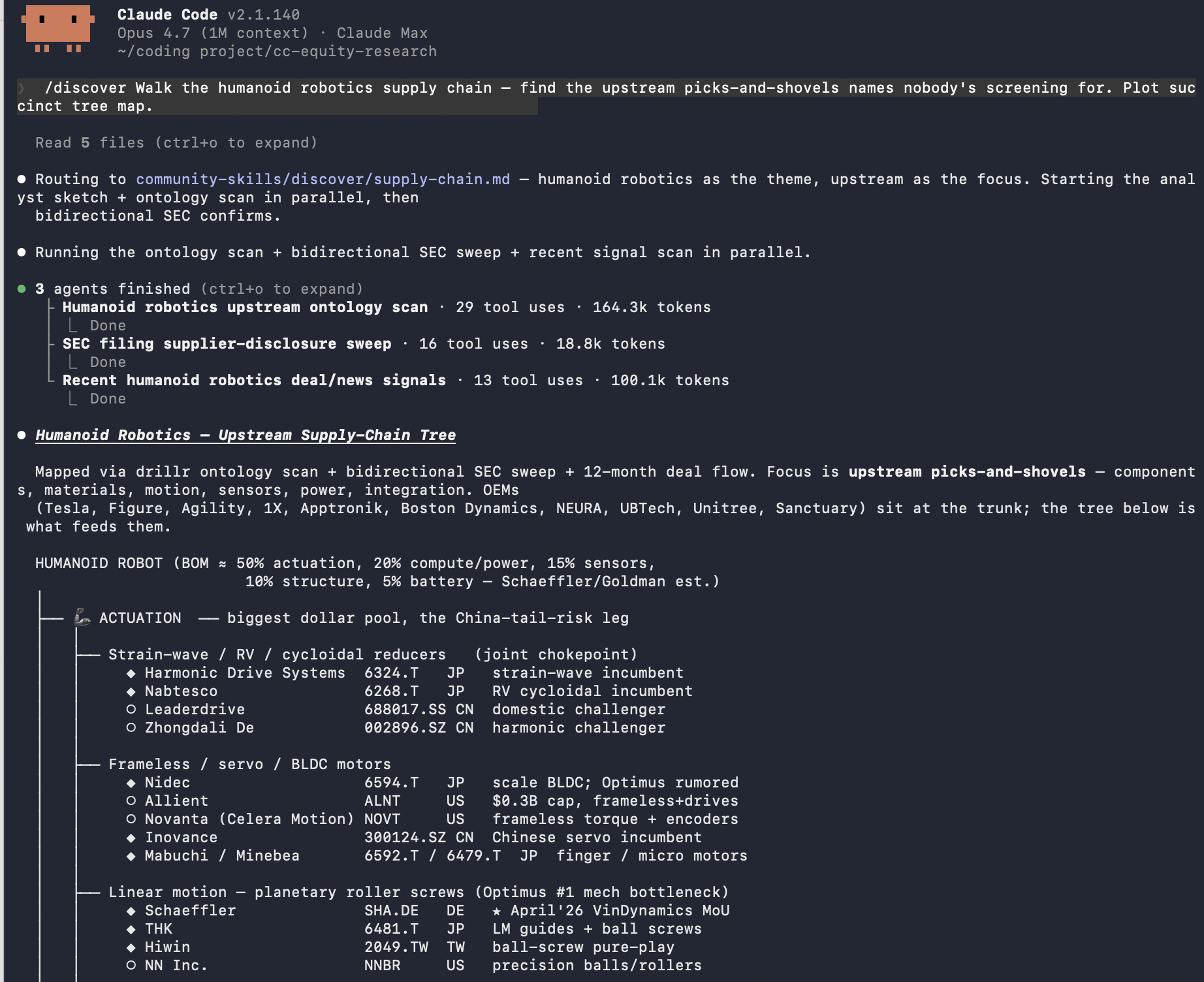
Three components make it work:
Skill library. 24 analysis workflows — Anthropic's official Apache-licensed equity-research bundle (9 skills) plus a community-maintained library (15 skills). Covers idea discovery, single-company deep dives, position monitoring, and macro research.
Accessible interface. Claude speaks to you according to your financial proficiency and preferences — adapting tone, depth, and jargon density to match a sell-side analyst, a portfolio manager, a retail investor, or an academic economist. Four unified slash commands —
/discover,/analyze,/monitor,/macro— auto-route plain-language requests across all 24 skills.Single data MCP.
drillrconsolidates everything the skills need: structured financial metrics, SEC filings, earnings-call transcripts, company ontology (suppliers / customers / competitors), alternative data (federal contracts, hiring, patents, trade flows), and macro / market context. Covers US and Japanese equities. Generous free quota for individual users.
Why we build this:
Anthropic recently open-sourced an excellent equity-research skill bundle — nine institutional workflow templates (initiation note, earnings analysis, catalyst calendar, morning note, thesis tracker, and more). They significantly raise Claude Code's ceiling for equity work. Two gaps remain.
Expensive data connector. The Anthropic skills are pure methodology — no data ships with them, so you have to wire in your own connectors. Anthropic's official reference repo wires the skills to eleven institutional MCPs — FactSet, LSEG, S&P Global, Morningstar, Moody's, PitchBook, and others — typically $15–30K per seat per year each, well over $150K combined. Out of reach for independent analysts, academic economists, and anyone running serious workflows without an institutional budget.
Targets sell-side professionals, no accessibility layer. The bundle's templates are built around the daily output of an equity research desk — initiation notes, morning notes, earnings previews. The concepts are universal; the jargons (A/E year notation, basis-point shorthand, sell-side report shapes) read arcane to retail investors and to academics doing exploratory company-level work. Out of the box, the agent doesn't adapt to the user's financial fluency or preferred tone.
This project addresses both. The drillr MCP consolidates the eleven-MCP stack into a single connector with a generous free quota; a memory-driven interface layer adapts the output register to whoever is at the keyboard.
Install
You need Claude Code installed.
git clone https://github.com/prof-little-bear/cc-equity-research.git
cd cc-equity-research
claude
Inside Claude Code, run /mcp to check the drillr connection and authenticate if prompted (the repo's .mcp.json declares the server — Claude Code picks it up on launch). After that you're ready — type what you want, or fire one of the four slash commands.
Interface — four slash commands
Each command opens a short menu of lenses in that category. Pick one by name, or just describe what you want and the dispatcher routes from there.
| Command | Category | What it covers |
|---|---|---|
/discover |
Idea generation | themes, supply chain, alt-plays, federal contracts; plus Anthropic's idea-generation (systematic screens) and sector-overview |
/analyze |
Single-company deep work | business model, earnings scorecard, forensics, reporting drift, management; plus Anthropic's initiating-coverage, earnings-preview, earnings-analysis, model-update |
/monitor |
Position tracking | watchlist, thesis check, event radar; plus Anthropic's thesis-tracker, catalyst-calendar, morning-note |
/macro |
Economic research | yield curve, trade flows, labor market |
Plain language works too. "Run forensics on NKE", "what's coming up for PLTR over the next 6 weeks", "is the labor market softening" — Claude routes through CLAUDE.md's intent map directly to the skill. The slash commands are the discoverability layer; plain language is the power-user layer. Same skills underneath.
Examples: /analyze NKE forensics → runs financial forensics on Nike. /macro → opens the macro menu. /discover what's working in AI infra → routes to themes.
The slash surface stays at four commands no matter how many skills get added — new skills are added inside the dispatchers, not as new commands.
Modes — adapting to the user
Two project-local files shape every response. This is the layer that addresses Problem #2 — same analytical rigor, different register depending on who's at the keyboard.
.claude/mode.md—new(default) shows orientation on session start;experiencedskips it. Switch by editing the file or telling Claude "I'm experienced now.".claude/style.md— four fields control how Claude communicates:experience(experienced / intermediate / learning),depth(quick / balanced / deep),tone(professional / institutional / conversational / educational), and optionalcoverage(sector focus). Defaults are sophisticated-but-accessible.
Claude reads both at session start, applies them every turn, and absorbs preference shifts mid-conversation. Start using A/E notation casually and tone promotes to institutional. Ask what a term means and experience shifts to intermediate. The file updates and the change is confirmed in one line.
Note: these files are project-local — they live inside the repo, not in Claude Code's cross-session auto-memory. Cloning to a different machine means starting fresh unless you sync the repo.
Skills
Anthropic bundle (anthropic-equity-research-skills/) — nine workflow templates vendored from anthropics/financial-services (Apache 2.0): initiating-coverage, earnings-preview, earnings-analysis, model-update, morning-note, catalyst-calendar, thesis-tracker, idea-generation, sector-overview.
Community extension (community-skills/) — fifteen analyst-contributed lenses across four areas: discover/ (themes, supply-chain, alt-plays, gov-contracts), analyze/ (business-model, earnings-scorecard, financial-forensics, reporting-quality, management), monitor/ (watchlist, thesis-check, event-radar), economic-research/ (yield-curve, trade-flows, labor-market).
Each skill is a short markdown file — read one to see exactly what it does.
Data — the drillr MCP
One MCP backs every skill. Six data domains:
- Structured fundamentals — statements, 60+ standardized metrics, consensus estimates
- SEC filings — 10-K, 10-Q, 8-K, proxy, S-1, S-4 with full-text search
- Earnings calls — transcripts and structured summaries
- Company ontology — suppliers, customers, competitors, peer groups, founder backgrounds
- Alternative data — federal contracts, hiring, web/app metrics, patents, trade flows, insider transactions
- Macro and market context — rates, credit, labor, sentiment, indices, commodities, FX, crypto
Sourced directly from primary sources (SEC EDGAR, company IR pages, government databases, customs filings, public market venues) via agentic AI — not resold proprietary feeds. Generous free quota for individual users; no FactSet, LSEG, S&P Global, or Morningstar subscription required.
Coverage: US equities, Japan equities, and ADRs. You don't write SQL — describe what you need, and Claude pulls the data when a skill runs.
Contributing
Community-skill contributions are very welcome — they're the part of the toolkit that gets sharper as working analysts share what they actually do.
Three small edits for any new community skill:
- Add the skill file itself in
community-skills/<area>/ - Add a one-line entry to the capability map in
CLAUDE.md - Add a row to the matching dispatcher's menu in
.claude/commands/<area>.md
Then submit a PR. The Anthropic bundle is vendored upstream — suggested changes there belong in anthropics/financial-services, not in this repo.
See CONTRIBUTING.md for the skill template, what good skills look like, and review expectations.
License
The toolkit (community skills, scaffolding, dispatchers, documentation) is licensed under Apache 2.0 — see the top-level LICENSE file. The vendored Anthropic equity-research bundle is also Apache 2.0; see anthropic-equity-research-skills/NOTICE.md for attribution and the upstream-sync command.
About
Used in this project:
- anthropics/financial-services — Anthropic's open-source equity-research skill bundle, vendored at
anthropic-equity-research-skills/(Apache 2.0) - Drillr — the single data MCP backing every skill (fundamentals, SEC filings, company ontology, alt-data, macro / market signals)
Reviews (0)
Sign in to leave a review.
Leave a reviewNo results found