eklavya
Health Warn
- License — License: MIT
- Description — Repository has a description
- Active repo — Last push 0 days ago
- Low visibility — Only 6 GitHub stars
Code Pass
- Code scan — Scanned 12 files during light audit, no dangerous patterns found
Permissions Pass
- Permissions — No dangerous permissions requested
No AI report is available for this listing yet.
Learn while your agent works. A Claude Code plugin that quizzes you on the concepts behind the code it just wrote — local knowledge graph, spaced repetition, optional commit gate.

Eklavya
Learn while your agent works.
Named for Ekalavya, who mastered archery practicing before a silent statue of his guru. Here, the statue talks back.
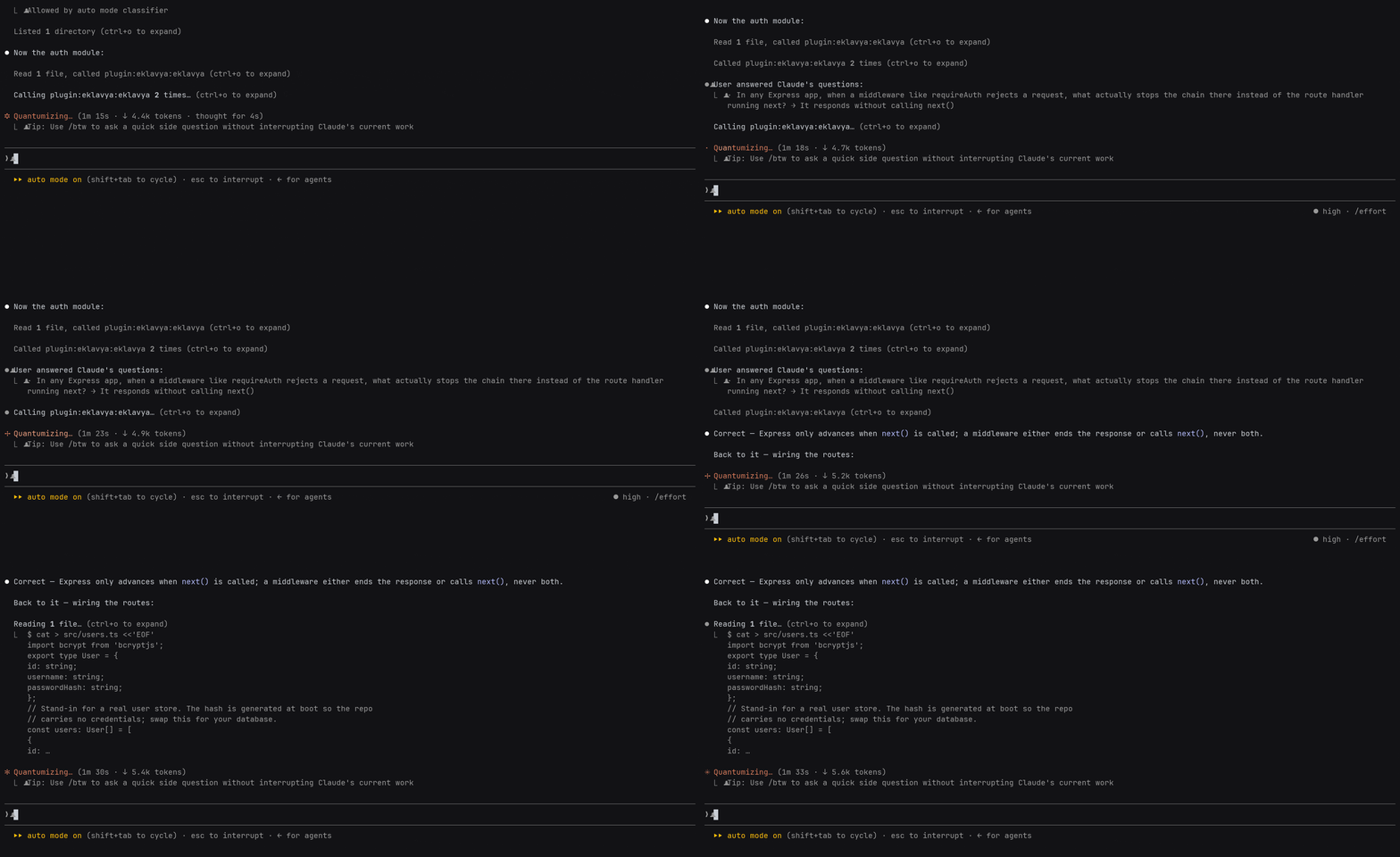


Eklavya is a Claude Code plugin that turns agent generation time into learning
time. While Claude Code implements your task, Eklavya teaches you the concepts
behind that exact work — adaptive Socratic questions grounded in the diff it
just wrote, mastery tracked in a local knowledge graph, and optionally a commit
gate until you can show you understood it.
Coding agents create a comprehension gap: you ship code you didn't write and
couldn't debug. The moment that code is being generated is the highest-leverage
teaching moment there is — the concepts are concrete, the code is on your screen,
and your hands are free. So Eklavya asks you about it, once per task, never the
same question twice, and harder each time you get it right.
Everything is local. No accounts, no sync, no telemetry.
→ Read the docs
Install
Needs Node 22+. Nothing else, on macOS, Linux or Windows.
npm install -g eklavya && eklavya install
That gives you the plugin and the eklavya command. Then run /eklavya:setup
inside Claude Code to choose a mode.
You can also install from the plugin marketplace inside Claude Code, with one
caveat about what a slash command is allowed to do — both routes and the caveat
are in Installing.
How it works
You ask for something. Claude logs what the work touches, and that logging call
triggers a checkpoint: one multiple-choice question about the concept it just
logged, asked while the code is still on your screen. You answer in a couple of
seconds and Claude carries straight on. When the task finishes, at most one more
question — never a pile.
Tier 1 asks what a thing is. Tier 5 asks when it is the wrong approach. You climb
as you get things right, which is how "never ask the same question twice"
survives contact with a finite concept graph. Difficulty is earned per project,
so a codebase you have just met starts easy however senior you are.
The manual
| Installing | Both routes, prerequisites, uninstalling |
| The four dials | mode, focus, cadence, difficulty — what each one changes |
| Levels and tiers | How difficulty is earned, and what each tier asks |
| Command reference | Every /eklavya:* command — or just ask in plain English |
| Configuration | Every key, its default, and which file wins |
| The commit gate | Enforced mode, and the git hook that works outside Claude Code |
| Your data | Where the database lives and what never leaves the machine |
| Troubleshooting | When the loop is silent, and how to check why |
For tutoring that runs during generation in a second pane — one session
teaching while the other builds, sharing one database — seedocs/parallel-tutoring.md.
Stars
Contributing
Development setup, the manual test scripts and the release process are inCONTRIBUTING.md.
License
MIT
Reviews (0)
Sign in to leave a review.
Leave a reviewNo results found