Pulse
Health Warn
- No license — Repository has no license file
- Description — Repository has a description
- Active repo — Last push 0 days ago
- Community trust — 24 GitHub stars
Code Warn
- process.env — Environment variable access in src/lib/config.ts
- network request — Outbound network request in src/watchers/helius.ts
Permissions Pass
- Permissions — No dangerous permissions requested
This tool is a short-horizon order-flow engine for Solana. It analyzes on-chain trade data to detect aggressive buying momentum and alerts users before significant market movements become obvious on standard charts.
Security Assessment
The overall security risk is Low. The tool makes outbound network requests, which is an expected behavior as it relies on the Helius Solana RPC API to ingest transaction data. It accesses local environment variables to securely load configuration settings like API endpoints or keys, meaning there are no hardcoded secrets in the source code. It does not request any dangerous system permissions, nor does it appear to execute arbitrary shell commands. Standard precautions should be taken to ensure your local environment variables are securely managed.
Quality Assessment
The project is actively maintained, with its most recent push happening today. It has a moderate level of community trust, boasting 24 GitHub stars. However, there is a discrepancy regarding licensing: the README displays an MIT badge, but the repository lacks an actual license file. While this is a minor issue, it formally leaves the usage terms undefined until the developer adds the file. The codebase is written in modern TypeScript, which is easy to inspect and audit.
Verdict
Safe to use, but exercise caution regarding the missing license file and ensure you securely handle your own API keys via environment variables.
Whale tracker - detects large on-chain movements.
Pulse
Short-horizon order-flow pulse engine for Solana.
Scores aggressive flow, buyer breadth, and liquidity migration before a burst becomes obvious on the chart.




Most Solana scanners tell you that a large trade happened. That is not enough. A real continuation setup depends on whether aggressive flow is broadening across wallets, whether liquidity is being consumed faster than it refills, and whether there is still enough topbook depth to exit without getting trapped.
Pulse ingests recent Helius transactions, derives short-horizon flow metrics, and asks a Claude agent to validate whether the current burst looks like a durable momentum pulse or a shallow false break. The output is a pulse-aware alert stream with regime context, confidence, and a watchlist of names where flow is compounding.
The engine is intentionally stricter on thin books where a signal can look strong but still be hard to exit.
DETECT -> SCORE -> VALIDATE -> REGIME -> REPORT
Quant Dashboard • Terminal Output • At a Glance • Operating Surfaces • How It Works • Example Output • Technical Spec • Risk Controls • Quick Start
At a Glance
Use case: short-horizon Solana flow detection before the chart becomes obviousPrimary input: trade imbalance, buyer acceleration, liquidity migration, wallet entropy, slippage pressurePrimary failure mode: mistaking a shallow burst for real continuationBest for: operators who need to know whether aggressive flow is compounding or already decaying
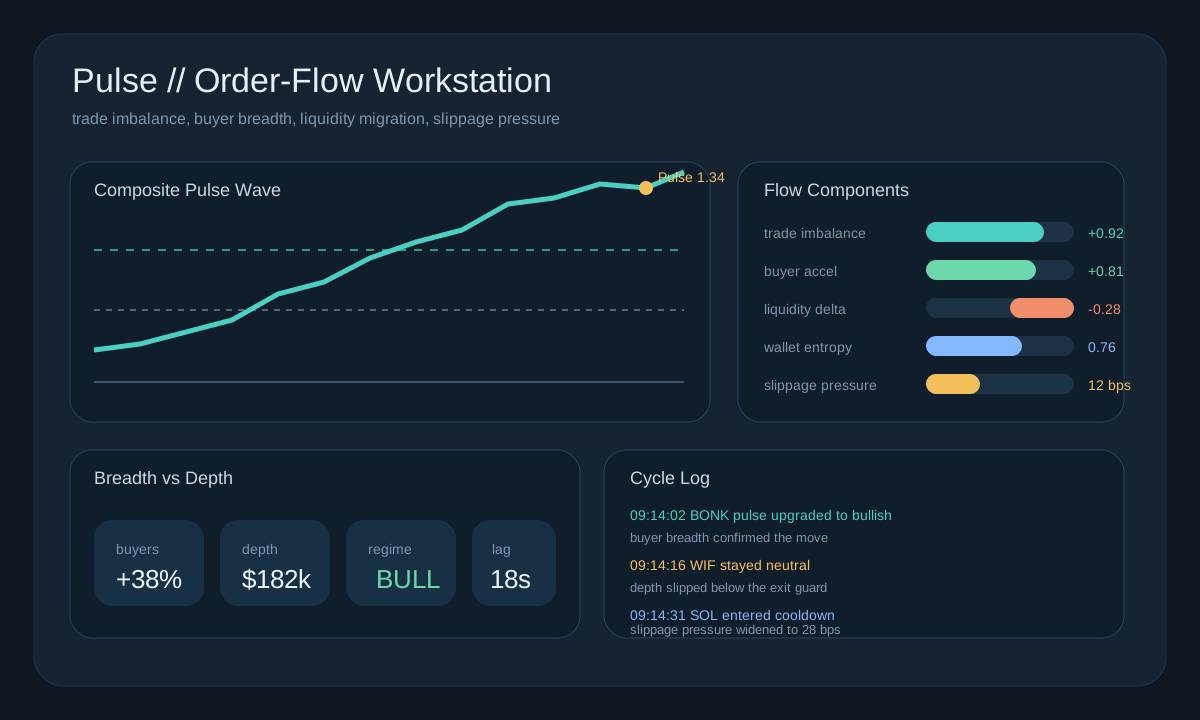
Quant Dashboard
Terminal Output
Operating Surfaces
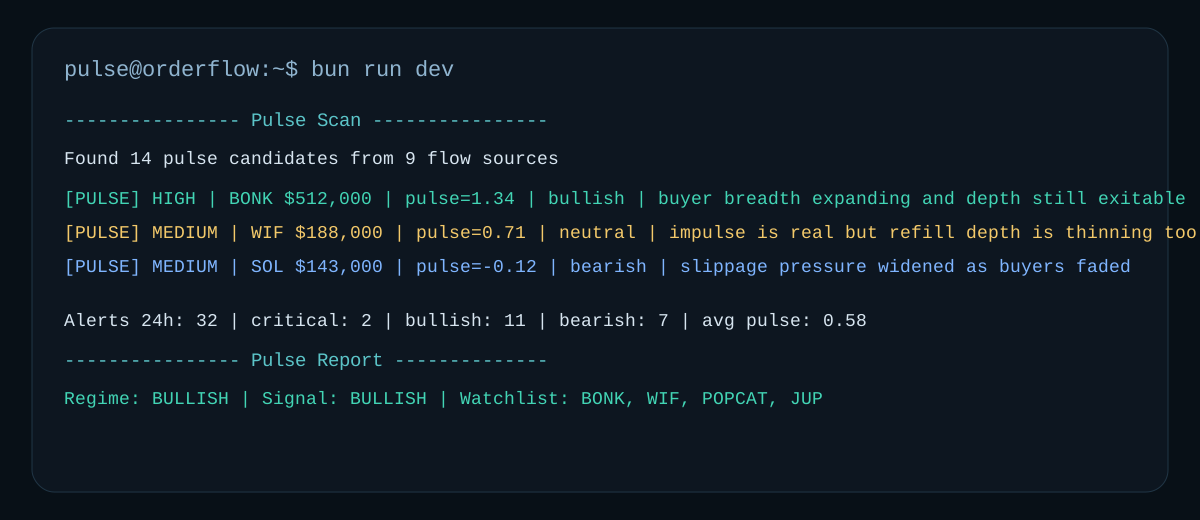
Quant Dashboard: shows composite pulse, regime state, and component breakdownPulse Ladder: tracks whether a name is building, active, cooling down, or fadingValidation Loop: asks the agent whether the pulse still looks tradeable after the first moveTerminal Output: prints the actual names worth watching with action-ready context
What Pulse Is Actually Solving
The hard part of short-horizon Solana trading is not noticing that activity increased. The hard part is noticing whether that activity is becoming more tradeable or less tradeable as it accelerates.
Pulse exists to make that distinction explicit. It is not trying to be a generic volume monitor. It is trying to answer whether a burst still has enough breadth and enough exit quality to matter.
How It Works
Pulse follows a five-step loop:
- ingest recent Solana transaction flow for the tracked symbols
- derive the short-horizon components that make a burst meaningful
- combine those components into a composite pulse score with regime logic
- validate the score against slippage and topbook depth so the move is still executable
- rank the surviving names into a pulse report the operator can actually use
That sequence matters because size alone is not a reliable signal. The board is designed to promote compounding flow and demote shallow optical bursts.
What A Good Pulse Looks Like
- trade imbalance is expanding, not just flickering
- buyer participation is broadening instead of staying concentrated
- liquidity is still refilling as the move develops
- slippage pressure is low enough that exits still look realistic
If those conditions break, the score should cool down quickly.
Example Output
PULSE // FLOW ALERT

[HIGH] BONK
pulse score        1.34
regime             bullish
buyer accel        strong
liq delta          positive
slippage pressure  12 bps

operator note: flow is broadening and depth still looks exitable
Technical Spec
Pulse builds a short-horizon composite score from five flow components:
Pulse_t = 0.30 * z(trade_imbalance_30s) + 0.25 * z(unique_buyers_accel_2m) + 0.20 * z(liquidity_delta_1m) + 0.15 * z(wallet_entropy_5m - 0.5) - 0.10 * z(slippage_pressure_30s)
Where:
trade_imbalance_30smeasures directional aggression in the most recent burst windowunique_buyers_accel_2mrewards broadening participation instead of one-wallet printsliquidity_delta_1mmeasures how quickly liquidity is disappearing or refillingwallet_entropy_5mpenalizes overly concentrated flowslippage_pressure_30spenalizes setups that look good on paper but are hard to exit cleanly
Regime classification uses hysteresis so Pulse does not flap between states:
- enter
bullishwhenpulseScore >= 1.25andtrailingPulseScore >= 0.40 - remain
bullishuntilpulseScore < 0.60 - mark
cooldownwhen either pulse or trailing confirmation drops below zero
Execution-quality guardrails:
- reject high-conviction pulses when
topbookDepthUsd < MIN_TOPBOOK_DEPTH_USD - cap conviction when
slippagePressure30s > MAX_SLIPPAGE_PRESSURE_BPS - increase re-entry delay as realized volatility expands relative to
VOLATILITY_BASELINE_BPS
Severity is not just size-based. A mid-sized burst can still rank high if the pulse score is extreme and breadth confirms continuation.
Risk Controls
depth filter: rejects bursts that are too thin to exit cleanlyslippage cap: prevents high-scoring but untradeable setups from being promotedregime hysteresis: reduces flapping between bullish and cooldown statesre-entry delay: slows the engine down when volatility expands too quickly
Pulse is intentionally strict because a fast signal without exit quality is usually worse than no signal at all.
Architecture
Helius transaction feed
  -> flow metric enrichment
  -> pulse score + regime model
  -> Claude validation loop
  -> rolling pulse report
Quick Start
git clone https://github.com/PulseSolana/Pulse
cd Pulse && bun install
cp .env.example .env
bun run dev
Configuration
ANTHROPIC_API_KEY=sk-ant-...
HELIUS_API_KEY=...
SOLANA_RPC_URL=https://mainnet.helius-rpc.com/?api-key=...
ALERT_THRESHOLD_USD=75000
BULLISH_PULSE_THRESHOLD=1.25
MIN_TOPBOOK_DEPTH_USD=25000
MAX_SLIPPAGE_PRESSURE_BPS=32
SCAN_INTERVAL_MS=30000
Legitimacy Notes
- Planned commit sequence:
docs/commit-sequence.md - Draft engineering issues:
docs/issue-drafts.md
Support Docs
License
MIT
catch the burst before the breakout looks obvious.
Reviews (0)
Sign in to leave a review.
Leave a reviewNo results found