ai-application-roadmap
Health Pass
- License — License: NOASSERTION
- Description — Repository has a description
- Active repo — Last push 0 days ago
- Community trust — 260 GitHub stars
Code Warn
- network request — Outbound network request in package-lock.json
Permissions Pass
- Permissions — No dangerous permissions requested
No AI report is available for this listing yet.
A bilingual map of AI engineering evolution, real-world AI usage patterns, and vibe coding best practices.
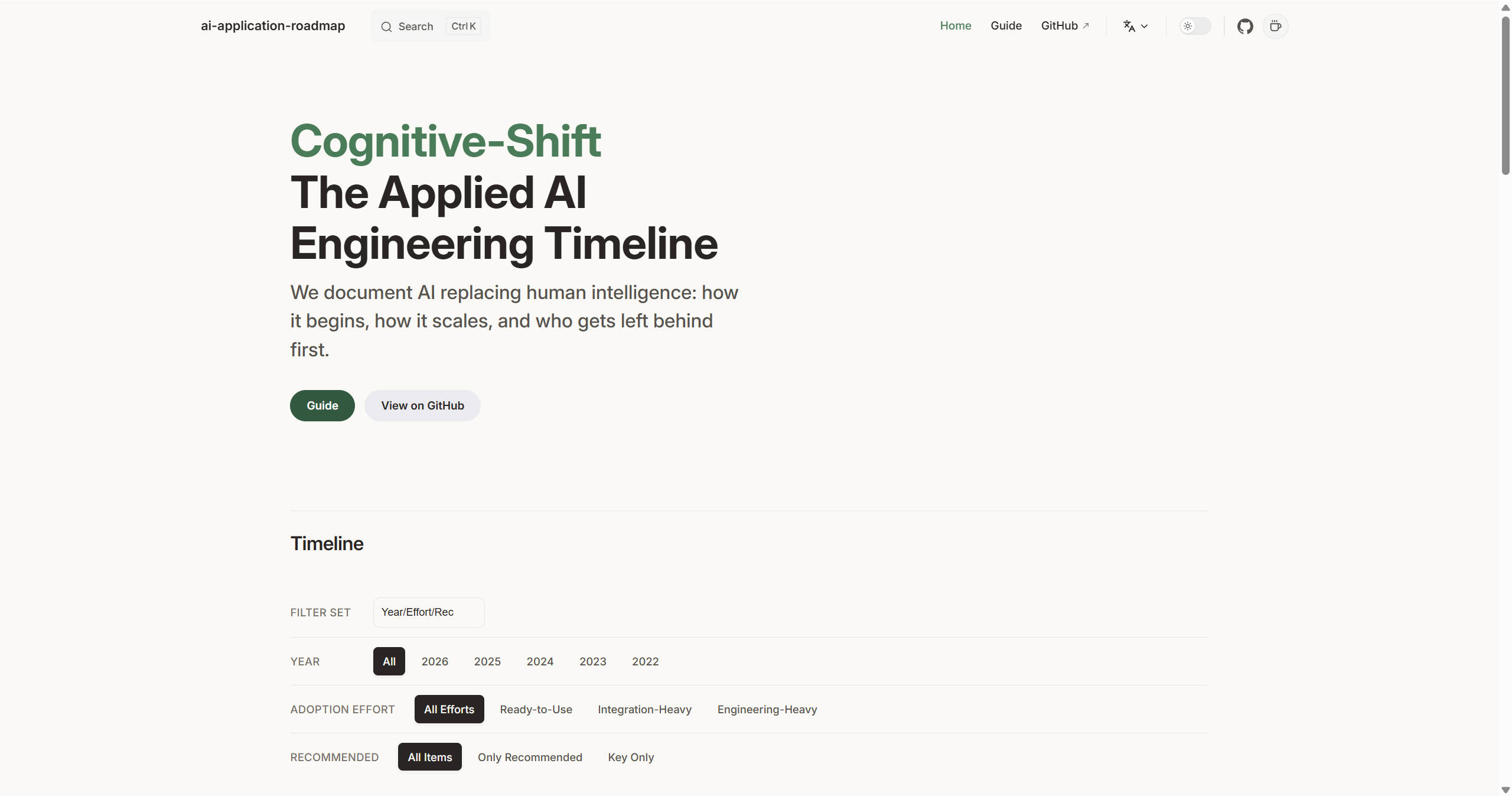
ai-application-roadmap





Visit The Website
Click once and start browsing:
https://qiuner.github.io/ai-application-roadmap/en/
AI is replacing human intelligence.
Before AGI fully arrives, we hope this site helps you waste less time on avoidable detours.
Chinese Summary
ai-application-roadmap 是一张双语的 AI 应用工程地图。它记录的不只是 MCP、Function Calling、Skills、Harness、Multi-agent 等技术的演进,也记录 AI 在真实工作中的使用方式,以及 vibe coding 工作流如何变化。
If you want the full Chinese introduction, go to README_ZH.md.
Why This Site Exists
There is a small story behind this project.
This year, I posted a video about coding styles popular in 2026, from traditional coding to multi-agent collaboration. In the comments, some people had never even heard of multi-agent, while others still saw AI as just a web chat box. Many websites track model releases, but very few systematically document applied engineering evolution beyond the models themselves. What we need is not more feature updates, but a technical map that answers: where am I now, and what should I learn next? ai-application-roadmap exists for exactly that reason. We do not focus on model parameter launches or benchmark scoreboards. We track how MCP, Function Calling, Skills, Harness, and Multi-agent workflows evolve, what they change, and which nodes are truly worth marking.
This repository is meant to serve as a practical roadmap for applied AI, helping you see where you are now and what is actually worth learning next.
How To Use The Site
- The homepage shows a timeline in reverse chronological order by default.
- Use the
Filter Setdropdown to switch between two filter groups:- Base filters:
Year/Adoption Effort/Recommended/Key - Evolution filters:
Phase/Trend/Signal
- Base filters:
- The
Guidepage highlights key technologies and concepts for quick scanning. - Docs use language-based routes (
/en/and/zh/). Use the language switcher in the top-right corner.
Who We Are Looking For
We welcome the best engineers, researchers, and builders worldwide to co-maintain this site.
If you care about real AI application-engineering evolution, not only model scoreboards, your contribution matters here. Contributing is simple: add a timeline node under docs/en/timeline/*.md (or docs/zh/timeline/*.md) and open a PR. You can also share practical AI usage tips, and we can feature them in the Guide section.
Build This Together
If you are also seriously tracking how applied AI engineering evolves, you are welcome to help build this repository.
Whether you want to add a key timeline node, correct a date judgment, contribute a more reliable source, or turn real implementation experience into a Guide article, that contribution is valuable.
How To Contribute
- Fork this repository and create a branch.
- Add a timeline node file under
docs/en/timeline/(English) ordocs/zh/timeline/(Chinese), preferably namedYYYY-MM-topic.md. - Fill in the required frontmatter fields (see below).
- Preview and build locally:
npm installnpm run docs:devnpm run docs:build
- Open a PR with context, references, and your rationale for the node.
Notes:
- New files under
docs/en/timeline/*.mdanddocs/zh/timeline/*.mdare auto-loaded on the homepage timeline. - Sidebar timeline links are generated from timeline folders in
docs/.vitepress/config.ts. - Commit prefix guidance is documented in COMMIT_CONVENTION.md.
Governance Rules
recommended,key, andkey_reasonare maintained centrally indocs/timeline.flags.ts, not in timeline markdown frontmatter.
Timeline Frontmatter Fields
Each timeline node supports the following frontmatter fields:
title: Node title.date: Node date shown on the timeline (for example,2026-08).- Definition: use the applied engineering adoption pivot (official + publicly verifiable), not the earliest academic publication timestamp.
- Priority: official announcement/docs of applied adoption > official repo release/tag used in engineering practice > package first release used as an engineering baseline.
- Keep one
dateonly; put additional milestone timestamps (for example,0.1.0,1.0.0) in the article body under a section such as "Key Dates".
year: Year used for filtering.summary: Summary shown on timeline cards.phase: Lifecycle phase, one ofemerging/mainstream/legacy.trend: Evolution direction, one ofrising/stable/absorbed/shrinking/obsolete.signal: Cognitive calibration, one ofover-hyped/under-rated/over-scoped/well-calibrated.adoption_effort: Adoption effort classification, one of:ready-to-use(install-and-use or light configuration)integration-heavy(noticeable integration and wiring work)engineering-heavy(system-level engineering and long-term maintenance)
tags: Tag array for filtering (for example,["mcp", "protocol"]).author: Contributor identifier.maintainer: Long-term maintainer for this node (optional; defaults toauthor).authored_by: Content origin, one ofhuman/ai-assisted/ai-generated(optional; defaults tounknown).
Thanks To All Contributors
Reviews (0)
Sign in to leave a review.
Leave a reviewNo results found